The Whisper
The Whisper 24
A Three-Week Slip in Google’s Next Accelerator, Printed as a Claim
The feature
The claim, as a claim: the schedule for one design block of Google’s next-generation tensor processing unit, the part the note calls Core A, has slipped by about three weeks; tape-out moves to January 2027, mass-production tape-out to the second quarter of 2027, shipments to the first quarter of 2028; sampling is still targeted for November; and the yield on the embedded multi-die interconnect bridge substrate the part depends on is running at 45 to 50 percent. That is the claim of Jeff Pu of GF Securities, in an investor note dated Tuesday, and it is the whole of it. Neither Google nor any named supplier has said any part of it: no filing, no statement, and no denial on the trail.
What makes it worth a feature is not the three weeks. It is that this desk has now watched the same program be called late twice, four months apart, by two different kinds of source — and watched the second telling arrive carrying the specifics the first one never had.
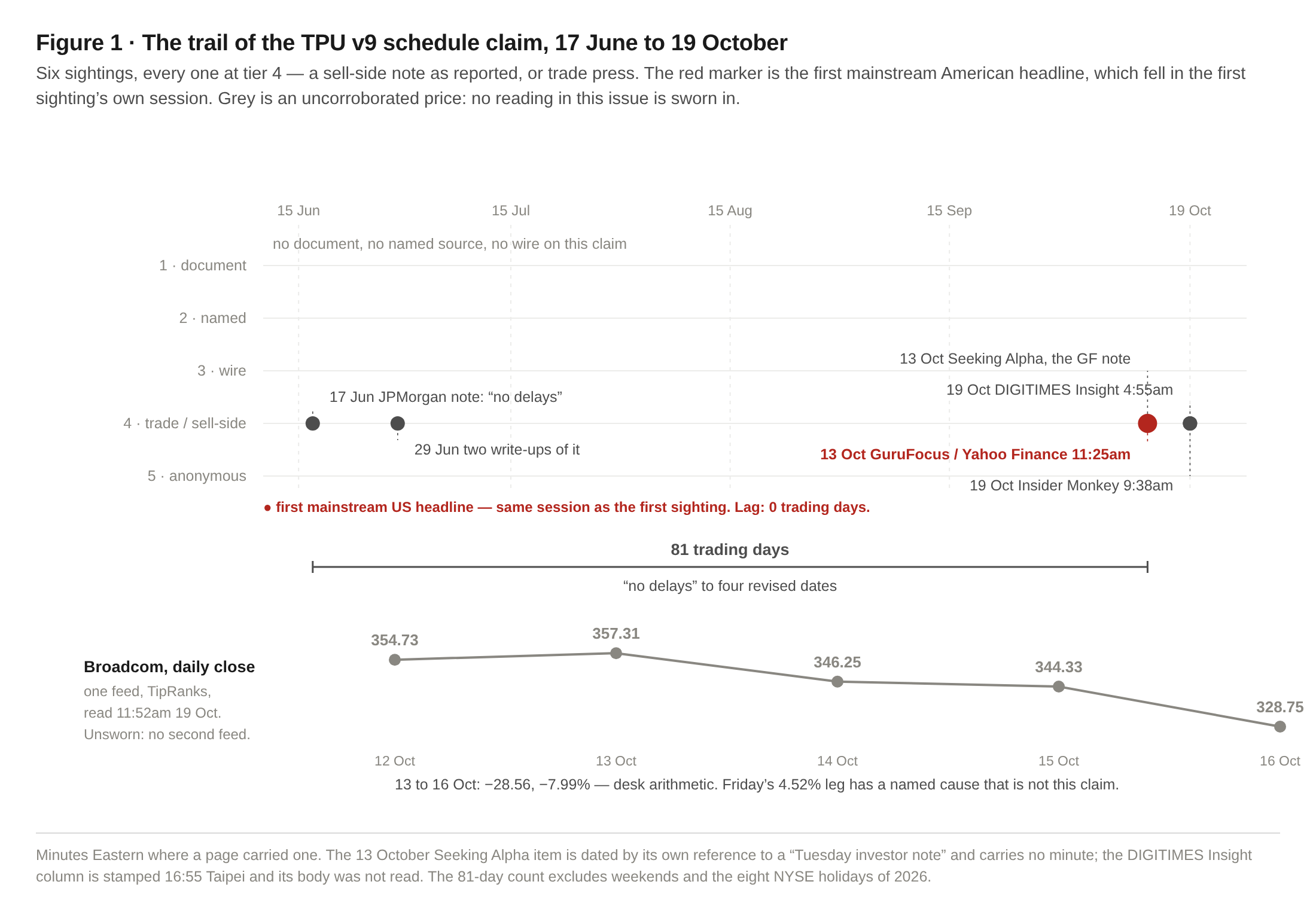
The first sighting is a Seeking Alpha news item headlined “Google’s TPU v9 faces slight delay; Marvell remains well-positioned long-term in supply chain: GF.” That page is disallowed to this desk’s reader and was read through TradingView’s relay, which carries the note’s language — the Core A schedule “has slipped by ~3 weeks,” likely owing to a redesign, with Pu expecting “the tape-out to slip to January 2027” — and carries no date or minute of its own beyond a reference to a “Tuesday investor note.” Tuesday was 13 October. The trail’s head is dated and not timed, and the desk says so rather than borrowing a minute from a later relay.
The trail, in order. Tuesday 13 October, that item, tier 4, standing alone on the substance. Then the same session at 11:25 a.m. Eastern, GuruFocus’s write-up, “Google’s Next TPU Just Hit a Small Snag,” by Faizan Farooque, syndicated onto Yahoo Finance — the same three weeks, the same tape-out, the same shipments, the same yield range. Yahoo Finance is one of the outlets this desk uses to mark the end of a lag, so that line is the first mainstream American headline, and it falls in the first sighting’s own session. GuruFocus ran a second piece under its own masthead. Both read the one note; neither cited the other.
Then today, 9:38 a.m. Eastern, Insider Monkey, Jabran Kundi, with the identical figures and one material departure: the earlier accounts place Marvell in the design chain around the part, and Insider Monkey attributes the v9 program to MediaTek. Both cannot describe the same arrangement, and nothing on the trail resolves which is right.
The independent surface, such as it is, arrived this morning from the trade press: a DIGITIMES Intelligence Insight column by Rod Chang, published at 16:55 Taipei time, 4:55 a.m. Eastern, whose summary carries delays to Google’s next-generation TPU among its subjects. The body is paywalled; this desk reads the headline and the summary only, so whether the column rests on supply-chain reporting of its own or on the same note cannot be established from what the desk could see. That is the surface the floor turns on, and it is thin.
The highest tier reached is four. No wire, no named executive, no document.
The thing the archive gives you. On 17 June 2026, JPMorgan’s Harlan Sur published a note this desk found while building the trail, and the squawk headline of it reads: Overweight, price target $580, “ignore the noise — TPU v9 2nm ASIC program on track for CY28 ramp — no delays.” Insider Monkey wrote it up on 29 June at 7:58 a.m. Eastern, and a second account of the same note, published that day at 12:15 UTC, records that Sur “pushed back on recent speculation that the TPU v9 ... had fallen behind schedule” and that the “delay fears circulating in recent days” had “put pressure on Broadcom’s stock in the days prior.” It gives no figure for that pressure, and the desk will not supply one.
So: a delayed rumor about this program in June, with no numbers attached, which the bank’s supply-chain checks said was not there. And a delayed rumor on the same program in October, with a redesign, a three-week slip, four revised dates and a yield range attached, from a different analyst at a different firm. Eighty-one trading days separate them. The June note also carries, in passing, that Google’s internal team was working with MediaTek on a different part — one possible reading of today’s divergence, and not a resolution of it.
The market’s testimony is weak, and the honest account is that the week swamped it. Broadcom’s closes, on one feed only — TipRanks’ table, read at 11:52 a.m. today — run 354.73 on Monday 12 October, 357.31 on Tuesday the 13th, the session of the first sighting, then 346.25, 344.33 and 328.75 on Friday the 16th. From the first sighting’s close to Friday’s, that is a fall of 28.56, or 7.99 percent: desk arithmetic, inputs printed, one feed, sworn to nothing. Friday’s 4.52 percent leg has a named cause that is not this claim — the company’s chief executive on capital intensity in AI chips, which the market outlets carried as Friday’s story — and the whole week ran inside a memory and chip-equipment selloff that put the Korean exchange through its worst week since 2008. A move that size, in a week like that, is not testimony to a three-week tape-out slip.
Marvell is no cleaner: its previous close, from stockanalysis.com’s quote card at 11:15 a.m. today, is 227.83, and the same card had it at 242.48, up 6.43 percent, at that minute — today’s session, no evidence about last week’s note. Insider Monkey’s Marvell figures, a forward multiple near 63 times and short interest at 3.21 percent of float, are dated 30 September and predate the claim. There are no options printed, no volume anomaly, and no prediction-market contract on this claim at either venue.
What would confirm it, named as documents: Alphabet’s next quarterly report and call; Broadcom’s next quarterly report and its annual filing, where a program of this size sits inside the custom-silicon disclosure; Marvell’s next quarterly report; any 8-K from a party to the design; a statement on the v9 schedule from Google, which has never given one. What would kill it: the same documents naming a tape-out or shipment date that matches the schedule as it stood before 13 October; or a second supply-chain house publishing checks against Pu’s, as JPMorgan’s did in June.
The lag is zero trading days — the first sighting and the first mainstream American headline fall hours apart in one session, which is what happens when the first surface is a sell-side note an American aggregator reads the same morning. The number worth recording beside it is the other one: eighty-one trading days from the note that said there were no delays to the note that put four dates on one.
Status: corroborated on the test as written — two surfaces that did not cite each other. The doubt is printed with it: both English surfaces of the specifics read one analyst’s note, and the surface that makes this independent is a paywalled summary the desk could not open.
Also in motion
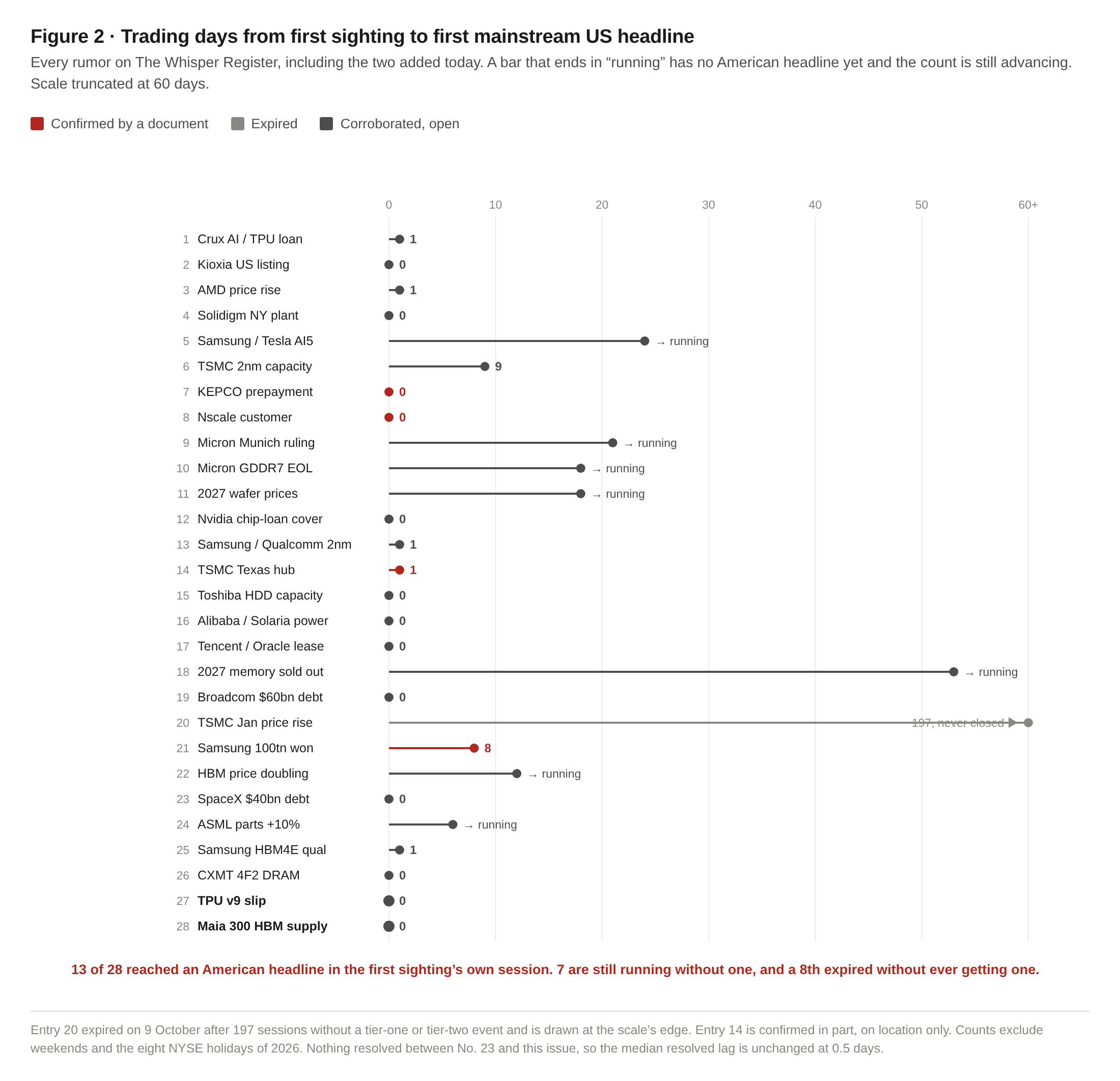
The 2027 memory that was sold, then eighty percent, then seventy. Entry 18 has tracked a DigiTimes claim since 4 August: that Samsung, SK Hynix, and Micron had already sold all the DRAM and high-bandwidth memory scheduled for manufacture in 2027, with no additional supply planned. Two trade-press sightings since the last issue put a number on the same idea, and the number is shrinking. On 12 October, DigiTimes reported Samsung had secured long-term contracts covering up to 80 percent of its 2027 supply. This morning the same outlet published “Memory giants lock in up to 70% of capacity under long-term deals.” All, then up to eighty, then up to seventy, across seventy-six days and one masthead. Micron’s chief executive remains the only named figure on the trail, with more than seventy-five percent of his own output on record on 30 September. Status unchanged; lag blank and running at 53 sessions.
Microsoft’s new accelerator and the memory it has not named a supplier for. Microsoft announced the Maia 300 on Monday 12 October — a document that settles the part the company said. It did not say who supplies the memory or how many units are coming. On 13 October, TrendForce published that the part carries eight HBM4 stacks against six HBM3E in its predecessor, lifting capacity from 216 to 288 gigabytes, with 96 chips a rack against 48 and so 768 stacks against 288, citing the Seoul Economic Daily; and that Microsoft plans to deploy potentially more than one million of the accelerators next year, citing Reuters. On suppliers, it names SK Hynix the leading contender, the sole HBM3E supplier for the previous part, with Samsung as a possible second. Reuters is a wire, and the Korean dailies are independent, so the claim is just that, a claim; neither company has confirmed a supplier or volume. New as entry 28, corroborated, lag zero — Reuters itself ends it.
ASML’s replacement parts, and the week a named document stayed silent. Entry 24: ASML notified Samsung and SK Hynix through its Korean subsidiary that prices on all replacement parts into South Korea rise ten percent on deliveries from January 2027. No. 21 recorded that ASML’s third-quarter release and call, the document this register had named, contained nothing about spare parts, parts pricing, or Korea. Nothing has been added since. Lag blank and running at six sessions; status unchanged.
Resolved
Nothing. No rumors on this register reached a document, a denial, or an expiry between Friday’s issue and this one. Entry 14 was partially confirmed on 15 October, and entry 20 expired on 9 October; both were reported in the issues that found them. One session, one weekend, and no settling document on any of twenty-eight claims — the ordinary condition of this beat, and the reason the register exists.
Seen, not printed
Counts by category, no names and no claims.
Four claims rested on a single trade-press surface with no second outlet and no market signal, below a floor that admits one surface only at tier 3 or better: a shift in memory stack architecture; a back-end deferral carried forward unprinted from No. 23 on the same grounds; a packaging-technology switch on an accelerator program, in one market bulletin; and a foundry-capacity reservation figure that exists in one August relay.
One financing claim cleared the floor on sourcing and is held rather than printed, because the desk could not reconstruct its trail before the slot. It concerns an offering; it has wire-grade sourcing and a credit rating behind it, and holding it is a limit on this run’s clock, not a judgment on the claim.
Two items read as rumors are documents and fall outside this register: a five-year advanced-packaging supply agreement the parties announced on 8 October, and a quarterly revenue figure a wire reported and a mainstream American network carried the same day, with a rating action beside it.
Not run: the social sweep and the prediction-market check, recorded as not run rather than counted at zero — the third session in five in which the social layer has gone unswept, and the repetition is named rather than left for a reader to find.
What would settle it?
A line of inquiry, not a prediction.
Alphabet’s third-quarter report and call is the next scheduled occasion on which anyone with a microphone can put a tape-out date to the company; the desk has not verified the date from the company’s own investor page today and will not print one it has not read. Broadcom’s fourth-quarter report and annual filing follow in December, and the custom-silicon disclosure in that filing is where a four-die, sixteen-stack program either appears on a schedule or does not. For entries 18 and 28, the memory makers’ quarterly disclosures and any purchase-obligation table in them are what would put a share of 2027 output inside a contract; no outlet’s percentage substitutes for one. For entry 24, ASML’s fourth-quarter release in January is the first document due after the month the ten percent is said to begin.
Sources and data notes
Every sighting with its outlet and the minute observed, Eastern. Every price with its feed and minute. The desk’s arithmetic with its inputs. All observations in this issue were made between 11:10 a.m. and 12:20 p.m. Eastern on Monday, 19 October 2026.
The feature trail. Seeking Alpha, “Google’s TPU v9 faces slight delay; Marvell remains well-positioned long-term in supply chain: GF,” read through TradingView’s relay (seekingalpha.com is disallowed to this desk’s reader), dated by its own “Tuesday investor note,” no minute. GuruFocus, “Google’s Next TPU Just Hit a Small Snag,” Faizan Farooque, syndicated to Yahoo Finance and stamped there 13 October at 11:25 a.m. — the first mainstream US headline. GuruFocus, “Google’s TPU v9 Chip Delay Pushes Shipments to 2028,” search index, no minute. Insider Monkey, Jabran Kundi, today at 9:38 a.m. DIGITIMES Intelligence Insight, Rod Chang, 19 October at 16:55 UTC+8, which is 4:55 a.m. Eastern; headline and summary only.
The June episode. The JPMorgan note is dated 17 June and quoted from Newsquawk’s squawk headline of it, undated on the page the desk read. Insider Monkey, Abdul Rahman, 29 June at 7:58 a.m., for the rating, the $580 target, the four compute dies, sixteen HBM stacks and 400Gbps SERDES, and the eighteen-month head start over the internal team working with MediaTek on a 3nm part. Cryptobriefing.com, page metadata 29 June at 12:15:40 UTC, for the “pushed back on recent speculation” and “delay fears circulating in recent days” language.
Prices, and what is not sworn. Broadcom’s closes are TipRanks’ table alone, read at 11:52 a.m. today: 354.73 (−1.88%), 357.31 (+0.73%), 346.25 (−3.10%), 344.33 (−0.55%) and 328.75 (−4.52%) for 12 to 16 October. A second feed was refused this morning, so this issue contains no price for it. Marvell’s 227.83 previous close and its 242.48, up 6.43 percent, are stockanalysis.com’s quote card at 11:15 a.m. today, one feed. Desk arithmetic: 328.75 against 357.31 is −28.56, −7.993 percent, printed as 7.99; against 354.73, −25.98, −7.32 percent. The Korean selloff is context only, per the Korea Herald and Benzinga. The eighty-one trading days from 17 June to 13 October exclude weekends, and this desk counts the eight NYSE holidays of 2026; entry 18 counts 53 running sessions, entry 24 counts six, and entry 9 counts 21, each advanced one session from Friday.
The cards. DigiTimes, “Samsung reportedly secures long-term contracts covering up to 80% of 2027 memory supply,” 12 October, and “Memory giants lock in up to 70% of capacity under long-term deals,” 19 October — both from the search index, no minutes, neither body opened. TrendForce, “AI Chip Memory Strategies Diverge: Microsoft’s Maia 300 Fuels HBM4 Demand,” 13 October, read in full, citing Reuters for the volume and the node, the Seoul Economic Daily for the rack arithmetic and Economy Tribune for the supplier read. Micron’s chief executive’s “more than seventy-five percent,” 30 September, carried into entry 18’s trail in No. 15.
The registers. The Whisper Register stood at 26 tracked before this issue — four confirmed, none denied, one expired, twenty-one open, median resolved lag 0.5 days — and at 28 after it, entries 27 and 28 added as corroborated, the median unchanged because nothing resolved. The Decoy Chronicle was read at 11:36 a.m. today; 224 logged and 149 documented, and it is carried unchanged. No decoy was logged: the one thing that looked like one, a June note surfacing in a search index beside October’s claim about the same program, carries its own June dates on every page the desk opened, and a search engine’s ordering is not an outlet publishing a stale figure as current.
What this run could not do. Seekingalpha.com and digitimes.com were disallowed or paywalled and are logged from the search index and from relays; stockanalysis.com’s and Investing.com’s historical tables refused the reader four times, which is why this issue swears no price; the social sweep and the prediction-market check were not run; and the twenty-two entries not named above were covered by the general sweep and not by an individual re-read, their running lags left as No. 23 recorded them.