Morning Brief · Monday, October 19, 2026
Morning Brief October 19th 2026
Following the most difficult chip week since April 2025 and after eight consecutive losses for the semiconductor index, Nasdaq-100 futures are up by about 1.2 percent just before the market opens, with last week's worst-performing companies now at the forefront
Monday, October 19, 2026 · Morning Brief · 8:30 a.m. ET · Five figures
The semiconductor index ended Friday lower for the eighth session in a row, from October 7 to 16, its longest losing streak since October 2008, and it has dropped about 16 percent from its October 6 close. This morning, the companies that have fallen most are the ones up the most; futures are positive where the chips are located and negative where they are not; and the three firms on whose capital spending the entire complex relies are up a few tenths of a percent. That sums up the issue of the day in a single sentence: the market is buying the suppliers before it has heard from the buyers, and the first buyer to speak is Meta, on Wednesday after the close.
The short version
A rally to ease the downturn is underway. Nasdaq-100 futures are up 1.17 percent to 29,735.75, S&P futures are up 0.42 percent to 7,736.50, Russell futures are up 0.35 percent, and Dow futures are down 0.28 percent. The VIX is 18.83, below 19, down from 19.99 on Friday. That is what the Yahoo Finance summary shows at 8:30; the exchange-traded funds, with their timestamps, show the same (SPY up 0.52 percent at 8:23, QQQ up 1.35 at 8:33).
Last week's pain is still having an influence. CoreWeave is up 7.0 percent, Nebius 7.5, IREN 6.4, Applied Optoelectronics 5.7, Marvell 4.8, Lumentum 4.5, Coherent 4.4, Lam Research 4.3, and Micron 3.7, reaching $911.35. Nvidia, at $218.30, has risen 2.0 percent and is lagging behind its own supply chain. The semiconductor funds are up 3.1% (SMH) and 3.5% (SOXX).
The catch. The capital expenditure payers have all stayed flat: Microsoft has risen by 0.1 percent, Meta by 0.4 percent, and Alphabet by 0.7 percent. Amazon is the exception, up 2.3 percent, and this is due to a note from Morgan Stanley. In Europe, major indices have fallen 0.8 to 1.5 percent for reasons unrelated to chips. The ten-year rate is 5.09 percent; although this is lower than last Tuesday's 5.22, it is still above 5, and the chances of anything other than a hold at the Fed's meeting next week have dropped to around 15 percent.
It's a week of earnings, with Netflix reporting on Tuesday and Meta, Tesla, Lam Research, Texas Instruments, IBM, and SAP reporting on Wednesday, while Western Digital and MaxLinear report on Thursday. Whether this bounce marks a bottom or is just a temporary upturn depends on Meta's capital spending guidance for 2027. The Fed is in its quiet phase until the meeting on October 27–28, with the decision on the 28th at 2 p.m., and GDP figures and September PCE data released the morning after.
The tape, an hour before the open
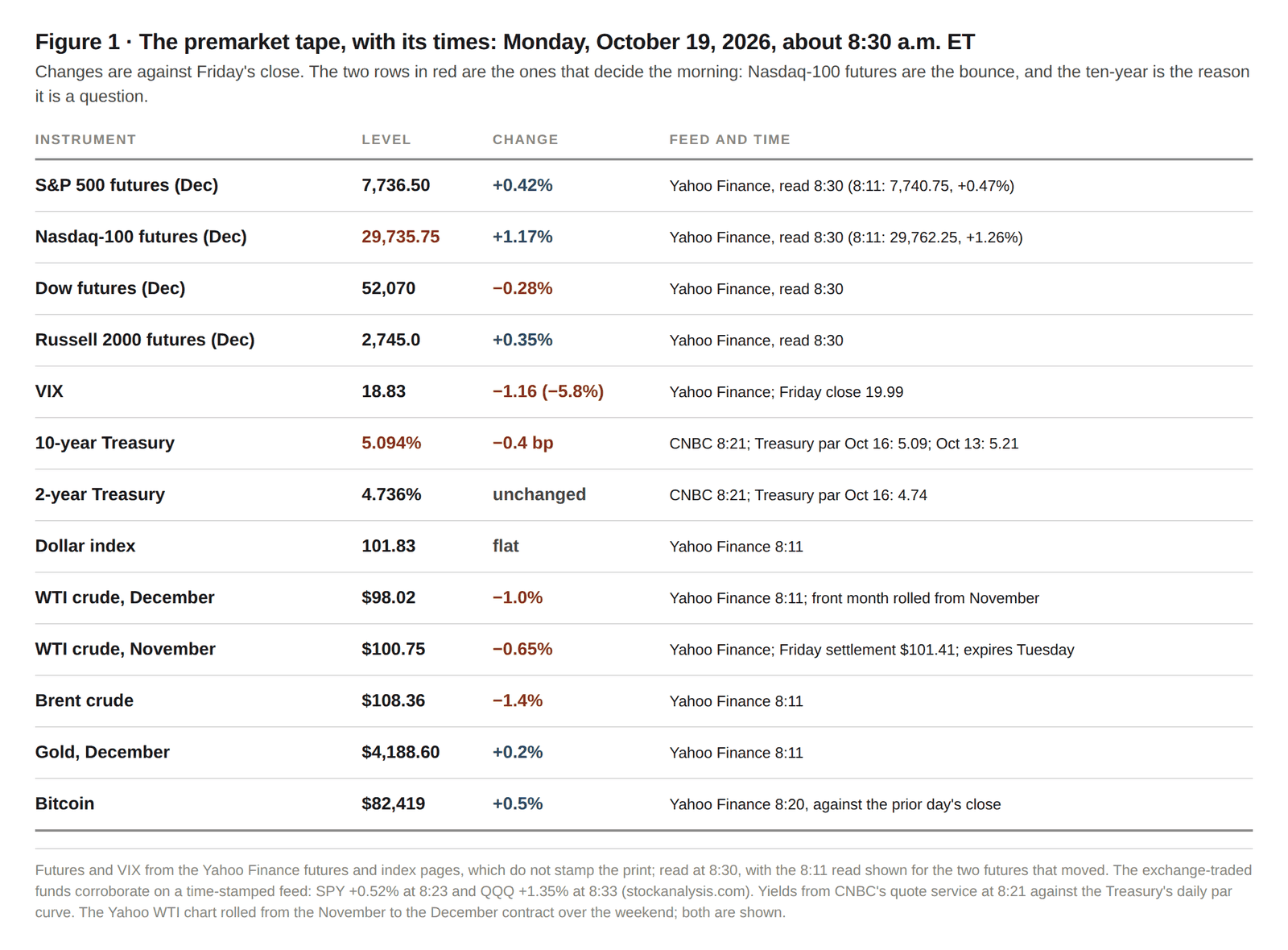
Start with rates, since they make the bounce even a question. The ten-year rate was 5.094 percent according to CNBC's figure at 8:21. The Treasury's own par yield for Friday was 5.09, so we can say it's 5.09: this is down on the 5.217 level of October 13 and the intraday high of 5.335, which came after Wednesday's consumer-price report, though it's still a long way from where the AI trade had been priced in September. The two-year rate is 4.736 on the same CNBC reading, unchanged on the day, with the Treasury par at 4.74 for Friday. The dollar index is at 101.83 and unchanged.
Oil prices have dropped, and Yahoo's front-month contract has been rolled. The WTI contract shown on the chart is now December at $98.02, down 1.0 percent; the November contract, which expires tomorrow and is quoted by most outlets at Friday's $101.41 settlement, is $100.75, down 0.65 percent. Brent is at $108.36, a drop of 1.4. As Investing.com stated at 7:24, this is because President Trump has waived some of the sanctions and tariffs on Russia for up to 60 days, according to Secretary Rubio's account, and because Iran's foreign minister, Araghchi, said that Tehran's proposal to reopen the Strait of Hormuz within days of an agreement is "still on the table". December gold is $4,188.60, up 0.2 percent. Bitcoin is $82,419 at 8:20 and is up half a percent during the day.
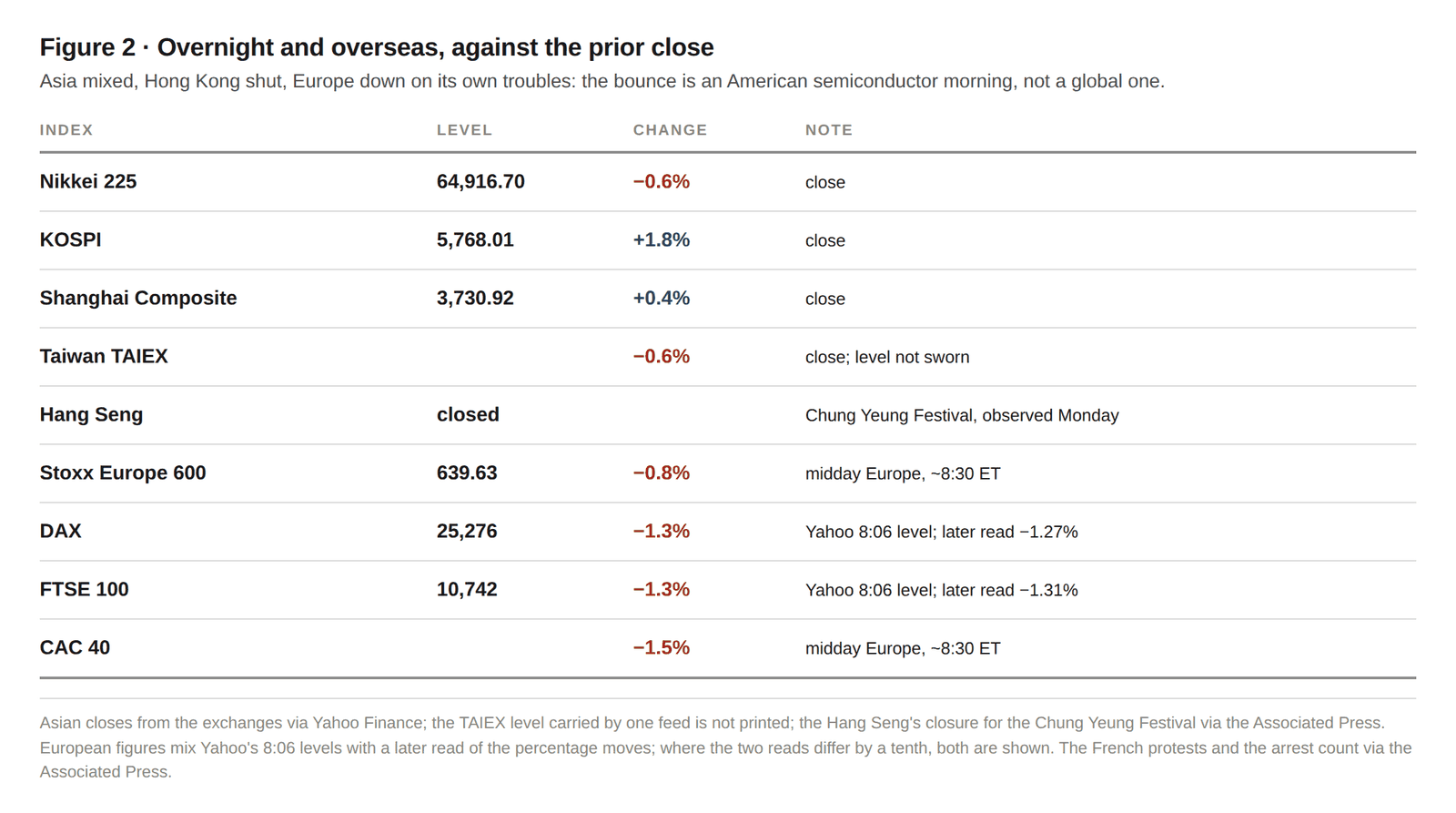
Asia's market performance was mixed, with the KOSPI up 1.8 percent to 5,768.01, the Nikkei down 0.6 percent to 64,916.70, the Shanghai index up 0.4 percent to 3,730.92, and Taiwan's TAIEX down 0.6 percent. Because Hong Kong is closed for the Chung Yeung Festival, observed today, there is no Monday figure for the Hang Seng.
Europe is the one region showing broad weakness this morning, and it has nothing to do with technology. The Stoxx 600 is at 639.63, down 0.8 percent; the DAX is about 1.3 percent lower; the FTSE 100 is down 1.3 percent; and the CAC 40 is down 1.5 percent. The protests that took place over the weekend in France became violent, with over 2,000 arrests, according to the Associated Press, and the French banks are down by 2 to 3 percent, with the spread between French and German government bonds now wider; Spain is also facing uncertainty over a snap election, and LVMH is under pressure. However, none of this justifies selling Nvidia. It does offer a reason to be cautious about calling this a global risk-on day, since it isn't; it is actually an American semiconductor day.
The movers and the headlines
Cleveland-Cliffs was the largest gainer amongst those companies that provided results, rising by 13.5 percent to $13.75 after achieving an adjusted earnings figure of 28 cents per share in the third quarter, which was better than the estimates ranging from 19 to 24 cents, based on revenue of $5.61 billion, slightly below the consensus figure of $5.71 billion. Although the stock is tied to steel prices and tariffs, not AI, it was the week's first industrial company report, and it beat.
Datadog rose 3.3 percent to $255.19 at 7:37 after Bernstein raised its rating to Outperform, with a target price of $350, up from $237. Amazon has increased by 2.3 percent to $255.72 after Morgan Stanley's Brian Nowak designated it as the firm's top choice, with a rating of Overweight and a target price of $350 from $335, and projected 47 percent AWS growth in 2027: "We continue to think AWS's growth and profit runway is under-appreciated." That is the margin argument that this desk set out on October 4, and it is the only hyperscaler bid in the premarket.
Intel's share price has risen by 4.3 percent to $93.75 following JPMorgan's Harlan Sur raising the stock rating from Underweight to Neutral late Friday, with an $85 target price: "Risk/reward is more balanced at current levels and we move to a Neutral rating." Disc Medicine was the biggest gainer on the day, up 46 percent to $83.01 on the stockanalysis strip and as high as 58 to 60 percent on earlier prints after the company released its Phase 3 APOLLO data for bitopertin at 7 a.m. Blue Owl has no premarket price on our feed at the time of writing, after closing at $8.85 on Friday, after Bloomberg reported that bankers have approached the firm about a possible full or partial sale; the report describes the proposal as a long shot.
As for the Federal Reserve, the FedWatch tool on the CME showed the probability of a hold at the meeting of October 27–28 at 85.1 percent according to FXStreet's reading at 4:58 a.m., this being an increase from 42.4 percent a month earlier, the target range being 3.75 to 4.00 percent following the unanimous rise in September. At the IMF and World Bank meetings in Bangkok on Friday, Chair Warsh said, "I don't prejudge meetings," and that is the last the committee will say publicly before the decision; the quiet period runs from Saturday the 17th to Thursday the 29th.
The AI trade: a relief bid, led by the most pain
The damage in the week ending last Friday, from Friday to Friday, was such that the semiconductor index fell by 11.41 percent, representing its worst week since April 2025; the Nasdaq Composite dropped by 4.48 percent; Applied Optoelectronics decreased by 31.08 percent; Lumentum lost 25.31 percent; CoreWeave fell by 25.21 percent; Micron dropped 14.59 percent to $878.84; and Coherent fell by about 25.5 percent on the one feed which provides a weekly figure. On Friday, the chip index moved from 11,581.22 to 11,137.29 (a decline of 3.83 percent), the Nasdaq fell to 26,140.03 (a drop of 2.15 percent), and the S&P 500 dropped to 7,659.44 (a loss of 1.09 percent). Nvidia closed at $214.13. The eight-session losing streak in the chip market, running from October 7 through October 16, is the longest such streak since one occurred in October 2008.
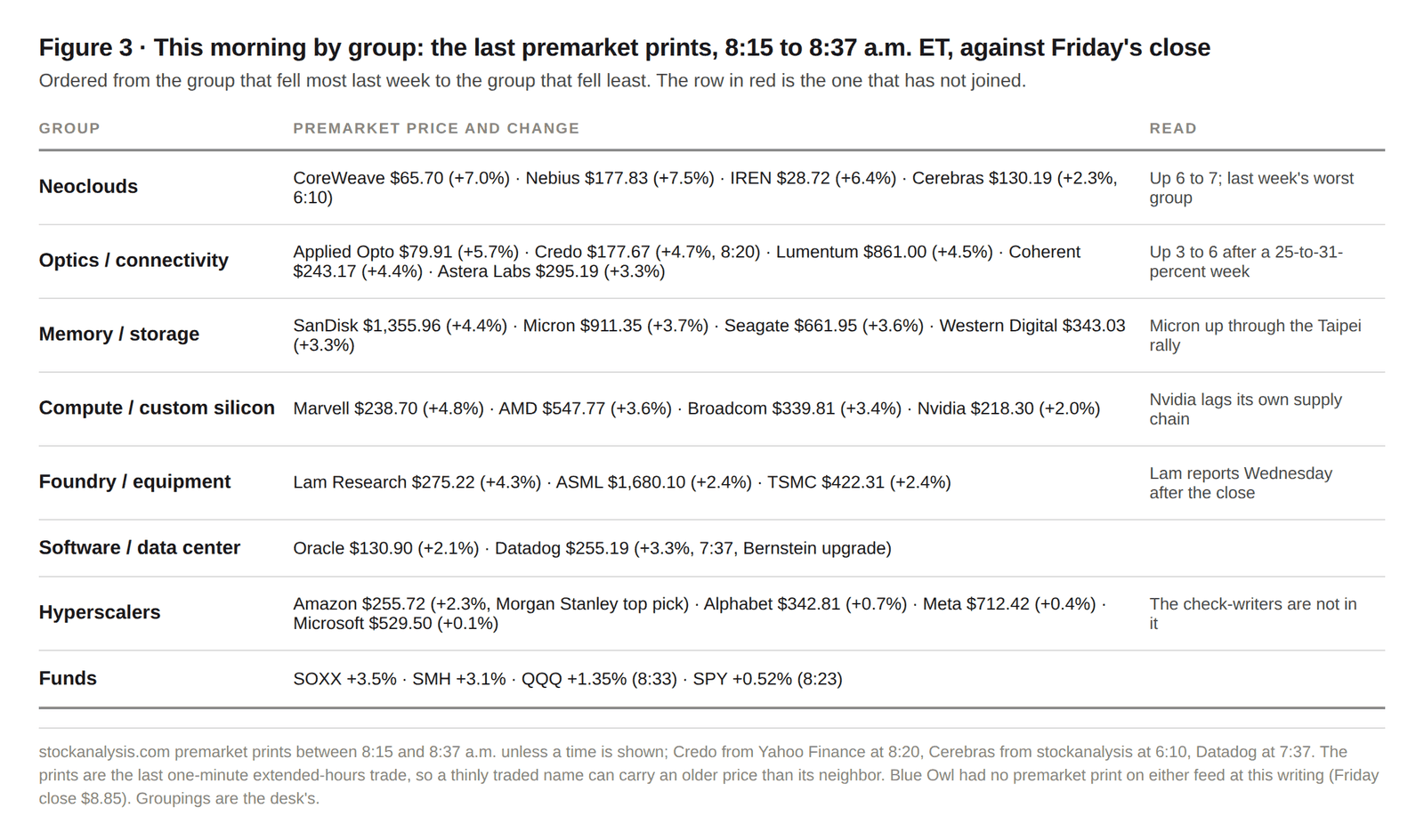
The extent of the bounce corresponds to the amount of the fall: the neoclouds, having fallen the most, are now rising the most; next comes the optical layer; then memory; then the compute names; then foundry and equipment; and finally the hyperscalers, who have fallen the least and are therefore bouncing the least. This sequence is exactly what a short-covering morning looks like and what the first day of a bottom looks like; hence, the sequence alone does not resolve the issue.
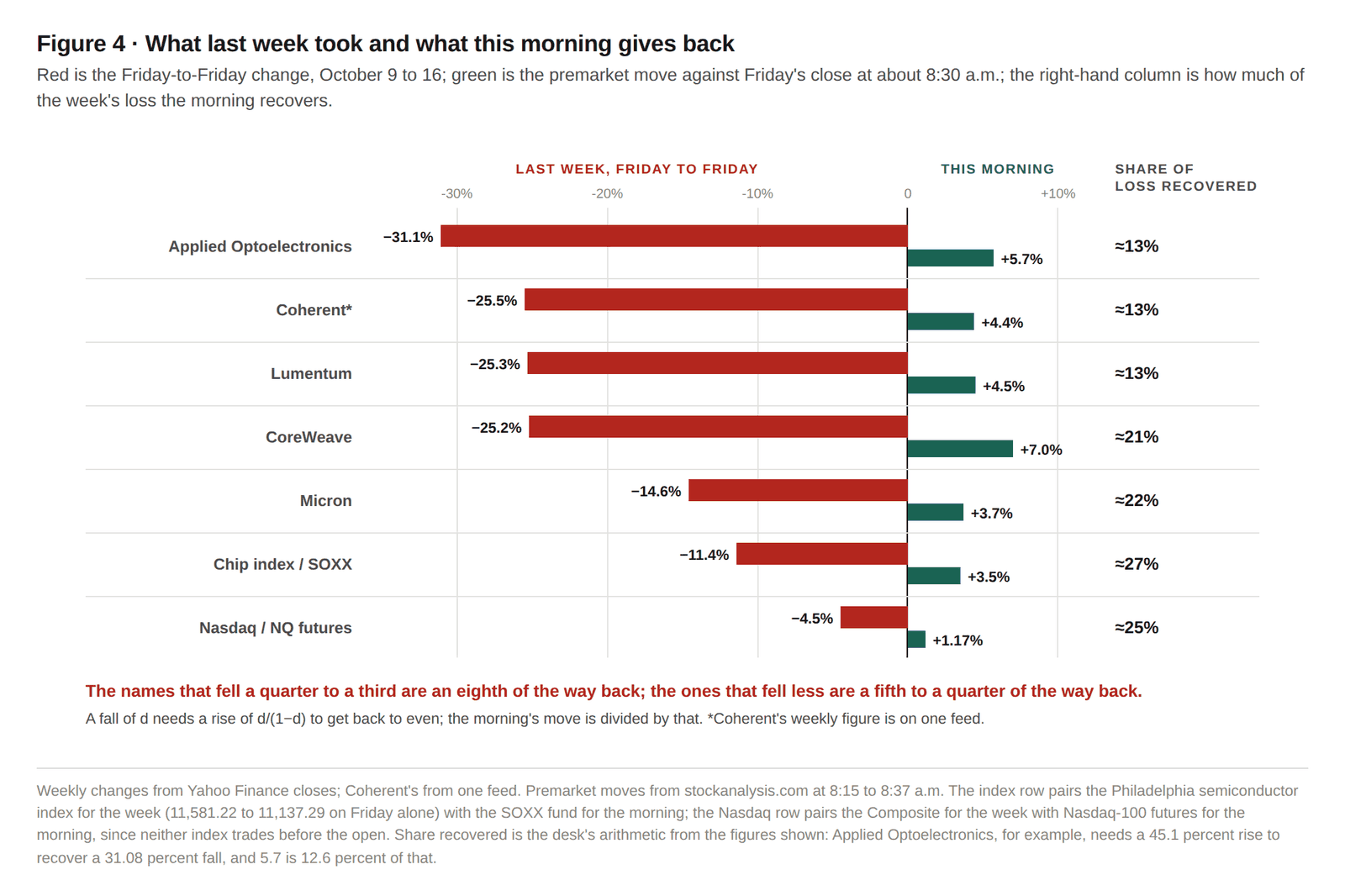
The diagram illustrates the distance still to be covered. A share that has dropped by 31 percent must rise by 45 percent to return to its previous level, and Applied Optoelectronics' 5.7 percent rise this morning represents about an eighth of what it lost for the week. Lumentum and Coherent, which have also fallen by a quarter, are recovering by about an eighth as well. CoreWeave and Micron are recovering about a fifth. The index and the Nasdaq, which fell less, recovered about a quarter. Based on the desk's figures, this is a recovery for the individual companies and a slightly better recovery for the index, with no evidence yet that the week's sellers would have to take it into account.
Why the bounce
A return to the mean following a historic flush. The companies that declined the most last week are now up the most this morning, in the same order as their previous fall. This is a typical relief pattern that occurs after a string of moves not seen since 2008. It does not indicate a bottom has been reached; it only shows that the tape has been stretched.
Concern about neocloud credit is diminishing, according to reports. The Information stated on Sunday that Nvidia is supporting its neocloud customers "through easier credit terms, site selection, and $20 billion in leases", and that executives anticipate "seven to 10 of hundreds" of such providers to survive. At 10:31 on Sunday night, Stocktwits linked the premarket rise of CoreWeave and Nebius to that report. TipRanks, on the other hand, noted that "no new company-specific announcement has clearly explained the rebound". Nvidia has not responded, and the backstop should be understood as reported, not confirmed. The only concrete evidence is a Form 4: Nebius director Arne Grimme purchased 296 shares, worth $50,317, on October 15.
The macro situation is a little improved. Oil prices are down as a result of both the Russia waiver and the Hormuz proposal; the VIX has once again dropped below 19; and the chance that the Fed will do anything other than hold its ground at next week's meeting has fallen to around 15 percent. None of that is a main argument, but taken together, it amounts to approval.
Chip-specific headlines. According to TrendForce, citing the Seoul Economic Daily this morning, Nvidia is asking Samsung, SK hynix, and Micron to transfer the HBM base die to TSMC's 3-nanometer process, suggesting a move to add more memory at a higher cost rather than less. Also, JPMorgan's upgrade of Intel put a rating change on the tape at the bottom of an eight-session chip losing streak.
Why it may not stick
Hock Tan's argument is still valid. On October 12, at a DBS forum, the chief executive of Broadcom said that what "might be the biggest constraint is capital", not chips. Since the ten-year rate is 5.09 percent and CoreWeave's bonds are where they are, money remains expensive, and nothing that happened this morning has affected its price.
The capex payers are not bouncing. Microsoft, Meta and Alphabet have increased by one tenth, four tenths and seven tenths respectively. The market is bidding the suppliers before hearing from the buyers, and Meta's report, due Wednesday, has a capital spending range for 2026 of $130 to $145 billion to defend, and for 2027, a figure the Street has somewhere between $205 and $225 billion.
CoreWeave's credit. This morning, FXStreet's account said corporate bond investors have also begun to avoid CoreWeave's debt, pushing the company's credit default swaps to distressed levels. The yield on the 2032 notes is about 14.8 percent after hitting 15 on Wednesday, and a 7 percent rise in the stock price doesn't change what the bonds suggest about the cost of the next data center.
Memory has its own overhangs: CXMT's move into server DRAM and the labor situation at Micron in Taiwan, as mentioned below. TradingKey's note issued this morning identifies $856.69 as support for Micron and $972.76 as resistance; these are third-party technical levels, not ours.
Europe has dropped more than 1%. An optimistic morning limited to one sector in one market hardly qualifies as a risk-on morning.
The premarket tape shows the relief bid is genuine, and the companies at the front of it are the right ones for such a bid. However, since Nvidia is lagging and the hyperscalers are unchanged, the market has not settled the funding issue; it has merely put off asking it for the morning. The true test will come from Meta's comments on Wednesday on capital spending, and Lam Research's comments that evening will indicate whether equipment manufacturers believe memory expansion will continue into 2027.
Today, Monday
The only data coming out is the NAHB housing market index at 10:00, expected at 31 versus last time's 32. At 11:30, the Treasury will sell $95 billion in 13-week bills and $82 billion in 26-week bills. There are no Fed speakers today, and there will be none all week.
Earnings are meager and unrelated to technology. Reporting before the market opens: Cleveland-Cliffs (as mentioned above), Fifth Third, Dynex Capital, and CBIZ. Reporting after the market closes: Steel Dynamics, W.R. Berkley, Zions, AGNC, Crown Holdings, Wintrust and Western Alliance. Regional bank earnings matter more for the credit market than for the AI sector; the steel companies' results offer a clue about the tariff situation.
The market absorbed news about Micron's labor situation in Taiwan with little reaction. The union in Taoyuan asked its members to take the day off for a rally, and hundreds of workers from dozens of unions gathered on Ketagalan Boulevard in Taipei on Monday afternoon, local time, which was the small hours here, by Focus Taiwan's account. Earlier this month, the Taoyuan union authorized a strike by a vote of 1,994 to 14, with 88.3 percent of members voting; no date has yet been set, and the union chair has not ruled out a short-notice walkout. The request is for 15 percent of operating profit to be allocated to employee bonuses. Micron responded, "We hear the concerns our team members have raised and take them seriously." The next mediation session with the Taichung union will take place on Thursday. Nevertheless, Micron's share price rose 3.7 percent.
Friday's reference levels were as follows: S&P 500 7,659.44, Nasdaq Composite 26,140.03, semiconductor index 11,137.29, Nvidia at $214.13 and Micron at $878.84. If the chip index failed to close above Friday's level, that would indicate that the rise was due to short-covering and no more. Above that, the S&P 500 closed at 7,805.45 on October 13, marking when the week's selling started in earnest, and the chip index closed on October 13 at about 12,209 on one feed, nearly 10 percent above Friday's close.
The week
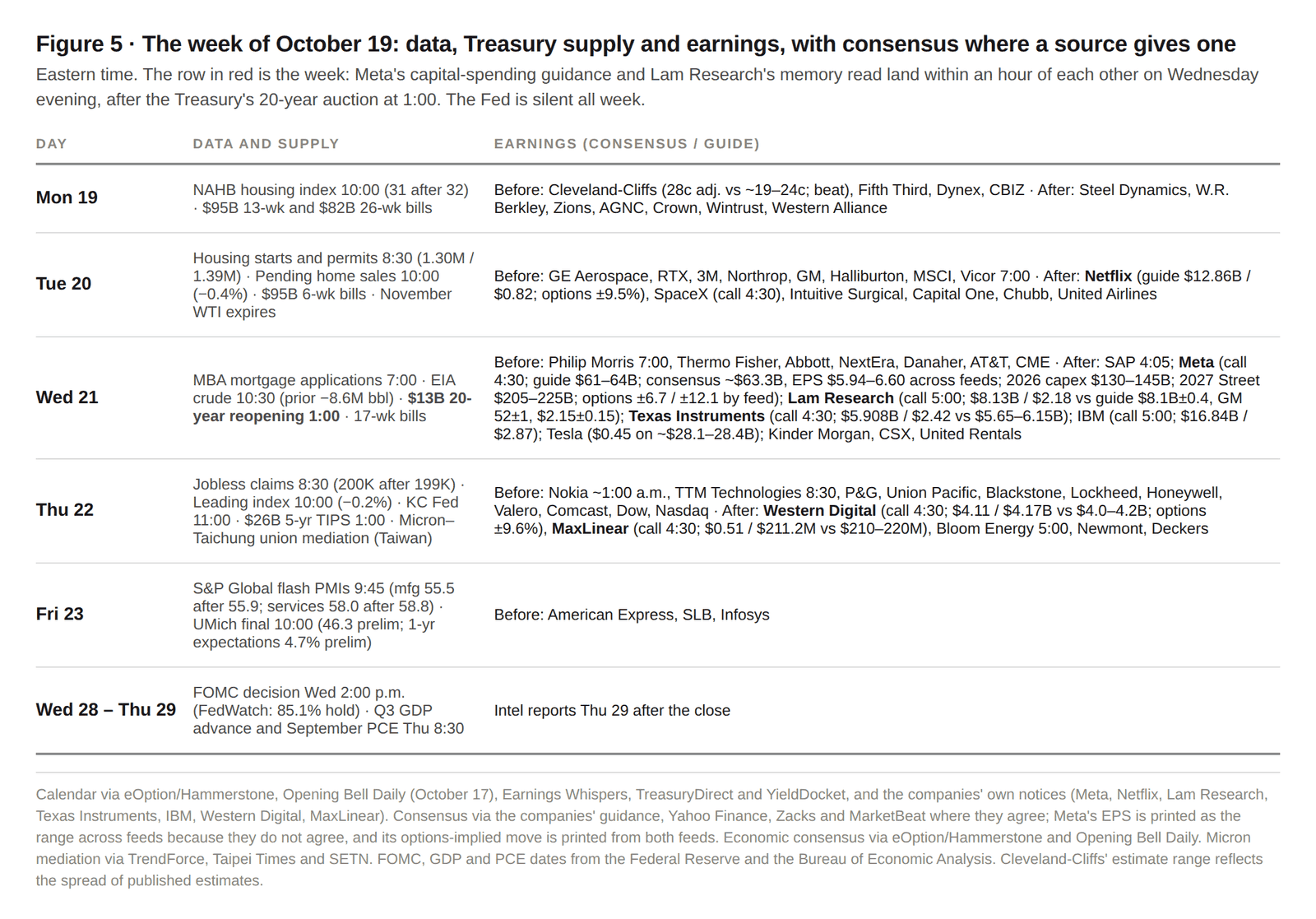
Tuesday. Housing starts and permits will be announced at 8:30 (with figures of 1.30 million and 1.39 million expected), pending home sales at 10:00 (expected to decrease 0.4 percent), and $95 billion in six-week bills. Before the market opens, companies including GE Aerospace, RTX, 3M, Northrop Grumman, GM, Halliburton, MSCI, and Vicor will release their results, Vicor at 7:00, the last of those a read on the power-delivery part of the AI build. After the market closes, Netflix, which guided the quarter to revenue of $12.86 billion and earnings of 82 cents per share; options suggest a move of about 9.5 percent. SpaceX will report on Tuesday evening on a 4:30 p.m. call; Intuitive Surgical, Capital One, Chubb and United Airlines will also report.
Wednesday is the week. Mortgage applications at 7:00, followed by the EIA crude inventories report at 10:30 after the previous week's 8.6-million-barrel withdrawal, and at 1:00 the Treasury will reopen the 20-year bond issue for $13 billion, which is the week's longer-dated test with the ten-year bond above 5 percent. Before the market opens, the companies to watch are Philip Morris at 7:00, Thermo Fisher, Abbott, NextEra, Danaher, AT&T, and CME. After the market closes, SAP reports at 4:05. Then, in the order of priority for the AI trade: Meta, with a call at 4:30, guided to $61 to $64 billion in third-quarter revenue against a consensus figure close to $63.3 billion, with estimated earnings ranging from $5.94 to $6.60 per share across different sources, a discrepancy that indicates the analysts do not agree on what should be included in the quarter; 2026 capital spending is guided at $130 to $145 billion; 2027 estimates are $225 billion from Guggenheim and Morgan Stanley and $205 billion from Bank of America; the options suggest a move of 6.7 percent on one feed and 12.1 percent on another. For Lam Research, the call is at 5:00, with a consensus of $8.13 billion and $2.18 per share against a guide of $8.1 billion plus or minus $400 million, a gross margin of 52 percent plus or minus a point and $2.15 plus or minus 15 cents; last quarter memory accounted for 46 percent of systems revenue, NAND more than doubled on a sequential basis, and the company puts 2026 industry wafer-fab equipment spending in the low $150 billions. Texas Instruments has a call at 4:30, with a consensus of $5.908 billion and $2.42 against a guide of $5.65 to $6.15 billion, covering the analog and industrial segments. IBM's call is at 5:00, with a consensus of $16.84 billion and $2.87. Tesla's consensus is 45 cents on revenue of about $28.1 to $28.4 billion. Kinder Morgan, CSX and United Rentals complete the list.
Thursday. Jobless claims will be released at 8:30 (expected at 200,000, up from last week's 199,000), the leading index at 10:00 (expected to fall by 0.2 percent), the Kansas City Fed survey at 11:00, and $26 billion in 5-year TIPS at 1:00. Nokia is set to give its report around 1 a.m. our time, and TTM Technologies before the market opens at 8:30, both optical and interconnect read-throughs. Also before the market opens: Procter & Gamble, Union Pacific, Blackstone, Lockheed Martin, Honeywell, Valero, Comcast, Dow, and Nasdaq. After the market has closed: Western Digital, with a call at 4:30, on a consensus of $4.11 per share on $4.17 billion compared to a guidance range of $4.0 to $4.2 billion, with options implying a 9.6 percent move; MaxLinear, with a call at 4:30, on a consensus of 51 cents on $211.2 million against a guidance range of $210 to $220 million, being the first of the optical-interconnect prints and the focus of this desk's October 4 feature; Bloom Energy at 5:00; and Newmont and Deckers. In Taiwan, the Taichung union, which the Taipei Times estimates includes about 10,000 Micron employees in Taichung and Tainan, is holding a second mediation session with management over the same 15-percent demand; if that fails, the union may hold a strike authorization vote.
Friday. The flash PMIs from S&P Global at 9:45, with manufacturing expected at 55.5 (having been 55.9 earlier) and services at 58.0 (down from 58.8 earlier); the University of Michigan's final October sentiment figure at 10:00, 46.3 on the preliminary basis, with one-year inflation expectations at 4.7 percent in the preliminary report. American Express, SLB and Infosys are scheduled to report before the market opens. The following week then brings the FOMC's decision on Wednesday the 28th at 2 p.m., and third-quarter GDP and September PCE released on Thursday the 29th at 8:30 a.m. Intel's report will come after the close that Thursday, not this week.
For the record, the Fed is looking at the data from last week: consumer prices rose by 0.6 percent in September and by 3.7 percent over the year, the core figure being 2.6 percent; producer prices increased by 1.3 percent month on month, against an expectation of 0.5 percent, and 6.3 percent over the year; retail sales rose by 0.8 percent compared with an expected 0.3 percent, the control group rising by 0.1 percent. This shows an inflation problem with a weak core of consumption, which is why the committee is more inclined to hold rates than raise them, and why no one is mentioning cuts. As for the chip industry, it is looking at TSMC's report from Thursday, which the selling ran straight through: net profit reached NT$763.06 billion, an increase of 68.7 percent, a gross margin of 66.4 percent, a fourth-quarter guidance of $52.3 to $54.3 billion at 65 to 67 percent, 2026 capital spending of $60 to $64 billion, a statement that spending from 2026 through 2028 will "significantly exceed" that of the previous three years, and a refusal to size 2027, which it called "too early". Last week's issue wasn't demand; it was the cost of money.
The watch list
Setups, not advice. Levels are based on Friday's closing price unless otherwise indicated.
The chip index at Friday's close, 11,137. A gap up that then drops below Friday's closing level is the dead-cat tell. The bull case is that the gap is held into Lam Research's announcement on Wednesday evening, since it is the equipment manufacturers who are the first to state whether the 2027 memory build is still being ordered.
CoreWeave and Nebius. Leading the rise on a reported, unconfirmed Nvidia backstop; higher beta in both directions. Look for confirmation or denial from Nvidia, and check the credit tape, particularly the 2032 notes and the CDS, since a stock price rise won't resolve that.
Micron, $911 premarket. Bouncing through a labor rally in Taipei. The next labor catalyst will be Thursday's mediation in Taichung, while Lam Research on Wednesday is the next demand catalyst. TradingKey identifies support at about $857 and resistance at about $973; those are its levels, not ours.
The optical sector: Applied Optoelectronics, Lumentum and Coherent. They fell 25 to 31 percent last week and rose 4 to 6 percent this morning, meaning they are about one-eighth of the way back. The next sector updates will be for Nokia and TTM on Thursday morning, followed by MaxLinear on Thursday evening; the first optical company to say orders did not decline in October will receive the group's bid.
Meta into Wednesday. This morning it was almost stationary while its suppliers rip. If the suppliers are right, Meta's capital spending in 2027 will be at or above the $205 to $225 billion range the market currently has, and the supplier bounce has legs. If Meta does cut back, then the bounce was just a bounce.
Bottom line
Nasdaq futures are rising now, with the companies that had the worst performance last week leading the move, in the same order they fell, which is exactly what a relief rally looks like, and what the first day of a recovery looks like. However, the capex buyers and the ten-year haven't confirmed this: the hyperscalers are unchanged, Nvidia is lagging, CoreWeave's bond yield is the same as it was on Friday, and 5.09 percent remains 5.09 percent. Treat it as a relief rally until Meta says otherwise on Wednesday, then let the chip index's ability to hold at 11,137, or fail to do so, show how much conviction there is under the open.
Sources and data notes
Futures and the VIX from the Yahoo Finance futures and index pages, read at 8:30 a.m. ET; the pages do not time-stamp the print. An earlier read at 8:11 showed S&P futures at 7,740.75 (up 0.47 percent) and Nasdaq-100 futures at 29,762.25 (up 1.26); the futures drifted a few points lower over the next twenty minutes. SPY and QQQ premarket prints from stockanalysis.com at 8:23 and 8:33. Treasury yields from CNBC's quote service at 8:21 and the Treasury's daily par yield curve for October 16 (10-year 5.09, 2-year 4.74) and October 13 (5.21). Dollar index, oil, gold and bitcoin from Yahoo Finance at 8:11 to 8:20; the November WTI contract and Friday's $101.41 settlement from Yahoo and the general press; the Russia waiver and Hormuz reporting via Investing.com (updated 7:24 a.m.) and Reuters. Overnight indexes from Yahoo Finance and the exchanges' own closes; the Hang Seng holiday closure via the Associated Press. European moves from Yahoo Finance at 8:06 and later reads of the Stoxx 600, DAX, FTSE 100 and CAC 40; the French protests and arrests via the Associated Press.
Premarket single-stock prints from stockanalysis.com and Yahoo Finance between 8:15 and 8:37 a.m., each in Figure 3 with its time where the feed gives one. Cleveland-Cliffs from the company's release and CNBC (7:56 a.m.). JPMorgan on Intel from the note as reported by CNBC and Investing.com. Bernstein on Datadog via Investing.com (7:25 a.m.). Morgan Stanley on Amazon via CNBC and the note as quoted. Disc Medicine from the company's 7:00 a.m. release. Blue Owl via Bloomberg as carried by CNBC. FedWatch via FXStreet (4:58 a.m.); Warsh's remark from the IMF and World Bank meetings in Bangkok, October 16; the blackout and meeting dates from the Federal Reserve.
Last week's index and single-stock moves from Yahoo Finance closes, Friday to Friday; Coherent's weekly figure is on one feed. The losing-streak count via Investing.com and Reuters. The Information on Nvidia and the neoclouds (October 18); Stocktwits via Yahoo Finance (10:31 p.m., October 18); TipRanks; the Nebius Form 4 via the SEC. Hock Tan via CNBC (October 12) and Reuters. CoreWeave's bonds and CDS via FXStreet (October 19) and TipRanks. The HBM base-die report via TrendForce (October 19), citing the Seoul Economic Daily. TradingKey's Micron levels (October 19). Micron's union: Focus Taiwan/CNA (October 19), Taipei Times (October 8 and 16), TrendForce (October 8); the Taichung mediation date via TrendForce, Taipei Times, and SETN.
The calendar from the eOption/Hammerstone weekly calendar, Opening Bell Daily's week ahead (October 17), Earnings Whispers, and the companies' own notices: Meta, Netflix, Lam Research, Texas Instruments, IBM, Western Digital and MaxLinear investor-relations releases. Consensus figures via the companies' guidance and Yahoo Finance, Zacks and MarketBeat where they agree; Meta's EPS consensus is printed as the range across feeds because they do not. Meta's 2027 capital-spending estimates via Guggenheim, Morgan Stanley, and Bank of America as reported. Options-implied moves via Yahoo Finance and Barchart; where two feeds differ, both are printed. Treasury auction sizes via TreasuryDirect and YieldDocket. The FOMC, GDP, and PCE dates from the Federal Reserve and the Bureau of Economic Analysis. Last week's CPI, PPI and retail sales from the Bureau of Labor Statistics and the Census Bureau; TSMC's quarter from the company's October 15 release and call.
Figure 4's "share recovered" is the desk's arithmetic: a fall of d percent needs a rise of d/(1−d) to get back to even, and the morning's move is divided by that. The index row uses the semiconductor index for the week and the SOXX fund for the morning; the Nasdaq row uses the Composite for the week and the Nasdaq-100 futures for the morning.
TrendyVest provides market research and commentary for informational purposes only. Not investment advice.