MORNING BRIEF
Morning Brief October 16th 2026
Thursday produced two prices for the same company's money: a record in its credit default swaps and a 5.94 percent rise in its stock. The sell-side model published the same afternoon sided with the equity, but the arithmetic didn't. Seoul, meanwhile, bought back a fraction of what it sold.
Friday, October 16, 2026 · Before the open · Industrial production at 9:15
Thursday produced two numbers for the same company, at the same hour, that cannot both be the price of its money. CoreWeave's five-year credit default swaps closed at a record, with the credit market pricing better-than-even odds that the company defaults inside five years. Its common stock closed up 5.94 percent, because the chief executive of its largest supplier said its cost of capital was falling. One of those markets is wrong about the cost of financing the buildout, and the model that Wall Street published the same afternoon quietly sides with the equity. That is the subject this morning. First the tape.
Overnight, sworn in
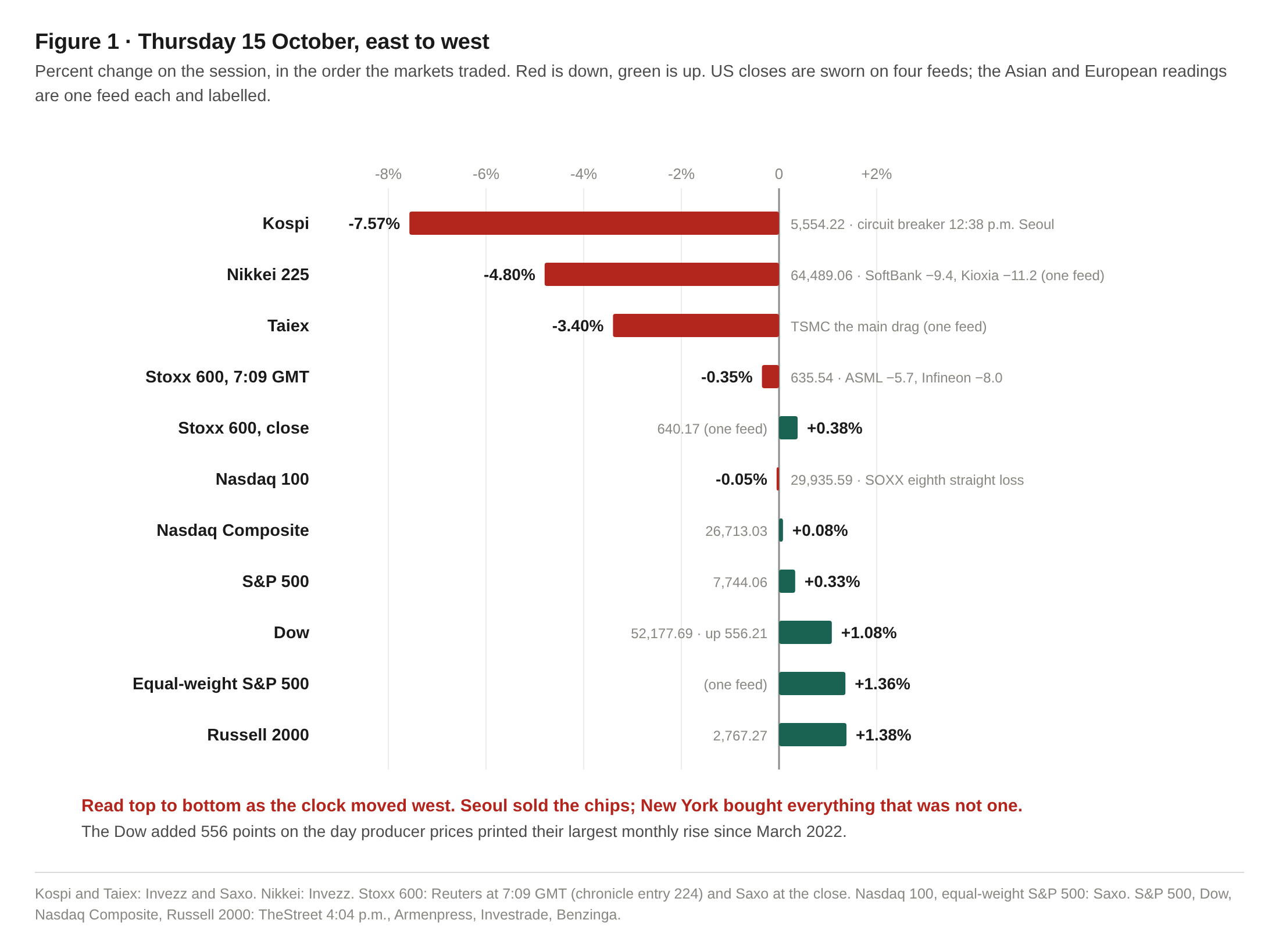
Thursday's closes are sworn in on four feeds. The S&P 500 finished at 7,744.06, up 25.12 points or 0.33 percent; the Dow at 52,177.69, up 556.21 or 1.08 percent; the Nasdaq Composite at 26,713.03, up 20.16 or 0.08 percent, with TheStreet's 4:04 p.m. table two hundredths lower at 26,713.02; the Russell 2000 at 2,767.27, up 37.74 or 1.38 percent, with Investrade a cent higher. Saxo's morning note puts the Dow at 52,183.23, an early table, so nobody has to wonder. The Dow added five hundred points on a day the producer price index printed its largest monthly rise since March 2022. The ten-year yield fell with it, to 5.085 percent on TheStreet at 3:19 p.m. and on Benzinga this morning, or 5.10 on two closing summaries; it is not sworn, and the difference is a reading taken before the Treasury's afternoon mark against one taken after. The two-year is 4.749, 4.77 and 4.74 on the same three feeds. The thirty-year closed at 5.43, down ten basis points, per Yahoo Finance.
The seam this morning runs through Seoul, and you read it east to west. On Thursday, the Kospi fell 7.57 percent to 5,554.22, with a circuit breaker at 12:38 p.m. Seoul time, and the Nikkei 225 fell 4.8 percent to 64,489.06; SoftBank fell about 9.4 percent, and Kioxia 11.2. Taipei lost 3.4 percent with TSMC the main drag. Europe was down 0.35 percent at 7:09 a.m. GMT and closed up 0.38 at 640.17 on the Stoxx 600, having sold its chipmakers (ASML down 5.7 percent, ASM International 8.6, Infineon 8.0) and bought its drugmakers. New York then put in the broadest up day in weeks for everything that is not a semiconductor: the equal-weight S&P 500 rose 1.36 percent, retail 3.68, healthcare 1.86, financials 1.38, while the Nasdaq 100 lost 0.05 and the iShares Semiconductor ETF closed at $514.71, its eighth straight loss and the longest such run since September 2015, down 12.6 percent from its $588.90 close of 2 October.
Friday, Asia bought back a fraction of what it sold. The Kospi closed at 5,668.05, up 113.83 points or 2.05 percent (5,668.06 on TradingKey, the two feeds a hundredth apart and both printed), which leaves it down 14.46 percent on the week; the Kosdaq rose 4.46 percent to 794.78 and tripped a buy-side sidecar at 12:55 p.m. Samsung Electronics closed at 215,500 won, up 2.62 percent, and SK Hynix at 1,272,000 won, up 0.79, both on the Seoul Economic Daily and TradingKey. The Nikkei closed at 65,324.24, up 898 points or 1.39 percent, sworn on TradingKey, BigGo Finance and Investrade, and is down 5.37 percent on the week. Hong Kong was up 124 points at 24,186 at 6:54 a.m. on Investrade and up 0.52 percent at the close on TipRanks; Shanghai up 8 points at 3,716 and 0.24 percent. Jakarta fell about eleven percent after MSCI opened a consultation on removing Indonesia from its emerging-market classification, per the Associated Press, which is the one Asian move this morning that has nothing to do with chips.
Europe at 5:35 a.m. Eastern on Newsquawk: DAX up 1 percent, Stoxx 600 up 0.5, FTSE 100 down 0.1; Investrade at 6:54 had the DAX at 25,668, up 285, and the FTSE at 10,854, up 14. US futures at the same minute: S&P 500 at 7,805, up 14.25 or 0.19 percent; Dow at 52,643, up 215 or 0.41; Nasdaq 100 at 30,127, down 16.50 or 0.06, its fifth decline in a row on Trading Economics reading. The dollar index was 101.70 at 5:35 a.m., down 0.3 percent, on Newsquawk and 101.77 on Benzinga ten minutes earlier; gold spot $4,184.82, up 0.70 percent, on Benzinga at 5:25.
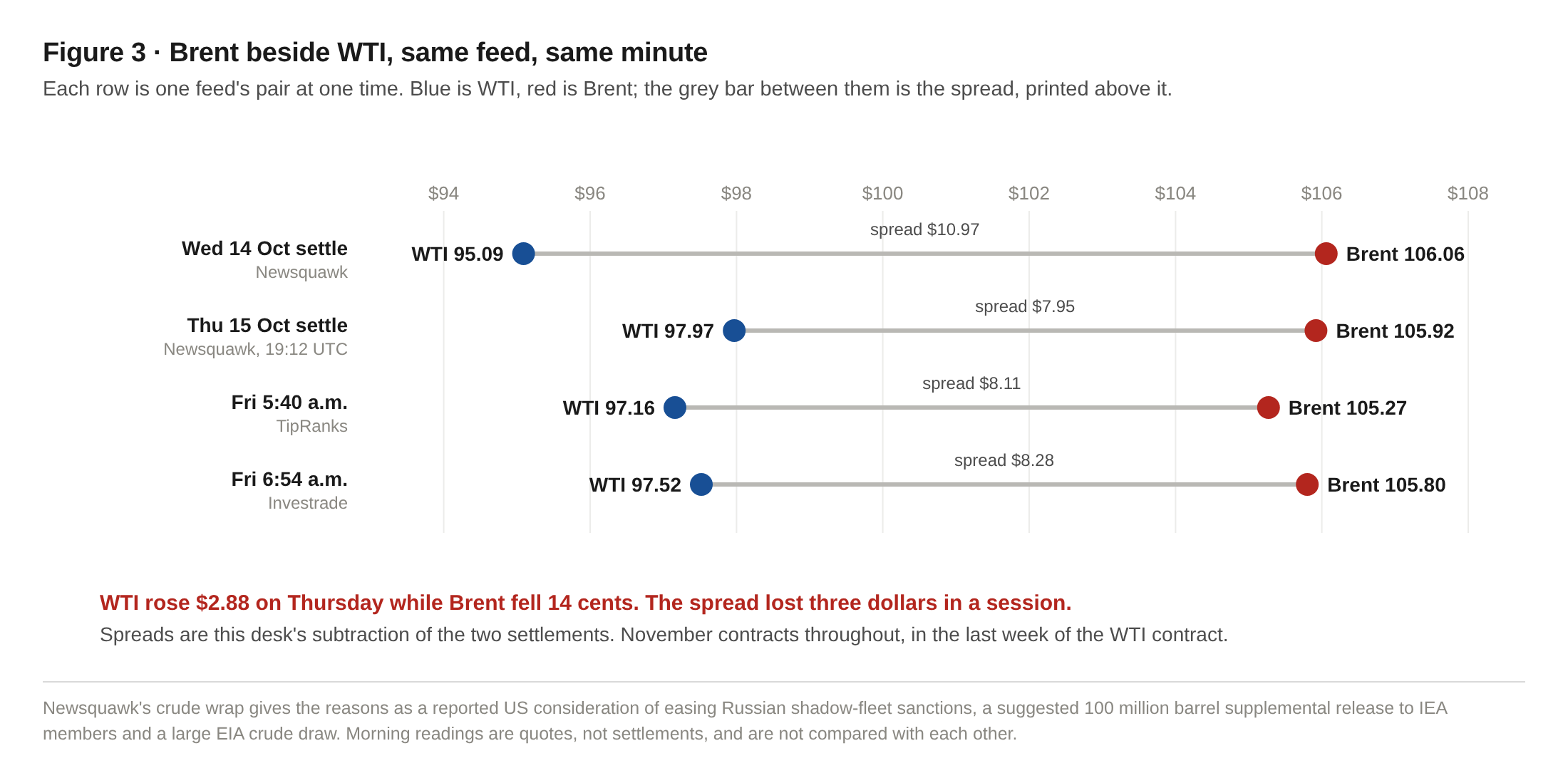
Crude never travels alone, and this morning it should not. Thursday's settlements on Newsquawk's wrap were WTI at $97.97, up $2.88, beside Brent at $105.92, down $0.14, both the November contracts. That is a $3.02 swing in one session in the spread between the two benchmarks, from $10.97 to $7.95, this desk's subtraction from Newsquawk's two settlements and Wednesday's ($95.09 and $106.06, also Newsquawk). The reasons given were a reported US consideration of easing sanctions on the Russian shadow fleet, a suggested supplemental release of 100 million barrels to IEA members, and a large weekly draw in US crude stocks; the first two weigh on Brent and the third lifts WTI, which is roughly what happened, though three dollars of spread in a day is a large number for those reasons, and the desk has not reconciled it. This morning on Investrade at 6:54: WTI $97.52, down 45 cents, beside Brent $105.80, down 12. On TipRanks at 5:40: WTI $97.16, down 0.83 percent, beside Brent $105.27, down 0.62. Treasury Secretary Bessent said overnight that "the noose is tightening around Iran's economy," with Reuters reporting Iranian seaborne crude exports at zero since the second week of September.
The subject: the price of CoreWeave's money
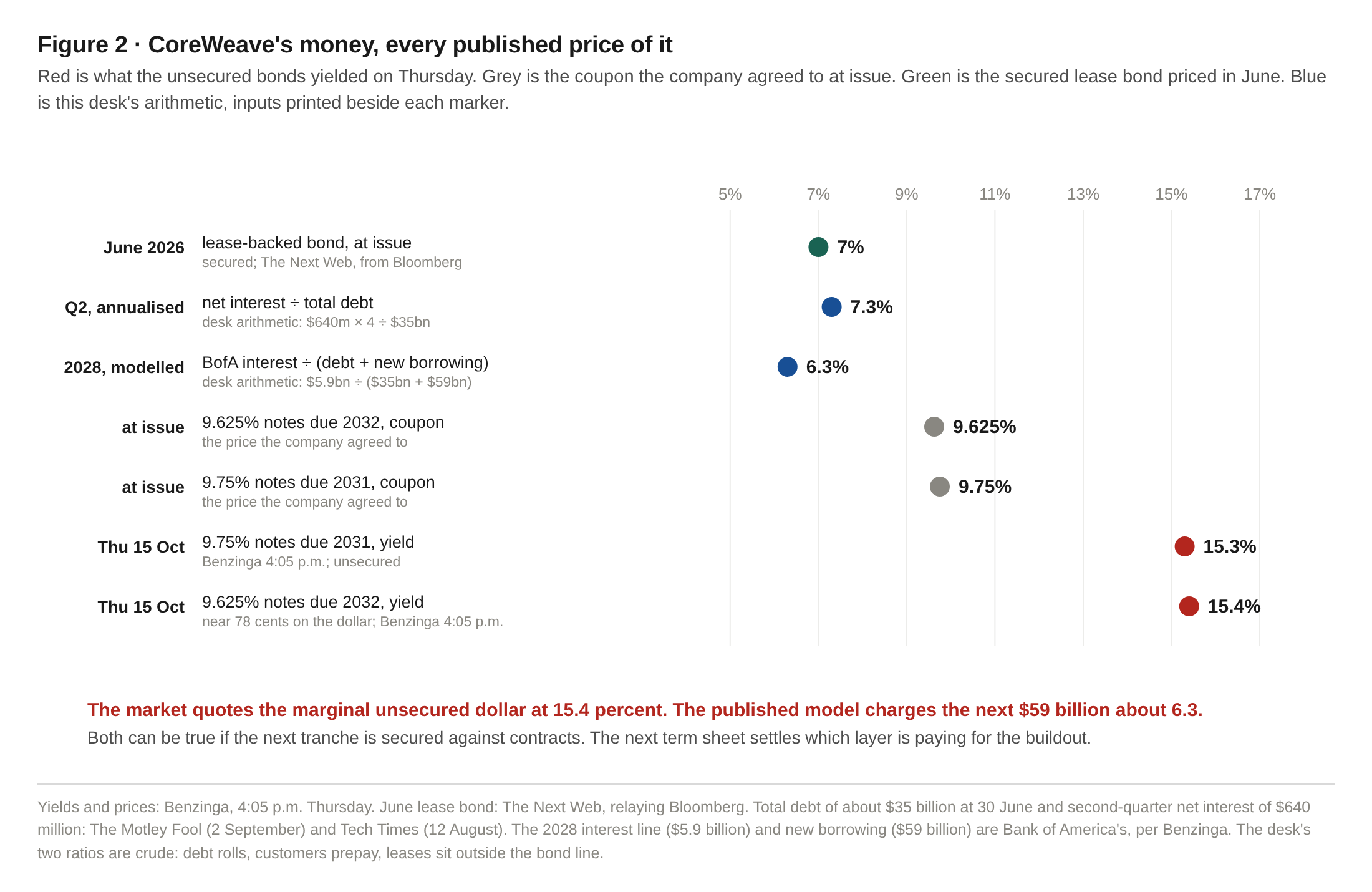
Here is the published number. CoreWeave's 9.625 percent notes due 2032 traded Thursday at a yield above 15.4 percent, near 78 cents on the dollar, and its 9.75 percent notes due 2031 above 15.3 percent, per Benzinga at 4:05 p.m.; Yahoo Finance's live blog had a 9 percent issue at 80.75 cents. Its five-year credit default swaps rose as much as 74.5 basis points to 1,194.5, the highest on record, per ICE Data Services as relayed by The Next Web from Bloomberg, a level the Bloomberg headline translated as default odds above 60 percent. For scale: those contracts were at 452 basis points in June and 855 in August, when the swap market was pricing roughly even odds. S&P Global rates the company B-plus.
Here is the other number, published the same afternoon. Jensen Huang, in Stockholm, to Bloomberg: "CoreWeave's strength is improving every day." And: "I'm optimistic. Their cost of capital is actually decreasing." He said Nvidia does not need to backstop it. Nvidia owns about ten percent of CoreWeave and sells the chips the business runs on. The stock, which closed Wednesday at $65.78, down 15.46 percent on 107 million shares, closed Thursday at $69.69, up 5.94 percent, according to Yahoo Finance's 4:00 p.m. quote and The Motley Fool's board. Benzinga's quote widget showed $69.90, and its 4:05 p.m. text said the shares "slid nearly 3 percent"; that was true at some point in the afternoon, not at the close.
Both statements can be true at once, and it matters how. The company's own claim, made on its 11 August call, is that it has "reduced our weighted average cost of debt by almost 300 basis points" over a year. A bond backed by a CoreWeave lease priced at 7 percent in June, per The Next Web. Secured money against a signed contract with Meta or OpenAI as the counterparty is cheap and getting cheaper; that is the layer Mr. Huang is describing, and he is probably right about it. Unsecured money against CoreWeave itself costs 15 percent and is getting dearer. The question for the buildout is which layer funds the next tranche, and the sell side answered it Thursday without quite saying so.
Bank of America's Tal Liani reiterated a Buy and a $140 target on Thursday, about 105 percent above the stock. His model, per Benzinga's account: negative free cash flow of about $67 billion from 2026 through 2028, about $59 billion of it new borrowing; interest expense of $3.08 billion in 2026 rising to $5.9 billion in 2028; active power rising from 1.5 gigawatts at the end of June to 4.8 by the end of 2028; revenue per watt from about $10 to $14 a year. Now the desk's arithmetic, with the inputs printed. Total debt was about $35 billion at 30 June per The Motley Fool's reading of the quarter, up from about $21 billion at the end of 2025. Add the model's $59 billion of new borrowing and the company is carrying roughly $94 billion of debt in 2028, on which the model charges $5.9 billion of interest. That is 6.3 percent. It is below the 7 percent the company's best-secured paper fetched in June, less than half the 15.4 percent its unsecured paper fetched on Thursday, and roughly where the company's blended cost sat last quarter: second-quarter net interest expense was $640 million, which annualised against the $35 billion is about 7.3 percent. The arithmetic is crude, because debt rolls, customers prepay about half a contract's value, and leases sit outside the bond line. But the direction is not in doubt. The published model assumes the next $59 billion costs what the last $35 billion cost, on a day the market quoted the marginal dollar at twice that.
Where should 15 percent show up, if it is real? In three places, and it has shown up in none of them yet. In the interest line: the company guided second-quarter net interest to $650 to $730 million and came in at $640 million; the third-quarter number arrives with results in November and is the first place the new price of money can print. In the capex plan: 2026 capital spending was raised in August to $35 to $39 billion from $31 to $35 billion, and the backlog that justifies it was about $104 billion at 30 June and about $129 billion by 11 August, with Meta at 27.1 percent of it and OpenAI at 17.4. A backlog grows on contracts signed, not on money raised, and nothing in the backlog tells you the rate at which the capacity behind it gets financed. And in the primary market: the company widened the spread on a $2.6 billion leveraged loan by 100 to 125 basis points in early August to get it done, per Tech Times. The next loan is the test. If it prices anywhere near the secured 7 percent, Mr. Huang was right, and the swap market was pricing fear rather than a rate. If it is priced nearer the unsecured 15, the $140 target has a $5.9 billion interest line that is wrong by a factor that compounds.
The wider frame is what Seoul puts on a circuit breaker. Gartner's note, which set Wednesday's selling off, said 80 percent of neoclouds could disappear by 2030; The Motley Fool's account adds that more than $3.5 trillion of AI infrastructure spending could be exposed to impairment by then, a figure this desk has not found on Gartner's own page and prints as the Fool's; Oracle fell 8.83 percent to $130.55 that day and Nebius 10.08 to $186.01. On Thursday, by Yahoo Finance's count at 6:30 p.m. UTC, six AI infrastructure suppliers lost about $23 billion in value and about $94 billion since 6 October, with Vertiv down more than 6 percent. A Korean analyst's line, relayed by Invezz, is the cleanest statement of what changed: the yardstick "is shifting away from the sheer size of capital expenditure towards profitability." Memory makers fell 9.5 and 11.4 percent in Seoul on Thursday not because anyone cut an order, but because the people who place the orders are being asked, for the first time, what their money costs.
At the other end of the pipe, the labs are being asked something similar. Reuters reported Thursday evening, from four people familiar with the matter, that some of Anthropic's most prominent investors discussed a valuation of around $1.5 trillion at its investor day, against the roughly $2 trillion they had expected for a November share sale, after the company told them third-quarter revenue rose 45 percent from the previous quarter to $16.8 billion, from $11.6 billion. A 45 percent quarterly rise disappointed the room. Anthropic did not respond to Reuters. The disclosure applies: this desk's tooling is built on Anthropic's Claude, and the desk has no view on the valuation, so it prints the report as-is.
What moved
TSMC was the day's other published number, and it moved the wrong way for the right reasons. Third-quarter revenue of $46.72 billion, gross margin 66.4 percent against 67.7 in the second quarter, operating margin 58.7, high-performance computing 68 percent of revenue and up 22 percent sequentially; fourth-quarter guidance of $52.3 to $54.3 billion at a 65 to 67 percent gross margin; capital spending reiterated at $60 to $64 billion, the figure set in July, with 2026 to 2028 spending "significantly higher" than the previous three years and overseas-fab dilution widening from about two points to three or four. The ADR was down 4.14 percent at 10:08 a.m. on TheStreet and "fell 2 percent" in Yahoo Finance's closing text; the close is not established on a second feed and the desk prints the range. A record quarter, a reiterated budget, and a lower stock price are what a market does when it stops asking how much and starts asking at what return.
Nvidia closed at $217.23, down 1.84 percent, according to Yahoo Finance and Saxo; AMD lost 1.50 percent. The names that carried the rotation were the ones a lower ten-year reaches first: Lennar rose more than 5 percent and the other builders less; Nike and Lululemon each around 5 percent; Apple crossed $5 trillion in market value while sitting out the selloff; large-cap healthcare opened at a record. Those are not the trade and they were swept into it, because the money that left the semiconductors on Thursday had to go somewhere and chose the parts of the index that benefit when the cost of money falls. The cost of money fell on Thursday for everyone except the company whose cost of money was the story.
Two more that got swept. Corteva fell 6.72 percent before the open on litigation over its seed spinoff and its removal from the S&P 500, unrelated to any of this. Interactive Brokers, reporting after the bell, said customer margin loans rose 36 percent to $105.2 billion, with accounts up 35 percent to 5.58 million; the stock was down 1.14 percent before the open on a one-cent miss. A $105 billion margin book is the retail side of the same question the swap market was asking CoreWeave, and nobody is asking it yet.
Before the open, on Benzinga at 5:25: Tesla up 4.36 percent after unveiling a Roadster that SpaceX thrusters make hover; CoreWeave down 4.09, giving back most of Thursday; Alcoa up 2.13; J.B. Hunt down 1.33.
The calendar
The 8:30 releases land after this Brief goes out and are previewed, not reported. Import prices for September, consensus +0.8 percent on the month against +0.7 prior; export prices +1.0 percent against +0.6; the New York Fed's services activity index for October, prior minus 8.7, no consensus. All from Trading Economics, whose display this desk reads as UTC and converts.
9:15 a.m.: industrial production for September, consensus +0.4 percent against 0.0 prior; manufacturing production +0.3 against minus 0.3; capacity utilization 76.5 percent against 76.3. 1:00 p.m.: Baker Hughes rig count, prior 462 oil rigs and 603 in total. 2:00 p.m.: the Treasury's monthly budget statement for September, consensus minus $29 billion against minus $167 billion. 2:45 p.m.: the President speaks in Dalton, Georgia, per Newsquawk. 4:00 p.m.: Treasury International Capital flows for August, long-term consensus +$75.2 billion against minus $27.9 billion. 6:00 p.m.: Chicago's Goolsbee speaks.
Chair Warsh spoke overnight in Bangkok at the IMF and World Bank meetings and gave no rate signal; "do not prejudge meetings," per Newsquawk's account, and money markets cut the odds of an increase at the 27 and 28 October meeting to 14 percent from 26. He said artificial intelligence "could substantially boost productivity" in the economies that adopt it, that the path would be "very bumpy," and that it would reach the demand side of the economy before the supply side. Goolsbee, separately, said AI-driven overheating would make inflation the more disturbing outcome. After October, the committee meets on December 8 and 9; the election is on November 3.
Earnings before the open: Truist, Regions, M&T, Citizens, Travelers. Citizens printed $1.41 against $1.39; Truist $1.16 against $1.21 with $1.45 billion of securities losses and a $253 million credit benefit, per Investrade.
Thursday's data, because the market's reaction to it was the quiet news: producer prices rose 1.3 percent in September against 0.5 expected, 6.3 percent on the year, core 0.7 against 0.3; retail sales 0.8 against 0.3, gasoline doing most of it, the control group 0.1; claims 199,000; the Philadelphia Fed index 20.9 against 28.4. On that print, the ten-year fell about ten basis points, and the odds of a hike fell by nearly half. A bond market that buys the hottest producer-price number in four years is reading something else, and Saxo's note names it: part of the dollar's weakness is being attributed to AI-debt concerns, and a flight from a $94 billion drawdown in infrastructure names into Treasuries would look exactly like this.
What we're checking next
The next CoreWeave financing, whenever it prices, and at what spread. The company widened a $2.6 billion loan by up to 125 basis points in August to clear it; the swap market has since moved from 855 to 1,194. The desk will read the term sheet rather than the headline, because "secured by contracted capacity" at 7 percent and "senior unsecured" at 15 are different companies for the purpose of the $140 target, and the sell-side interest line only works for one of them.
The third-quarter net interest number in November, against the second quarter's $640 million, which came in under the $650 to $730 million the company had guided. That is where a higher cost of money first prints, and it prints in the company's own document.
And the Korea Exchange's foreign-flow data for this week. The Kospi lost 14.46 percent in five sessions on a memory-price argument that no memory maker has yet made; the Korea Times' line this morning is that the selloff is "excessive as memory outlook stays strong." Foreigners were net sellers for an eighth session on KED Global's count while domestic institutions bought. Whether that reverses before Samsung and SK Hynix report their full quarters at the end of the month tells you whether Thursday was a repricing or a position being closed.
Sources and data notes
Pages were read between 7:17 and 8:32 a.m. Eastern this morning and are stamped to that window unless a feed carries its own time, in which case that time is given. Pages reach the desk through a reader that relays their text; the quotations in the two chronicle entries below were read twice.
Sworn in. Thursday's S&P 500 (7,744.06), Dow (52,177.69) and their changes on TheStreet's 4:04 p.m. table, Armenpress at 8:49 a.m. Friday, Investrade's preview (10:54 UTC) and Benzinga (5:25 a.m.); the Nasdaq Composite at 26,713.03 on Armenpress, Investrade and Yahoo Finance's 5:15 p.m. quote and 26,713.02 on TheStreet and Benzinga; the Russell 2000 at 2,767.27 on TheStreet, Benzinga and Trading Economics and 2,767.28 on Investrade. Saxo's Dow of 52,183.23 is printed as an early table. Friday's Nikkei at 65,324.24 (TradingKey, 6:58 a.m.), 65,324 up 898 (Investrade; BigGo Finance). The Kospi at 5,668.05, up 113.83 (Seoul Economic Daily, 16:03 KST) and 5,668.06 (TradingKey); Samsung 215,500 won and SK Hynix 1,272,000 won on both. CoreWeave's close at $69.69, up 5.94 percent (Yahoo Finance 4:00 p.m.; The Motley Fool's board). Nvidia at $217.23, down 1.84 (Yahoo Finance; Saxo). The semiconductor ETF at $514.71 and its eight sessions (Investrade; GuruFocus 3:55 a.m.). Crude settlements, Wednesday and Thursday, on Newsquawk (19:12 UTC Thursday; Wednesday's as logged in chronicle entry 225).
Not sworn. The ten-year's Thursday close: 5.085 on TheStreet at 3:19 p.m. and Benzinga, 5.10 on Strategitz and hyeongeonnoil's summary; the Treasury's par curve was not read. The two-year: 4.749 (TheStreet), 4.77 (Strategitz), 4.74 (Benzinga, Friday 5:25 a.m.). TSMC's Thursday close, with the ADR down 4.14 percent at 10:08 a.m. (TheStreet) and "fell 2 percent" in Yahoo Finance's closing text; the range is printed. Thursday's Nikkei (64,489.06, down 4.8 percent) and Taiex (down 3.4) are Invezz's and Saxo's, one feed each. Hong Kong and Shanghai's Friday closes rest on Investrade's 6:54 a.m. levels and TipRanks' 5:40 a.m. percentages, which agree with each other to the rounding. The Stoxx 600's Thursday close of 640.17 is Saxo's alone; its 7:09 GMT reading of 635.54 is Reuters' as logged in entry 224. Futures, Europe, the dollar and gold are as stamped in the text, from Investrade (6:54 a.m.), Newsquawk (5:35) and Benzinga (5:25).
The subject. CoreWeave's bond yields and prices, the B-plus rating, Bank of America's target and every figure of its model: Benzinga, 4:05 p.m. Thursday. The CDS level, its June base, Mr. Huang's quotations and the June 7 percent lease bond: The Next Web, 16:33 UTC Thursday, relaying Bloomberg and ICE Data Services; the "60 percent" is Bloomberg's headline of 15 October, which the desk could not open. The August CDS level (855), the $2.6 billion loan's widening, the backlog's three readings ($99.4 billion, about $104 billion, about $129 billion), second-quarter revenue ($2.575 billion), the net loss ($626 million), net interest ($640 million against $650 to $730 million guided; $536 million in the first quarter), the capex raise ($35 to $39 billion from $31 to $35) and third-quarter guidance: Tech Times, 12 August. Total debt (about $35 billion at 30 June; about $21 billion at the end of 2025) and the "almost 300 basis points" quotation: The Motley Fool, 2 September. Wednesday's close ($65.78, down 15.46 percent, 107 million shares), the Gartner figures, Oracle and Nebius: The Motley Fool, 5:28 p.m. Wednesday. Thursday's $23 billion and $94 billion and Vertiv: Yahoo Finance's live blog, 6:30 p.m. UTC post. The analyst's yardstick line: Invezz. The Anthropic report: Reuters, 15 October, as published by Global Banking & Finance Review at 07:52 UTC. Desk arithmetic: 5.9 ÷ (35 + 59) = 6.3 percent; 0.640 × 4 ÷ 35 = 7.3 percent; the Brent–WTI spread, 106.06 − 95.09 = 10.97 and 105.92 − 97.97 = 7.95.
Data and calendar. Trading Economics' calendar, read with its times as UTC and its first figure as previous and second as consensus; Thursday's actuals from the same page, with Saxo's and investingLive's summaries agreeing. Warsh and the hike odds: Newsquawk's US opening note, 09:59 UTC; Saxo has the odds at about 15 percent. Earnings: TipRanks, Investrade. TSMC: Investing.com's slides summary, 3:30 a.m. Thursday, and the chief financial officer's "reiterate," as logged in entry 223.
The chronicle. Two entries join the register, taking it from 222 to 224. Investrade's preview for Friday has "the Korean Kospi rose 2% or 17 points to 878," the same template that printed 860 on Thursday (entry 222); the close was 5,668.05, up 113.83. And Benzinga's 5:25 a.m. market piece has WTI "trading higher in the early New York session by 0.98% to hover around $97.01," where $97.01 is 0.98 percent below Thursday's $97.97 settlement: the right size, the wrong sign. Seen and not logged: Benzinga's 4:05 p.m. text with CoreWeave down nearly 3 percent beside a widget at $69.90, an intraday reading; Yahoo Finance's ten-year ticker reading "5.09 −5.19 (−50.49%)," a widget; Saxo's Dow; a TheStreet sidebar headline on MongoDB's chief executive that belongs to September; TheStreet's and Yahoo's two readings of TSMC; Share Talk's Associated Press relay with the Kospi up 3.6 percent and the Nikkei at 65,658.59, which are intraday levels under a morning headline.
Sources. TheStreet, 15 October · Yahoo Finance live blog · Armenpress · Investrade, Morning Preview · Benzinga, Friday premarket · Benzinga, CoreWeave bonds and Bank of America · The Next Web, Huang and the swaps · The Daily Upside · The Motley Fool, 14 October · The Motley Fool, 2 September · Tech Times, 12 August · Reuters on Global Banking & Finance Review · Invezz, the Kospi · Seoul Economic Daily · KED Global · TradingKey · Share Talk, AP relay · Saxo, Market Quick Take · Newsquawk, US opening news · Newsquawk, crude wrap · TipRanks · Strategitz · GuruFocus, SOXX · Investing.com, TSMC slides · Trading Economics, calendar · Trading Economics, US indexes · Korea Times (headline only) · Bloomberg, CoreWeave swaps (unfetched) · The Decoy Chronicle.
The Decoy Chronicle — every entry, dated and sourced — is published as a standing register and updated with each issue.
The TrendyVest Championship is open for registration at Tournament.Trendyvest.com — 500 seats, a $100,000 simulated stake, free to enter. Trading began October 1 at the market open.
TrendyVest is an independent research practice. This is analysis and editorial opinion, not investment advice, and nothing here is a recommendation that any particular person buy or sell any security. Figures identified as this desk's arithmetic are the practice's own, and the inputs are printed alongside them.