THE WHISPER
The Whisper 14
A $7 Billion Lease, a $664 Billion Backlog, and No Document That Connects Them
The feature
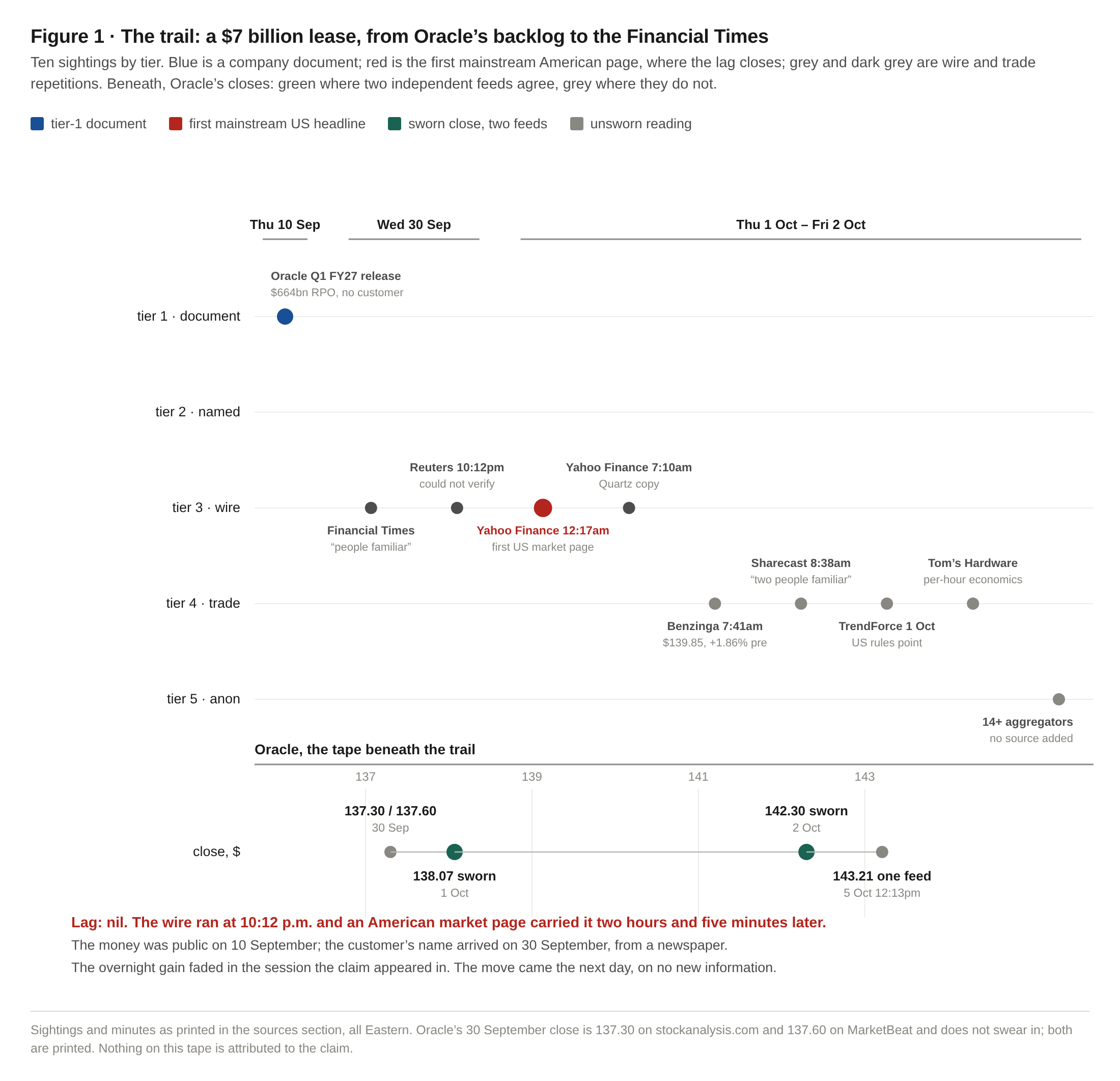
The claim, as it was printed: Tencent has signed its largest overseas lease deal, with Oracle, for access to about 100,000 advanced AI chips that are not available to it in China — a five-year lease across multiple Oracle data centers in south-east Asia, agreed earlier this year, worth about $7 billion, with roughly thirty percent paid upfront. That is the Financial Times, Wednesday 30 September, citing people familiar with the matter. Neither company has confirmed a dollar of it, and neither has denied it. Status: corroborated. Highest tier reached: three.
What makes it worth the column is not the size. It is the mismatch: Oracle's public backlog was disclosed first, and the later name came from a leak with no document connecting them.
The first sighting. The FT's report was on Wednesday 30 September. This desk did not open ft.com and does not quote it directly; the substance comes from Reuters, which carried the report in full on a syndicating station's page stamped "Sep 30, 2026 | 10:12 PM" with no time zone shown. Reuters: "Tencent signed its largest overseas lease deal with US cloud provider Oracle to access about 100,000 advanced AI chips that were not available in China, the Financial Times reported on Wednesday, citing people familiar with the matter. The Chinese technology giant this year agreed to a five-year lease across multiple Oracle data centers in south-east Asia." Then the two sentences this desk reads before any others: "Reuters could not immediately verify the report. Oracle and Tencent did not immediately respond to Reuters' requests for comment."
Three words there carry the whole issue: this year agreed. The lease was not signed on Wednesday. It was signed at some point in 2026, and on Wednesday night somebody told a newspaper about it.
The trail, in order. The FT stood alone. Reuters relayed it and said so, adding nothing but the two declinations. At 12:17 a.m. Eastern on Thursday 1 October, Stocktwits copy on Yahoo Finance's markets pages, byline Yuvraj Malik, asked why Oracle was jumping more than 2.5 percent in overnight trading and answered with the FT report — and because Yahoo Finance is one of the outlets this desk uses to mark the end of a lag, that is where the lag closes, two hours and five minutes after the wire. At 7:10 a.m. Quartz copy on the same pages, byline Cris Tolomia, credited MarketWatch, Reuters and the FT. At 7:41 a.m. Benzinga, byline Namrata Sen, attributed every figure to the FT and printed Oracle up 1.86 percent at $139.85 premarket. At 8:38 a.m. Sharecast's Benjamin Chiou added the sourcing detail nobody else carried — the FT "cited two people familiar with the matter" — and had the premarket at $139.75. TrendForce picked it up the same day with the regulatory sentence that explains why the deal is a lease at all: "U.S. rules do not currently prohibit them from leasing computing capacity overseas, giving them access to advanced NVIDIA chips that are generally unavailable in China." Tom's Hardware followed with per-hour economics, the implied rate roughly forty-three percent below standard H100 rental rates, logged as a headline from the search index and not as a read.
Below that, at least fourteen English-language sites restated the claim without adding a source. Counted, not weighted, not named.
One origin, one wire relay, an American market page inside three hours. The lag is zero trading days, and nobody here had a session's head start.
What the market did about it. Less than the headline suggested, and then more, a day late. Oracle gained more than 2.5 percent overnight and gave back almost all of it. It opened Thursday at $139.60, traded down to $135.33, and closed at $138.07 — sworn on stockanalysis.com's daily table and Yahoo Finance's previous-close field, MarketBeat at $138.09 and printed. Against Wednesday, that is $0.77, 0.56 percent, this desk's arithmetic, 0.77 ÷ 137.30, on a base that does not itself swear in. Volume was 22.95 million shares, up from Wednesday's 21.71 million and below the Yahoo average of 32.64 million. No volume anomaly appeared in the session the claim appeared in.
The move came on Friday instead. Oracle closed 2 October at $142.30 — sworn, stockanalysis.com and Yahoo Finance carrying the close, the $142.09 open and the $140.26 to $144.86 range identically, MarketBeat a third feed at $142.58 and printed. That is $4.23, 3.06 percent, on 30.19 to 33.21 million shares by feed. Nothing new about the lease was published on Friday; the last fact in the chain was more than a day old.
Wednesday's close to Friday's: +$5.00, +3.64 percent on one pairing, +$4.98, +3.62 percent on the other. Both endpoints are printed because the base does not swear in — $137.30 against $137.60, thirty cents apart, a difference between feeds and not an error inside either. Today, one feed and unsworn: $143.21, +$0.91, +0.64 percent, stockanalysis.com at 12:13 p.m. Nothing is attributed. Oracle came into this week down roughly thirty percent year to date, on the Stocktwits item's own account, and a three percent Friday in that stock is not evidence of anything.
The number that was already public. On 10 September — fourteen trading days before the first sighting — Oracle published its first-quarter results for fiscal 2027. The release is a tier-one document, and this is the sentence: "Oracle booked more than $30 billion of additional AI cloud contracts in Q1, increasing its RPO to $664 billion." Cloud infrastructure revenue was $7.4 billion, up 121 percent. No customer is named anywhere in it; the release says, "Oracle's enterprise customers" and "AI Cloud customers" and stops there.
If the FT is right that the lease was agreed this year, then a five-year, $7 billion commitment was sitting somewhere inside the remaining performance-obligation figure Oracle put in a press release three weeks before anyone could attach a name to it. This desk does not assert that $7 billion is inside the $664 billion. No document says so, the release does not break the figure down, and a lease agreed in late September might fall outside the quarter entirely. That is the point: the money was disclosed as an aggregate, the leak disclosed the counterparty, and nothing public connects the two. A $664 billion backlog is a number you can audit and not a number you can read.
The desk went looking for the record anyway. EDGAR's full-text index, searched this morning for "Tencent" across 10-Q and 8-K filings from 1 September to 5 October, returns Aerkomm's 10-Q of 18 September and MongoDB's of 1 September, and no Oracle filing of any kind — a documented negative with a result rather than an assertion that nothing exists.
What would settle it. Oracle's second-quarter results and 10-Q in December, where the remaining-performance-obligation disclosure and any customer-concentration note would have to account for the contract; an 8-K, if Oracle judges a single commitment of this size material on its own; Tencent's third-quarter results in November and its capital-commitments note, or a Hong Kong Stock Exchange filing; a statement from either company on the record. What would kill it: either company saying no such lease exists, or an Oracle disclosure showing the south-east Asian capacity committed elsewhere.
Lag: zero trading days. Recorded separately, because it is the figure this issue turns on: fourteen trading days from Oracle's 10 September release to the first sighting, across which the aggregate was public, and the name was not. That is the case in one line: the number was out, and the connection was not.
Also in motion
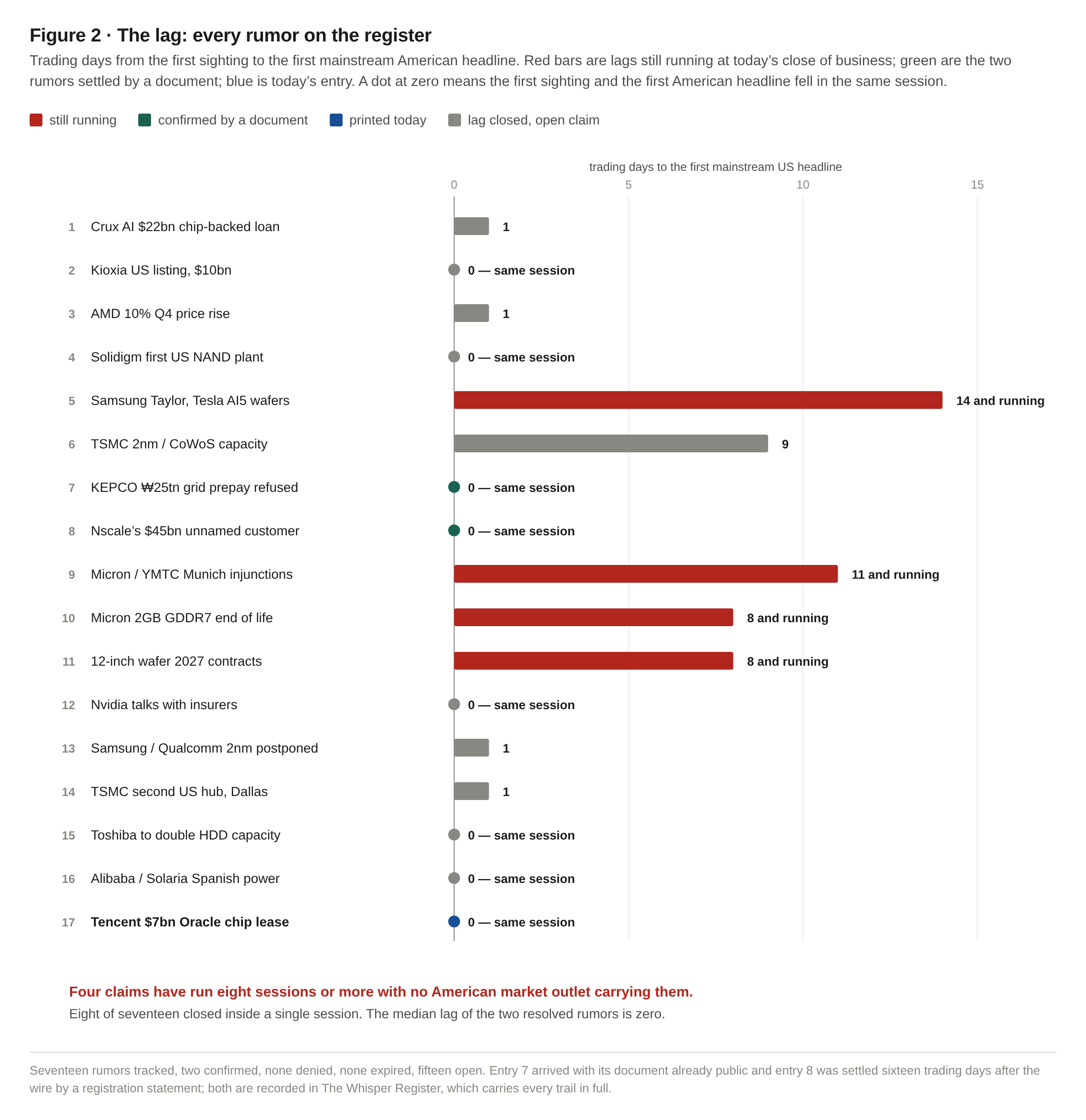
Samsung's Taylor wafer starts, and the longest silence on this register. The claim, from Seoul Economic Daily on 15 September at 4:21 a.m. Eastern: Samsung has begun running wafers for Tesla's AI5 processor at Taylor, Texas, ahead of a November start. Corroborated by DigiTimes on 17 September by its own Taipei stamp. Re-checked today against CNBC, Yahoo Finance, MarketWatch, Barron's, Reuters and Bloomberg: not one carries it, and no company has said anything either way. Lag: 14 trading days and running, the longest open count here.
Twelve-inch wafer contracts, and an earlier surface this register had missed. The claim, from the Commercial Times of Taipei on 23 September: 2027 long-term contract prices up fifteen to twenty-five percent on epitaxial twelve-inch wafers and above forty percent on polished. What changed today is a 6 August item in The Elec, byline Selye Moon, that the register had not logged. GlobalWafers, institutionally rather than through a named executive, says its twelve-, eight- and six-inch lines are "effectively operating at full utilization" with constraints already appearing on certain advanced twelve-inch products, and gives the mechanism in its own words: "Existing LTAs will maintain their contracted prices, but future agreements will incorporate pricing mechanisms that reflect market conditions, product mix changes and industry developments." It carries no 2027 figure. The company said future contracts would be repriced seven weeks before a newspaper said how much, and the amount is still unconfirmed by anyone. Lag: 8 trading days and running.
Micron and YMTC in Munich. Two first-instance injunctions over German utility models, per IP fray on 18 September and, from a second source, TechNode on 23 September. Re-checked today: no judgment text, no ruling on a stay, no Micron 8-K, no verbatim company statement, no mainstream American outlet carrying it. Guru3D, Pandaily, and JUVE Patent have thickened the specialist layer, all downstream. Lag: 11 trading days and running.
Micron's 2-gigabyte GDDR7 parts. Marked end of life in Micron's own parts catalog, per five outlets reading one page that requires an account and that no reader outside the company can check. Re-checked today: no notice, no product change notification, no distributor catalog mirroring the flag, no Nvidia comment, and still no graphics-memory mix commentary in the 30 September results. Lag: 8 trading days and running.
Resolved
Nothing. No rumors here reached a document, a denial, or expiry since The Whisper, No. 13, on Friday. Seventeen tracked, two confirmed, none denied, none expired, median lag of the resolved pair zero. Four claims — entries 5, 9, 10 and 11 — have now run eight trading days or more with no American market outlet carrying them, which is the reason the lag figure exists.
Seen, not printed
Twelve items fell below the floor today. No names, because the point of the floor is that an unprintable claim stays unprinted.
Four stale claims resurfaced by search indexes as though current — a memory-production start, a supplier's order share, a named director on foundry capacity limits, a scaled-back financing guarantee. All are correctly dated at source, between January and August, and none was republished as current, so none is a decoy and none is printed.
Two single-origin trade-press claims with no second surface — an earnings-preview synthesis, and a weekly supply-chain roundup this desk could not open, digitimes.com having returned a 403.
Four aggregator framings of the feature's own claim, from at least fourteen restatements, none adding a source.
Two company announcements rather than rumors, among them an exchange's margin-rate change on memory futures. A disclosure is not a whisper.
What would settle it?
Thursday 8 October, 13:30 Taipei: TSMC's September monthly revenue release, the first document bearing on entry 6's capacity figures. Thursday 15 October: TSMC's third-quarter results, where the 2027 wafer-pricing question reaches a chief executive. Late October: Samsung Electronics' and GlobalWafers' third quarters, the first for entry 5 and the second for entry 11. 3 November: AMD's, where a ten percent price rise would reach a published gross margin. November: Tencent's and its capital commitments, Nvidia's on the 17th. December: Oracle's second quarter and 10-Q. A line of inquiry, not a prediction, and the remaining performance obligation disclosure is what this desk will read first.
Sources and data notes
Every sighting carries its outlet and the minute observed, Eastern; every price its feed and minute; desk arithmetic its inputs.
The feature's trail. Oracle's first-quarter fiscal 2027 release, 10 September, quoted above; no customer named. The Financial Times' report of 30 September, not opened by this desk, read through Reuters' syndication, page stamp "Sep 30, 2026 | 10:12 PM" with no time zone shown and stated as such. Yahoo Finance, Stocktwits copy, 1 October, 12:17 a.m., byline Yuvraj Malik. Yahoo Finance, Quartz copy, 7:10 a.m., byline Cris Tolomia. Benzinga, 7:41 a.m., byline Namrata Sen. Sharecast, 8:38 a.m. Eastern — 13:38 British time on its own page — byline Benjamin Chiou. TrendForce, 1 October. Tom's Hardware, logged as a headline from the search index and not as a read.
Oracle's tape. Closes from stockanalysis.com — 30 September 137.30, 1 October 138.07, 2 October 142.30 — and from MarketBeat, which has 137.60, 138.09 and 142.58, the last up 3.25 percent. Yahoo Finance's quote page, read at 12:04 p.m. today and still stamped "October 2 at 4:02:32 PM EDT," carries 2 October at 142.30, previous close 138.07, open 142.09, range 140.26 to 144.86, volume 30,193,711, average volume 32,640,029. The 1 and 2 October closes are sworn on two feeds; 30 September is not. Today, one feed: 143.21, volume 9,115,721, stockanalysis.com at 12:13 p.m.
This desk's arithmetic, inputs shown. 142.30 − 137.30 = 5.00, ÷ 137.30 = 3.64 percent. 142.58 − 137.60 = 4.98, ÷ 137.60 = 3.62 percent. 138.07 − 137.30 = 0.77, ÷ 137.30 = 0.56 percent. 142.30 − 138.07 = 4.23, ÷ 138.07 = 3.06 percent. The fourteen sessions from Oracle's release to the first sighting: 11, 14, 15, 16, 17, 18, 21, 22, 23, 24, 25, 28, 29 and 30 September.
Documented negatives. EDGAR's full-text index, searched today for "Tencent" in Forms 10-Q and 8-K between 1 September and 5 October 2026, returns Aerkomm's 10-Q of 18 September (0001213900-26-101291) and MongoDB's of 1 September (0001628280-26-059830), and no Oracle filing. No options print tied to the claim, and no prediction-market contract on it.
The carry-forwards. Entry 5 re-checked against CNBC, Yahoo Finance, MarketWatch, Barron's, Reuters, and Bloomberg; nothing found, the enthusiast layer unchanged in kind. Entry 11's new surface: The Elec, 6 August, 07:40 Korean time, byline Selye Moon. Entry 9 re-checked; Guru3D and JUVE Patent remain the specialist record. Entry 10 re-checked; the catalog still requires an account. Dates ahead from TSMC's financial calendar.
The register. Sixteen rumors tracked at the start of this issue, seventeen after it; two confirmed, none denied, none expired, fifteen open, median lag of resolved rumors zero. The Decoy Chronicle stands at 182, unchanged: no decoy was logged today, because the stale items surfaced with their dates intact and the Oracle feed disagreements are differences, not errors inside a page.
The Decoy Chronicle — every entry, dated and sourced — is published as a standing register and updated with each issue.
The TrendyVest Championship is open for registration at Tournament.Trendyvest.com — 500 seats, a $100,000 simulated stake, free to enter. Trading began October 1 at the market open.
TrendyVest is an independent research practice. This is analysis and editorial opinion, not investment advice, and nothing here is a recommendation that any particular person buy or sell any security. Figures identified as this desk's arithmetic are the practice's own, and the inputs are printed alongside them, and nothing here asserts that any rumor is true.