The Whisper
The Whisper 11
The Korean Financial Daily Knew the Qualcomm 2nm Contract Had Stalled Twelve Sessions Before the Seven Percent Day
A price argument that fourteen sessions have not produced a single document about
The claim: Samsung Electronics and Qualcomm have postponed the contract under which Samsung would make Qualcomm's application processors on its 2-nanometre process because the two cannot agree on price. That is The Bell's reporting, carried into English by Investing.com. The report says Qualcomm “is pushing for lower prices and Samsung is resisting,” that manufacturing the processors within 2026 is “becoming difficult because chip production needs to line up with smartphone launch schedules,” and that the discussion may shift instead toward next-generation parts. The revenue basis is the price Samsung would receive for that work, and neither company has said anything about it in the past twenty calendar days.
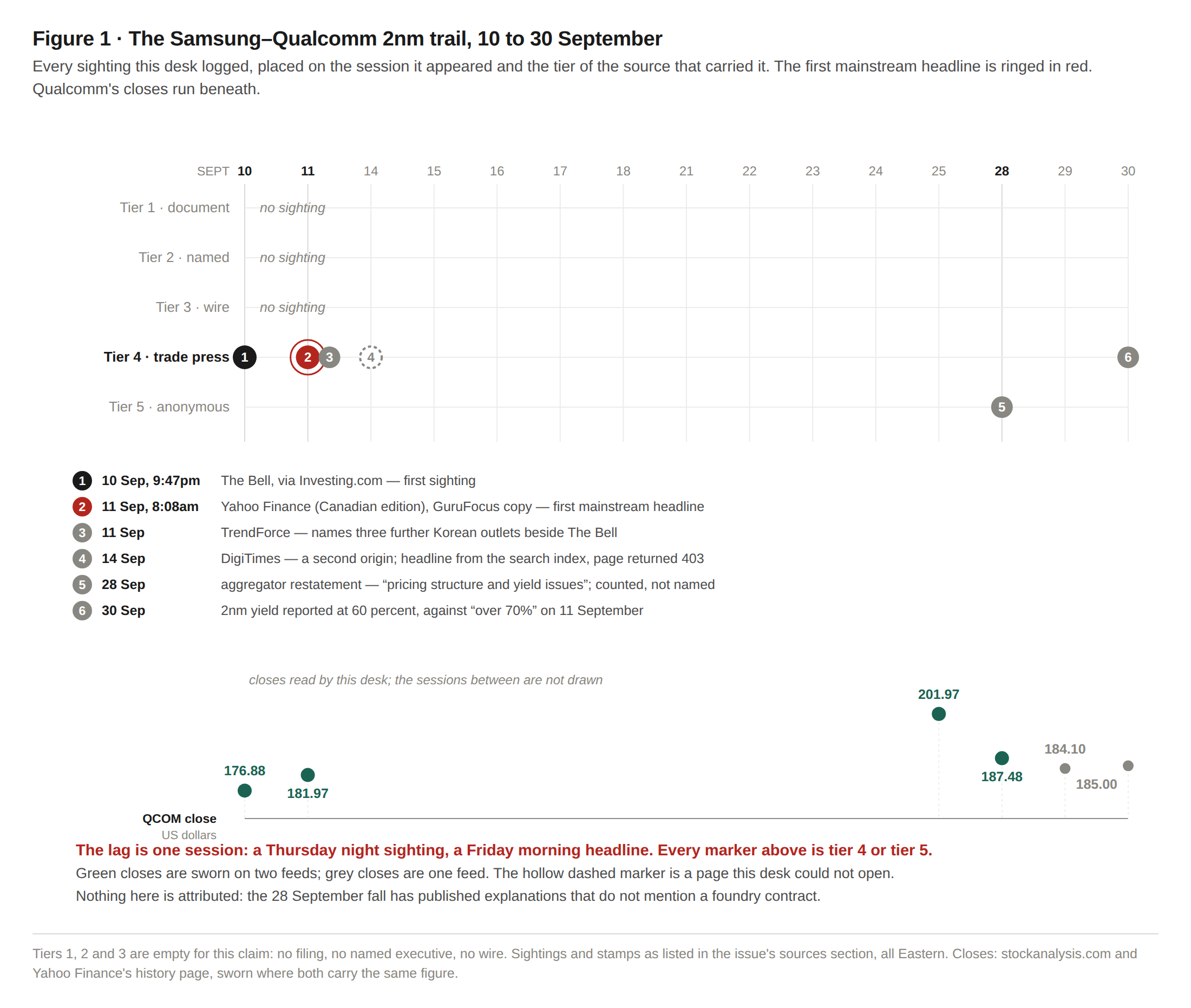
The first sighting this desk can stamp is Investing.com's relay of The Bell, 10 September at 9:47 p.m. Eastern, updated at 10:54 p.m., byline Roushni Nair. The stamp matters more than usual here: 9:47 p.m. on a Thursday falls after the close and before a Friday session, which is what makes the lag arithmetic below come out the way it does. The piece adds the reason Samsung is said to be holding — having signed Tesla and Broadcom, it regards the volume under discussion as too small to justify a concession on revenue — and records that neither company replied to a request for comment.
The trail from there is short, foreign, and entirely without a document in it — which is the point: the record never catches up to the claim.
Yahoo Finance carries GuruFocus copy under the headline “Qualcomm Chip Deal With Samsung Hits a Major Pricing Snag,” byline Nauman Khan. This is the first mainstream headline on the claim and the point at which the lag closes, with one qualification the desk prints rather than buries: the page the desk read is Yahoo Finance's Canadian edition. The copy is syndicated, and American readers of Yahoo were served the same wire, but the desk logs what it opened. The piece states the disagreement as “Qualcomm is seeking more competitive manufacturing costs, while Samsung appears less willing to reduce pricing,” puts the slip at 2027, and notes that neither company has issued a public statement. It adds a fact that belongs in the ledger of why Samsung would hold: a multi-year Broadcom AI-chip agreement valued at over $200 billion through 2030.
TrendForce publishes “Samsung-Qualcomm 2nm Deal May Slip to 2027; Foundry Resists Lower Pricing as Process Stabilizes.” This is the item that carries the claim over this desk's floor, because it does not rest on The Bell alone: it names Maeil Business Newspaper, Munhwa Ilbo and Money Today beside it, three further Korean outlets, and Reuters. The desk searched for a Reuters item carrying the stall and did not find one; it is therefore not counted, and the reader should treat TrendForce's source list as covering the whole piece rather than this one sentence. What TrendForce adds on its own account is the number that makes the argument legible: Samsung's 2nm gate-all-around yield “over 70%, up sharply from below 50% at the beginning of 2026,” a foundry share of 5.9 percent in the second quarter, July price increases of 10 to 15 percent on 4nm orders from Chinese and American customers, and a Taylor fab reported fully booked for 2nm before it opens. Those figures set the revenue basis for Samsung's refusal to discount, because a foundry with a fixed line and a full book does not cut price.
DigiTimes runs its own item, a20260914VL208, “Samsung, Qualcomm deepen 2nm talks as pricing and yield hurdles persist.” Logged as a headline from the search index and not as a read: digitimes.com returned a 403 to this desk, and the page was not opened. On its headline alone, it is a second origin rather than a relay, and it introduces the second variable — yield — that the Korean reporting did not lead with.
The claim reappears in the trade layer in a harder form, and with the tape beside it. An aggregator's account of Monday's session, citing TrendForce, DigiTimes, and three sell-side desks, says negotiations have stalled on “pricing structure and yield issues,” that a partnership is unlikely before 2027, and that every announced 2nm product remains contracted to TSMC. It is counted, not named, and it is not an independent source for the claim: its two named sources are already in this trail.
This morning the yield figure forks. A technology outlet reports Samsung Foundry 2nm yield at 60 percent, with a power-draw disadvantage against Snapdragon parts. TrendForce had “over 70%” on 11 September; DigiTimes had 60 percent for the Exynos 2600 last November: three numbers, two directions, one process. The desk records this as a difference rather than an error — different dates, possibly different products — and notes that a claim whose whole mechanism is that the buyer will not pay what the seller's yield now justifies cannot be settled. In contrast, the yield itself is reported three ways, and the revenue basis shifts with it, so the pricing argument remains tied to the yield that each report describes.
The market's testimony. On Friday 25 September, MarketBeat's alert recorded unusual call buying in Qualcomm: 140,153 call contracts against an average daily volume of 108,956, about 29 percent above normal, with the stock at $204.11 intraday, up $9.85. On Monday, 28 September, the stock fell. From Friday's sworn close of 201.97 to Monday's sworn close of 187.48 is −14.49, −7.17 percent; this desk's arithmetic: 14.49 ÷ 201.97. A headline from the search index that this desk could not open — the page requires JavaScript — puts Monday's options volume at 99,880 contracts against open interest of 963,020; it is logged as unread. Nothing here is attributed. Monday's session has published explanations that have nothing to do with a foundry contract: a broad semiconductor decline that took several large names down three to five percent, the ten-year Treasury yield at 5.218 percent, and Qualcomm's chief executive selling 20,000 shares across 21 and 25 September under a 10b5-1 plan adopted last December. That last one is a document — Form 4 — and it is the only document anywhere near this story. It is about a man's share sales, not about a wafer price.
The highest tier this claim has reached is four. Twenty calendar days, fourteen trading sessions, four Korean outlets, two Taiwanese trade titles, one American syndication, and one sell-side-flavored aggregation, and not one named executive, not one filing, not one line of company comment in either direction. That is the whole finding: the market has moved, but the record has not. A contract negotiation between two public companies over the most expensive manufacturing process in the world has been reported, re-reported, and priced, and remains entirely unsourced above the trade press.
What would confirm it, named as documents. Qualcomm's fiscal fourth-quarter results and call, due in early November, where a foundry second-source decision reaches the cost commentary. Samsung Electronics' third-quarter results in late October and its foundry-segment disclosure. A Samsung Foundry customer announcement naming Qualcomm. A die or package teardown of a shipping Snapdragon part identifying the fab. What would kill it: either company saying on the record that no contract was postponed, or a 2nm Snapdragon part appearing on a Samsung line this year, which would change the revenue basis entirely.
The lag: one trading day. First sighting Thursday 10 September at 9:47 p.m. Eastern, after the close; first mainstream headline Friday 11 September at 8:08 a.m., before the open. The move, sworn: 176.88 → 181.97, +5.09, +2.88 percent, the 10 September close to the 11 September close, this desk's arithmetic, 5.09 ÷ 176.88. Carried on to Monday's sworn close, the move from the same base is +10.60, +5.99 percent. The number in the headline above is a different one, and it is not a lag: twelve sessions ran between the sighting and the seven percent day — 11, 14, 15, 16, 17, 18, 21, 22, 23, 24 and 25 September, then the 28th — and the desk counts them without claiming they are connected.
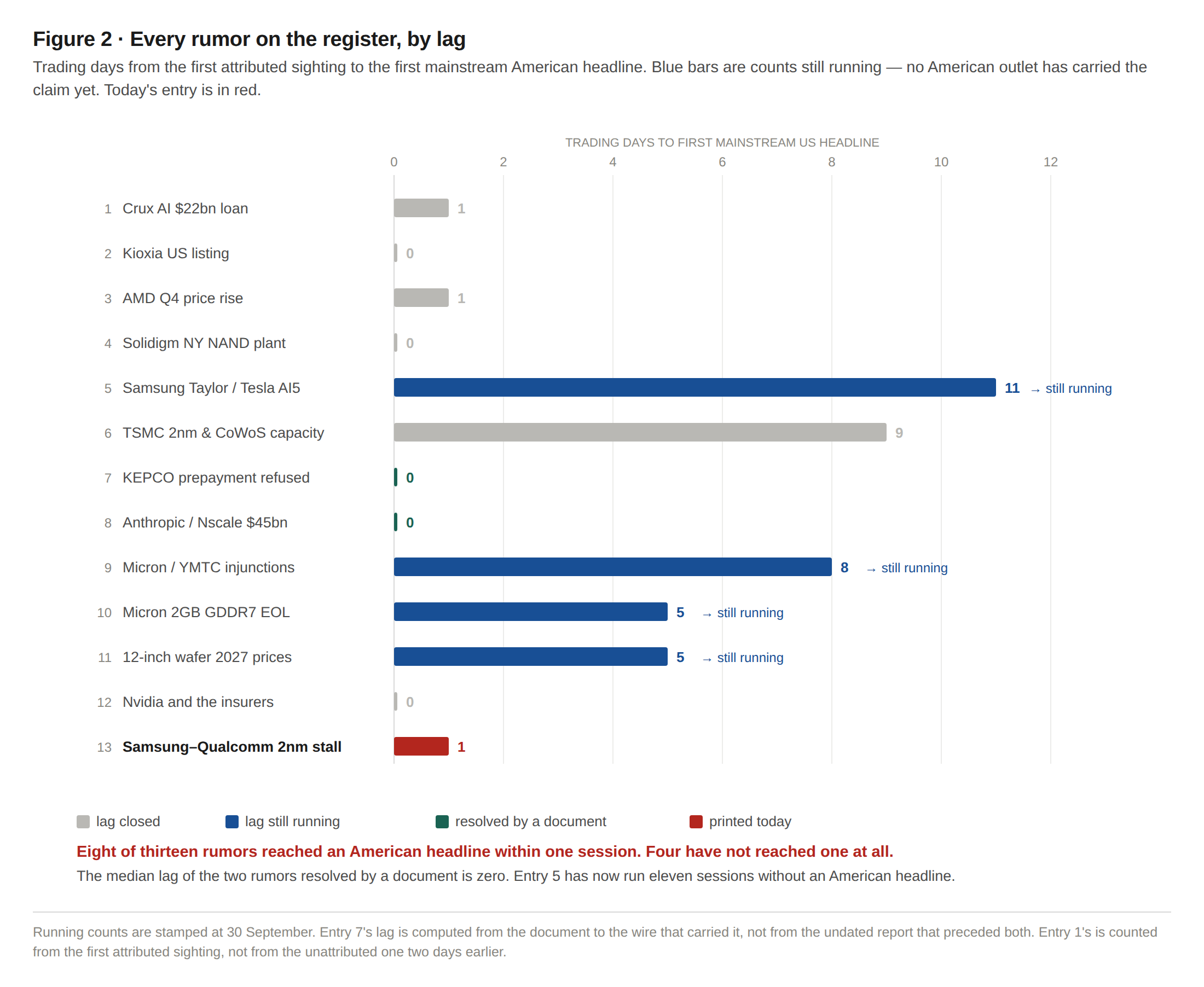
Status: corroborated. It enters the register as entry 13 because the market moved before the record did.
Also in motion
Micron and the German injunctionsEntry 9 · first seen 18 September
What changed today: nothing in the trail, and everything in the calendar. Micron reports fiscal fourth-quarter results after this issue goes out, and the legal-proceedings commentary is the first occasion on which anyone will be in a position to ask about two first-instance injunctions granted to Yangtze Memory in Munich. Re-checked today: still no judgment text, no ruling on a stay, no 8-K and no verbatim company statement, and still no mainstream American outlet. The lag runs on, now eight trading days, the second-longest open count on this register.
Micron's 2GB GDDR7 end-of-lifeEntry 10 · first seen 23 September
Re-checked today: no Micron notice, no product change notification, no distributor catalog mirroring the flag with a last-time-buy date, no Nvidia comment. The parts catalog every report reads still requires a Micron account and remains unreadable to this desk and to every other reader outside the company. This one also meets its first real test after the close tonight, in the commentary on graphics-memory mix. The lag runs on, now five trading days.
Samsung's Taylor wafers for TeslaEntry 5 · first seen 15 September
Re-checked today against CNBC, Yahoo Finance, MarketWatch, Barron's, Reuters and Bloomberg. None carries the September wafer-start claim. Electrek's 13 July tape-out piece remains the nearest American surface and is a different claim; the enthusiast layer — Drive Tesla Canada, Not a Tesla App, autoevolution, Basenor — continues to carry the trial start as settled fact. No company statement. The lag runs on, now eleven trading days, the longest open count here, and worth holding beside today's feature: both claims are about the same fab, in the same quarter, sourced to the same Korean press, and one of them the American market has never printed at all.
Nvidia and the insurersEntry 12 · first seen 29 September
Re-checked today. The relay layer has thickened exactly as expected — TheNextWeb, GuruFocus, Dealroom, Fudzilla, Serrari, Startup Fortune and an aggregator or two, none adding a source — and no document has appeared: no carrier or broker placement, no neocloud credit agreement naming residual-value cover, no rating-agency description. Howden Re's declination stands. Status unchanged at corroborated; lag still zero.
Resolved
Nothing. No rumor on this register reached a document, a denial, or an expiry between yesterday's issue and this one. Two claims — entries 9 and 10 — have their settling occasion tonight rather than today, and this desk will report what the Micron call does or does not say about either in tomorrow's issue. Reported, not graded.
Seen, not printed
Nine items surfaced in today's sweep and were set aside, in five categories. Two had a single origin with a stack of relays behind it and no second surface — one a foundry pricing claim now in its fourth session below this floor, the other a capacity figure from one Taiwanese title. Two were downstream of reporting already in this issue's own trail and so cannot corroborate it. Two were research-house forecasts published under the house's own name, which is analysis rather than a claim about what somebody is doing. Two were company statements already on the public record, which makes them documents and not rumors. One was an aggregate market-flow figure, which is data. No names and no claims are printed for any of them; the categories are the record.
What would settle it
- Tonight, after the closeMicron's fiscal fourth-quarter results, call and legal-proceedings commentary — the document that bears on entries 9 and 10 at once.
- Thu 8 October, 13:30 TaipeiTSMC's September monthly revenue release, the standing marker on entry 6.
- Mid-OctoberTSMC's third-quarter call and its 2027 wafer-pricing language, which reaches entries 3 and 11.
- Late OctoberSamsung Electronics' third-quarter results and foundry disclosure, and GlobalWafers', SUMCO's and Shin-Etsu's results with their long-term-agreement guidance.
- 3 NovemberAMD's third quarter, where a ten percent price rise would first reach a published margin.
- Early NovemberQualcomm's fiscal fourth quarter, the first company occasion on today's feature.
- 17 NovemberNvidia's third quarter and the guarantees note behind entry 12.
A line of inquiry, not a prediction.
Sources and data notes
Feature sightings. The Bell via Investing.com, “Samsung, Qualcomm delay 2nm chip deal as price talks drag,” 10 September 9:47 p.m. Eastern, updated 10:54 p.m., byline Roushni Nair; read today. GuruFocus via Yahoo Finance (Canadian edition), “Qualcomm Chip Deal With Samsung Hits a Major Pricing Snag,” 11 September 8:08 a.m. Eastern, byline Nauman Khan; read today. TrendForce, “Samsung-Qualcomm 2nm Deal May Slip to 2027; Foundry Resists Lower Pricing as Process Stabilizes,” 11 September; read today; names The Bell, Maeil Business Newspaper, Munhwa Ilbo, Money Today and Reuters among its sources. DigiTimes item a20260914VL208, 14 September, headline from the search index only — digitimes.com returned a 403, and the page was not opened. An aggregator account of the 28 September session, counted and not named, citing TrendForce, DigiTimes, Raymond James, Barclays and JPMorgan. A technology outlet's 30 September piece carried 2nm yield at 60 percent. Observations stamped between 11:10 a.m. and 12:20 p.m. Eastern today unless otherwise noted.
Prices. Qualcomm closes, sworn under the two-feed rule — stockanalysis.com's daily history and Yahoo Finance's history page carry each identically to the cent: 10 September 176.88, 11 September 181.97, 25 September 201.97, 28 September 187.48. The 29 September close of 184.10 is from stockanalysis.com only, printed and not sworn. Today, one feed and unsworn: 185.00, +0.49 percent, stockanalysis.com at 11:56 a.m. Eastern. Volumes where the feeds disagree, both printed: 15,597,657 against 15,597,700 on 10 September; 11,556,632 against 11,546,600 on 11 September; 16,680,120 against 16,614,256 on 28 September. A caution for anyone reproducing this: Yahoo Finance's QCOM quote page at 11:54 a.m. today was serving the 25 September close as its latest reading, with a previous close of 194.26 beside it; the page labels that date, so it is a stale page and not a decoy, and the desk used Yahoo's history page instead.
Desk arithmetic, inputs shown. 181.97 − 176.88 = 5.09; 5.09 ÷ 176.88 = 2.877 percent. 187.48 − 176.88 = 10.60; 10.60 ÷ 176.88 = 5.993 percent. 201.97 − 187.48 = 14.49; 14.49 ÷ 201.97 = 7.174 percent. The twelve-session count runs from the first session after the sighting through the seven percent day inclusive, and is stated that way so it can be rejected.
Market testimony. MarketBeat instant alert, 25 September: 140,153 Qualcomm call contracts purchased against an average daily volume of 108,956, the stock at $204.11 intraday, up $9.85. A 28 September options item headlined at 99,880 contracts and 963,020 open interest is logged as a headline from the search index; the page requires JavaScript and was not read. Forms 4 for the chief executive's 10b5-1 sales of 10,000 shares on 21 September and 10,000 on 25 September are documents about share sales, not the claim. EDGAR full-text search for 8-K filings naming both “Samsung” and “2nm” across September 2026 returns zero filings; recorded as a negative result.
Carry-forwards re-checked today: entries 5, 9, 10 and 12, against CNBC, Yahoo Finance, MarketWatch, Barron's, Reuters and Bloomberg where a mainstream American headline is the open question. Entries 1, 2, 3, 4, 6 and 11 carry a 30 September desk check with no change to status; the lags on 5, 9, 10 and 11 each advance by one session.
The register count: twelve rumors tracked before this issue, thirteen after. Two confirmed, none denied, none expired, eleven open. The median lag of resolved rumors is zero and is unchanged. No decoy was logged in today's sweep, so the Decoy Chronicle is not republished with this issue, and its count stands where The Errata last left it.