The Whisper
The Whisper *10*
The Collateral Was Filed in April. The Insurance Question Reached the Financial Times This Morning
Tuesday, September 29, 2026 · 12:30 p.m. · No. 10 · Corroborated, no document
The feature
The claim: Nvidia has been talking to insurers about structures that would reduce the financing risk carried by loans made against its own chips, including insurance on lending to smaller "neocloud" operators that would pay a lender if the borrower defaulted and the pledged chips could not be resold for enough to cover the debt. That is the Financial Times, this morning, citing people familiar with the matter. The FT's qualifier travels with the claim in every relay the desk read: the discussions "remain at an early stage and may not result in agreements."
Nobody is on the record. Howden Re, the broker named in the reporting, declined to comment to the FT; this desk found no Nvidia statement and no carrier confirming a placement. There is no document. What makes the claim worth an issue is that the exposure it describes has sat in a public filing since April, and the market that would have to insure it was working on the problem in August. The wire is the last step in that sequence, not the first.
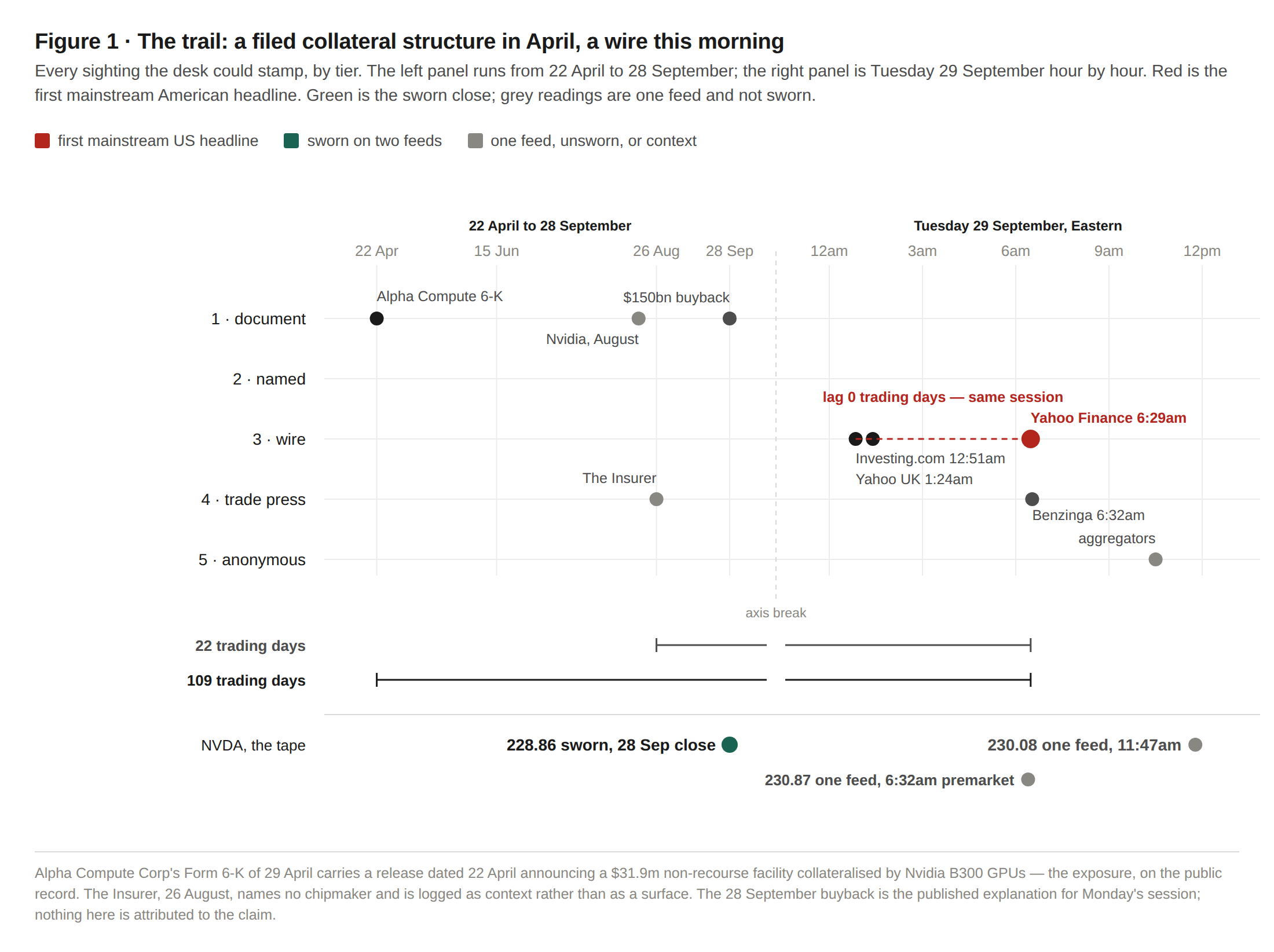
The document nobody wrote about. On 29 April, Alpha Compute Corp filed a Form 6-K carrying a press release dated 22 April. It announces a $31.9 million non-recourse senior secured loan facility collateralized by Nvidia B300 graphics processors, from an unnamed institutional lender. The filing puts the structure plainly: the collateral is "strictly limited to the underlying Nvidia GPU assets and the facility's build-out," and the lender's remedies on default are "exclusively restricted to the pledged hardware." The same language returns in the company's 424B3 of 22 May.
A tier-1 document, public on EDGAR for five months, describes the position the FT reports Nvidia is now trying to help lenders lay off: money advanced against chips, with no recourse to anything but the chips. EDGAR's full-text index returns those two filings for "GPUs as collateral" across 2026 and nothing else. A reader cannot weigh the claim without knowing the exposure is real, filed, and underwritten by nobody.
The first sighting of the question. On 26 August, the specialist title The Insurer published an analysis headlined "GPU residual value: Insurance paper used to tackle AI financing risk." The desk could not open theinsurer.com, which robots.txt disallowed, and read the piece through Slipcase's syndication, dated 27 August. It sets out three approaches — residual value insurance, warranty-backed guarantees, derivatives — and quotes American Compute's founder Bernie Margulies on underwriting an asset nobody has depreciated: "If the data says it's going to be 70%, don't underwrite 70%, underwrite 30%."
It names no chipmaker, so the desk logs it as context, not a surface — upstream of this claim the way Nikkei's July wafer-pricing report sits upstream of the AMD claim on this register. What it establishes is a date: twenty-two trading sessions before this morning's wire, how to underwrite a pledged graphics processor was a live question in the London market.
The trail, in order. The April filing sits at the top. In August, per Benzinga's account this morning, Nvidia was already in the business of arranging other people's balance sheets: a consortium with Apollo, BlackRock, Blackstone, Brookfield, Goldman Sachs and KKR to mobilize more than $500 billion for AI infrastructure, and guarantees of up to $105 billion on an Ohio data center project. Jensen Huang in August, per the same account: "We began by building chips; today, we are helping create a new class of productive, investable infrastructure: AI factories." Company material, and none of it mentions insurance.
On Monday, 28 September at about 11:34 a.m. Eastern, Nvidia announced a $150 billion increase in its buyback authorization, taking the total to $235 billion; Yahoo Finance, bylines Michael B. Kelley and Julie Hyman. A tier-1 document, and the published explanation for Monday's session. It matters here because it sits one day before the claim and will be credited with whatever the tape does this week.
The first sighting of the claim itself that this desk can stamp is Investing.com's relay of the FT, page stamp 29 September, 12:51 a.m. Eastern: "Nvidia turns to insurers to spread risk of AI build-out - FT." It carries the substance: insurance on loans to smaller neocloud companies; Huang's argument that chips are "an 'investable asset class' similar to other expensive, long-lived technology assets"; Nvidia having explored syndicating the risk onto hedge funds; Howden Re named and declining to comment. A Yahoo Finance UK relay of the same copy is stamped 5:24 UTC, 1:24 a.m. Eastern.
At 6:29 a.m. Eastern, the claim reached an American mainstream page: Yahoo Finance's technology file, byline Fiona Craig, "Nvidia Holds Talks With Insurers Over AI Infrastructure Financing Risk, FT Reports." It adds a detail the earlier relay did not: Nvidia has given at least one insurer information on chip depreciation and on the value of computing capacity. Three minutes later Benzinga published its own version, the first to set the claim beside the $500 billion consortium, and printed a price: NVDA at $230.87 in the premarket, up 0.88 percent, one feed, unsworn.
Then the relay layer, thick by late morning and entirely derivative: Dealroom, BigGo, Serrari, Startup Fortune, Memesita, Finwire and a crypto-news site that bundled the insurance story into the buyback headline. Not one adds a source, and several state as settled what the FT hedged.
The market's testimony. Thin, and reported as thin. Nvidia's Monday close is sworn at 228.86 — Yahoo Finance's quote page carries it as the 28 September close, up 3.79 on 225.07, and stockanalysis.com's live change today implies the identical previous close, 230.08 less 1.22. Today's reading is one feed and not sworn: 230.08, +1.22, +0.53 percent, stockanalysis.com at 11:47 a.m. Eastern.
From the last close before the claim existed to the latest reading, the move is +1.22, +0.53 percent — this desk's arithmetic, 1.22 divided by 228.86 — and the desk attributes none of it. Monday's larger move has a document behind it; today's is half a percent in a stock that has moved more on nothing. No options print tied to the claim was found, and no volume anomaly separable from the buyback, and Polymarket's fourteen live Nvidia contracts include not one on the financing question. The claim is carried by the premarket bid and the American headline behind it, with the competing explanation printed alongside.
Highest tier reached: 3. A wire, people familiar with the matter, with a named broker declining to comment. The tier-1 material in the trail — the buyback, the consortium, the guarantees — is adjacent to the claim and does not touch it.
What would settle it. The desk went looking for the document first. EDGAR's full-text index for "residual value insurance" across June to September returns auto-lease securitizations — Porsche, Volkswagen, Nissan — with Assured Guaranty and MassMutual, and no filer in artificial intelligence or compute anywhere in the results. The claim has no document, and that is now a search with a result rather than an assertion. What would produce one: a placement disclosed by a carrier or broker; a borrower's credit agreement or registration statement naming cover over pledged Nvidia hardware; a syndicated risk transfer a rating agency has to describe; Nvidia's 10-Q after results on 17 November. What would kill it: Nvidia saying no such structures are under discussion.
Lag: 0 trading days. First sighting and first mainstream American headline fall in the same session, five and a half hours apart. The numbers that carry the story are different ones, printed separately rather than inside the lag field: 109 trading days from Alpha Compute's 22 April release, which put the exposure on the public record, to this morning's wire; and 22 trading days from the insurance trade taking up the question on 26 August to a wire naming the chipmaker in it.
Status: corroborated. One wire-grade surface plus a market signal, printed with the signal's contamination stated. Nothing here asserts that Nvidia has agreed anything with anyone.
Also in motion
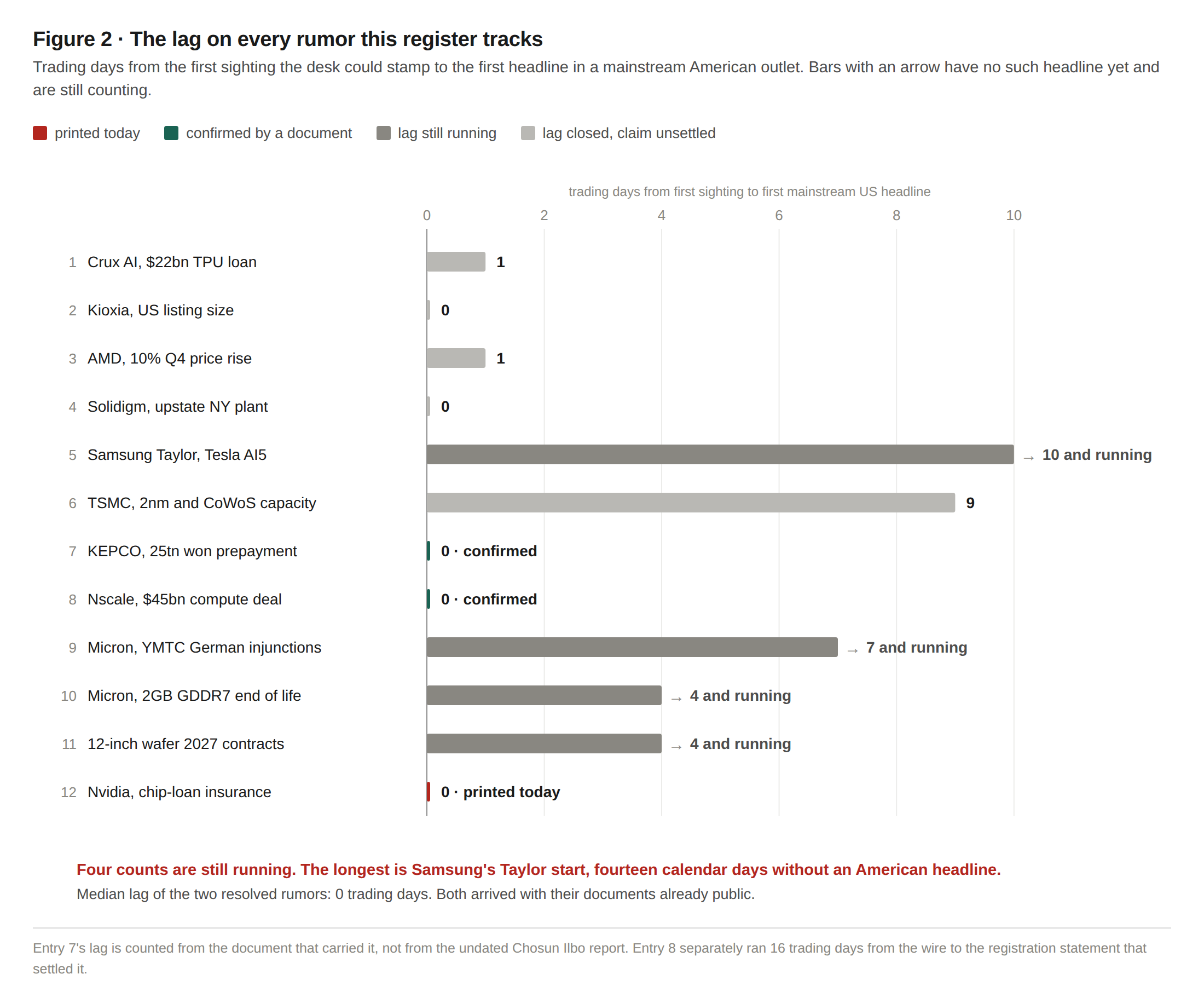
Micron, twice over, and both settle tomorrow. The German injunctions, lag 7 trading days and running: per ip fray on 18 September and TechNode citing IT Home on 23 September, the Munich I Regional Court found Micron to infringe two German utility models held by Yangtze Memory and granted injunctions on the infringing 3D NAND products in Germany, with Micron saying it disagrees, has appealed, and is challenging the rights' validity. The 2GB GDDR7 end-of-life flag, lag 4 and running: per Hardware Busters, The FPS Review, VideoCardz, TechPowerUp, TrendForce and Tom's Hardware, all reading the same page of Micron's own parts catalog, the 28Gbps D8FHL part and its 32Gbps sibling now carry an EOL status, leaving Samsung and SK hynix as the sources of the 2-gigabyte parts across much of Nvidia's RTX 50 range. Re-checked today: on the first, no judgment text, no ruling on a stay, no 8-K, no verbatim statement, and no mainstream American outlet; on the second, no notice, no product change notification, no distributor catalog carrying a last-time-buy date, and no Nvidia comment, with the catalog still unreadable to every reader outside the company. Micron's fiscal fourth-quarter results land tomorrow, Wednesday 30 September — the first occasion on which either can be put to the company. Both corroborated.
Samsung's Taylor fab and Tesla's AI5. Lag 10 trading days and running — the longest open count on this register. Per Seoul Economic Daily on 15 September and DigiTimes on 17 September, Samsung has begun running wafers for Tesla's AI5 processor at Taylor, Texas, ahead of a November start. Re-checked today against CNBC, Yahoo Finance, MarketWatch, Barron's, Reuters and Bloomberg: none carries it. Electrek's 13 July tape-out piece is the nearest American surface and is a different claim. No company statement. Status: corroborated.
Twelve-inch wafer contract prices for 2027. Lag 4 trading days and running. Per the Commercial Times of Taipei on 23 September, citing an industry survey and analyst estimates: epitaxial wafer contract prices up fifteen to twenty-five percent, polished possibly above forty, some second-tier customers above fifty. Re-checked today: no confirmation from any wafer maker or customer, no document, and no travel into American publishing beyond Wccftech and TrendForce. Status: corroborated.
Resolved
Nothing on the register reached a document, a denial, or an expiry since The Whisper, No. 9. Entries 7 and 8 were confirmed before that issue and are not restated. No entry reaches thirty trading days without a tier-1 or tier-2 event before the middle of October.
Seen, not printed
A correction before this section is read. An earlier build carried a count of twenty-two items set aside in six categories. It was reconstructed rather than tallied, and no social sweep had been run when it was written. It is withdrawn.
The sweep covered the trade press, EDGAR's full-text index, Polymarket, Data Center Dynamics and the American market press. Set aside from it, each because it fails the floor and not because it is untrue: a foundry pricing item carried from one origin through three outlets with no second surface, already recorded against register entry 3 on 28 September; a set of data-centre capacity and financing announcements — a Meta agreement at Firmus's Southeast Asian sites, Samsung's $1 billion into KKR's Helix platform, a £2.45 billion financing at Virtus — which are company announcements rather than rumors; and a Sydney planning application withdrawn on 28 September with the regulatory environment called "evolved significantly," which has one surface and no second.
No social sweep was run today, so no anonymous-category count is printed.
What would settle it
Wednesday 30 September: Micron's results and call — legal proceedings for the German injunctions, graphics memory mix for the GDDR7 flag. Thursday 8 October, 13:30 Taipei: TSMC's September monthly revenue, the next hard number against the 2nm and CoWoS figures. Mid-October: GlobalWafers' monthly revenue, then its third-quarter investor conference. Late October: Samsung's third-quarter results, where the Taylor start can be put to the company. Tuesday 3 November: AMD's results, where a ten percent price rise reaches the gross-margin line. Tuesday 17 November: Nvidia's results and the 10-Q that follows, whose guarantees and contingencies note is where an insurance structure would first have to appear in a document — a line of inquiry, not a prediction.
Sources and data notes
Sightings, feature, all Eastern. The Insurer, "GPU residual value: Insurance paper used to tackle AI financing risk," URL-dated 26 August, read through Slipcase where it is dated 27 August; theinsurer.com is disallowed to this desk by robots. Investing.com on the FT, 29 September 12:51 a.m.; a Yahoo Finance UK relay of the same copy, 1:24 a.m.; Yahoo Finance's technology file, byline Fiona Craig, 6:29 a.m., read there and in the ADVFN syndication; Benzinga, byline Shomik Sen Bhattacharjee, 6:32 a.m. Yahoo Finance on the buyback, bylines Michael B. Kelley and Julie Hyman, 28 September 11:34 a.m.
Prices. NVDA 28 September close sworn at 228.86 on two feeds: Yahoo Finance's quote page, carrying it as that session's close with previous close 225.07 and change +3.79 on 141.3 million shares, read at 11:44 a.m. Eastern; and stockanalysis.com, whose live reading of 230.08 less 1.22 implies the identical previous close, read at 11:47 a.m. Today unsworn, one feed: 230.08, +1.22, +0.53 percent. Premarket, one feed: 230.87, Benzinga at 6:32 a.m. Yahoo's quote page served Monday's close on both reads and is not used for today.
Desk arithmetic, inputs shown. 230.08 minus 228.86 = 1.22; 1.22 divided by 228.86 = 0.53 percent. Trading days from The Insurer to the wire, counting neither endpoint's session: 27, 28, 31 August, 1 to 4, 8 to 11, 14 to 18, 21 to 25 and 28 September — 22 sessions, 7 September excluded as a holiday. From Alpha Compute's 22 April release on the same basis, 109 sessions, with Memorial Day, Juneteenth, 3 July and Labor Day excluded.
Documents searched, and the searches themselves. EDGAR full-text index, this afternoon. "GPUs as collateral" across 2026 returns two filings, both Alpha Compute Corp, CIK 1095435: a Form 6-K of 29 April, accession 0001171843-26-002823, whose exhibit 99.1 is the 22 April release quoted above, and a 424B3 of 22 May. "Residual value insurance" across June to September returns Porsche, Volkswagen and Nissan auto-lease vehicles with Assured Guaranty and MassMutual, and no AI or compute filer. "Residual value" with "GPU" returns 87 hits, among them Nscale's S-1 of 18 September. Polymarket's Nvidia page: fourteen live contracts, none on the financing question.
Carry-forward checks, all made today. Entry 1, Crux AI: no closing release, rating, offering document, or named bank. Entry 2, Kioxia: no Form F-1 and no exchange application; the F-1 on these terms is still SK hynix's, CIK 2120882, the trap recorded here on 22 September. Entry 3, AMD: no statement, no denial, no price list — and recorded because the desk should have carried it into the check. AMD announced an $8.2 billion all-stock acquisition of World Labs on 28 September, per Bloomberg, CNBC and TechCrunch; an announced transaction is a document, not a rumor, so it stays off the register, but the AMD tape now has a second published explanation beside the price-rise claim. Entry 4, Solidigm: no award, permit or board resolution. Lags advanced one session on entries 5, 9, 10 and 11.
A note on this build. The issue was first assembled between 11:11 a.m. and 12:40 p.m. Eastern; the sweep then extended to EDGAR's full-text index, Polymarket, Data Center Dynamics, and the biotechnology trade press, with later observations stamped between 12:50 and 1:40 p.m. The Alpha Compute filing and both EDGAR negatives come from that second pass.
Register count: 11 rumors before this issue, 12 after. Tracked 12, confirmed 2, denied 0, expired 0, open 10. Median lag of resolved rumors: 0 trading days.
The Decoy Chronicle stands at 96 documented entries; none were logged today.
The Decoy Chronicle — every entry, dated and sourced — is published as a standing register and updated with each issue.
The TrendyVest Championship is open for registration at Tournament.Trendyvest.com — 500 seats, a $100,000 simulated stake, free to enter. Trading begins October 1 at the market open.
TrendyVest is an independent research practice. This is analysis and editorial opinion, not investment advice, and nothing here recommends that any particular person buy or sell any security. Figures identified as this desk's arithmetic are the practice's own, and the inputs are printed alongside them, and nothing here asserts that any rumor is true.