MORNING BRIEF
The Morning Brief- October 7th 2026
SpaceX Had $100 Billion in June and Wants $40 Billion More for Chips
The S&P 500 closed at a record on Tuesday. By breakfast on Wednesday the thirty-year Treasury was yielding more than at any time since 2002, Brent was back above a hundred dollars a barrel, and the futures had handed most of the day back.
In between, the Financial Times reported that SpaceX is asking banks and bond investors for $40 billion to buy Nvidia chips.
Those are one story, not two. A single company wants to borrow, for a single line of its shopping list, a billion dollars more than the United States Treasury will raise at one o'clock this afternoon. It is asking in the week the price of long money reached a twenty-four-year high. And it is asking four months after it went public, with $100 billion in the bank at the last count.
Overnight, sworn in
Tuesday closes first, because it's the last firm ground. The S&P 500 finished at 7,818.93, up 44.98 points or 0.58 percent, a record, on the Associated Press's table, on TheStreet's and in Yahoo Finance's price history. The Dow closed at 51,521.28, up 253.38. The Nasdaq composite closed at 27,599.79, up 122.48. Those three are sworn in. The Russell 2000 is not: the AP and Trading Economics have 2,830.30, down 16.84, and TheStreet's 4:03 p.m. table has 2,830.97. Both agree on the key point: small companies fell on the day large ones made a record.
The ten-year Treasury closed at 5.27 percent, down four basis points, on Yahoo Finance's board and on the Treasury's curve as stockmarketwatch.com relays it; TheStreet has 5.275 and the AP 5.28. The two-year closed at 4.79.
That was Tuesday. At 8:39 this morning, Yahoo had the ten-year at 5.35, and Investing.com's page, updated at 8:42, had 5.346. Reuters put the thirty-year at 5.72 percent, "the highest since 2002." The dollar index stood at 102.46, up 0.62 percent, on Trading Economics at about 8:47. Brent was $101.75, while West Texas Intermediate was $90.18 on Investing.com at 8:42; Trading Economics, three minutes earlier, had $101.77 and $90.11. At 8:22, per Reuters, S&P 500 futures were down 34.5 points, or 0.44 percent; Nasdaq 100 futures were down 0.77 percent; and Dow futures were down 411 points. At 5:41, Benzinga had the S&P contract down 0.07; nearly all of the fall came as New York woke to the bond market.
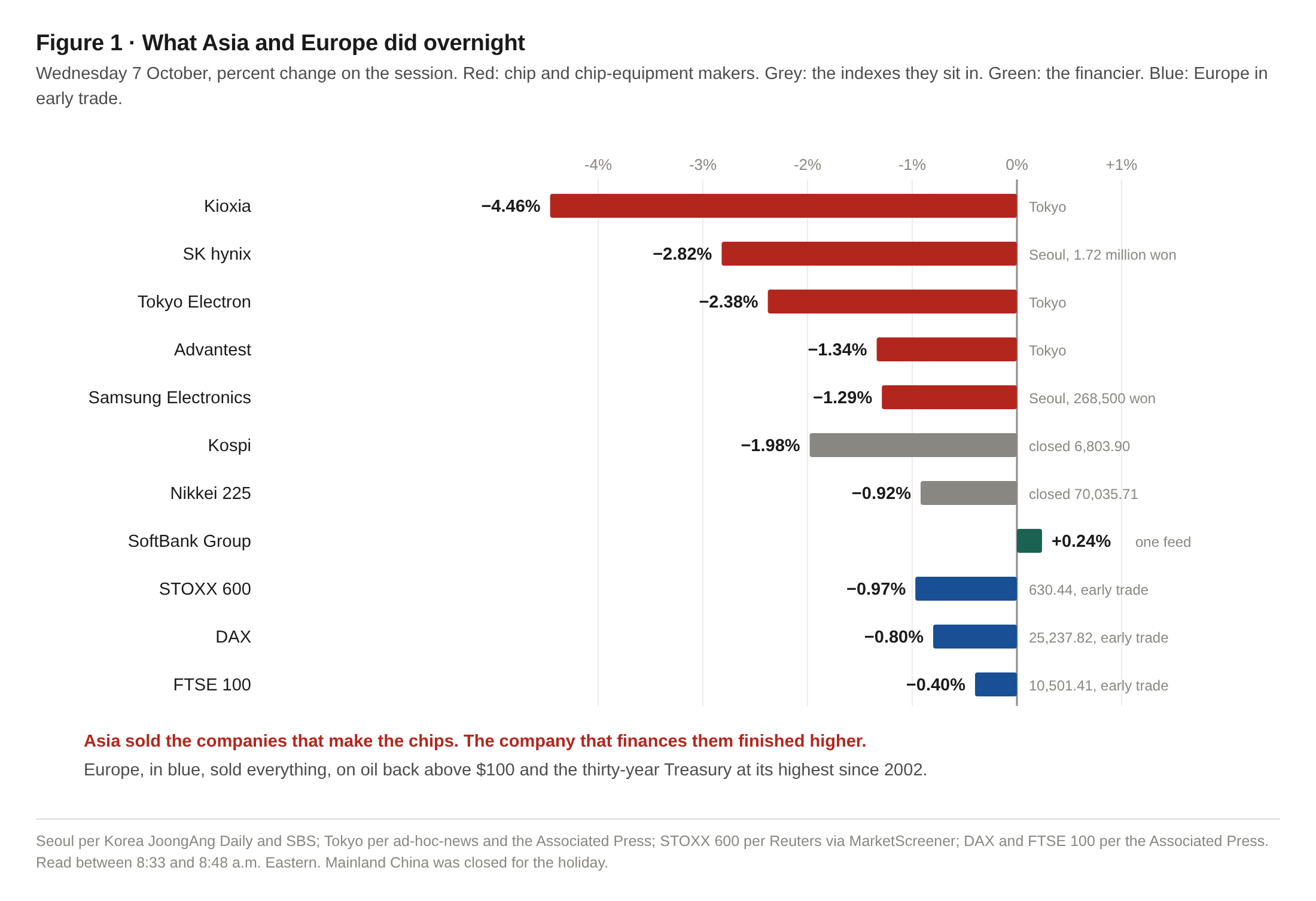
Asia's selling was specific. Seoul's Kospi closed at 6,803.90, down 137.49 points or 1.98 percent, on Korea JoongAng Daily and SBS, and the weight of it sat on two names: SK hynix fell 2.82 percent to 1.72 million won and Samsung Electronics 1.29 percent to 268,500, a day before Samsung is due to publish its preliminary third-quarter figures. Tokyo's Nikkei 225 closed at 70,035.71, down 648.27 points or 0.92 percent, on ad-hoc-news and the AP, with Kioxia off 4.46 percent, Tokyo Electron 2.38 and Advantest 1.34. SoftBank, which finances the buildout and does not manufacture for it, rose 0.24 percent on the one feed that carried it.
Europe's selling was general. The STOXX 600 was down 0.97 percent at 630.44 in early trade, per Reuters; the DAX was down 0.8 percent at 25,237.82 and the FTSE 100 was down 0.4 at 10,501.41, per the AP. Reuters gave the reasons as energy and fiscal worry, and JoongAng's headline in Seoul named bond yields.
So the seam this morning does not run between Asia and Europe. It runs through Asia: the makers of memory and tools were sold, and the financier was kept. That is an odd thing to do on the night a customer is reported to be placing a forty-billion-dollar order. It makes sense only if the market's worry is the price of the money and not the appetite for the chips.
The subject
The published number is $40 billion. The Financial Times reported on Tuesday evening, and Reuters and Bloomberg relayed that SpaceX is seeking about $10 billion in bank loans and about $30 billion in investment-grade debt to pay for Nvidia chips. Apollo Global Management is leading. Pimco is among the managers looking at it. The financing is expected to close in 2027. Quartz adds that the talks are preliminary and may not produce a transaction. SpaceX, Apollo and Nvidia did not respond to Reuters; Pimco declined to comment. The chips are for the Colossus data centers that run the Grok models, on Reuters's account, and Bloomberg's says Colossus 2 already holds 110,000 of Nvidia's GB200 chips and 440,000 GB300s.
A number that size has to pass through three sets of books. It is worth taking them in turn.
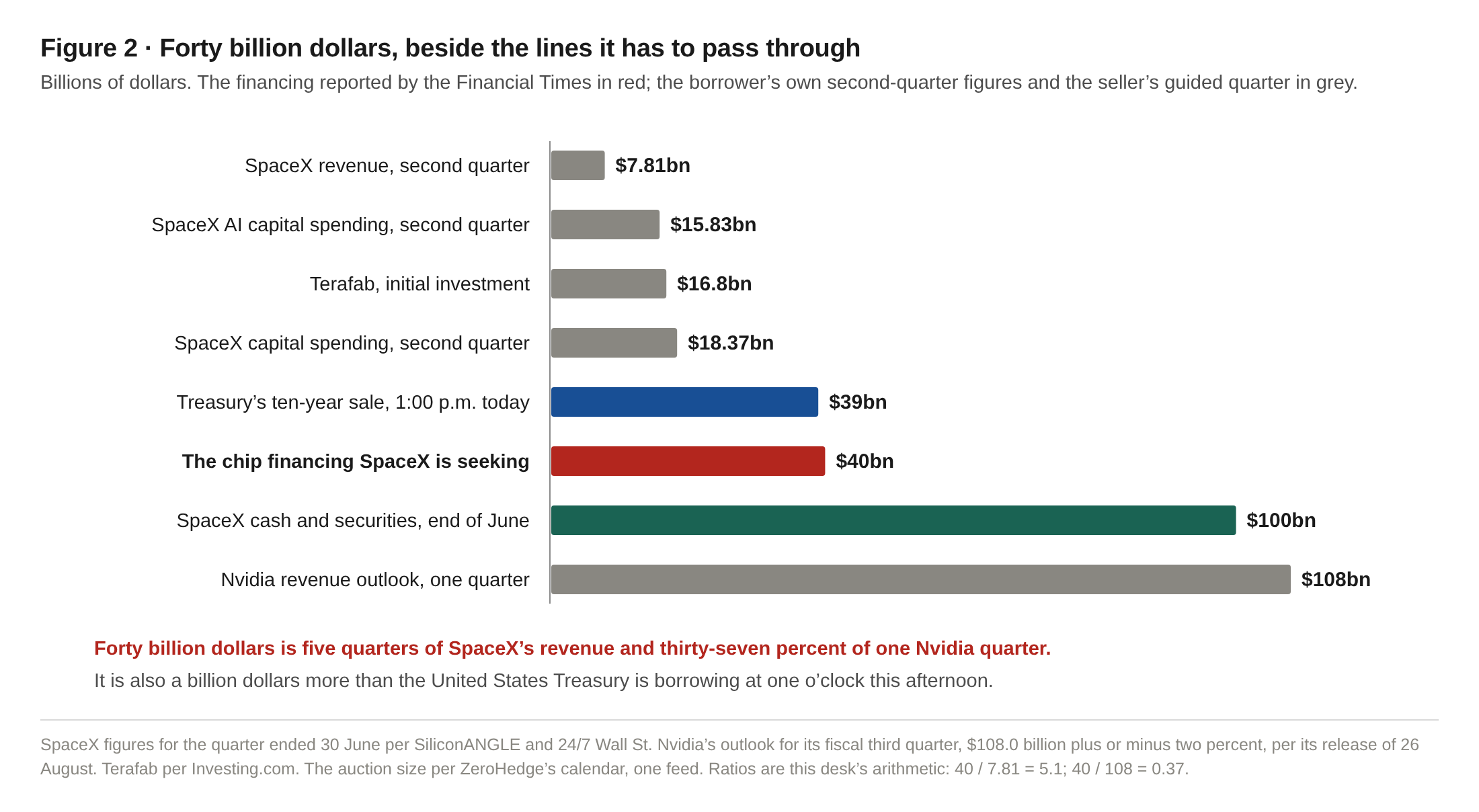
The borrower's cash. SpaceX priced its initial public offering at $135 a share on June 11, according to 24/7 Wall St. Its first quarterly report, in August, showed revenue of $7.81 billion for the three months to June, up 92 percent, and capital spending of $18.37 billion, more than six times the year before, of which $15.83 billion went to artificial intelligence. The net loss was $541 million. It ended the quarter with $100 billion in cash, cash equivalents and marketable securities, after about $85.7 billion in net proceeds from the offering and a $25 billion bond sale that closed on June 26. Those figures are SiliconANGLE's account of the release, and 24/7 Wall St. carries the same revenue, capital spending, and loss. The company gave no guidance.
The arithmetic from there is mine, and the inputs are in the paragraph above. SpaceX spent $2.35 on plants and chips for every dollar it took in. At that pace, $100 billion is five and a half quarters of capital spending. Forty billion is a little more than two quarters of it, and five quarters of revenue.
So a company that raised $110.7 billion in June is, in October, arranging to borrow for the chips. There are two ways to read that. Either the pace has risen since June, or the cash is spoken for elsewhere.
The second reading got some support within hours. On Wednesday morning, Elon Musk wrote about Terafab, the chip plant Tesla and SpaceX plan in Texas: "No, we will build and run the fab. Let there be ZERO doubt about that." Taiwan Semiconductor might sublease part of it, "but nothing more than that." Investing.com puts Terafab's initial investment at $16.8 billion and its potential cost across all phases at up to $119 billion. A fabrication plant cannot be pledged the way a pallet of chips can. On this evidence, the equity is going to the assets no lender will take, and the assets a lender will take are being financed. That is this desk's inference, and no document yet says so.
The seller's revenue. Nvidia reported $96.2 billion of revenue for its fiscal second quarter on August 26 and told investors to expect $108.0 billion, plus or minus two percent, for the third. Forty billion dollars is 37 percent of that guided quarter. Nvidia's shares rose about half a percent in extended trading on the report per Reuters, and were down about 0.6 percent before the open, per ZeroHedge, with everything else.
An order worth more than a third of a quarter that does not move the seller is an order the market has already counted. The news on Tuesday night was not that SpaceX wants the chips. It was who is paying for them, and when: not before 2027.
The lender's book. Bloomberg notes that Apollo "was among the US investment giants that Nvidia tapped for a high-profile partnership in August to source $500 billion in financing," and that it had already struck a $7 billion financing for xAI. Nothing about that is hidden or improper. But it means the firm leading the loan to the buyer was recruited, two months ago, by the seller. If this loan belongs to that partnership, and no account says whether it does, then revenue on one side of the trade depends on credit the vendor helped to organize. Morgan Stanley's estimate, cited in the same coverage, is that the buildout will need $1.5 trillion of outside financing by 2028. Tuesday's report shows what one-fortieth of that looks like with a name on it.
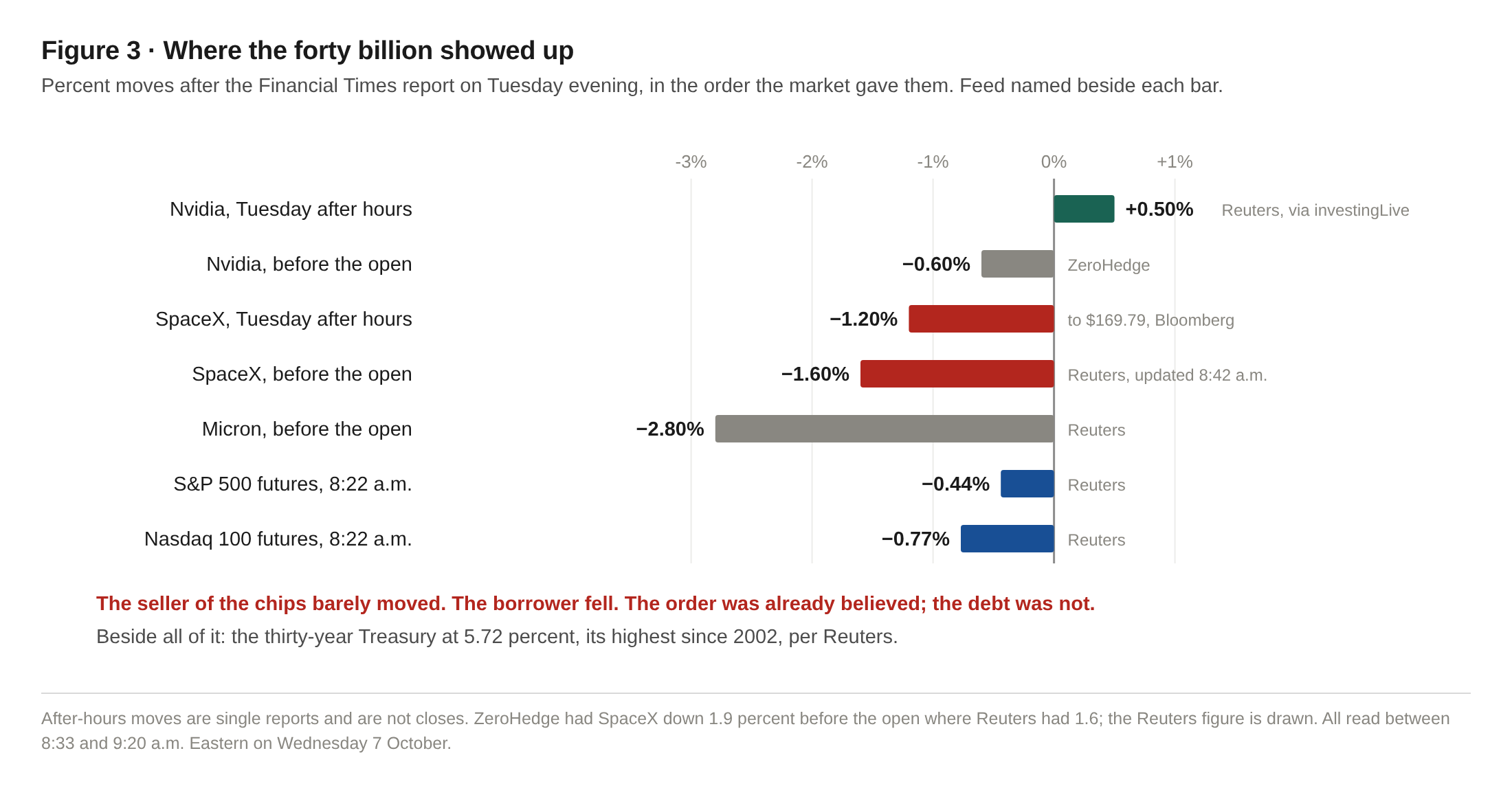
Did the number show up? In the borrower's shares, yes. SpaceX closed at $171.92 on Tuesday, on one feed, and fell 1.2 percent to $169.79 after hours, per Bloomberg; before the open it was down 1.6 percent on Reuters and 1.9 on ZeroHedge. In the seller's shares, no. In a filing, not yet: nothing is signed, and no party has confirmed it.
And the price is the part nobody has published. No rate or term has been reported. As a hypothetical, and only that: at Tuesday's ten-year Treasury close of 5.27 percent, a rate no company is offered, $30 billion of bonds would cost $1.58 billion a year, which is nearly three times the whole of SpaceX's second-quarter loss. Each further percentage point is another $300 million. And if the chips are the security, as ZeroHedge's description of a chip-backed vehicle implies, they are hardware of which Colossus 2 already holds two generations.
The offering was sold as the money for the build. Four months later the build needs a lender, and the lender is being asked on the dearest morning for long money in twenty-four years.
What moved
The largest moves in Tuesday's record were in power, not in chips. Utilities led every sector, up 2.98 percent on the one summary that carried the figure. Constellation Energy rose 12.30 percent at the close on TheStreet, and 12.25 on Simply Wall St's list, on its nuclear supply agreement with Google. Vistra closed at $160.50, up 10.77 percent, on Investing.com's price history and The Motley Fool, with Simply Wall St at the same percentage. Marvell rose 7.14 percent on TheStreet after lifting its long-term revenue targets at an investor day.
The names closest to this morning's subject barely moved. Nvidia closed at $240.43, up 0.64 percent, on Investing.com's history, and at $239.24 on 24/7 Wall St., which also gives a record intraday high of $243.37; the two do not agree, and neither is sworn. Micron closed at $1,065.90, up 0.18 percent, on one feed. Intel slid 3.2 percent on Tuesday and was up 1.6 percent before the open at 5:10 this morning, on Investing.com, after its chief executive told Bloomberg that Intel stays in Terafab.
Two moves were filed under the wrong heading. Vistra's Tuesday was described by Benzinga as sympathy with Constellation; The Motley Fool reported that the Department of Energy will lend the company $4.2 billion for nuclear plant upgrades, which is a reason of its own. And this morning Micron was down 2.8 percent before the opening, with AMD, Broadcom and Marvell down between 1.3 and 2.1, per Reuters. A forty-billion-dollar order for their customer's product is not bad news for any of them. They are falling with Seoul and with the long bond, and the SpaceX headline happens to be standing next to them.
The calendar
Nothing prints at 8:30 today. All times are Eastern.
The Mortgage Bankers Association's weekly applications index was due at 7:00 against a prior of −6.0 percent; ZeroHedge carries −4.2, on that feed alone. The Energy Information Administration's crude inventories follow at 10:30, with consensus at a build of 1.9 million barrels after a build of 0.922 million. The New York Fed's September survey of one-year inflation expectations is at 11:00, where ZeroHedge has the estimate at 3.64 percent against 3.58.
Then the borrowing. The Treasury sells $75 billion of seventeen-week bills at 11:30 and reopens the ten-year note for $39 billion at 1:00 p.m., sizes from ZeroHedge's calendar. The previous ten-year auction drew a high yield of 4.834 percent, on Trading Economics and Investing.com.
The minutes of the Federal Reserve's meeting of 15–16 September are released at 2:00 p.m. August consumer credit is at 3:00, with consensus at +$15.0 billion on Trading Economics and ZeroHedge and +$14.5 billion on Investing.com, against +$18.06 billion in July. Two notes, Newsquawk's and FXStreet's, list Dallas Fed President Lorie Logan for today without a time; Kiplinger's calendar has her on Tuesday evening, and no other Fed speaker is listed. Applied Digital reports its fiscal first quarter after the closing and holds its call at 5:00.
Thursday brings Samsung's preliminary third-quarter figures, with a published consensus for operating profit of 106.1 trillion won on one count and 108.1 trillion on another, versus 12.17 trillion a year earlier; initial jobless claims at 8:30, consensus 200,000 after 197,000; and a $22 billion reopening of the thirty-year bond. The committee next meets on 27–28 October, six days before the election on 3 November. Reuters reports that a hold is expected then and that "a December hike remains on the cards."
What we're checking next
Where the debt lands. The Financial Times's account, as relayed, describes bank loans and investment-grade bonds; ZeroHedge's summary calls the structure a chip-backed vehicle. Those are different things. Debt on SpaceX's own balance sheet appears beside the $25 billion it sold in June. Debt in a vehicle that owns the chips and leases them back may appear nowhere a reader of the income statement would look. The third-quarter report is the first document that can say which, and the cash line in it is the one to read against $100 billion.
The one o'clock auction, for the size of the gap. The last ten-year sale cleared at 4.834 percent. This morning's screens are half a point above that. The difference is what a month has done to the price of money for the borrower nobody doubts, and every corporate borrower is priced from there.
The minutes, for whether the committee discussed what is pushing the long end of the curve, and whether corporate issuance was on its list.
And Friday. According to 24/7 Wall St., 328.4 million SpaceX shares become free to trade on October 9, the same number again on October 24, and up to 1.3 billion after third-quarter results. A company whose early holders are about to be allowed to sell is one for which debt is the cheaper way to raise forty billion dollars this month, whatever the bond market is charging.
Sources and data notes
Every level carries its feed and the time observed, Eastern. Pages were read on Wednesday 7 October in three windows: 8:33 to 8:48 a.m. for closes and overnight levels, 8:33 to 9:10 for the calendar and single names, 9:17 to 9:20 for the SpaceX, Nvidia and Terafab documents. Where a page stamps itself, that stamp is given.
Sworn in. S&P 500, Dow and Nasdaq composite: the Associated Press's table via Yahoo Finance, 4:21 p.m. Tuesday, with copies on myMotherLode and KRMG, and TheStreet's 4:03 p.m. table; the S&P 500 also on Yahoo's history. Ten-year 5.27 on Yahoo's board and the Treasury par curve as relayed by stockmarketwatch.com; the Treasury's own page was not read. Vistra: Investing.com and The Motley Fool. Kospi: Korea JoongAng Daily and SBS. Nikkei 225: ad-hoc-news and the AP via KSAT.
Not sworn in. The Russell 2000 (AP and Trading Economics against TheStreet) and Nvidia (Investing.com against 24/7 Wall St.), both values printed. One feed each: SpaceX's close, Micron, Marvell, Constellation Energy, SoftBank, the Tokyo single names and every European level, the last from the AP and Reuters via MarketScreener in early trade. Tuesday's movers are from TheStreet's wrap, Simply Wall St via Yahoo, Benzinga and, for utilities, Current Logic.
This morning. Futures at 8:22, the thirty-year, the first crude pair and the premarket moves: Reuters via Investing.com, updated 8:42. Ten-year: Yahoo Finance, page clock 8:39. Dollar index and the second crude pair: Trading Economics (currency, Brent). Earlier futures: Benzinga, 5:41. Neither crude pair names a contract month.
The subject. The Financial Times's report was not opened; it is read through Reuters via investingLive, Bloomberg via Business Standard, Quartz, Techzine, Newsquawk and ZeroHedge. SpaceX's second quarter: SiliconANGLE, 4 August, and 24/7 Wall St.; the company's release was not opened. Nvidia: its release of 26 August as filed and Pulse 2.0. Terafab: InvestorsHub via Yahoo, 6:11 a.m., and Investing.com, 5:10.
Desk arithmetic. 18.37 / 7.81 = 2.35. 100 / 18.37 = 5.4 quarters. 40 / 18.37 = 2.2; 40 / 7.81 = 5.1. 85.7 + 25 = 110.7. 40 / 108.0 = 0.37. 40 / 1,500 = one in 37.5, written as one-fortieth. Hypothetical coupon: 30 × 0.0527 = 1.58; 1.58 / 0.541 = 2.9. 5.35 − 4.834 = 0.52 of a point. 2026 − 2002 = 24.
The calendar. Trading Economics, whose times are UTC and whose first figure is the previous and second the consensus; Investing.com; ZeroHedge's futures note and week-ahead list; Kiplinger; Newsquawk; FXStreet. The Federal Reserve's, the Treasury's, the EIA's and the MBA's own pages could not be opened; the auction sizes are ZeroHedge's alone and the minutes' time rests on secondary calendars that agree. Applied Digital: its announcement via Finviz. Samsung: Vantage Markets and Whalesbook.
The chronicle. One entry joined the register this morning, taking the count from 198 to 199. Entry 202: a 24/7 Wall St. market card dated Wednesday says "The FTSE 100 is currently trading at 13,967." The index was at 10,501.41 in early trade on the AP, at 10,481 on Trading Economics, and had closed at 10,542 on Tuesday per Newsquawk; it has never traded within three thousand points of the printed figure. Desk arithmetic: 13,967 / 10,501.41 = 1.33, and Trading Economics had the pound at $1.3195 at 9:48 a.m., so the figure may be the index restated in dollars; the card does not say. The quotation was read twice. Seen and not logged: Newsquawk's opening note, published at 06:04 UTC, gives Tuesday's close as "SPX +0.72% at 7,830" against 7,818.93 and 0.58 percent on three feeds; the level and the percentage agree with each other, and the basis of the reading was not established.