MORNING BRIEF
The Morning Brief October 6th, 2026
Three-Quarters of Google's 3,590 Megawatts Already Exist, and the Rest Are Promised by 2032
Tuesday, October 6, 2026 · Before the open · Three-year auction, 1:00 p.m.
The chips arrive by the quarter. The power arrives by the refuelling outage.
Google and Constellation Energy supplied the document for that argument at half past six this morning. Their release announces 890 megawatts of new nuclear capacity for PJM, the grid that serves 67 million people from Illinois to New Jersey, and a second agreement, for 2,700 megawatts, drawn from plants that are already running. The first new megawatt is expected "by 2028." Google's own blog post gives the last: before the end of 2032. Nvidia, meanwhile, closed at a record on Monday, having told investors to expect $108 billion of revenue in the three months that end this month.
Two clocks are running inside one trade. On Monday the market priced the fast one.
Overnight, sworn in
Four of Monday's closes can be sworn in to the cent, each on the Associated Press's closing table and at least one other feed. The Dow Jones Industrial Average finished at 51,267.90, up 90.94 points. The S&P 500 finished at 7,773.95, up 51.23. The Nasdaq Composite finished at 27,477.31, up 286.45, a record close. The Russell 2000 finished at 2,847.14, up 14.24. TheStreet's wrap, posted seven minutes after the bell, had the S&P 500 four cents higher and the Russell six points higher. Those are early tables, differences and not errors, and the reason a close needs a second feed.
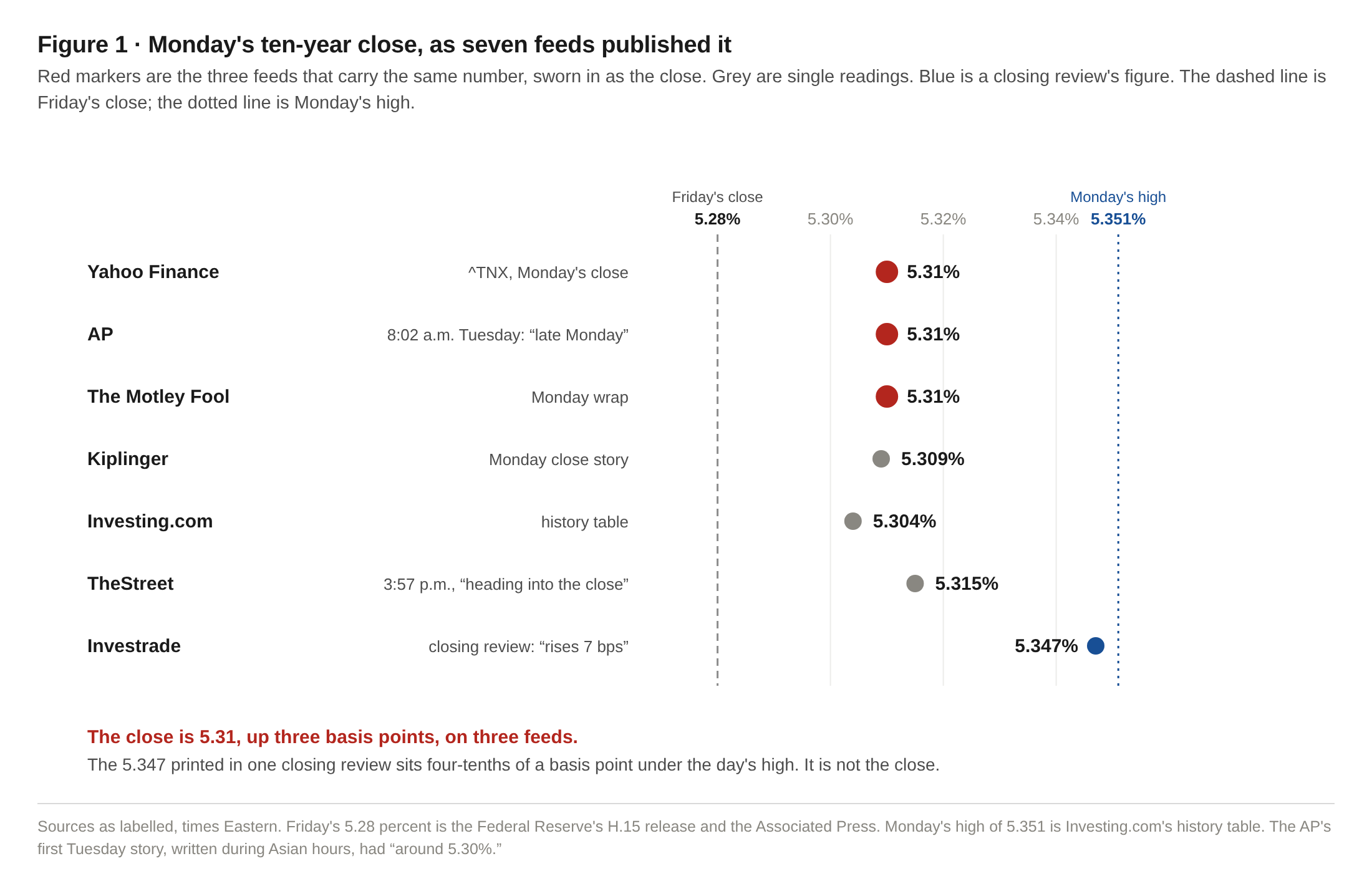
The ten-year Treasury yield closed at 5.31 percent, up three basis points from Friday's 5.28, on Yahoo Finance, The Motley Fool and the AP, with Kiplinger at 5.309. Yahoo calls it the highest close in 24 years. Two other numbers were in print for the same session, and neither is the close. TheStreet's 5.315 was taken at 3:57 p.m., "heading into the close." Investrade's closing review has the yield rising seven basis points to 5.347, which is four-tenths of a basis point under the day's high. A reading from the top of the session, carried into a review of the close, turns a three-point day into a seven-point one. The thirty-year closed at 5.66 and the two-year barely moved, at 4.821 on Kiplinger.
Asia's closes are settled too. Tokyo's Nikkei 225 closed at 70,683.98, up 737.12 points or 1.05 percent, and nearly half of that gain was one stock: the chip-test maker Advantest rose 3.85 percent and contributed 334 of the index's 737 points on Fisco's closing table. SoftBank Group fell 3.11 percent on a day its home index rose. Seoul went the other way. The Kospi closed at 6,941.39, down 0.89 percent, with SK Hynix down 3.69 percent and Samsung Electronics down 1.45. Hong Kong's Hang Seng closed at 24,280.56, up 1.0 percent. Mainland China is shut for the National Day holiday until Thursday.
Be careful what that seam is made of. Seoul was closed on Monday, so its fall is measured from Friday, and Yonhap put it down to bond yields and foreign selling; the AP tied SoftBank's to a warning from its chief executive about the technology's dangers. What can be said without a theory is narrower: Monday's Nasdaq record reached Asia as a rally in one equipment stock, and the memory makers and the OpenAI investor did not take part.
Europe was higher in the AP's 8:02 a.m. update, the DAX by 0.6 percent and the FTSE 100 by 0.4. US futures pointed up by the same amounts on two feeds, Investrade's 6:47 table and Yahoo Finance's strip: S&P 500 contracts 0.25 percent, the Dow's 0.42, the Nasdaq 100's 0.40.
Oil fell again. November West Texas Intermediate settled Monday at $89.43, down $1.68, with December Brent at $100.32, down $1.93, on Investrade and in Reuters' settlement report. At 6:47 this morning Investrade had $87.66 beside $98.50 and TheStreet $87.77 beside $98.67; by the AP's 8:02 update it was $87.60 beside $98.33. Brent is under a hundred dollars on all three. The dollar bought 158.18 yen, up from 157.91, and the euro $1.1238, up from $1.1223, in the AP's later report. The ten-year was back at 5.28 on Investrade and in the AP.
The subject
Here is the published number, and here is how it changed between Monday night and breakfast.
On Monday evening, after the close, Bloomberg reported that Google was nearing a deal "to pay Constellation $1 billion or more over the course of a multi-year agreement." It added that the "exact scale and location of the nuclear capacity couldn't be determined."
At 6:30 a.m. the companies published the agreement themselves. It has megawatts in it and no price, and the megawatts come in two parts that are not alike.
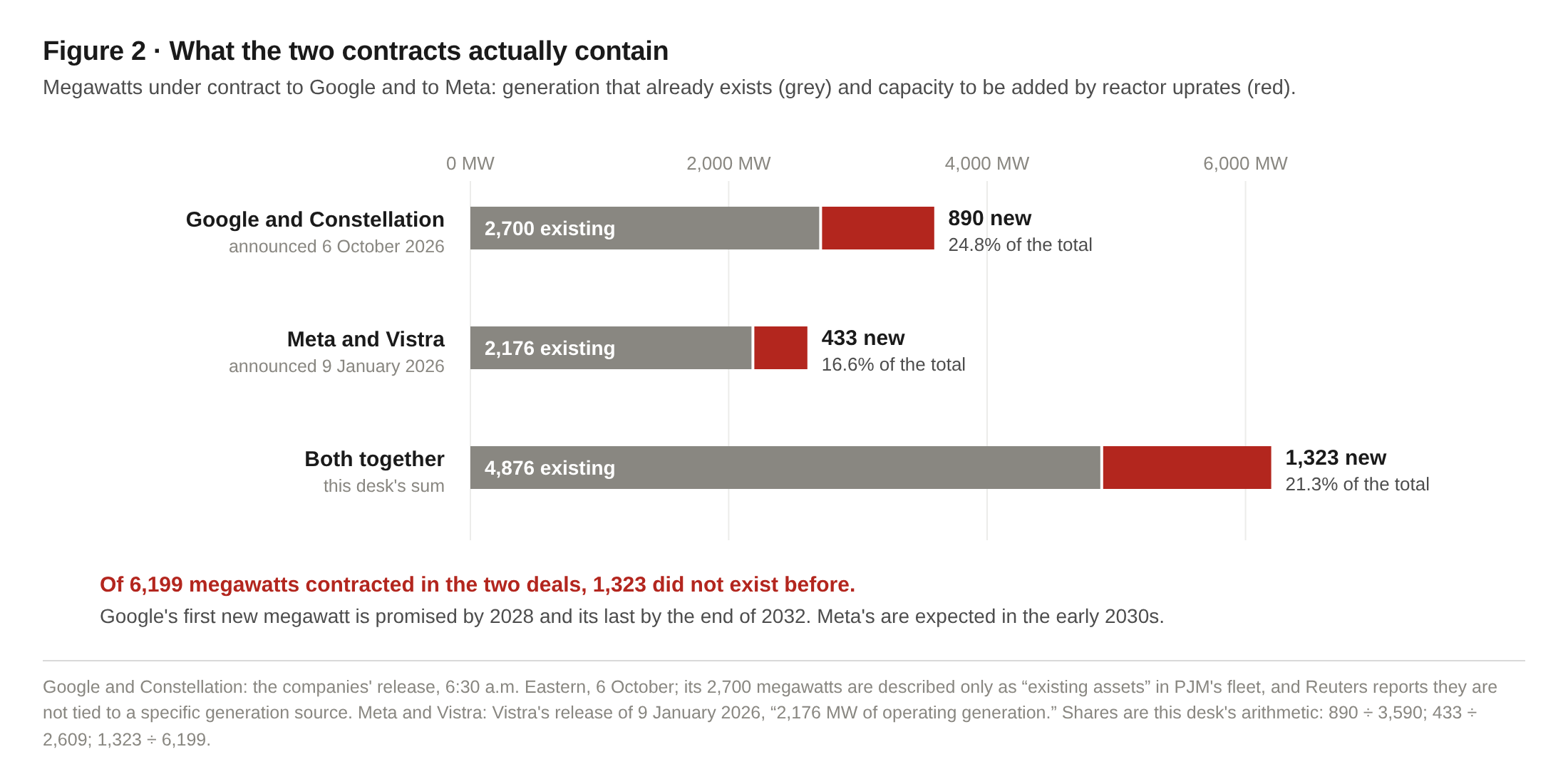
The first part is a twenty-year power purchase agreement that, in the release's words, "will enable investments in new equipment and technology at 11 Constellation-owned nuclear units" in Illinois, Pennsylvania and New Jersey. Those investments are uprates: more output from reactors that already exist. They are to add 890 megawatts, and the release says the agreement "represents more than $4.3 billion of new investment by Constellation."
The second part is a fifteen-year supply agreement "for an additional 2,700 MWs in PJM's fleet." Its stated purpose is that it "ensures existing assets remain economically viable without taking resources off of the grid." It names no plant, and Reuters reports that this power "is not tied to a specific generation source." So it is electricity already being generated, already flowing into the same grid, now under contract to one buyer. The release does not say it is nuclear.
Reuters did the sum before this desk did, six minutes after the release, and the credit is its own: Google "has contracted for 3,590 megawatts," it wrote, "with new nuclear energy accounting for about a quarter of that supply." To a decimal, 890 over 3,590 is 24.8 percent. The release's headline counts the one megawatt in four. The contract covers all four.
None of this is a criticism of the deal; keeping reactors solvent may be the most useful thing a buyer of power can do. But capital is being committed now to artificial intelligence against revenue promised later, and the revenue needs electricity that does not yet exist. Of the megawatts announced today, the ones that did not exist yesterday number 890.
The pattern is not Google's alone. On Monday the Department of Energy announced a conditional commitment to lend Vistra up to $4.2 billion for uprates that would add 433 megawatts at Beaver Valley in Pennsylvania and at Davis-Besse and Perry in Ohio. Meta contracted for that power in January, in twenty-year agreements that Vistra described as "2,176 MW of operating generation and an additional 433 MW of combined power output increases." By the same division the new share is 16.6 percent. Between them the two companies have contracted for 6,199 megawatts, of which 1,323, or 21.3 percent, are additions. Benzinga's headline on Monday put it better than I can: a federal loan "to Add Nuclear Power Meta Already Bought."
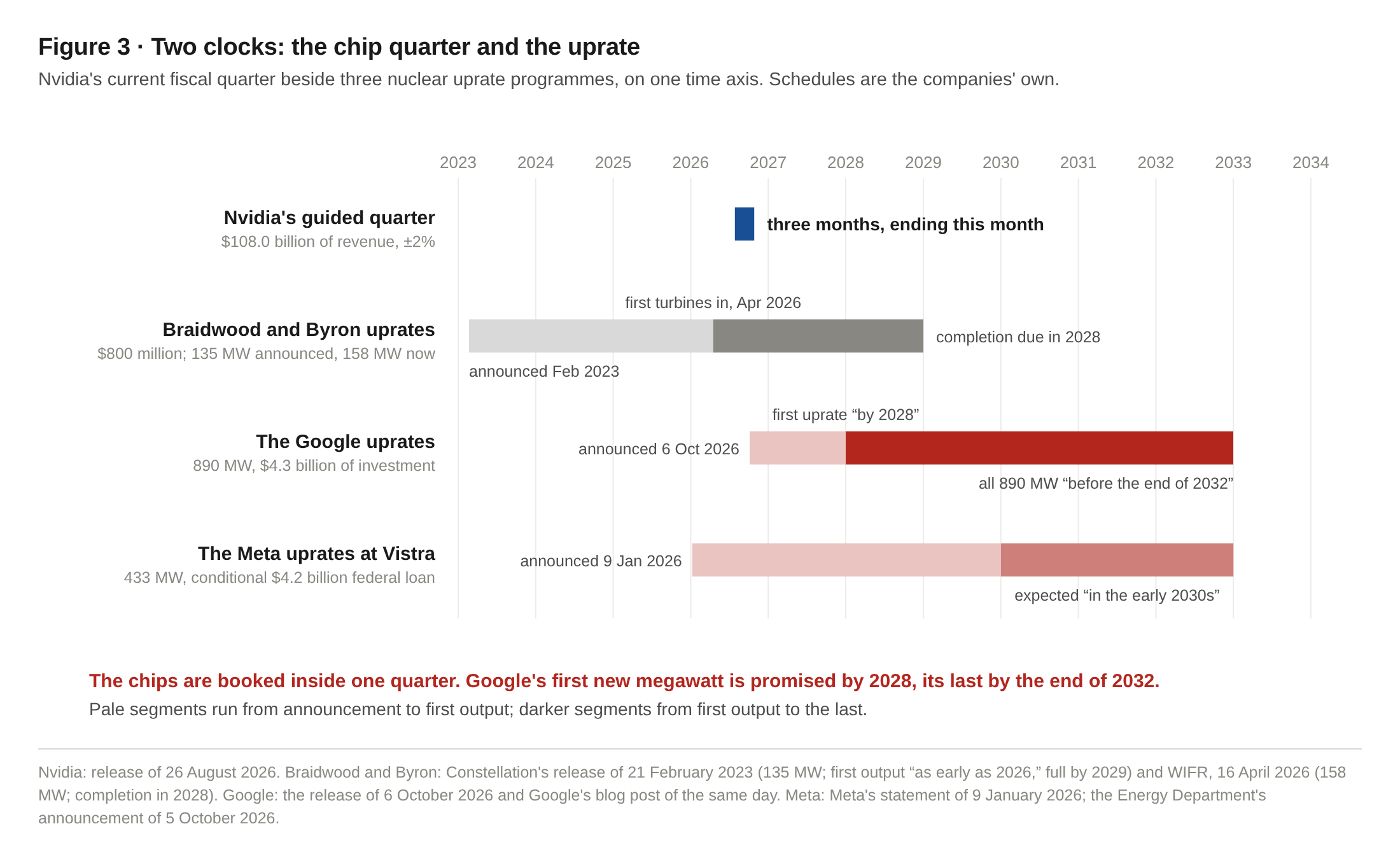
Now the clock. The release gives the first date, "by 2028." Google's blog post gives the last: "Before the end of 2032, these uprate projects will add 890 MW." Meta said in January that its uprates are "expected to come online in the early 2030s."
Constellation has run this play before. In February 2023 it announced $800 million of uprates at Braidwood and Byron in Illinois, about 135 megawatts, with increased output "as early as 2026" and the full amount by 2029, the work to be done "in stages during scheduled refueling outages." This April a Rockford television station reported the first phase finished, new turbines in Byron's Unit 1, with the project now put at 158 megawatts and due for completion in 2028. A little over three years from announcement to the first turbine, and about five to the last.
Set that beside the other side of the trade. Nvidia's release of August 26 guides to revenue of "$108.0 billion, plus or minus 2%" for the quarter now ending, after $96.2 billion in the quarter before. On September 28 Nvidia added $150 billion to its share repurchase authorisation, 35 times Constellation's uprate programme by this desk's division.
So where should these numbers show up, and have they? Bloomberg's billion is not in the release, which prints no price and no payment of any size. It says only that the agreement is "to fund nuclear reactor uprates," and its one dollar figure is Constellation's own spending. Google's side belongs in the purchase-commitments note of Alphabet's next quarterly filing, and Constellation's in the capital plan it presents with third-quarter results. Neither exists yet.
The megawatts should show up at the Nuclear Regulatory Commission, because an uprate changes a reactor's licensed power and needs a licence amendment. There the record is thinner than the announcement. The commission's page of applications under review, last updated August 27, reads: "There are no power uprate applications currently under review." Its page of expected applications, updated September 8, lists a dozen entries under Constellation's name, the plant in each marked "Proprietary," the first planned for the fourth quarter of this year and the last for 2030. Vistra's are there by name, planned for 2029 at Perry, 2030 and 2031 at Beaver Valley and 2032 at Davis-Besse. Constellation had uprates in the regulator's diary four weeks before Google's name was attached to any.
On the evidence in print this morning, the claim is real, contracted and unpriced. The first of its new megawatts is promised by 2028, and the commission's pages show no application yet filed.
What moved
Nvidia closed at a record $238.90, up 2.12 percent, which makes it worth about $5.7 trillion on investingLive's reckoning. Broadcom closed at $362.51, up 2.08 percent. Those two are the trade.
Constellation closed at $267.62 on Monday, up 3.93 percent. But look at when. The stock stopped trading at four o'clock. A Reuters relay of Bloomberg's report is stamped 10:24 p.m., and the earliest stamp I can find on any account of it is 9:14. Monday's gain was made before the Google story existed. By 2:07 p.m. the stock was already up 4.43 percent on TradersUnion, which credited an agreement with Amazon; Benzinga's midday story on Vistra's loan carried it up 4.30. Whatever moved it, it was not Google.
The Google agreement is in this morning's quotes instead, and those do not agree: up 4.83 percent at $280.55 on Benzinga's 6:53 story, about 5 percent on Investing.com at 6:44, up 7.2 percent in a 7:35 account citing Seeking Alpha. None of them is a close. Even at Monday's close the stock was down 24.24 percent this year. Alphabet, which closed at $346.47, was up 0.48 percent on the same Benzinga page.
Intel closed down 2.63 percent at $116.19, after Elon Musk confirmed on Saturday that his Terafab chip venture in Texas is talking to Taiwan Semiconductor. "Just discussions, but something may come of it," he wrote.
One move was not the trade and was counted in it anyway. PTC, an industrial software company, closed up 33.49 percent at $192.26 after Schneider Electric agreed to buy it for $205 a share in cash, which Schneider's release calls a 42.3 percent premium to Friday's close. That is a takeover premium inside a Nasdaq record that was written up as technology momentum.
The calendar
The August trade report is due at 8:30 a.m. Eastern. The consensus is in print at three sizes: a deficit of $102.0 billion on Trading Economics and in Reuters' day-ahead note, $95.2 billion on Investing.com's calendar, and $89.8 billion in Yahoo Finance's morning blog. July's deficit was $88.6 billion as first reported. ADP's weekly employment estimate comes at 8:15; the last one, published September 22, put private hiring at an average of 20,000 a week.
Five Federal Reserve officials are on the schedule, by Newsquawk's primer. John Williams moderates a discussion at the New York Fed at 9:05 a.m. Alberto Musalem opens a St. Louis conference at 10:40, where Michelle Bowman speaks at 10:45. Jeffrey Schmid takes questions in Oklahoma at 1:15 p.m., and Lorie Logan moderates a conversation in San Antonio at 7:00.
The RCM/TIPP economic optimism index for October is due at 10:00, consensus 44.5 against 45.6. The Treasury sells $58 billion of three-year notes at 1:00 p.m.; the last three-year sale, on September 8, cleared at 4.474 percent. With the long end at a 24-year high, that auction is the day's real test.
Marvell Technology holds its investor day in New York, with a livestream from 9:00 a.m.; Reuters expects it to update its long-term financial targets. Penguin Solutions and Constellation Brands report after the close.
Wednesday brings a $39 billion ten-year note auction at 1:00 p.m. and, at 2:00, the minutes of the September 15–16 meeting, at which the committee raised its target range to 3.75 to 4 percent. Applied Digital, the data-center developer, reports after Wednesday's close. The next Fed meeting is October 27–28, ending six days before the election on November 3. Benzinga, citing the CME's tool, put the chance of another increase at that meeting at 21.6 percent this morning.
What we're checking next
Three documents would turn this morning's megawatts into something that can be measured, and the desk will read each as it appears.
The first is an actual filing at the Nuclear Regulatory Commission. Constellation's earliest entry on the list is planned for this quarter. When it is filed it will carry a plant's name, a number of megawatts and a date, which is more than the release gives for any of its eleven units. It may also settle a smaller puzzle: Constellation's nuclear holding in New Jersey is 43 percent of Salem, which PSEG operates, and Salem's planned uprates are on the list under PSEG's name.
The second is Alphabet's quarterly filing. The company has not announced a date for its results; outside calendars estimate October 28. Two long agreements are commitments, and commitments have a note. If Bloomberg's "$1 billion or more" is the right order of magnitude, it should be visible there, and so should whether it is a billion in total or a billion a year.
The third is Constellation's third-quarter presentation. The company says $4.3 billion is new investment. The question is whether its capital plan rises by that amount, or whether some of the 890 megawatts were already in it. It has been telling investors about uprates since February 2023.
Behind all three sits the question no single filing answers. Nvidia's guidance implies more than a hundred billion dollars of revenue this quarter, most of it from chips for data centers. Somebody has to plug them in. How much of the power contracted for them this year is new, and how much is a change of customer?
Sources and data notes
Every level carries its feed and, where the feed gives one, its time. Pages were read between 8:32 and 8:58 a.m. Eastern and again, with second sources, between 10:20 and 11:20 a.m. No price taken after the 9:30 open is used; Monday's and Asia's closes are settled figures. The 8:30 trade report is previewed with its consensus and prior, and its result is not used.
Sworn in. Dow 51,267.90: the AP's table, stamped 4:15 p.m. Monday; TheStreet's 4:07 p.m. wrap; FRED. S&P 500 7,773.95, from Friday's 7,722.72: the AP, FRED, Investing.com, Yahoo Finance. Nasdaq Composite 27,477.31: the AP, TheStreet, Investing.com. Russell 2000 2,847.14: the AP, Yahoo Finance. Ten-year 5.31: Yahoo Finance, The Motley Fool and the AP's 8:02 a.m. update ("5.31% late Monday"), with Kiplinger at 5.309 and Investing.com at 5.304; Friday's 5.28 is the Federal Reserve's H.15. Thirty-year 5.66: Yahoo Finance; Kiplinger 5.664. WTI $89.43 and Brent $100.32: Investrade, Reuters, Investing.com. Nikkei: Nikkei's index page and the AP. Kospi and the two Korean stocks: Yonhap. Hang Seng: the AP's later update and etnet. Single-stock closes: stockanalysis.com and Yahoo Finance.
Not sworn in. TheStreet's 4:07 p.m. S&P 500 (7,773.99) and Russell 2000 (2,853.27) and its 3:57 p.m. ten-year (5.315). Investrade's ten-year (5.347); Monday's high of 5.351 is Investing.com's. Two-year: 4.821 (Kiplinger), 4.823 (TheStreet), 4.833 (Investing.com). The morning's European, oil, currency and futures readings are as labelled. Advantest's contribution to the Nikkei is Fisco's closing table, one feed. Pre-market readings for Constellation and Alphabet are quote boxes on stories stamped at the times given; the 4.30 percent is the quote box of Benzinga's 12:29 p.m. story.
Desk arithmetic. 890 ÷ 3,590 = 24.8 percent. 433 ÷ (2,176 + 433) = 16.6 percent. (890 + 433) ÷ (3,590 + 2,609) = 1,323 ÷ 6,199 = 21.3 percent. $150 billion ÷ $4.3 billion = 34.9. 334.41 ÷ 737.12 = 45 percent. Constellation from $353.27 on December 31 to $267.62 is −24.24 percent. Nvidia's quarter ends October 25 by this desk's count of thirteen weeks from July 27.
Left open. The price of either agreement; the units to be uprated; what generates the 2,700 megawatts; whether the 890 counts all of each unit or Constellation's share. The NRC's expected-applications page was read row by row twice. Both readings gave twelve Constellation entries, but its yearly summary and its rows did not reconcile by one row as relayed, so "a dozen" and "2030" are printed and no exact count or quarter. Whether those entries are the release's eleven units, the list does not say. Byron's progress is one local station's report.
The chronicle. One entry joins the Decoy Chronicle, taking the count from 197 to 198. Entry 201: Investrade's morning preview, published at 6:47 a.m., says the Nikkei "jumped 737 points to 70,883." The change is right and the level is not. The index closed at 70,683.98, and 70,883 less 737 is 70,146, where Monday's close was 69,946.86. Caught by subtracting.
Pages read. Closes and yields: AP closing table · TheStreet, October 5 · TheStreet, October 6 · FRED, S&P 500 · FRED, Dow · FRED, ten-year · Federal Reserve H.15 · Yahoo Finance, S&P 500 · Yahoo Finance, Russell 2000 · Yahoo Finance live blog, October 5 · Yahoo Finance live blog, October 6 · The Motley Fool, October 5 · Kiplinger · Investrade review, October 5 · Investrade preview, October 6 · YCharts · Slickcharts · Reuters on oil, via Euronext · Investing.com's history tables for the S&P 500, the Dow and the Nasdaq Composite, and for the ten-year and crude · oilprice.com's futures pages for WTI and Brent. Asia and Europe: AP, first version · AP, 8:02 a.m. update · AP, later copy · AP, European-hours copy · Nikkei index page · Fisco closing table · BBN Times on Monday's Nikkei · Yonhap in The Korea Times · etnet · The Standard · Investing.com on SoftBank. The subject: the release, Business Wire copy · the release, Google's press site · the release, Constellation's site · Google's blog post · Reuters, Laila Kearney, 6:36 a.m. · Bloomberg's report, not opened · Bloomberg's text in the Deccan Chronicle · Reuters' relay · Investing.com, 1:18 a.m. · Crypto Briefing, 9:14 p.m. · Energy Department on Vistra · Vistra, January 9 · Meta, January 9 · Benzinga on Vistra · Constellation, February 21, 2023 · Power Engineering · WIFR on Byron · NRC on uprates · NRC, applications under review · NRC, expected applications · Constellation on Salem · Nvidia's second-quarter release · Nvidia's 10-Q · Nvidia's buyback release · investingLive on Nvidia. What moved: stockanalysis.com and Yahoo Finance history pages for NVDA, AVGO, CEG, GOOGL, VST, INTC, CBRS and PTC · TradingView News · Benzinga on Constellation · Investing.com on Constellation · TradersAgency · TradersUnion · The Motley Fool on Terafab · Schneider's release. The calendar: Trading Economics · Reuters day-ahead via Rallies · investingLive's morning note · Investing.com's trade calendar · BEA, July trade · ADP, September 22 · Newsquawk's primer · New York Fed · Federal Reserve Board calendar · Dallas Fed · investingLive on the September three-year sale · Treasury refunding statement · FOMC statement, September 16 · Marvell · Applied Digital's notice, headline only · Benzinga, Tuesday 5:22 a.m. · myfxbook on the TIPP index · Forex Factory on Schmid · St. Louis Fed conference · Constellation Brands' notice · Penguin Solutions' notice · Wall Street Horizon on Alphabet. Linked and not read: the Treasury's October par curve; CNBC's pages.