MORNING BRIEF
The Morning Brief October 13 2026
South Korea's market fell 5.46 percent on a claim that a Chinese memory cell is one-third smaller. The figure follows from the name of the design, not from a measured chip. It shows up in the incumbents' shares and nowhere else it should.
Tuesday, October 13, 2026 · Before the open · Existing home sales at 10:00 a.m.
South Korea's stock market lost 5.46 percent on Tuesday. The cause, on every wire, was a figure: a Chinese memory maker's new cell design is a third smaller and holds half again as many cells.
I went looking for where that figure was measured. It was not measured. It is what you get when you divide four by six.
That is this morning's subject. The closes come first.
Overnight, sworn in
Monday in New York was quiet, with one loud corner. The Dow closed at 51,850.55, up 0.38 percent; the S&P 500 at 7,807.24, down 0.06; the Nasdaq Composite at 27,245.90, down 0.44. Those three are on TheStreet's four o'clock table and in TradingKey's recap, and The Motley Fool's wrap rounds to the same. Investrade's review has the Dow up 195.36 points and the S&P 500 down 4.34, while TheStreet has 195.60 and 4.30; the levels above are the ones two feeds carry. The Russell 2000 closed at 2,794.48 on TheStreet, down 0.45 percent.
The bond market did not open. Monday was Columbus Day, the cash Treasury market was shut, and the ten-year's last close is still Friday's 5.24 percent. This morning it is lower: 5.19 percent, down five basis points, on Investrade at 6:54 and on Trading Economics, whose note credits falling oil and a bid for safety. The two-year is 4.78 on Trading Economics alone.
Oil gave back Monday's gain. November WTI settled at $93.74 and December Brent at $106.65 on Monday, each up about two percent, on Investrade and TradingKey. At 6:54 this morning Investrade had WTI at $91.94 beside Brent at $104.58; the Associated Press, updated at 7:30, had $91.78 beside $104.62. The dollar index closed Monday at 102.59, which Investrade calls an eighteen-month high, and the dollar is easing this morning with yields.
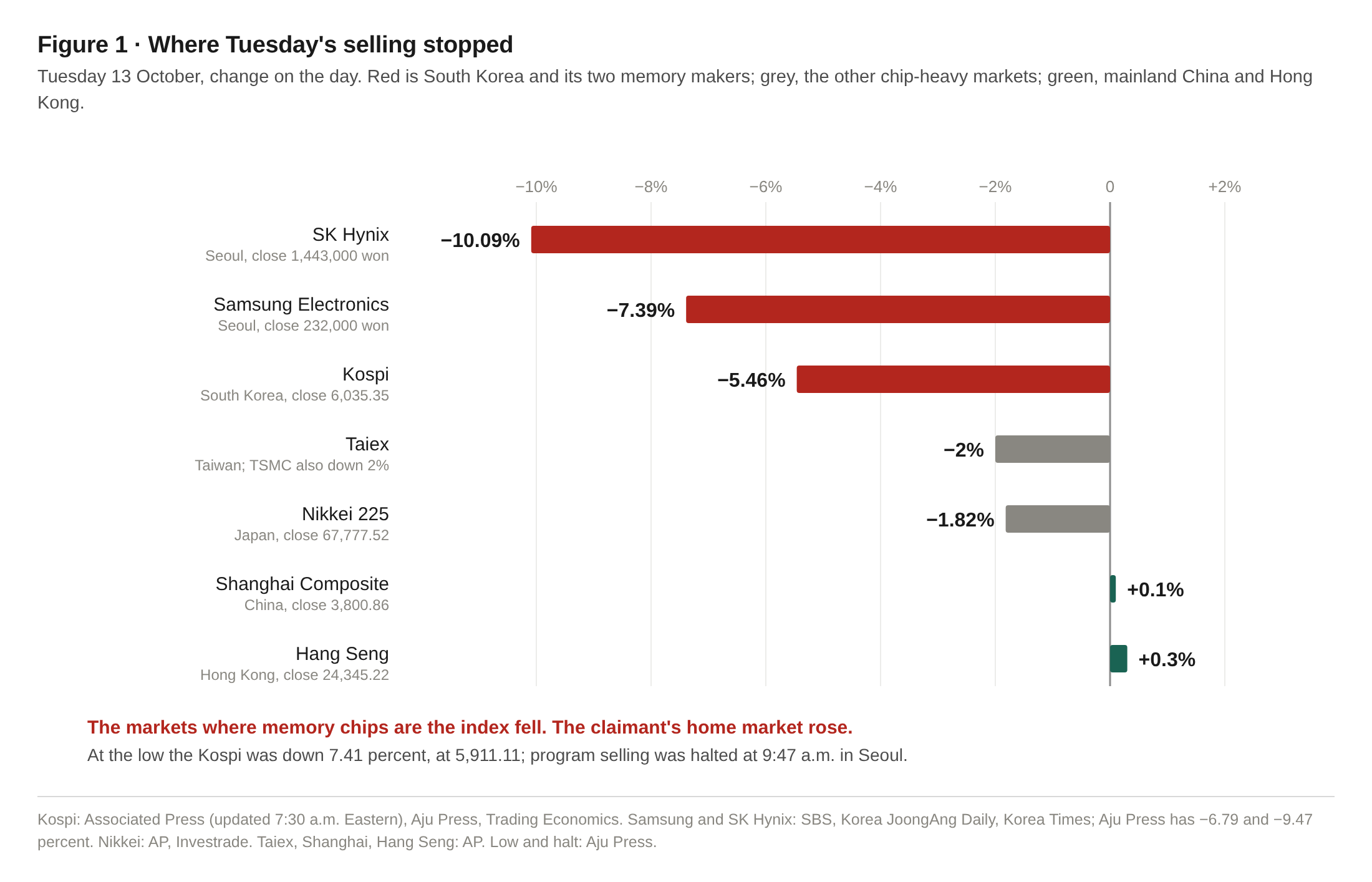
Then Asia, which did not fall together. The Kospi closed at 6,035.35, down 348.89 points, on the Associated Press, Aju Press and Trading Economics. At the low it was down 7.41 percent at 5,911.11, and at 9:47 in the morning, Seoul time, the exchange halted program selling, the first such curb in nearly two months. Tokyo's Nikkei 225 fell 1.82 percent to 67,777.52. Taiwan's index fell 2 percent, and TSMC with it.
Shanghai rose 0.1 percent to 3,800.86. Hong Kong rose 0.3 percent to 24,345.22.
So the line this morning does not run between Asia and Europe, or between risk and safety. It runs between the markets where memory chips are the index and everything else. The country whose company made the claim finished higher. The country whose companies were its target lost more than a twentieth of its market in a session. Europe sits on the same line inside a single exchange: the DAX was up 130 points at 25,407 and the FTSE 100 up 79 at 10,735 on Investrade at 6:54, while Invezz, at 4:19, had ASML down more than 3 percent and STMicroelectronics and Infineon down more than 4 percent each.
American futures carry the split too. At 6:54 Investrade had Dow futures up 180 points, S&P 500 futures down 7.25 and Nasdaq 100 futures down 169.50. The AP at 7:30 had the S&P 500 contract down 0.1 percent and the Nasdaq's down 0.6.
The subject: a third smaller, on paper
Here is what was published.
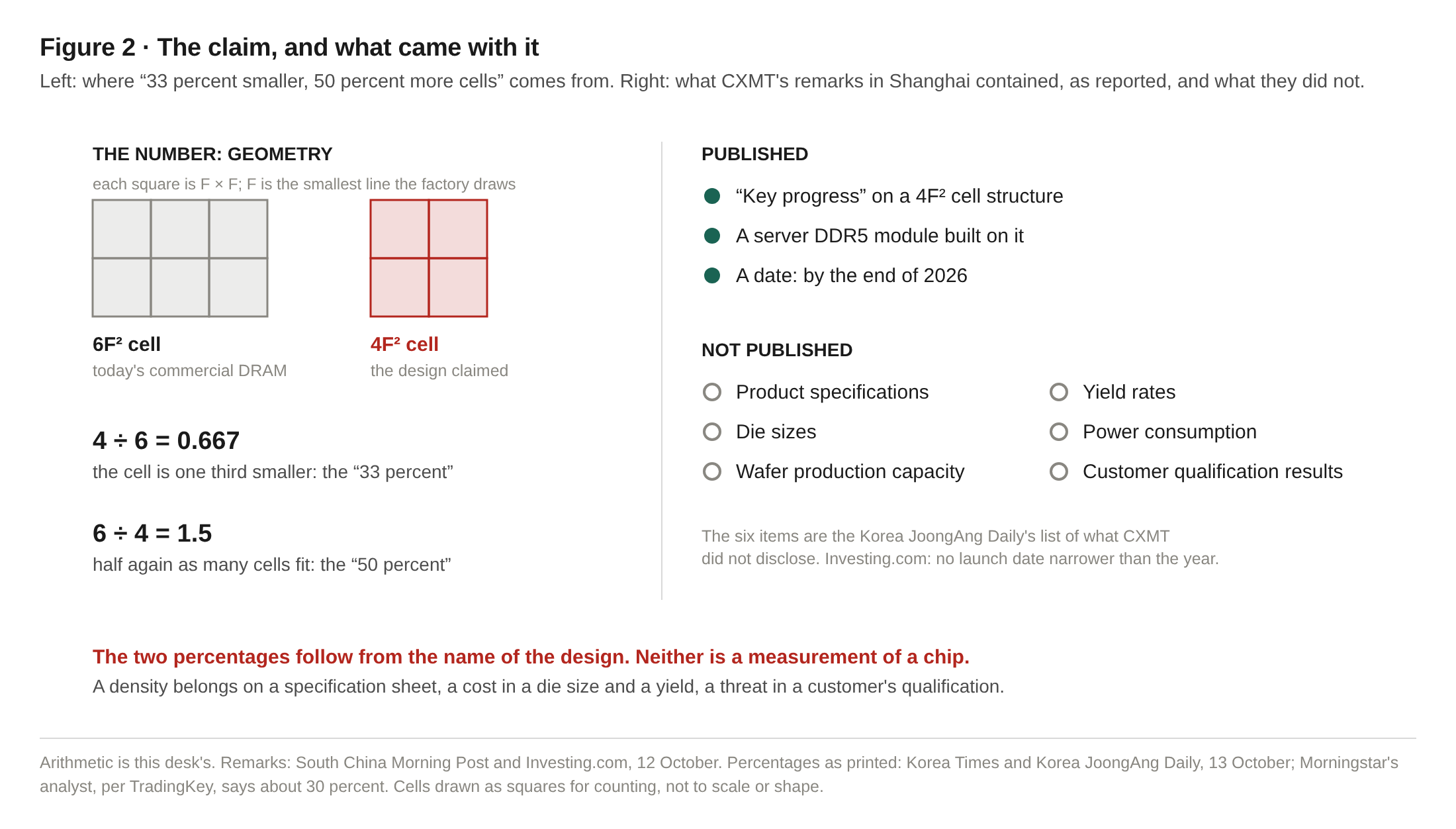
Over the weekend, at an industry event in Shanghai, CXMT's president, Cao Kanyu, said the company had made "key progress" on a memory-cell structure known as 4F², and planned to bring out a new generation of server memory built on it by the end of 2026. That is the South China Morning Post's account of a company statement, published Monday morning, and Investing.com's the same day. CXMT makes DRAM, the working memory in every server. The product is a registered DDR5 module, the part a data center buys in bulk.
Here is the number that traveled. The Korea Times: the design "could reduce cell area by 33 percent and fit 50 percent more cells into the same space." The Korea JoongAng Daily carries the same pair with the word "theoretically" attached. Morningstar's analyst, as TradingKey relays her, says about 30 percent.
And here is where the number comes from. F is the smallest line a factory can draw. Today's commercial DRAM cell occupies six squares of side F. The new one would occupy four. Four divided by six is two-thirds, so the cell is a third smaller. Six divided by four is one and a half, so half again as many fit on the same silicon. That is this desk's arithmetic, and it is the whole of the derivation. The 33 and the 50 are properties of the name. They would be just as true of a design that had never left a whiteboard.
What a measurement would look like is no mystery. A density figure belongs on a specification sheet. A cost claim belongs in a die size and a yield. A competitive claim belongs in a customer's qualification. The JoongAng Daily lists what CXMT did not disclose: "detailed product specifications, yield rates, die sizes, power consumption, wafer production capacity or customer qualification results." Investing.com adds that there is no launch date narrower than the year. TradingKey adds customer lists.
Nor is the idea CXMT's alone. SK Hynix published a 4F² roadmap in 2025. Samsung has reportedly targeted mass production by 2028 and, by the Korea Times's account, has reportedly identified a working die without announcing a timeline. What is new is the claim to ship first, and to do it on older equipment: the Korea Times notes that export controls have kept CXMT from the extreme ultraviolet tools its rivals use, and that it was until recently on a roughly 16-nanometre process. The Wall Street Journal, as The Motley Fool relays it, has CXMT's technology trailing the three leaders "by two or three generations." Morningstar's analysts, per TradingKey, say that commercializing the structure could be "extremely difficult."
None of that makes the claim false. It makes it a claim.
So where should it show up, if it is real? In three places, and I looked at each.
The first is the price of memory. A credible wave of new supply should bend the contract-price forecasts. TrendForce's latest, dated 30 September, projects conventional DRAM contract prices up 10 to 15 percent in the fourth quarter over the third, and says server DRAM "is therefore expected to remain undersupplied." That forecast predates the Shanghai remarks, and none of the coverage read this morning cites a newer one.
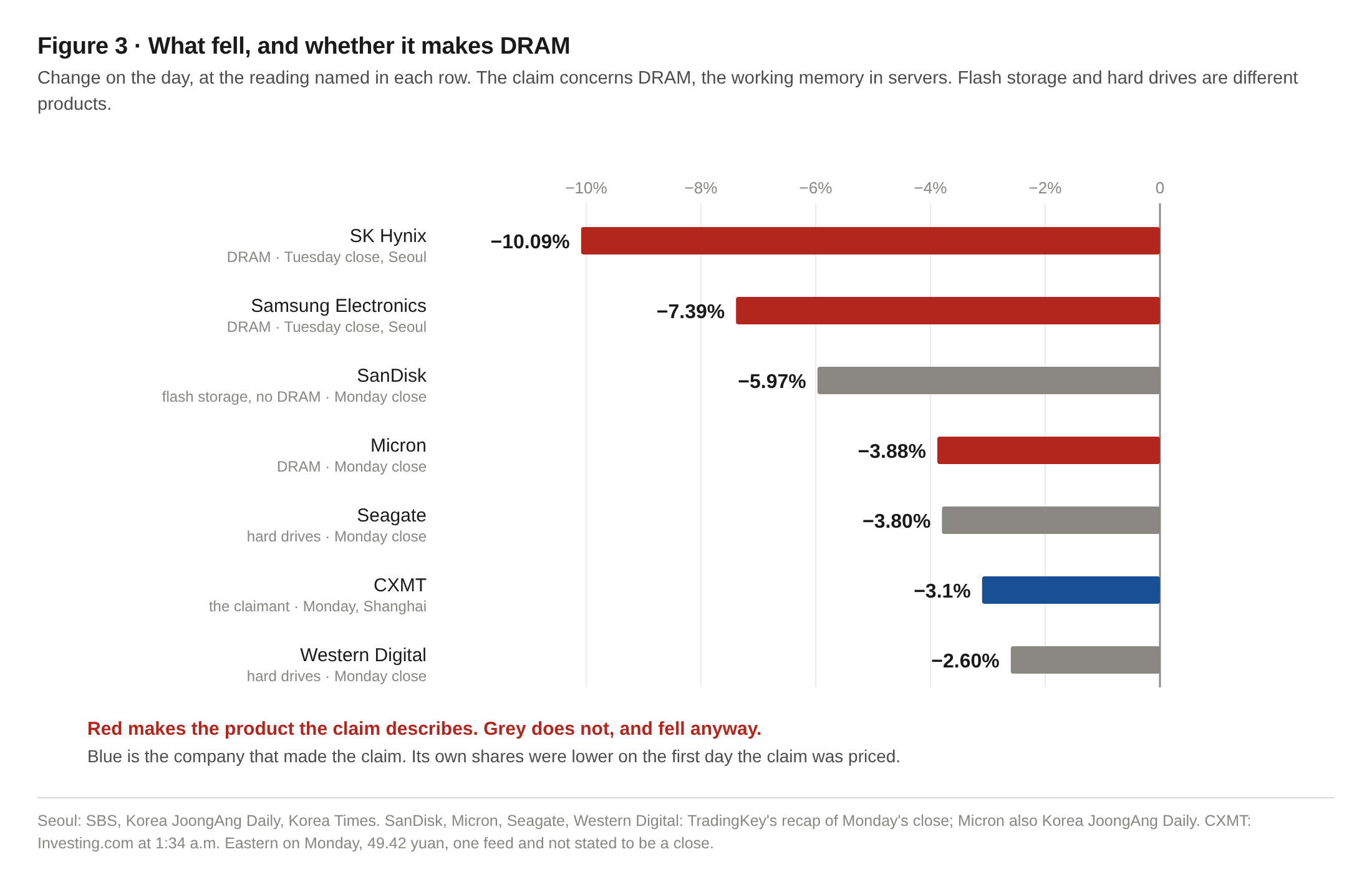
The second is the claimant's own shares. A company that has just leaped its rivals should be bid. CXMT was down 3.1 percent to 49.42 yuan in Shanghai on Monday afternoon, according to Investing.com at 1:34 a.m. Eastern.
The third is the incumbents' shares, and there it showed up at once. Samsung Electronics closed Tuesday at 232,000 won, down 7.39 percent. SK Hynix closed at 1,443,000 won, down 10.09. They had fallen 4.4 and 4.5 percent on Monday. Compounded, that is 11.5 percent off Samsung and 14.1 percent off SK Hynix over two sessions, this desk calculated from the Korean papers' daily figures. Foreign investors sold a net 4.53 trillion won of Kospi shares on Tuesday, about $3.4 billion. On SBS's figures, 3.72 trillion of it was those two stocks: 82 percent.
So, the count stands like this. The claim is present in the share prices of the companies it threatens. It is absent from the product's price, from the shares of the company that made it, and from any document that would let an engineer check it.
Why would a market do that? Because what is being priced is not next quarter. Ha Seok-keun of Eugene Asset Management, quoted by TradingKey, called it uncertainty over "the duration of the memory industry's upcycle," and the same piece frames the question as whether the boom "can persist into 2028 and beyond." That is this beat in one line. The capital has been committed now, against years of scarcity pricing promised later, and the length of "later" is the asset. A sentence from a podium in Shanghai shortened it, and nobody waited for the specification.
It didn't help that a buyer said something similar the same day. Broadcom's chief executive, Hock Tan, told an audience in Singapore on Monday that "a lot of investors have no clue what they are investing in" and that it was "almost like they are in a casino," Benzinga reported, citing Bloomberg. The same account says access to financing, rather than a shortage of memory chips, could become the industry's biggest constraint. When a customer says memory is not the bottleneck and a competitor says there will be more of it, the scarcity premium has two reasons to shrink in forty-eight hours. Only one of them came with numbers, and those numbers were arithmetic.
What moved
The single names sort into what the claim is about and what it is not about.
It is about DRAM. Micron, the one large American maker, closed Monday down 3.88 percent, on TradingKey and the JoongAng Daily; The Motley Fool's quote table has the close at $989.04, one feed. During the session it was printed down 4.2 percent at 10:55 a.m. and 4.70 in mid-afternoon, so the close was the mildest reading of the day. The Philadelphia semiconductor index lost 2.67 percent. In Seoul, the closes above are as SBS, the JoongAng Daily and the Korea Times carry them. Aju Press, at 5:49 p.m. local time, has Samsung at 233,500 won, down 6.79 percent, and SK Hynix at 1,453,000, down 9.47. I print both pairs without knowing which session Aju's belong to.
Then there is what got swept in. SanDisk closed down 5.97 percent, the worst of the American group, after 7.12 at mid-afternoon. SanDisk makes flash storage. It does not make DRAM, and a denser DRAM cell says nothing about it. Seagate fell 3.80 percent and Western Digital 2.60. They make hard drives, and a spinning platter has no memory cell. In Tokyo, Kioxia, another flash maker, was down more than 12 percent at midday, per TradingKey. The market sold the word "memory." It did not sell the product the claim describes.
The equipment makers are a subtler case. BE Semiconductor was down more than 2.5 percent in early Amsterdam trading, and TradingKey's account of the design says it "combines vertical channel transistors with hybrid bonding technology." Hybrid bonding is the business BE Semiconductor is known for. Whether a Chinese factory can buy its tools is a separate question, and I have not answered it. But a stock that falls on news that a technique it sells is spreading deserves a second look.
One figure will be quoted all week and comes in two sizes. TradingKey gave CXMT 7 percent of the DRAM market in the second quarter on Monday, citing Counterpoint, and about 10 percent on Tuesday, citing Counterpoint. Invezz has 10, up from 8 in the first quarter and 4 a year earlier. One may be revenue and the other volume; neither page says. On either figure, the companies the market sold hold most of the rest: Samsung about 38 percent and SK Hynix about 25, in the Tuesday piece.
Earnings season opened this morning. Investrade's preview puts JPMorgan's adjusted earnings at $5.75 a share versus a consensus of $5.94, and UnitedHealth's at $4.69 versus $4.14, with its guidance raised. That is one feed, not yet read against the releases. It is also why the Dow's futures and the Nasdaq's point in opposite directions.
The calendar
All times are Eastern. Consensus and prior are from Trading Economics, whose display I read as UTC and converted.
The NFIB small-business optimism index for September came out at 6:00 a.m. at 97.9, versus a consensus of 98.0 and 98.7 in August, according to Trading Economics and Investrade.
At 10:00 a.m., September existing home sales are released. Consensus is 3.95 million at an annual rate; the prior is 3.98 million.
At 2:00 p.m., the Treasury's September monthly budget statement. Consensus is a deficit of $29 billion; the prior is a deficit of $167 billion.
Fed speakers, on the same calendar: Governor Waller was listed for 3:45 a.m., Richmond's President Barkin is at 1:00 p.m. and Boston's President Collins at 4:00 p.m.
Reporting before the open, per Investrade: JPMorgan, Goldman Sachs, Citigroup, Wells Fargo, Johnson & Johnson, UnitedHealth and Domino's.
Nothing is scheduled for 8:30 today. Tomorrow is the morning that matters for rates: September's consumer price index, Wednesday at 8:30 a.m. Consensus is +0.6 percent on the month and 3.6 percent on the year for the headline, against +0.4 and 3.4 in August; for the core, +0.2 and 2.5, against +0.3 and 2.4. On this beat, previews have ASML reporting on Wednesday and TSMC on Thursday, 15 October.
The Federal Open Market Committee meets next on 27–28 October. Trading Economics' note this morning puts the market's odds of a quarter-point increase this month at about 19 percent, and December's at nearly 72.
What we're checking next
The claim has a deadline, which is rare and useful. CXMT said the end of 2026. Between now and then, documents could settle it, but none of them is a share price.
The first is a product page: a part number, a density, a speed grade. The second is a customer: a server maker saying it has qualified the module. The third is TrendForce's next contract-price reading, and whether "undersupplied" survives it.
Then there are the incumbents' own words. SK Hynix and Samsung both have 4F² programs, and neither has given a production date. Their next earnings calls are the place where a date would appear, if Tuesday has changed anyone's mind about publishing one.
There is one more line, and it is the one I would follow first. The long-term supply agreements that the memory makers have described this year fix something, and the question is what. If they fix a price, then Tuesday's selling was an argument about 2028. If they fix only a volume, it was an argument about next spring. The filings will say which, and I haven't read them yet.
Three smaller items stay open. Which session Aju Press's closing prices belong to. Whether CXMT's share of the market is 7 percent or 10, and of what. And whether the hybrid-bonding detail in TradingKey's account appears in the company's own statement, which I read only through the South China Morning Post.
Sources and data notes
Every figure carries its feed and the time it was observed, Eastern. Every page was read on Tuesday 13 October in one of three windows, between 8:36 and 8:45 a.m., between 8:45 and 8:53, and between 8:53 and 8:54; where a page stamps itself, that stamp is given. No level later than 8:54 a.m. is used. Pages reach the desk through a reader that relays their text.
Sworn in. Monday's closes, Dow 51,850.55, S&P 500 7,807.24 and Nasdaq Composite 27,245.90, are on TheStreet's 4:00 p.m. table and in TradingKey's recap, with The Motley Fool's wrap at 51,851, 7,807 and 27,246. Investrade's Market Review has changes of +195.36 and −4.34 for the Dow and the S&P 500 against TheStreet's +195.60 and −4.30, a difference between tables. The Associated Press's index table could not be opened. Monday's settlements, November WTI $93.74 and December Brent $106.65, are on Investrade and TradingKey. The Kospi's close of 6,035.35 is on the Associated Press (updated 7:30 a.m.) and Aju Press, with Trading Economics at 6,035, down 348.89 points. The Nikkei's 67,777.52, down 1.82 percent, is on the AP and Investrade's Morning Preview (published 6:54 a.m.); an Investing.com headline seen in search has 1.68 percent and was not opened. Samsung's 232,000 won (−7.39 percent) and SK Hynix's 1,443,000 won (−10.09) are on SBS and the Korea JoongAng Daily, the percentages also in the Korea Times. Trading Economics' Korea note has Samsung down 7.19 percent, read once.
Not sworn in. The ten-year at 5.19 percent this morning is on Investrade at 6:54 a.m. and on Trading Economics, which shows no minute; Friday's 5.24 is as the chronicle has carried it from Yahoo Finance and Trading Economics, and Yahoo Finance's Tuesday page still showed 5.24. The dollar index, the DAX, the FTSE 100, the futures and the Russell 2000 are one feed each as labelled. This morning's crude pairs are Investrade's at 6:54 and the AP's at 7:30, each pair from one feed at one time. Hong Kong and Shanghai are the AP's levels, with Investrade's rounded figures agreeing. The intraday low, the 9:47 a.m. curb, the won (1,342.5 per dollar against 1,335.1) and the flow total are Aju Press's; "first in nearly two months" is KED Global's. European chip shares are Invezz's, stamped 4:19 a.m., and are early readings, not closes. Micron's $989.04 is the quote table on The Motley Fool's Micron piece, which also carries the 10:55 a.m. reading and the Journal's "two or three generations"; the 4.70 and 7.12 percent readings are TradingKey's, stamped 2:52 p.m. Monday. The semiconductor index's 2.67 percent is the JoongAng Daily's, with Invezz and Investrade at 2.7. The bank and insurer earnings are Investrade's alone.
The claim. CXMT's remarks are as reported by the South China Morning Post (published 8:30 a.m. Hong Kong time on 12 October) and Investing.com, on Yahoo Finance (1:34 a.m. Eastern on 12 October), which also carries CXMT's 49.42 yuan. The desk did not open the company's statement or Bloomberg's report. Market shares and the hybrid-bonding description are from TradingKey's Tuesday piece; the analyst quotation is from TradingKey's Kospi piece. The contract-price forecast is TrendForce's release of 30 September. Mr. Tan's remarks are from Benzinga, on Yahoo Finance, 3:35 p.m. Monday, citing Bloomberg.
Desk arithmetic. Cell area: 4 ÷ 6 = 0.667, a reduction of one third; 6 ÷ 4 = 1.5, or 50 percent more cells in the same area. Two-session moves: (1 − 0.044) × (1 − 0.0739) = 0.885 for Samsung and (1 − 0.045) × (1 − 0.1009) = 0.859 for SK Hynix. Share of foreign selling: (2.3613 + 1.3595) ÷ 4.5259 = 0.822, in trillions of won, all three from SBS.
The calendar. Trading Economics' United States calendar, read once; its CPI row at 12:30 on the display fixes the conversion. The Fed speakers' times rest on that calendar alone. The ASML and TSMC dates are from preview headlines seen in search (The Cerbat Gem; TipRanks), neither page opened.
The chronicle. Two entries joined the register of stale or mistaken figures published as current, taking it from 214 to 216. Entry 218: Investrade's Morning Preview of 13 October, "The South Korean Kospi sunk -62 points or 6.25% to 942," where the Kospi closed at 6,035.35, down 348.89 points or 5.46 percent; the line was read twice and the series it belongs to was not established. Entry 219: The Motley Fool's Monday wrap, also on Yahoo Finance, in which "the 10-Year Treasury yield edged up 0.01% to 5.24%" in a piece that also says "Bond markets were closed today"; 5.24 is Friday's close.
Seen and not logged. Aju Press's closing prices for Samsung and SK Hynix, 1,500 and 10,000 won above three other pages'; CXMT's market share at 7 and 10 percent under one citation; gold on Monday at $4,167.56, $4,190.60 and $4,195.9 on three pages, spot and futures; Investing.com's CXMT quote page, showing a price stamped 24 September; and The Motley Fool's SanDisk headline, seen in search and not opened.
The Decoy Chronicle — every entry, dated and sourced — is published as a standing register and updated with each issue.
The TrendyVest Championship is open for registration at Tournament.Trendyvest.com — 500 seats, a $100,000 simulated stake, free to enter. Trading began October 1 at the market open.
TrendyVest is an independent research practice. This is analysis and editorial opinion, not investment advice, and nothing here is a recommendation that any particular person buy or sell any security. Figures identified as this desk's arithmetic are the practice's own, and the inputs are printed alongside them.