Morning Brief
Morning Brief: September 30th, 2026
OpenAI Asked for $30 Billion on a Revenue Number Printed About $30 Billion Apart
A valuation is a price divided by a number. On Tuesday afternoon, the price arrived, and the number underneath it arrived twice.
OpenAI is seeking at least $30 billion at a valuation of about $1.4 trillion, according to Bloomberg, as relayed by Reuters, Quartz and TechCrunch. That is the price. The number is revenue, and Bloomberg and Reuters put it near $70 billion, while Quartz and TechCrunch later put it at $40 billion, with the same growth rate attached to both. Use the higher figure as the base for the valuation.
At $1.4 trillion, the first figure is twenty times revenue. The second is thirty-five. A reader who met one page would not know there was a question. Read the higher figure as the current revenue basis, and the lower as last month's.
This brief is about which number it is, where a number that size should already be visible, and who is collecting the money in the meantime. The point is simple: the valuation depends on the revenue figure, and that figure was printed two ways. The third answer reports after the bell tonight.
Overnight, sworn in
Tuesday's closes first, because one of the places a reader would look for them had the wrong day.
The S&P 500 closed at 7,670.84, down 12.85 points, or 0.17 percent. The Dow closed at 51,349.92, down 131.59 points. The Nasdaq Composite closed at 26,797.54, down 22.84, and the Russell 2000 at 2,807.92, down 9.99. Those are the Associated Press's figures, each matched by a second feed: Investing.com's table for the S&P 500, Trading Economics' point changes for the S&P, the Dow and the Russell, and Investrade's for the Nasdaq. They are sworn in.
Kiplinger's close story for the same session says the S&P 500 "was down 0.8% at 7,683" and the Dow "had fallen 0.7% to 51,481." Those are Monday's closes, 7,683.69 and 51,481.51, with Monday's percentages. The Nasdaq in the same sentence is Tuesday's: one sentence, two sessions.
The ten-year is not sworn in. Kiplinger has it at 5.251 percent on Tuesday, up nine-tenths of a basis point; Investrade has 5.282, up four basis points. They also disagree on the two-year's direction: 4.889, down three and a half basis points, versus 4.934, up one. The Treasury's own par curve would settle it, and the page would not give me a September row this morning. This morning's screens are no closer together: 5.23 on Trading Economics, 5.26 on Yahoo Finance's board, "near 5.3" on TheStreet, which also has the thirty-year through 5.6.
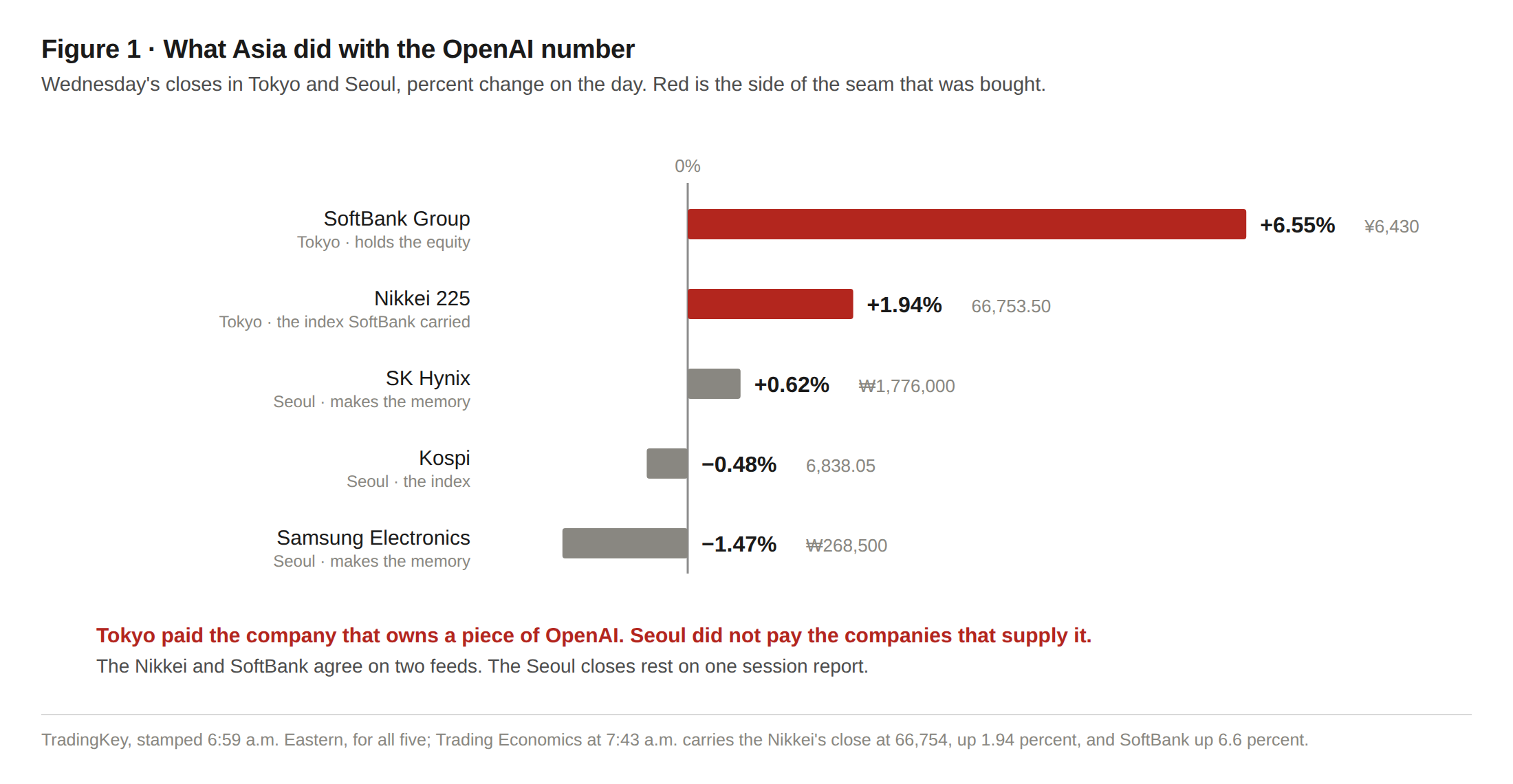
Then Asia, which traded the OpenAI report before New York gets a second look at it, split along a line worth describing.
Tokyo bought the owner. SoftBank Group, which holds a large stake in OpenAI, rose 6.55 percent to ¥6,430, and the Nikkei 225 closed up 1.94 percent at 66,753.50. Trading Economics reports the same close and attributes SoftBank's jump to the funding report. Seoul did not buy the suppliers. Samsung Electronics fell 1.47 percent to 268,500 won, SK Hynix rose 0.62 percent to 1,776,000 won, and the Kospi closed down 0.48 percent at 6,838.05.
So a higher price for OpenAI was good for the company that owns a piece of it and did nothing for the two companies whose memory chips it runs on. A report that a customer is worth more is not an order.
Europe rose on something else entirely. The STOXX 600 was up 0.7 percent at 642.69 by 3:22 a.m. Eastern, led by miners, with German yields easing for a second day. US futures are slightly higher, by a tenth of a percent on Yahoo Finance's board and two-tenths in Trading Economics' narrative. The dollar index is at 101.24. West Texas Intermediate is at $90.17, up 0.88 percent, beside Brent at $103.30, up 0.66 percent, from TheStreet at 6:47 a.m.
The subject
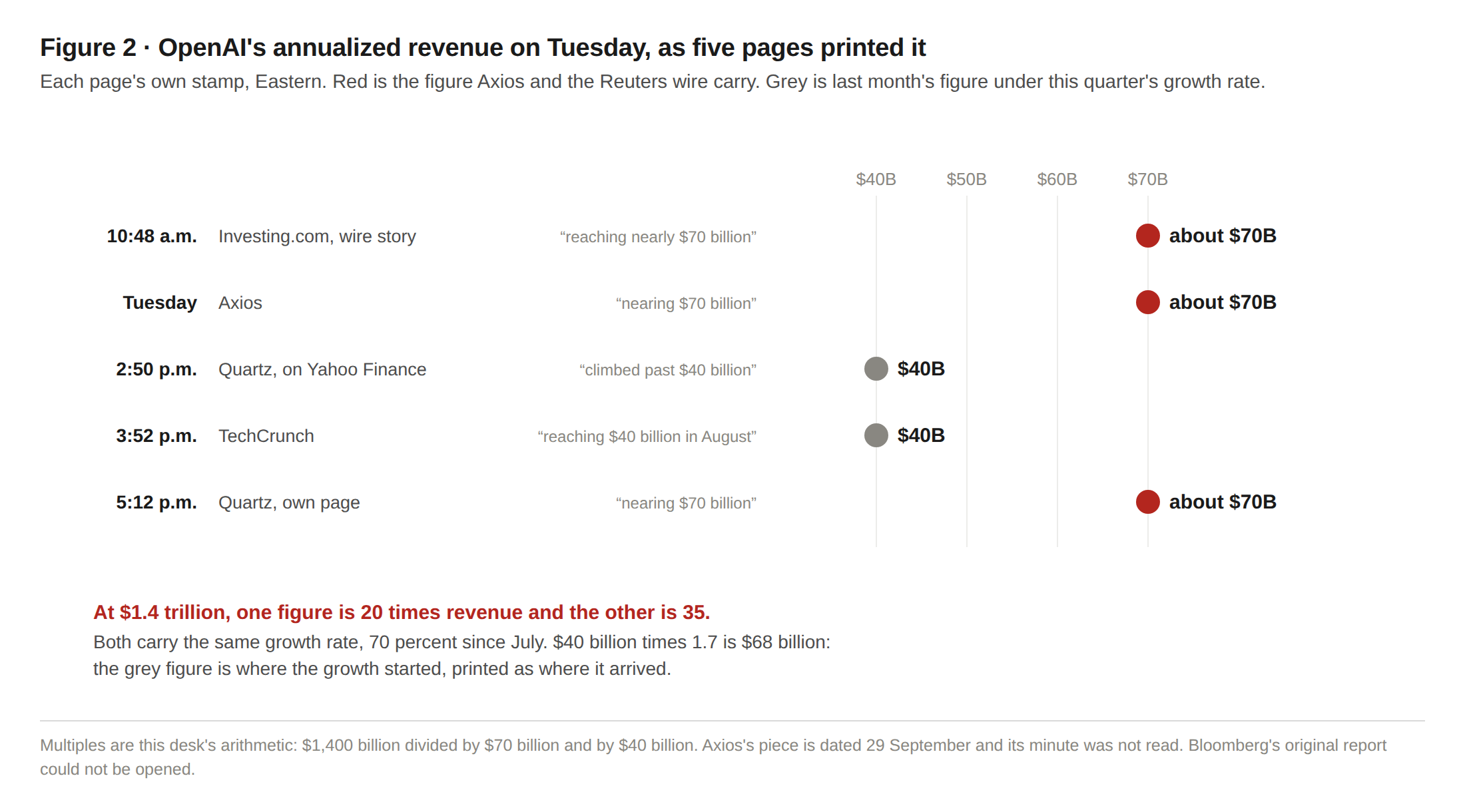
Here is what was published, in order.
On Tuesday morning, Axios reported, citing sources familiar with the financials, that OpenAI's annualized revenue run rate "has grown more than 70% since the beginning of the third quarter, reaching almost $70 billion." Reuters then carried the same figure; Investing.com's version of that story is stamped 10:48 a.m. and adds the sentence that matters most here, that the figure "marks a sharp jump from the $40 billion run rate reported by Bloomberg and Forbes just last month."
Then Bloomberg reported the funding round, and the rewrites began.
Quartz's story, as syndicated on Yahoo Finance at 2:50 p.m., says: "The company's annualized revenue has climbed past $40 billion, a figure that reflects 70% growth since July." TechCrunch, at 3:52 p.m., says a refocus on coding "has fueled a 70% jump in run-rate revenue since July, reaching $40 billion in August."
Both sentences take the 70 percent and attach it to the number it started from.
I ran the arithmetic. Forty billion dollars times 1.7 is $68 billion, which is "almost seventy." If instead $40 billion were the result of 70 percent growth, the run rate in July would have been $23.5 billion, and no report I could find says that. The $40 billion is where the quarter began. It was printed twice, as if it were the quarter-end number. Use $40 billion only as the starting point for the 70% gain.
Quartz's own page now reads differently from its syndicated copy. The version on qz.com, stamped 5:12 p.m., says the run rate "is nearing $70 billion, having climbed more than 70% since the start of the third quarter." The copy on Yahoo Finance still said $40 billion when I read it this morning. I cannot see what Quartz's page said at 2:50, and I could not open Bloomberg's original. What I can say is that Axios and the wire both carry the higher figure, one outlet carries both figures, and the lower one is last month's.
This matters for the price. At about $70 billion, $1.4 trillion is 20 times annualized revenue. At $40 billion, it is 35. Those are two different arguments about one company, and the second is wrong by the amount of the raise. Use the figure that matches the reported run rate.
Now the desk's standing question. A run rate is a claim: it is one recent month multiplied by twelve, reported by people familiar with the matter. Where should a claim this size already show up in a document somebody signed?
One place is Microsoft. Investing.com's version of the wire story says Microsoft recorded $24.1 billion of revenue from its commercial arrangements with OpenAI in its fiscal 2026, which ended in June. If OpenAI's business grew 70 percent in the three months since, the quarter that ends today is the first audited ledger in which that growth has to appear. It has not been reported yet. That is left open, and it is checkable.
The other place is the supply chain, and that one reports tonight.
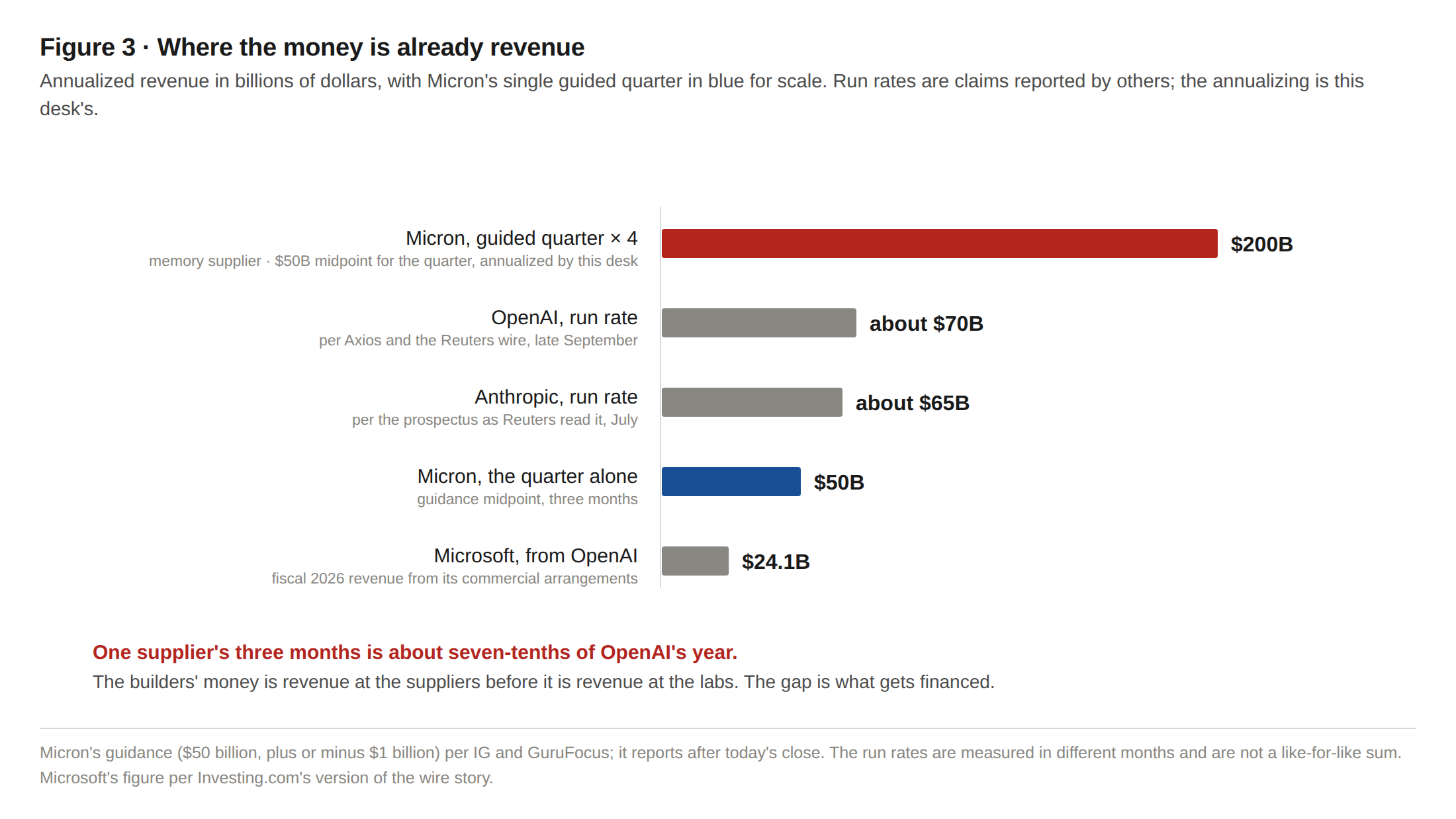
Micron has guided to revenue of $50 billion, plus or minus $1 billion, for the quarter it reports after today's close, at a gross margin of about 86 percent. A year ago, the same quarter was $9.30 billion. Multiply the guided quarter by four, which is my arithmetic and not the company's, and one memory supplier is selling at a pace of $200 billion a year.
Set that beside the labs. OpenAI's run rate is about $70 billion. Anthropic's was about $65 billion in July, according to the prospectus Reuters reviewed. One supplier's three months is about seven-tenths of OpenAI's year.
That is the shape of this whole trade. Money spent on artificial intelligence is revenue for suppliers before it becomes revenue for laboratories, and the gap between the two is what gets financed. Reuters reports Anthropic's obligations at $518 billion over ten years across six partners, about 80 percent of it non-cancelable: $111.1 billion to Google, $110 billion to Amazon, $31.4 billion to Microsoft, $161.2 billion in Broadcom equipment leases, up to $84.5 billion to xAI. Those five sum to $498.2 billion, which, by subtraction, leaves $19.8 billion for a sixth partner the accounts I read do not name.
Anthropic is reportedly targeting a valuation above $2 trillion, up from $965 billion in May. OpenAI's $1.4 trillion compares with $852 billion after its March round. Together, the two laboratories are asking to be valued at $3.4 trillion on run rates that sum, across two different months, to about $135 billion. That is 25 times, and it is a multiple of a run rate, not of a year anyone has reported. Use the run-rate total as the comparison point.
A disclosure belongs here: this desk's tooling is built on Claude, made by Anthropic.
None of this says the price is wrong. It says the price depends on a number; the number was printed two ways within five hours, and the only audited figures in the chain belong to the companies being paid. That is the point.
What moved
The report moved one stock cleanly, and it was in Tokyo. SoftBank's 6.55 percent is the market's reading of a higher mark on something it already owns.
In New York on Tuesday, the money went further down the chain. Micron closed at $1,065.08, up 1.05 percent, on two feeds, the day before its results; it was at $1,068.60 before the open at 7:43 this morning, and it is up 269 percent this year, according to IG. Applied Materials closed at $512.29, up 5.2 percent. Lumentum closed at $972.47, up 5.5 percent, and Bloom Energy at $292.34, up 11.2 percent, after Jefferies raised its price target. Those three closes are from one feed; TheStreet's live page had Lumentum up 5.90 and Bloom up 10.89 during the session, so treat the last decimal as unsettled.
Equipment, optics, power. The names that rose are the ones that get paid whether the laboratory's multiple is 20 or 35.
I could not open a second feed this morning for Nvidia's, Microsoft's, Oracle's, or Advanced Micro Devices' close, and none is printed here.
Two moves were not this trade and sat beside it. Fair Isaac fell 21.57 percent on TheStreet's live page and 26.6 percent in Kiplinger's close story, after the federal housing regulator said it would open mortgage scoring to competition; the two figures are an intraday reading and a close, and the gap between them is the afternoon. DraftKings fell 7.3 percent to $19.62, its lowest since April 2023. Neither has anything to do with the price of intelligence. Both were in the same red column as the index.
And the index fell on a day when a company at the center of the theme was reported to be seeking a price 64 percent above what it fetched in March. The ten-year did that, not the laboratories.
The calendar
Today is the last session of the month and the quarter—all times Eastern; consensus first, prior second, from Trading Economics unless noted.
At 8:15, ADP private employment for September: +70,000 against +38,000.
At 8:30, August personal income and outlays, previewed here and not reported. The PCE price index: +0.4 percent on the month against +0.2, and 3.7 percent on the year against 3.7. Core: +0.3 percent on the month against +0.2. On core's annual rate, the calendars disagree: 3.3 percent on Trading Economics and TheStreet, 3.4 on FXStreet, against a prior of 3.3. Personal income: +0.4 percent against +0.4. In the same minute, the third estimate of second-quarter GDP came in at +1.5 percent annualized, down from +2.1 in the calendar's previous column, and the advance goods trade balance for August was −$115.0 billion, up from −$118.8 billion.
At 9:45, the Chicago PMI for September: 51.2 against 47.1. At 10:30, the weekly crude inventory report: −0.7 million barrels against +2.969 million.
Federal Reserve speakers: Barkin at 1:30, Goolsbee at 5:10, Kashkari at 6:00. Those times are Trading Economics' and were not checked against the Board's calendar.
After the close, Micron. Guidance is $50 billion of revenue, give or take $1 billion, and about $31 a share; consensus is $51.07 billion and $31.61 on IG's count, $50.8 billion and about $31.50 on GuruFocus's.
The next FOMC meeting is 27–28 October. The market's odds of an increase there were printed this morning as 72.5 percent by FXStreet, citing CME FedWatch, and as "approximately 45%" in Trading Economics' narrative. I print both because I cannot tell which is looking at the right meeting.
What we're checking next
Three documents, in the order they arrive.
Tonight, Micron's release. Last quarter, its cloud memory unit was $13.77 billion of $41.46 billion in revenue, a third. The question is whether the company says who is ordering, and on what terms: whether the memory going into the laboratories' capacity is being bought by the laboratories, or by the cloud companies they have promised to pay later.
Late in October, Microsoft's first-quarter filing. If a run rate rose from about $40 billion to about $70 billion in the three months ending today, the revenue Microsoft records from OpenAI is the first place that growth meets an auditor.
And Bloomberg's own sentence. Two rewrites of one report attached a growth rate to the wrong end. I want to read the original before saying where the slip began.
Sources and data notes
Reads were made between 7:17 and 7:50 a.m. Eastern on Wednesday 30 September. Where a page carries its own stamp, that stamp is given; otherwise the minute is the desk's. The run stalled after the files were built and the brief was delivered after its 8:15 target; nothing was read after 7:50, and the 8:15 and 8:30 releases are previewed, not reported.
Sworn in. S&P 500 7,670.84 (−12.85), Dow 51,349.92 (−131.59), Nasdaq Composite 26,797.54 (−22.84), Russell 2000 2,807.92 (−9.99): Associated Press via KRMG, read 7:37; the S&P close on Investing.com's table, 7:33; the S&P, Dow and Russell point changes on Trading Economics, 7:31; the Nasdaq change on Investrade, stamped 4:12 p.m. Tuesday. Investrade's Dow change, −130.52, was taken twelve minutes after the bell: a difference, not an error. Micron $1,065.08 (+1.05%): stockanalysis.com, close stamped 4:00 p.m., premarket $1,068.60 stamped 7:43 a.m., and Investing.com, 7:47. Nikkei 225 66,753.50 (+1.94%) and SoftBank ¥6,430 (+6.55%): TradingKey, stamped 6:59 a.m., and Trading Economics, Japan, 7:43 (66,754; SoftBank +6.6%).
Not sworn in. TradingKey has the Kospi, Samsung, and SK Hynix closes. Applied Materials, Lumentum, Bloom Energy and DraftKings closes are from 24/7 Wall St., whose page also shows the Russell 2000 at 2,821.38, up 0.19 percent, against the sworn 2,807.92; the page carries no time, and it is not logged. Intraday figures for Lumentum, Bloom Energy and Fair Isaac are from TheStreet's Tuesday page. Tuesday's Treasury yields are Kiplinger's and Investrade's, as printed above; the Treasury's par curve page returned no rows later than 22 September to this desk's reader and is linked unread. This morning's yields: Trading Economics, 7:39 (ten-year 5.23, two-year 4.88, thirty-year 5.56); Yahoo Finance's board, page stamped 5:00 a.m. (5.26; S&P 500 futures 7,740.00, +0.10%); TheStreet, 7:04 a.m. Dollar index 101.24: Trading Economics, 7:39. STOXX 600: Investing.com, carrying Reuters, reading at 0722 GMT.
Oil. WTI $90.17 and Brent $103.30 are from TheStreet's 6:47 a.m. post, one feed, one minute. Their stated changes imply Tuesday bases of $89.38 and $102.62 (desk arithmetic: 90.17 ÷ 1.0088; 103.30 ÷ 1.0066), which match Investrade's Tuesday settlements of $89.38 and $102.59. Trading Economics at 7:38 had WTI at $89.37 beside Brent at $96.02, and Kiplinger has Tuesday's Brent at $95.95: that is December's contract beside November's, which expires today—a difference, not a seven-dollar fall.
The subject. OpenAI's round: Quartz, stamped 21:12 UTC Tuesday; Quartz via Yahoo Finance, stamped 2:50 p.m.; TechCrunch, stamped 12:52 p.m., Pacific. The run rate: Axios, dated 29 September; Investing.com, stamped 10:48 a.m. Bloomberg's report could not be fetched and is linked unread. Anthropic's prospectus figures are from PYMNTS, stamped 15:02 UTC Tuesday, Axios and Kiplinger, each reporting what Reuters reviewed; the desk has not seen the document—Micron's guidance and consensus: IG and GuruFocus via Yahoo Finance.
Desk arithmetic. $1,400 billion ÷ $70 billion = 20.0; ÷ $40 billion = 35.0. $40 billion × 1.7 = $68 billion; $40 billion ÷ 1.7 = $23.5 billion. $1,400 billion ÷ $852 billion = 1.64, a pre-money figure over a post-money one. Micron: $50 billion × 4 = $200 billion; $50 billion ÷ $70 billion = 0.71; $13.77 billion ÷ $41.46 billion = 33 percent. Anthropic's named obligations: 111.1 + 110 + 31.4 + 161.2 + 84.5 = $498.2 billion; 518 − 498.2 = $19.8 billion. Both laboratories: (1,400 + 2,000) ÷ (70 + 65) = 25.2.
The calendar. Trading Economics, read 7:33; times are UTC and were converted by the desk, and the first figure is the previous and the second is consensus, which FXStreet confirms on the core monthly row. Personal spending is not printed: the page's nominal row (+0.8) and real row (+0.1) cannot both be consensus beside prices at +0.4.
The chronicle. The count stood at 154 this morning and rose to 157 with three entries. Entry 156: Kiplinger's Tuesday close story carrying Monday's S&P 500 and Dow closes. Entry 157: OpenAI's run rate printed as $40 billion under this quarter's growth rate, by TechCrunch and by Quartz as syndicated on Yahoo Finance. Entry 158: Trading Economics' index page at 7:31 a.m. showing the S&P 500 at 7,667.39 beside −12.85 and the Dow at 51,302.99 beside −131.59, both dated 30 September; the changes are Tuesday's cash session to the cent, and the levels are this morning's contracts, the twelfth time in fourteen sessions. Its Japan page did the same with the Nikkei at 7:43 and is counted in the same entry.