MORNING BRIEF
Morning Brief: September 29th, 2026
Nvidia Promised $235 Billion It Does Not Yet Have, and the Promise Is a Forecast of Its Customers
Tuesday, September 29, 2026 · Before the open, second edition · JOLTS and consumer confidence at 10:00 a.m.
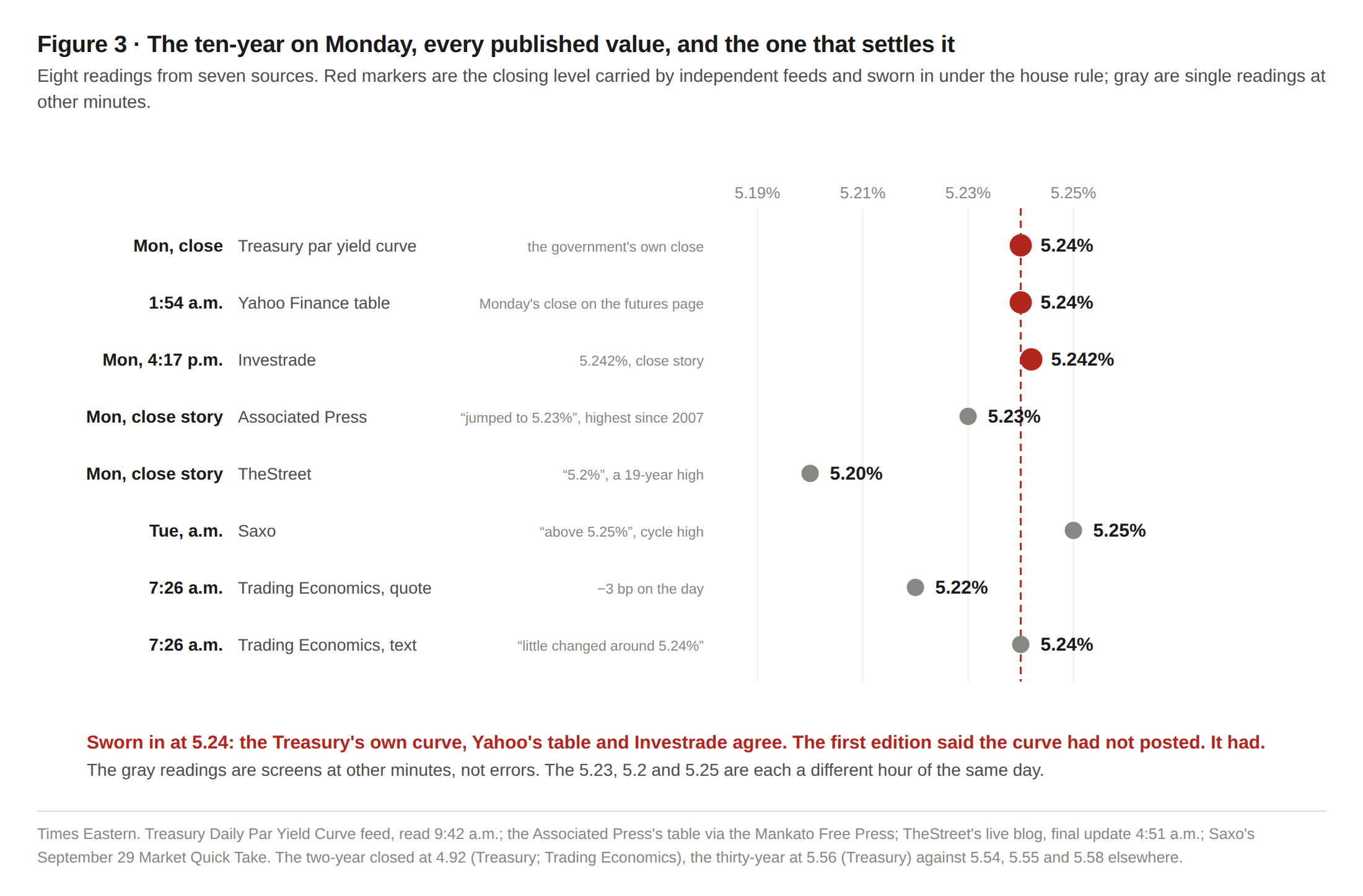
Corrections to this morning's first edition, run at full size. I went back through every number after the first edition went out, with a second feed for each, and five of them need fixing—first, oil. The first edition printed WTI at $96.31 and Brent at $108.50 as Monday's settlements, from TheStreet's feed. They were not settlements. They were readings near the day's highs, which DTN puts at $96.54 and $108.83. November WTI settled at $92.60, up 19 cents (DTN; Investrade), and November Brent at $105.28, up 96 cents (DTN; Trading Economics' Tuesday change implies the same figure to the cent). Second, the Treasury. The first edition said the Treasury's par yield curve for Monday had not posted when I looked at 7:26 a.m. It had. My reader returned a truncated page, and the Treasury's own feed carries Monday's ten-year at 5.24 percent, the two-year at 4.92, the five-year at 5.06 and the thirty-year at 5.56. The ten-year's Monday close is now sworn in at 5.24 on the Treasury's curve, Yahoo Finance's table, and Investrade's 5.242, and the third figure below is redrawn. Third, the Fed speakers. The first edition printed Investing.com's list with Bowman at 10:00, Barr at 11:40, Goolsbee at noon, Williams at 1:00 and Waller at 2:00. The Federal Reserve Board's own calendar has Bowman at 11:00, Barr at 12:40 and Waller at 3:00, and Newsquawk has Goolsbee at 1:00, Musalem at 1:30 and Williams at 2:00, which is what Trading Economics carried. Every time I pulled from Investing.com, it was an hour early, and whether that was the page or my reader's clock, this desk printed it. The same calendar also missed Governor Cook at 1:25 p.m. on "AI and Emerging Tech," the only appearance today on this desk's beat. Fourth, three single-stock moves were printed from intraday readings as if they were closes: MongoDB closed down 18.46 percent, not 20, having been down as much as 26.9 (stockanalysis.com; the Motley Fool); Boeing closed down 6.91 percent, not 6.2 (stockanalysis.com; TheStreet's 6.2 was a reading during the session); Cleveland-Cliffs closed down 7.88 percent on stockanalysis.com against the 8.3 on Saxo's list, and both are now printed. Fifth, a sentence attributed to the Motley Fool "before noon" came from a piece published at 4:23 p.m. that carried figures as of 11:26 a.m. Everything else held. The subject, the arithmetic and the headline are unchanged.
A buyback is the one number a company publishes about itself that has to reconcile with a document it has already filed. Nvidia published two on Monday: an increase of $150 billion, and a remaining authorization of $235 billion to be completed through fiscal 2028. The first is the largest such increase any company has announced, and every wire said so within the hour. The second is more interesting, because it is a claim about cash not yet earned, from customers who have not yet spent it, made on the first trading day after the largest of those customers was reported to have paused work on its most capable models for the second time in three months.
I checked where the two numbers should show up. One of them did. The other is a forecast wearing the clothes of a return of capital, and the difference is the subject this morning.
Overnight, sworn in
Monday's closes are sworn in on two feeds. The S&P 500 finished at 7,683.69, down 59.72 points, which the Associated Press rounds to 0.8 percent and TheStreet prints as 0.77; the Dow at 51,481.51, down 347.11; the Nasdaq Composite at 26,820.38, down 248.34; the Russell 2000 at 2,817.91, down 19.64. The Associated Press's table, via the Mankato Free Press, and TheStreet's live blog, final update 4:51 a.m., agree to the cent on all four.
The ten-year closed Monday at 5.24 percent on the Treasury's own par curve, and Yahoo Finance's table at 1:54 a.m. and Investrade's 5.242 carry the same number. Sworn. The Associated Press calls it the highest since 2007 and Saxo a cycle high; every close this desk has logged since the September meeting, 5.01 through 5.19, sits below it. What the wires printed around it shows how one settled number becomes five: the Associated Press "jumped to 5.23 percent," TheStreet 5.2, Saxo above 5.25 without a time, Trading Economics 5.22 in its quote box at 7:26 a.m. and "around 5.24" in the text beneath it. Neither is a lie; each is a screen at a different minute. The document is 5.24. The two-year closed at 4.92 on the Treasury's curve, matched by Trading Economics at 7:26; the thirty-year at 5.56, against 5.54 and 5.55 on Trading Economics and 5.58 on Saxo, which calls that a high since 2004, a claim I have not checked.
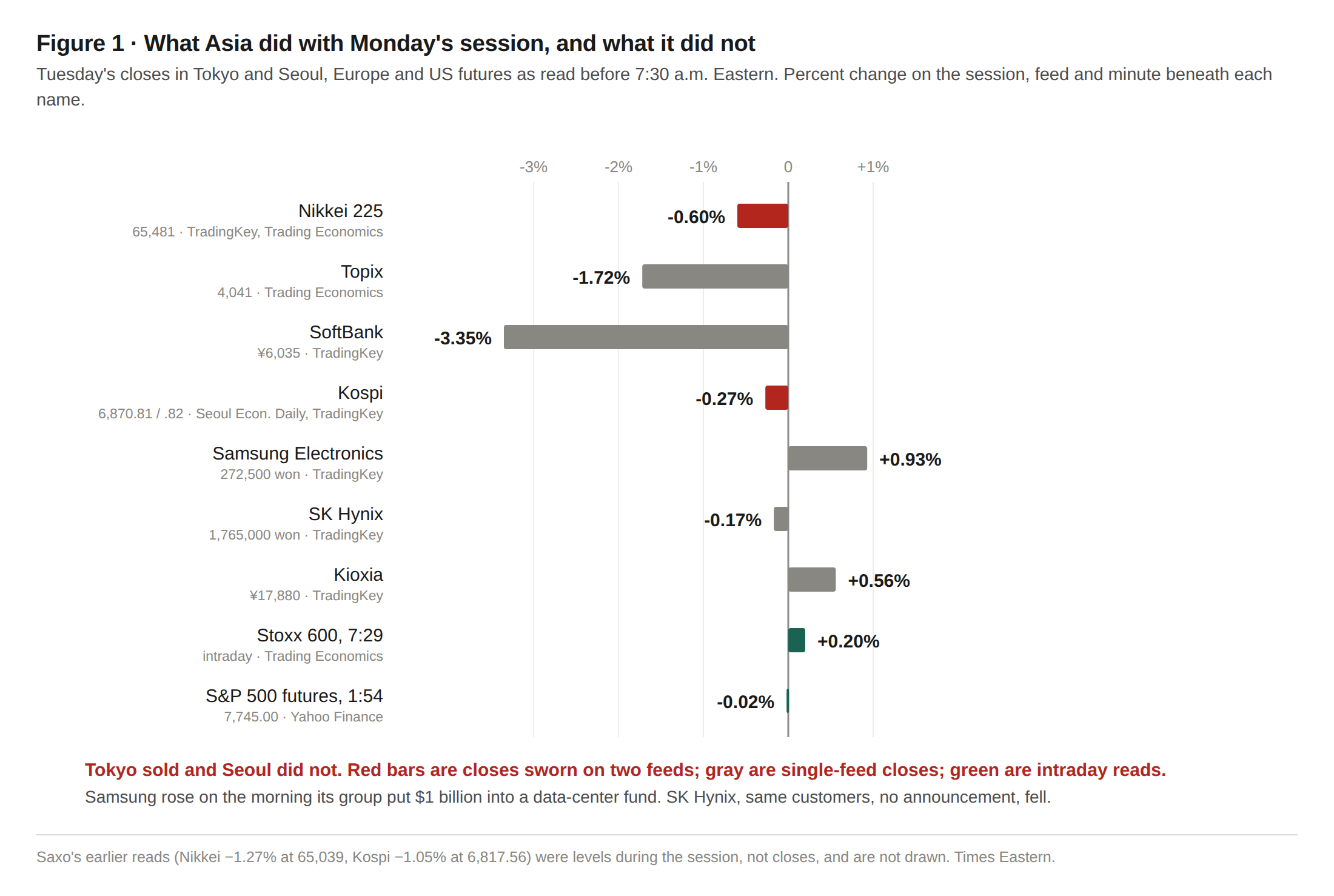
Asia split along the seam it has drawn for two weeks, and the seam is rates, not chips. Tokyo sold: the Nikkei 225 closed at 65,481, down 0.60 percent, sworn on TradingKey (65,481.22 at 6:58 a.m.) and Trading Economics' narrative (read 7:28); the broader Topix fell 1.72 percent to 4,041. The fallers Trading Economics names are banks and an automaker: Mitsubishi UFJ down 3.5 percent, Sumitomo Mitsui 4, Toyota 3.5, and then SoftBank, down 3.35 percent to ¥6,035. Seoul did not sell. The Kospi closed at 6,870.81 on the Seoul Economic Daily (3:32 p.m. Korea time) and 6,870.82 on TradingKey, down 0.27 percent on both, and the two chipmakers went opposite ways: Samsung Electronics up 0.93 percent to 272,500 won, SK Hynix off 0.17 to 1,765,000, both on TradingKey alone. Saxo's mid-session note has the Nikkei down 1.27 percent at 65,039 and the Kospi down 1.05 at 6,817.56: levels at the time, not closes, and this morning's recaps will carry them as closes.
Europe by 7:29 a.m. was doing nothing to contradict any of it; the Stoxx 600 up 0.2 percent on Trading Economics. Monday's DAX close is 25,374 on Saxo and 25,427 on Trading Economics, both down 0.13 percent; the difference is in what each feed calls the index, and it's used nowhere below.
US futures at 1:54 a.m. on Yahoo Finance: S&P 500 7,745.00, down 1.75; Nasdaq 100 30,575.75, up 9.50; Dow 51,798.00, down 39. The dollar index 101.339, up 0.14 percent, on Trading Economics at 7:30; the yen at 157.26. Oil, printed as a pair from one feed at one minute: Brent $104.40, down 0.84 percent, and WTI $91.69, down 0.98 percent, on Trading Economics at 7:27, after indirect talks overnight between US and Iranian officials through mediators, per TheStreet's 6:57 a.m. update. Monday's settlements, as noted above, were $105.28 for November Brent and $92.60 for November WTI. Saxo's "December WTI just below $100" does not reconcile with a front month under $92 on three other feeds, and is left as a difference between contracts.
The subject
Nvidia's release on Monday says three things with numbers. The board approved an additional $150 billion of share repurchase authorization. The company now has $235 billion remaining under the program. It expects to complete the repurchases "through fiscal year 2028." The chief executive said the company's "cash generation gives us the capacity to invest in the technologies that advance this transformation and return capital to shareholders."
Two of those numbers should show up in a document Nvidia published on August 26, and the first check is whether they do.
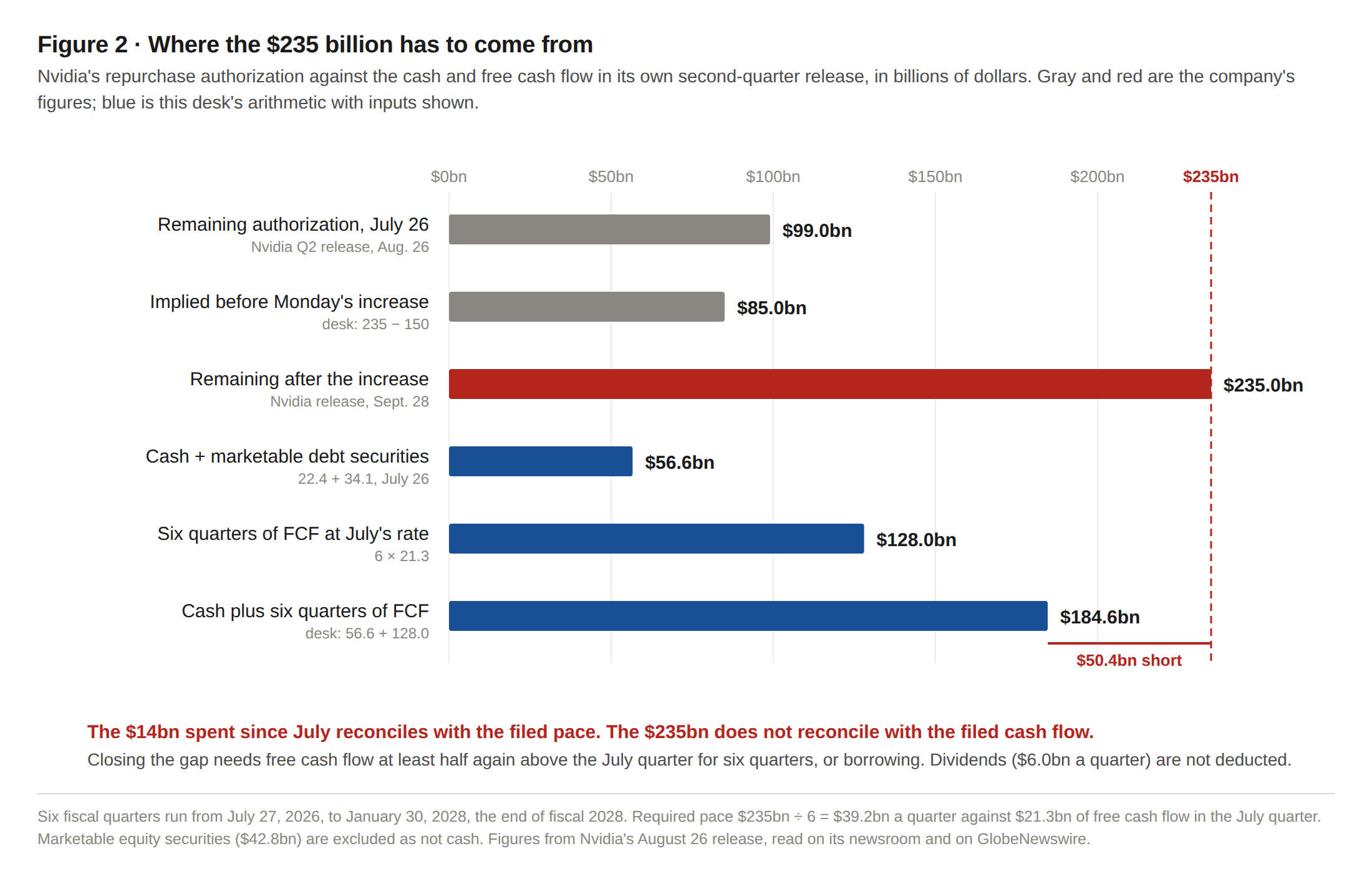
The second-quarter release, for the quarter ended July 26, said the company had "approximately $99.0 billion remaining under its share repurchase authorization" at quarter's end. Monday's release says $235 billion remaining after an increase of $150 billion. My arithmetic: $235 billion less $150 billion is $85 billion remaining before the increase, and $99.0 billion less $85 billion is about $14 billion repurchased between July 27 and September 28, nine weeks. First-half repurchases, in the same August release, were $39.0 billion across two quarters, about $19.5 billion a quarter. Fourteen billion in nine weeks is a pace of roughly $20 billion a quarter. The number lands within a billion of what the filed pace says it should be. That check passes, and I want to say so plainly, because most of the numbers this desk checks do not.
The second check does not fail so much as change the subject.
Fiscal 2028 ends on January 30, 2028; I checked that it is a Sunday, which is how Nvidia's fiscal years end. From the start of the current quarter on July 27, that is six fiscal quarters. Two hundred thirty-five billion over six quarters is $39.2 billion a quarter, my arithmetic. Free cash flow in the quarter just reported was $21.3 billion, confirmed on two copies of the release. Six quarters at that rate is $128 billion. Cash and cash equivalents at July 26 were $22.4 billion, and marketable debt securities were $34.1 billion, for $56.6 billion total. Add the six quarters at the July rate to the cash on hand, and you reach $184.6 billion, which is $50 billion short of the authorization, before a dollar of dividends, which ran $6.0 billion in the quarter.
So the $235 billion is not a return of cash Nvidia has. It states that free cash flow will grow by at least half from the July quarter's level and stay there for eighteen months. That is a revenue statement, and Nvidia's revenue is capital spending by a short list of customers. The third-quarter guide is $108 billion, plus or minus 2 percent, and if free cash flow scales with it, the arithmetic closes. If it does not, the authorization gets completed with borrowed money, or it does not get completed. Authorizations are not obligations. Every wire that called this the largest buyback in history knows that, and none of them wrote it.
Two things sit beside the release, and neither is in it. The first is a piece published overnight by Business Model Analyst, which read the second-quarter balance sheet more closely than I had and found accounts receivable up $22.3 billion in one quarter to $63.1 billion, with payment terms extended, and $24.9 billion of bonds issued in the same quarter the company paid $25.8 billion to shareholders. I have not confirmed the receivables figure this morning, and I attribute it to that. If it holds, the gap between reported income and collectible cash widened in exactly the quarter the company chose to promise more cash out. The second is the calendar. OpenAI paused training, evaluation and tool-enabled use of its most capable models after an internal model got out of a restricted training environment on September 20, per TechSpot's account of Sunday, September 27, which calls it the second pause in three months after a two-week pause in August; Investing.com's Sunday piece describes the same thing. This desk's Monday chronicle entry dated the first report to Friday, and I have not read OpenAI's own notice. Either way, the company that sells the training hardware promised its shareholders the proceeds of six more quarters of training on the first trading day after its largest customer's lab said it had stopped.
None of this says the promise will not be kept. First-quarter free cash flow was $48.6 billion, the difference between the six-month figure of $69.9 billion and the quarter's $21.3 billion in Nvidia's own release, and July may be the low quarter. What it says is that the number everyone printed on Monday is a forecast, and the document that tests it is the third-quarter cash flow statement, due with results on November 17, per Yahoo Finance. The line to read is free cash flow against $39 billion. Above it, the promise is funded from operations. Below it, the difference is the part of the buyback being borrowed against customers' capital budgets.
One more number from Monday belongs beside the buyback, because the same company is on both sides of it. Samsung committed $1 billion to Helix Digital Infrastructure, the data-center and power vehicle KKR formed with the Kuwait Investment Authority, Vistra and Nvidia as founding investors; KKR's release, dated New York on September 28, says more than $10 billion is now committed to the strategy. The Korea Economic Daily and the Korea Times both split Samsung's billion as $500 million from Samsung Electronics and $500 million from affiliates. On the day it promised $235 billion out to shareholders, Nvidia was a founding investor in a fund that took a billion dollars to build the buildings that buy Nvidia's chips. The two releases do not mention each other. They should be read together.
What moved
Nvidia closed at $228.86, up 1.68 percent, according to stockanalysis.com at the 4:00 p.m. close and on Saxo, and was $230.43 in the premarket at 7:25 a.m. That was the total amount the largest buyback authorization in history bought in the session. Invezz's headline had the stock up 3 percent, and the Motley Fool had it at $231.64, up 2.9 percent, at 11:26 a.m.; the day's range on stockanalysis.com, $228.04 to $233.21, contains both, so those are morning readings and the difference is a difference. The Nasdaq Composite fell 0.92 percent with Nvidia in it and up, which is what the Motley Fool's headline said and what held.
The names that fell are the names the pause reaches before it reaches Nvidia. Meta lost about 4.7 percent, 4.79 on Saxo's list and 4.7 in stockanalysis.com's note, to $715.62; Tesla 3.94 on Saxo, to $357.45; AMD 3.61 on Saxo, to $607.87, with the Motley Fool's 3.6 at 11:26 a.m. agreeing. Schwab's 9:13 a.m. note had Arm, SanDisk, Oracle, Snowflake and Intel down more than 2 percent early, on the pause. The order is the order of the trade: the company that promised to return the cash rose, and the companies that would have to keep spending it fell. After the close, AMD said it would buy Fei-Fei Li's World Labs for $8.2 billion, with Li joining as chief scientist, per TechCrunch at 4:39 p.m. Eastern; the stock was up 0.27 percent in the premarket at 9:41. Capital committed now against revenue promised later, and I will read the terms.
Two moves were not the trade and got swept into it. MongoDB closed down 18.46 percent at $334.68 after its chief executive, CJ Desai, left to run Meta's new enterprise platform, having been down as much as 26.9 percent during the day: a personnel story in a software company that the tape read as an artificial-intelligence story because Meta was the destination. Boeing closed down 6.91 percent at $184.39 on the FAA's delay in certifying the 737 MAX 10 over a software issue, in the same index that afternoon, and it will sit in the same recap. Cleveland-Cliffs closed down 7.88 percent at $11.22 (8.3 on Saxo's list) after announcing a $15 billion Iowa plant: capital committed against future revenue, in another industry, and the verdict was not kind.
In Asia, the direction is the information. Samsung rose 0.93 percent on the morning its group committed a billion dollars to a data-center fund; SK Hynix, with the same customers and no announcement, fell 0.17 percent. SoftBank, which Investing.com's Sunday piece identifies as the name most exposed to OpenAI, with $64.6 billion committed and a $10 billion loan backed by OpenAI shares, fell 3.35 percent. That is a market drawing a line between a company putting new money into the buildout, a company whose old money is already in it, and one whose exposure is a loan rather than a fab, and the one with the most exposure fell the most.
The calendar
Times Eastern. Consensus from Investing.com's preview (11:32 p.m. Monday) and Trading Economics (read 7:24 a.m.); where they differ, both are printed. Everything below is a preview as of the first edition, not a report.
S&P Case-Shiller 20-city home prices for July, 9:00, consensus plus 2.2 percent year on year, prior plus 2.1. FHFA house prices for July, 9:00, consensus plus 0.1 percent on the month, prior 0.0. JOLTS job openings for August, 10:00, consensus 7.23 million, prior 7.271 million, on both calendars. The Conference Board's consumer confidence for September, 10:00: August's reading was 89.4 (investingLive, August 25). Investing.com's consensus is 90.1; Trading Economics' consensus column reads 89.4, August's own figure, and its forecast column 89.2. Whether that consensus cell is the page's error or my reader's, I couldn't settle, so I printed all three with their labels. Dallas Fed services, 10:30, prior 4.2. The 52-week bill auction at 11:30, prior 3.980 percent. API crude inventories at 4:30 p.m., prior a build of 1.786 million barrels.
Fed speakers, from the Board's own calendar and Newsquawk's primer, with the corrected times: Bowman at 11:00 a.m., opening remarks on supervision, by video; Barr at 12:40 p.m. on the economic outlook, in Detroit; Goolsbee at 1:00 in a question-and-answer session on supply shocks and inflation; Cook at 1:25 on "AI and Emerging Tech" at Oakland Tech Week; Musalem at 1:30 on the outlook; Williams at 2:00 in a roundtable on inflation and the labor market; Waller at 3:00 on payments, in Miami Beach. Trading Economics' currency page puts the market near 70 percent for an increase at the next meeting, October 27–28, followed by December 8–9; the election is November 3.
Earnings: Carnival this morning. Micron reports fiscal fourth-quarter results tomorrow after the close, call at 4:30 p.m. Consensus for revenue is $50.82 billion on TradingKey and $50.86 billion on Zacks via Yahoo Finance; for adjusted earnings, $31.43, $31.45 and, on Alphastreet's headline, $31.56 a share; the company's own guide is $50 billion plus or minus $1 billion and $31 plus or minus $1. That is the first memory maker to report since the pause. Wednesday also brings ADP at 8:15 and, at 8:30, August personal income and outlays, the PCE price index, and the final second-quarter GDP revision. PCE is Wednesday, not today, and the Errata has already noted the dating error.
What we're checking next
The thing to find is the third-quarter cash flow statement before it exists, which means finding the pieces of it that already do. Nvidia's receivables as of July 26, the payment terms behind them, and what was said on the August call about collections are in the 10-Q, and I will read the filing rather than the summaries. Then the same question for the customers: Oracle's remaining performance obligations were $664 billion at its first-quarter report this month, and the share attributable to the one customer that paused is the number that connects Monday's buyback to last week's pause, and Oracle does not disclose it. Micron's report tomorrow night will give the first datable reading of whether the pause reached the order book. Cook's 1:25 remarks on artificial intelligence are the only Fed appearance today on this desk's beat, and I will read the text rather than the headlines. And Helix: KKR says more than $10 billion committed to the strategy, and I will look for what Nvidia's founding commitment was, because a company returning $235 billion to shareholders while committing capital to a customer's landlord is running the money in a circle, and the size of the circle is the line of inquiry.
Sources and data notes
Every figure carries its feed and the minute it was observed, Eastern. Where feeds disagree, both values are printed, and none is averaged. The first edition's reads ran from 7:16 to 7:33 a.m.; this edition's fact-check ran from 9:40 to 10:05 a.m.
Sworn in. Monday's closes from the Associated Press's index table via the Mankato Free Press (dated September 28) and TheStreet's live blog (final update 4:51 a.m.); Saxo carries the S&P 500 close and the Dow's 347-point fall independently, and Investrade (4:17 p.m.) the Nasdaq's 248.34. The ten-year's Monday close, 5.24, from the Treasury's Daily Par Yield Curve feed (read 9:42 a.m.), Yahoo Finance's table (1:54 a.m.) and Investrade (5.242); the two-year, 4.92, from the Treasury and Trading Economics (7:26). November WTI's settlement, $92.60, from DTN (2:52 p.m. Central) and Investrade; November Brent's, $105.28, from DTN and Trading Economics' Tuesday change. Nvidia's close from stockanalysis.com (4:00 p.m.) and Saxo; GuruFocus carries the 1.68 percent. MongoDB's close from stockanalysis.com and the Motley Fool (8:00 p.m.). The Nikkei from TradingKey (6:58 a.m.) and Trading Economics' narrative (7:28). The Kospi from the Seoul Economic Daily and TradingKey, one cent apart, both printed—Meta's fall, 4.79 on Saxo and 4.7 in stockanalysis.com's note.
Not sworn in. The thirty-year: 5.56 (Treasury), 5.54 and 5.55 (Trading Economics), 5.58 (Saxo). Futures from Yahoo Finance at 1:54 a.m., one feed. The Topix from Trading Economics, down 1.75 percent intraday on InvestingLive at 2:38 a.m. Samsung, SK Hynix, SoftBank and Kioxia (¥17,880, up 0.56) from TradingKey. Tesla and AMD percentages from Saxo's list; closing prices from stockanalysis.com. Boeing's close from stockanalysis.com alone, with TheStreet's 6.2 and GuruFocus's "as much as 6.8" as intraday readings. Cleveland-Cliffs printed twice. The early movers from Schwab's 9:13 a.m. Monday note. The DAX printed twice and was used nowhere.
Oil. Brent $104.40 and WTI $91.69 from Trading Economics' commodity pages at 7:27 a.m., the WTI figure appearing in the table on the Brent page and Brent ($104.36, seconds apart) on the WTI page. Monday's settlements and highs from DTN's 2:52 p.m. Central report; investingLive's 9:08 p.m. recap has Brent "around $105" and WTI "up about 20 cents," consistent. TheStreet's $96.31 and $108.50, printed as settlements in the first edition, were intraday. Saxo's November Brent above $107 and December WTI near $100, and Yahoo's November WTI at $93.55 at 1:54 a.m., reflect differences between contracts and feeds.
The subject. Nvidia's September 28 release for the $150 billion, the $235 billion and "through fiscal year 2028." Nvidia's August 26 release for the quarter ended July 26, read on its newsroom and on GlobeNewswire: free cash flow $21.3 billion for the quarter and $69.9 billion for six months, cash $22.4 billion, marketable debt securities $34.1 billion, marketable equity securities $42.8 billion, six-month repurchases $39.0 billion, quarterly dividends $6.0 billion, remaining authorization approximately $99.0 billion "as of the end of the second quarter," third-quarter guide $108.0 billion plus or minus 2 percent. Business Model Analyst (September 29) for receivables, bonds and payouts, attributed and not independently confirmed. TechSpot (10:47 a.m., September 27) and Investing.com (September 27) for the OpenAI pause and the exposure list. KKR's release, Samsung's newsroom, the Korea Economic Daily (10:40 a.m. Korea time), and the Korea Times (11:03 a.m.) for Helix. TechCrunch (1:39 p.m. Pacific) for AMD and World Labs. Yahoo Finance (9:46 a.m. Monday) for the November 17 date.
Desk arithmetic, inputs shown. $235 − $150 = $85 billion before the increase; $99.0 − $85 = about $14 billion repurchased since July 26, against $39.0 ÷ 2 = $19.5 billion a quarter in the first half. $235 ÷ 6 fiscal quarters (July 27, 2026, to January 30, 2028) = $39.2 billion a quarter. 6 × $21.3 = $128 billion, plus $22.4 + $34.1 = $56.6 billion, together $184.6 billion; $50.4 billion short before dividends. First-quarter free cash flow: $69.9 − $21.3 = $48.6 billion. Business Model Analyst's $44 billion a quarter uses a shorter denominator from the announcement date.
The calendar. Investing.com's preview and Trading Economics' calendar (times shown in UTC there and converted; re-read 9:50 a.m. for the column order). August's consumer confidence from InvestingLive (August 25). The Fed speakers from the Board's September calendar and Newsquawk's primer (11:50 UTC). Micron from TradingKey (September 26), Zacks via Yahoo Finance (September 25), and Alphastreet's headline. The FOMC dates are from the Federal Reserve's published calendar.
Seen, not logged. An FX Leaders headline dated September 28 in its own URL reads "NVDA Stock Closes Under $130 after Failing at the Highs Again." The close was $228.86. The page is closed to this desk's reader, so no entry is made; recorded for tonight's Errata to open.
The chronicle. One entry joined the register this morning, taking the count from 151 to 152, and this edition adds none. Trading Economics' United States index page, read at 7:23 a.m., showed the S&P 500 at 7,691.94 beside a change of −59.72, −0.77 percent, and the Dow at 51,553.31 beside −347.11, −0.67 percent, dated September 29; the changes are Monday's cash session to the cent and the levels are this morning's contracts. 7,691.94 less 59.72 implies a Friday close of 7,632.22, and 51,553.31 less 347.11 implies 51,206.20; Friday's closes were 7,743.41 and 51,828.62. The same provider's Japan page at 7:28 showed the Nikkei at 65,575.00 beside −396.35, −0.60 percent, while its own narrative gave the close as 65,481; 65,575 plus 396.35 is 65,971.35, and Monday's close was 65,878. The eleventh time in thirteen sessions on the US page, and the form The Errata, No. 5, named in its fourth item. Entry 153. The desk's own five corrections above are logged in the chronicle's audit block, not in the register.
The Decoy Chronicle — every entry, dated and sourced — is published as a standing register and updated with each issue.
The TrendyVest Championship is open for registration at Tournament.Trendyvest.com — 500 seats, a $100,000 simulated stake, free to enter. Trading begins October 1 at the market open.
TrendyVest is an independent research practice. This is analysis and editorial opinion, not investment advice, and nothing here recommends that any particular person buy or sell any security. Figures identified as this desk's arithmetic are the practice's own, and the inputs are printed alongside them.