MORNING BRIEF
Morning Brief October 1st 2026
Micron's Customers Put Down More Cash Last Quarter Than Micron Spent on Its Factories
Second edition. This issue was fact-checked between 10:39 and 10:45 a.m. Eastern, and one thing in the first edition was wrong. It called Tencent's agreement with Oracle a data center lease. It is a Financial Times report, from two people with knowledge of the matter, that Tencent has leased 100,000 artificial intelligence chips in Oracle's Southeast Asian data centers for $7 billion over five years. The first edition also gave one survey's revenue estimate for Micron as the estimate; there are two, and both are now printed. The other changes are second feeds: the Kospi's and the Topix's closes, the contract months behind the oil quotes, a third reading of Micron's close, and checks on Amazon's and Microsoft's capital budgets.
This issue is late, and the reader should know by how much. The run that builds the Brief started at 7:15 a.m. Eastern, and its clock was not read again until 9:39, nine minutes after the opening bell. Wednesday's closes, Micron's release, and the overnight notes were read somewhere in that gap, at minutes this desk did not record. The rest was read between 9:37 and 9:52, and the section on October and the fourth quarter between 10:18 and 10:26. The morning's releases had printed by then. None is reported here; each appears in the calendar with its consensus and prior, and the figures are left to tonight's Errata.
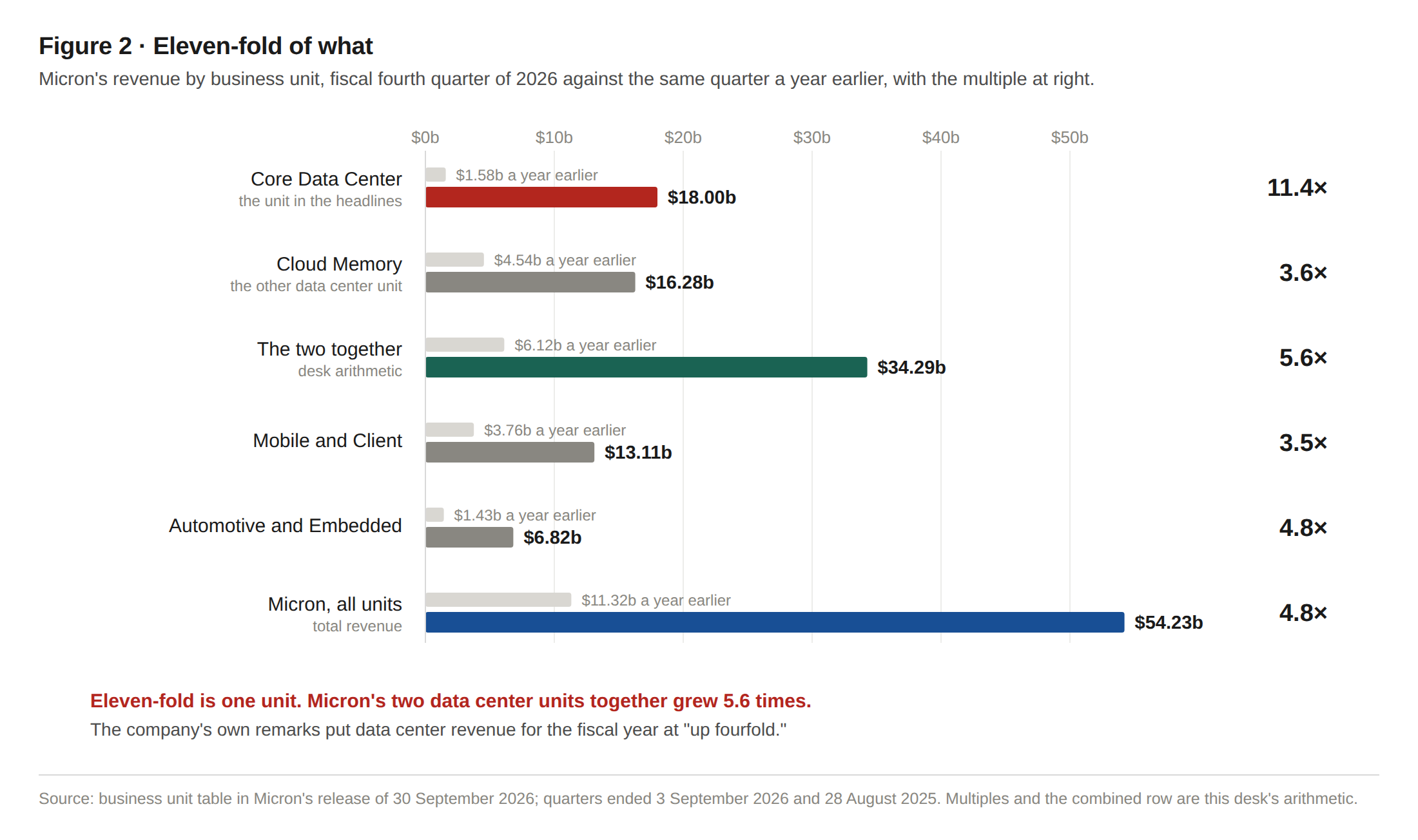
Micron Technology reported on Wednesday afternoon, and the number in the headlines was eleven. Data center revenue, they said, rose eleven-fold.
The number worth a morning is thirty-two. Micron says its customers have made $32 billion of financial commitments to secure memory, "the vast majority of which are cash deposits." That figure has an address. A deposit is cash on one statement and a liability on another, and Micron published both at 4:01 p.m.
I went and read them. $12.7 billion had arrived by the balance sheet date. In the quarter it arrived, it was more than Micron spent on its factories.
Today is also the first session of the fourth quarter. The quarter just ended, the history that will be quoted at this one and its dates have a section of their own below.
Overnight, sworn in
Wednesday's closes are sworn. The S&P 500 finished at 7,651.54, down 19.30 points, or 0.25 percent. The Dow closed at 50,906.05, down 443.87, or 0.86 percent. The Nasdaq Composite closed at 26,861.06, up 63.52, or 0.24 percent. The Associated Press carried all three at 4:16 p.m., and a Benzinga note on Yahoo Finance carried them to the cent late Wednesday. The Russell 2000 closed at 2,796.86, down 11.06, on the AP and on Trading Economics.
The ten-year Treasury closed at 5.29 percent on the Treasury's own par curve, and at 5.289 on TheStreet. The two-year closed at 4.88 and 4.879 on the same two sources. The thirty-year is not sworn: 5.64 on the Treasury's curve, 5.632 on TheStreet, 5.652 on Benzinga.
Then Asia opened on Micron and split.
Tokyo took the report whole. The Nikkei 225 closed at 68,957, up 2,203 points, or 3.3 percent, on Trading Economics and on News On Japan; a third report gives 68,956.72. Seoul took about half as much. The Kospi closed at 6,971.35, up 133.31, or 1.95 percent. In the first edition that close rested on Trading Economics alone. The Korea JoongAng Daily carries the same change and prints the level two ways, 6,917.35 in its text and 6,971.35 under its photograph. The Seoul Economic Daily's 1:33 p.m. reading implies a prior close of 6,838.04, and 6,838.04 plus 133.31 is 6,971.35. Hong Kong and the mainland were shut for National Day, and the mainland reopens on October 8.
The seam did not run between Asia and Europe. It ran through Tokyo. The Topix closed up 0.57 percent at 4,131.98, about a sixth of the Nikkei's gain, with banks down 2.44 percent and insurers down 2.31, on a market report carried by Rallies. Investing.com's close story counts 1,896 falling stocks on the Tokyo exchange against 1,548 rising. An index rose three percent on a day when more stocks fell than rose. Sydney fell about two percent: 2.28 on Trading Economics, 2.0 in a midday wire report. Europe was lower at 9:46: the Stoxx 600 at 631.12, down 0.59 percent; the FTSE 100 down 0.94; the CAC 40 down 0.95; the DAX down 0.11, all on Trading Economics.
New York was open by the time these were read, and this note uses no index levels from this morning's session. ZeroHedge's note, with figures as of about 8:00, had the ten-year at 5.27 percent after an overnight peak of 5.34, which it called the highest since 2002.
Oil travels as a pair. Trading Economics, between 9:37 and 9:39, had West Texas Intermediate at $90.53 and Brent at $98.31, up 0.12 and 0.29 percent, with no contract month named. Investing.com's Tokyo close story names them: November WTI at $90.82, up 40 cents, and December Brent at $98.55, up 52 cents. That puts Wednesday's settlements at $90.42 and $98.03, the same bases Trading Economics' changes imply. ZeroHedge, as of about 8:00, had WTI up about 2 percent near $92 and Brent up 2.6 percent above $100, which on those bases is $92.23 and $100.58. The feeds agree on the contracts, and most of the morning's gain had gone by 9:37.
The subject
Start with what Micron published. Revenue for the fiscal fourth quarter, which ended September 3, was $54.23 billion, up from $11.32 billion a year earlier. Gross margin was 87.0 percent on the company's adjusted basis. The guide for the current quarter is $61.5 billion, give or take $1.5 billion.
Underneath that sits a claim about the future. Micron says it has signed 26 strategic customer agreements, which it estimates will account for more than 35 percent of its revenue through 2030. Three-quarters of that estimated revenue has "a defined pricing framework," most of it "pricing bands with floor and ceiling prices." And for those agreements, the prepared remarks say: "financial commitments from customers have increased to $32 billion, the vast majority of which are cash deposits." Investing.com puts the June figure at $22 billion.
That is the published number. Here is where it should show up.
A cash deposit from a customer is a receipt on the cash flow statement and a liability on the balance sheet until the goods ship or the money goes back. Micron's cash flow statement for fiscal 2026 has the line: proceeds from customer contract liability deposits, $12,747 million. Its balance sheet shows noncurrent customer contract liabilities of $12,895 million, up from $568 million at the end of May and $142 million a year earlier. The remarks agree: $12.3 billion of deposits were received in the quarter, and $12.7 billion was on the balance sheet at quarter-end.
So the number showed up, and two-fifths of it is cash. The other $19.3 billion, which is this desk's subtraction, is a commitment that had not become a receipt by September 3.
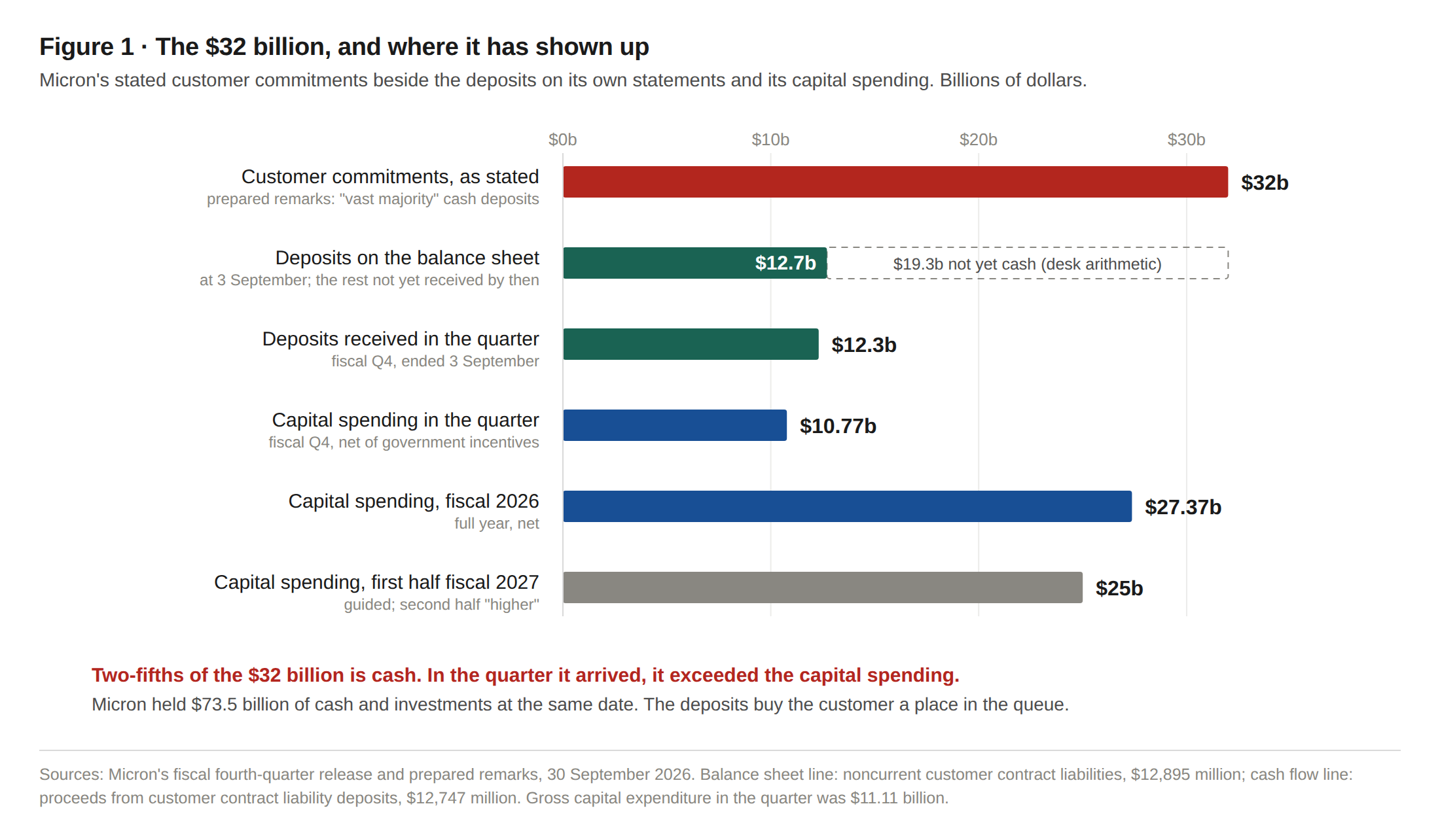
Now set the receipt beside the spending. Micron's capital expenditure in the quarter was $10.77 billion net of government incentives, and $11.11 billion gross on the cash flow statement. Its customers put down $12.3 billion in the same quarter. On either measure, buyers' deposits exceeded the builder's capital spending.
It would be easy to say that customers are financing the buildout, and it would be half right. Micron does not need the money. It ended the quarter with $73.5 billion of cash and investments against $5.2 billion of debt, and generated $43.97 billion of operating cash in the quarter alone. The company says the deposits are unrestricted and "will be returned to customers over time, toward the latter half of each agreement's term, assuming minimum purchase requirements are met."
A buyer has lent money to a supplier with $68 billion of net cash, to be repaid years from now and only if the buyer takes its minimum. In exchange, it gets a place in the queue and a price ceiling. Nobody does that because the supplier lacks capital. They do it because the thing in short supply is the memory.
This desk's standing question is capital committed now against revenue promised later. Here both halves sit inside one contract, and only one side has been published. The matching asset, a prepayment to a supplier, belongs on the balance sheets of the companies that wrote the cheques.
A second pair of numbers in the remarks didn't match. Micron gives its remaining performance obligations, the revenue it is contractually owed for goods not yet delivered, as "approximately $150 billion." It also says the agreements represent more than 35 percent of revenue through 2030. If those represented the same revenue, total revenue through 2030 would be at most $429 billion ($150 billion divided by 0.35). At the guided $61.5 billion a quarter, that is seven quarters of sales, and the period runs sixteen or seventeen quarters. The likelier reading is that the $150 billion counts only the contractual minimum and the 35 percent is what Micron expects. The remarks do not say, and I leave it open. It matters, because a firm number and a hoped-for number are easily quoted as one.
And the spending is going up. Micron projects capital expenditure of about $25 billion for the first half of fiscal 2027 and says the second half will be higher. By its own numbers, that is more than $50 billion for the year, up from $27.37 billion net in fiscal 2026. It says it has raised the plan, that most of the increase is construction, and that the visibility the agreements give it is part of the reason. Idaho's first fab is due to produce wafers in mid-2027 and New York's in 2030. Deposits taken this summer sit against buildings whose first output is anywhere from nine months to four years away.
As for the eleven: it is real, and it is one unit. The Seoul Economic Daily, at 4:55 a.m. Eastern, ran the headline "Micron Data Center Revenue Jumps 11-Fold on AI Demand" over the sentence "The data center business drove the record, with revenue of $18 billion, more than 11 times the $1.577 billion posted a year earlier." Those figures are for Core Data Center, one of two Micron units that sell into data centers. By the company's own definitions, Core Data Center has the server makers and data center storage, and Cloud Memory has the large cloud companies and high-bandwidth memory. Cloud Memory went from $4.54 billion to $16.28 billion, which is 3.6 times. Together, they went from $6.12 billion to $34.29 billion, which is 5.6 times, and Micron's own remarks put data center revenue for the fiscal year at "up fourfold." CNBC's headline carries the same eleven; its page would not open for me, so I cannot say what its body does with it.
What moved
Micron fell. It closed nearly flat on Wednesday, before the release. It slipped after hours on a quarter that beat the revenue estimate by 7.5 percent on Investing.com's consensus and by 6.33 percent on Zacks's, with a guide above estimates. It was lower again after this morning's open.
The close is two numbers. Stockanalysis.com carries $1,065.11, up three cents from Tuesday's $1,065.08. Investing.com's account at 5:46 p.m. and Trading Economics give $1,066.10, up $1.02. Two feeds to one would settle it, except that the same Investing.com page had the stock at $1,056.75 after hours, down 0.78 percent, and 0.78 percent is the distance from $1,065.11, not from $1,066.10. Both are printed. Stockanalysis.com's page, stamped 9:37 this morning, had it at $1,048.63, down $16.48, or 1.55 percent, after an open of $1,054.08. Its table, read again between 10:40 and 10:42, had $1,032.08, down 3.10 percent. Those are intraday readings, not closes.
The explanation on offer is the margin: Micron guided it to about 86.25 percent from 87.0 and called that the floor for the year. The plainer explanation is the one this piece has been following. The news in the report was not that Micron will earn more. Everyone expected that. The news was that it will spend more, and has agreed to ceilings on what it can charge.
Follow the spending and the overnight tape sorts itself. In Tokyo, Lasertec closed up 11.1 percent, Advantest 9.8, Murata 8.4 and Kioxia 5.6, each on at least two feeds, and Taiyo Yuden 8.3 on Trading Economics alone. In Seoul the feeds differ. Trading Economics has SK Hynix up 3.10 percent and Samsung Electronics up 2.61 at the close; the Korea JoongAng Daily has 3.21 and 2.79, at 1.83 million won and 276,000 won.
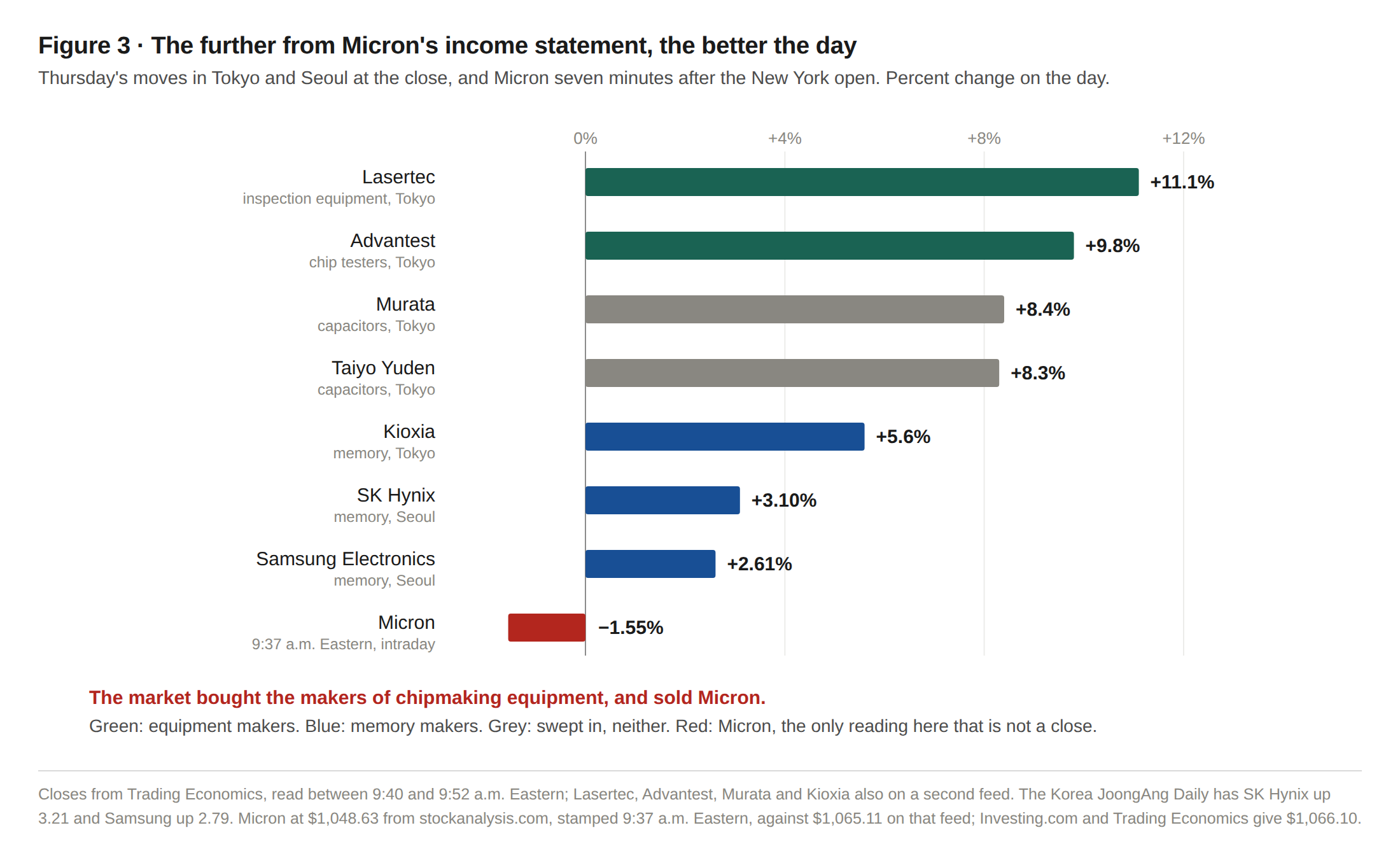
Put those in order. Chip inspection and testing companies rose about ten percent. Micron's memory competitors rose roughly three to six percent. Micron fell. The further a company stands from Micron's income statement, and the closer it is to a chipmaker's capital budget, the better its day. The market read a record quarter as a purchase order.
Some of what rose beside it was not this trade. Murata and Taiyo Yuden make capacitors, not memory or the machines that build it. Seoul had a number of its own: September chip exports of $60.3 billion, the first month above $60 billion, on the trade ministry's figures in the Korea Times and the Seoul Economic Daily. And ZeroHedge's premarket list, as of about 8:00 and not settled, had Constellation Energy up 3 percent and Oracle up 1.9. Constellation's news is a twenty-year agreement, announced Wednesday, to sell Amazon 690 megawatts from Calvert Cliffs, 190 of them new capacity due between 2030 and 2032. Oracle's is the Financial Times report that Tencent has leased 100,000 artificial intelligence chips in its Southeast Asian data centers for $7 billion over five years, with about 30 percent paid up front. Neither has anything to do with memory, though the second is the morning's other prepayment.
The calendar
All times Eastern. Consensus and prior are from Trading Economics, read between 9:37 and 9:39, checked against FinancialJuice's morning note. The three releases below had printed before this issue went out. None is reported.
At 8:30, initial jobless claims for the week ended September 26: consensus 200,000, prior 197,000.
At 9:45, S&P Global's final September manufacturing index: consensus 57.0, unchanged from the flash, against 53.9 in August.
At 10:00, the ISM manufacturing index for September: consensus 55 on both feeds, from 54.6. The prices index, on Trading Economics alone: consensus 72.3, from 71.1. Last night's Errata printed 54.8 and 72.9 from another survey; the two sets differ, and both are on the record.
The Federal Reserve Board's calendar lists four speakers: Governor Waller at 10:00; Vice Chair Jefferson at 1:30 on the economy and monetary policy; Vice Chair for Supervision Bowman at 3:00; and Governor Cook at 3:30. Other feeds add Presidents Barkin, Collins and Schmid on a panel at 9:05.
Tomorrow at 8:30 is the September employment report: consensus payrolls of plus 90,000, from plus 162,000, and an unemployment rate of 4.1 percent, unchanged, on Trading Economics; Bloomberg's preview headline carries the same 90,000 and 4.1.
October and the fourth quarter
The quarter that ended last night was two quarters. From the Associated Press's closes of June 30 and September 30, the Nasdaq Composite gained 2.47 percent, the S&P 500 gained 2.03 percent, the Dow lost 2.70 percent, and the Russell 2000 lost 7.52 percent. That is this desk's arithmetic, and Investrade's review prints 2.5, 2.0 and 2.7 for the first three. September alone took 4.29 percent off the Dow and 0.45 off the S&P 500. For the year, the Nasdaq is up 15.6 percent, the Russell 12.7, the S&P 500 11.8 and the Dow 5.9, on the AP.
The quarter also changed the price of money. The Federal Reserve raised its target range to 3.75 to 4.00 percent on September 16, by a vote of 12 to 0, its first increase since July 2023. On the Treasury's par curve the ten-year closed at 4.79 percent on September 1 and at 5.29 on September 30, fifty basis points in a month. Its first close above 5 percent was September 16, and it touched 5.304 on Wednesday, which Investrade calls its highest since May 2002. I read the split between the indexes as a split between companies paid by the buildout and companies that borrow at the new rates. That is a reading, not a finding.
The history that will be quoted this month comes with a condition. In midterm election years since 1950, October has been the S&P 500's best month: up 3.0 percent on average and higher 73.7 percent of the time, which is fourteen years out of nineteen, with November adding 2.7. Those are Carson Group's figures, carried by Fortune and Yahoo Finance on September 23. J.P. Morgan's version, in the same Fortune piece, is that the index "has historically been slightly negative on average in each of the first three quarters of midterm years, before averaging a 6.6% gain in the fourth quarter." Across all years since 1950, the fourth quarter averages 4.2 percent, per Jay Woods of Freedom Capital Markets on Benzinga, who also calls October "the most volatile month of the second half of the year."
The midterm pattern, as J.P. Morgan describes it, is a recovery from three weak quarters. This year the S&P 500 arrives at October up 11.8 percent, while the Dow and the Russell arrive off a losing quarter. The precedent's starting condition holds for part of the market and not for the rest. An average of nineteen years cannot say which part matters, and this desk does not forecast.
What October does have is dates. September's consumer price index is Wednesday, October 14, at 8:30, on the Bureau of Labor Statistics' schedule. TSMC holds its third-quarter conference on Thursday, October 15, at 2:00 a.m. Eastern. The Federal Open Market Committee meets on October 27 and 28, with a press conference at 2:30 on the 28th. Futures call it close to a coin flip: after Wednesday's inflation report, CME FedWatch, as carried by Phemex and PANews, showed 52.9 percent for no change, 47.1 percent for a quarter-point increase, and 90 percent for at least one increase by the meeting of December 8 and 9. A week earlier, per BeInCrypto on Yahoo Finance, October stood at 70 percent for an increase.
Microsoft, Alphabet and Meta are projected to report after the close that same Wednesday, and the word Wall Street Horizon puts on all three dates is "unconfirmed." MarketBeat estimates Amazon for Thursday the 29th. At 8:30 that Thursday, the Bureau of Economic Analysis publishes third-quarter GDP and September's personal income and outlays together. The election is the following Tuesday, November 3. October's CPI follows on November 10, and Nvidia is confirmed for November 17 on Wall Street Horizon's calendar.
If the projected dates hold, the Fed's decision, three of the four largest capital budgets in the buildout, the quarter's growth figure and the Fed's preferred inflation measure arrive inside a single day, six days before a vote.
Those budgets are this desk's focus this quarter. Alphabet's 2026 guidance is $195 billion to $205 billion, raised on July 22 from $180 billion to $190 billion, per Data Center Dynamics and The Motley Fool. Meta's is $130 billion to $145 billion, which this desk checked against its filing on September 22. Amazon's is about $220 billion, raised from $200 billion on its July call; Benzinga's account gives the reason as soaring memory chip prices, and CNBC's headline says higher memory costs. Microsoft's is about $175 billion for calendar 2026, lowered from about $190 billion by an accounting change and not a spending change: it extended the useful lives of its data centers from 15 years to 25, and more of its future leases fall outside capital expenditure (CFO Dive; Yahoo Finance). A tally by MLQ on August 2 sums the four to $720 billion to $745 billion. On Microsoft's old basis it is $735 billion to $760 billion.
Micron's $50 billion-plus is what one supplier is spending to meet it, and Amazon has already said what memory prices did to its budget. The late-October calls are the first scheduled chance to ask those four what 2027 costs look like, and which of them has a receipt from Micron.
What we're checking next
The other side of the deposit. Micron has $12.7 billion of customer deposits on its balance sheet and named none of the customers in what I read. The asset has to sit somewhere: a supplier prepayment, a long-term deposit, a purchase commitment in the notes. If $12.3 billion left the buyers' accounts over the summer, it will show up in the quarterly filings after the late-October reports and in the ones just before them, and its size will say who is buying certainty.
The terms. The remarks give one: the money comes back late in each agreement, if the customer has bought its minimum. The annual report should say whether the deposits carry interest, what happens to them if Micron fails to deliver, and how wide the band is between floor and ceiling.
The $150 billion against the 35 percent. One is a contract, and one is an estimate, and the filing should show which revenue is firm.
And Seoul. SK Hynix and Samsung sell the same product to the same buyers and report their September quarters in the coming weeks. If they hold deposits on this scale, this is how memory is now financed. If they do not, the question becomes what Micron gave up to get them.
Sources and data notes
Times are Eastern. The desk's clock was read at 7:15 a.m. and next at 9:39. Pages read in between carry no recorded minute and are marked unrecorded; the last group of them was fetched alongside a page that stamps itself 9:37 and is given as 9:37 to 9:39. After that the clock was read between groups, and reads are given to those windows: 9:40 to 9:46, 9:46 to 9:47, 9:47 to 9:52, and, for the October section, 10:18 to 10:26. Three sentences of Micron's remarks were re-read at 10:14. The fact check ran from 10:39 to 10:45.
Sworn in. The S&P 500, Dow and Nasdaq Composite closes: the Associated Press via ABC News, stamped 4:16 p.m., and Benzinga via Yahoo Finance, both unrecorded. The Russell 2000: the AP and Trading Economics, 9:37 to 9:39. The ten-year and two-year: the Treasury's par curve, 9:37 to 9:39 and again in the fact check, and TheStreet, unrecorded. The Nikkei 225: Trading Economics' narrative, 9:40 to 9:46, News On Japan, 9:47 to 9:52, and Rallies in the fact check. The Kospi: Trading Economics, 9:47 to 9:52; the Korea JoongAng Daily, read twice in the fact check; the base from the Seoul Economic Daily, 9:46 to 9:47.
Not sworn in. The thirty-year. Europe and Sydney: Trading Economics' indices page, 9:46 to 9:47. Sydney at midday and the mainland's reopening date: a wire report on Yahoo Finance UK, unrecorded. The Topix's close and Tokyo's sectors: Rallies, one feed. Tokyo's breadth: Investing.com's close story, one feed. The ten-year's overnight peak and the premarket list: ZeroHedge, unrecorded, after 8:00 on the evidence of its contents. Seoul's single-stock closes, where Trading Economics and the Korea JoongAng Daily differ.
Oil. WTI $90.531 and Brent $98.312 on Trading Economics, 9:37 to 9:39, one page, one read. Contract months, $90.82 and $98.55: Investing.com's close story, in the fact check. Implied bases, this desk's subtraction: $90.42 and $98.03 on both feeds.
Micron. The release, stamped 4:01 p.m. Wednesday, unrecorded, and its tables on Micron's investor site, 9:40 to 9:46 and twice in the fact check. The prepared remarks, 9:37 to 9:39, 9:40 to 9:46, 10:14 and in the fact check. Unit definitions: Micron's reorganization release of April 17, 2025. Estimates: Investing.com, stamped 5:46 p.m., unrecorded, and Zacks via Yahoo Finance. The close: stockanalysis.com and its history table, Investing.com, and Trading Economics. The June figure of $22 billion: Investing.com, one feed. Pages reach the desk through a reader that relays their text. Every sentence quoted from the remarks was read at least twice, and the two statement lines, $12,747 million and $12,895 million, now twice.
What moved. Tokyo's closes: Trading Economics, Rallies and Investing.com's close story. Chip exports: the Korea Times. Calvert Cliffs: Constellation's release of September 30. Tencent and Oracle: the Financial Times as reported by Investing.com; the FT's own page was not read. All in the fact check.
The calendar. Trading Economics, 9:37 to 9:39, its times converted from UTC; FinancialJuice and the Federal Reserve Board's calendar, 9:47 to 9:52. Bloomberg's headline was seen in search and its page not opened.
October and the quarter. Read between 10:18 and 10:26 unless marked. June 30 closes: the Associated Press via Yahoo Finance. Rounded quarter figures and the ten-year's Wednesday touch: Investrade. The September 16 increase and its vote: Schwab, in the fact check, and the register, entry 121. Meta's range: the register, entry 123. Midterm history: Fortune, Yahoo Finance and Benzinga; J.P. Morgan's and Mr. Woods's figures each rest on one outlet. Dates: the Bureau of Labor Statistics, the Bureau of Economic Analysis, TSMC, Wall Street Horizon for Microsoft, Alphabet, Meta and Nvidia, and MarketBeat for Amazon. Odds: Phemex and, in the fact check, PANews, dated September 30; BeInCrypto via Yahoo Finance, dated September 29. Budgets: Data Center Dynamics and MLQ; and in the fact check The Motley Fool, Benzinga, CFO Dive and Yahoo Finance. CNBC's Amazon headline was seen in search and its page not opened. None of the four budgets except Meta's has been read in the company's own document.
Desk arithmetic. $32 billion less $12.7 billion is $19.3 billion; $12.7 billion over $32 billion is 40 percent. $12,895 million less $568 million is $12,327 million, which is the $12.3 billion received in the quarter. Cash and investments: $38,364 million + $5,070 million + $30,019 million; debt: $491 million + $4,688 million. $150 billion divided by 0.35 is $429 billion, or 7.0 quarters at $61.5 billion; September 2026 through 2030 is sixteen quarters on fiscal years and seventeen on calendar. A $25 billion first half with a higher second half is more than $50 billion. Unit multiples: $18,002 million over $1,577 million is 11.4; $16,283 million over $4,543 million is 3.6; $34,285 million over $6,120 million is 5.6. $54.23 billion is 7.49 percent above $50.45 billion and 6.33 percent above $51.00 billion. $1,056.75 is 0.78 percent below $1,065.11 and 0.88 percent below $1,066.10. Oil: $90.82 less $0.40 and $98.55 less $0.52; $90.42 times 1.02 and $98.03 times 1.026. The quarter: 7,651.54 over 7,499.36, 50,906.05 over 52,319.20, 26,861.06 over 26,213.72, 2,796.86 over 3,024.37. September: 7,651.54 over 7,686.14 and 50,906.05 over 53,185.90; the August 31 closes on the register. The ten-year: 5.29 less 4.79. Fourteen of nineteen is 73.7 percent. 0.57 over 3.3 is about a sixth. $220 billion, $195 to $205 billion, $130 to $145 billion, and $175 billion sum to $720 to $745 billion; with $190 billion for Microsoft, $735 to $760 billion.
The Chronicle. The count stood at 167 and rose to 168 with entry 170: the Seoul Economic Daily's eleven-fold, read twice between 9:46 and 9:52, one unit's growth under the name of the whole. CNBC's page returned an error; it is linked, unfetched, and not counted. This run posted entry 169 to the register and withdrew it within the hour, and its number is not reused. It was Trading Economics' United States index page, which between 9:37 and 9:39 showed the S&P 500 at 7,683.07 beside Wednesday's change of minus 19.30, under a sentence saying the index had gained 0.43 percent. That is the same page and the same pairing as entry 162, logged last night, and it is counted once. The fact check turned up three more that are not yet logged and are left for tonight's Errata: the Korea JoongAng Daily's two Kospi closes on one page; Investing.com's close story, which has the Nikkei up 3.43 percent where three feeds give 3.3; and MLQ's account of the range Alphabet raised from, $175 billion to $185 billion, where two other outlets give $180 billion to $190 billion. Also not logged: Fortune's web address, which still carries 78.9, November's share of winning years, where its headline now gives October's 73.7. The Tencent correction at the top of this edition is this desk's own error and belongs in the register's audit block.
The Decoy Chronicle — every entry, dated and sourced — is published as a standing register and updated with each issue.
The TrendyVest Championship is open for registration at Tournament.Trendyvest.com — 500 seats, a $100,000 simulated stake, free to enter. Trading begins October 1 at the market open.
TrendyVest is an independent research practice. This is analysis and editorial opinion, not investment advice, and nothing here is a recommendation that any particular person buy or sell any security. Figures identified as this desk's arithmetic are the practice's own, and the inputs are printed alongside them.