MORNING BRIEF
Morning Brief October 15th 2026
TSMC Printed the Number the AI Trade Needed, and the Market Sold the People Who Received It The foundry reported a record quarter at 1:00 a.m. Eastern and reiterated a $60 to $64 billion budget it needs to meet in a record fourth quarter. By then, Seoul had halted trading, and the companies that received that spending had lost a tenth of their value. The number is published; it must appear in January's capital line.
Thursday, October 15, 2026 · Late edition · TSMC's third quarter; producer prices and retail sales at 8:30
A foundry can't choose which morning its quarter lands on. TSMC released its third quarter at 1:00 a.m. Eastern, a record by every line the company publishes, with the demand sentence the whole buildout rests on: supply still short of what customers want, no sign of a slowdown. By then, Seoul had already opened five and a half percent lower, and by the time the call ended, the Kospi had been halted for twenty minutes and was heading for the worst session in its recent history. The company that collects the industry's capital spending said the orders are there. Companies that collect TSMC's capital spending lost a tenth of their value before lunch.
That is the seam this morning, and it is worth being precise about which side of it the evidence supports.
Overnight, sworn in
Wednesday's closes are sworn on the Associated Press's table and TheStreet's 4:00 p.m. entry: the S&P 500 at 7,718.94, down 86.51 points or 1.1 percent; the Nasdaq at 26,692.87, down 511.51 or 1.9 percent, its biggest one-day fall since 23 July per Investrade; the Dow at 51,621.48, down 48.62, flat on the day; the Russell 2000 at 2,729.53, down 1.9 percent. Saxo's morning note carries the Dow at 51,626.17, read as an earlier table and not used. The Philadelphia semiconductor index fell 4.5 percent on Saxo's reading and 4.3 on Investrade's. The day's cause was the September consumer price index, 3.7 percent on the year against 3.6 expected, 0.6 on the month as forecast, with the core rate at 2.6 against 2.5.
The ten-year note finished Wednesday at 5.278 percent on TheStreet, after touching above 5.32 during the session on the Associated Press's account; no feed read this morning carried the two-year at the close. Then the overnight did something the hot inflation print did not predict. By 12:06 a.m. the AP had the ten-year at 5.10 percent. FXStreet had it near 5.1 at 3:44 a.m. Eastern, Investrade and TipRanks at 5.08 before 7:00, the two-year at 4.73 on Investrade and Saxo. A twenty-basis-point rally in the ten-year on the morning after a 3.7 percent inflation print is not a bond market changing its mind about prices. It is a bond market being used as the exit from something else.
Asia is where something else happened, and it split along a non-geographic line. The Kospi closed at 5,554.22, down 454.59 points or 7.57 percent, according to the Korea JoongAng Daily and Trading Economics; sell-side sidecars fired at 9:07 and 9:12 a.m. Seoul time, and a circuit breaker halted the main board for twenty minutes at 12:38 p.m. after the index fell more than eight percent, to 5,527.12. Foreign investors sold a net 3.62 trillion won, about $2.7 billion, their eighth session of selling. Samsung Electronics closed at 210,000 won, down 9.48 percent on both feeds; SK hynix at 1.26 million won, down 11.06 percent on the JoongAng Daily and 10.85 on Trading Economics, both printed. The Nikkei 225 closed at 64,426 on Trading Economics' narrative and the Rio Times, 64,425 on Investrade, down 3,318 points or 4.9 percent, its biggest fall since March. Kioxia lost 12.5 percent, Advantest 14.2, Lasertec 13.3, SoftBank Group 8.9 on Trading Economics' Japan page. Hong Kong fell about one percent, to 24,060 on the Rio Times and 24,062 on Investrade, and Shanghai about 1.6 percent to 3,707 on Investrade alone. Taiwan fell 3.4 percent at midday on the AP's reading, with TSMC itself down 1.8 percent ahead of its results; the Taipei close could not be read.
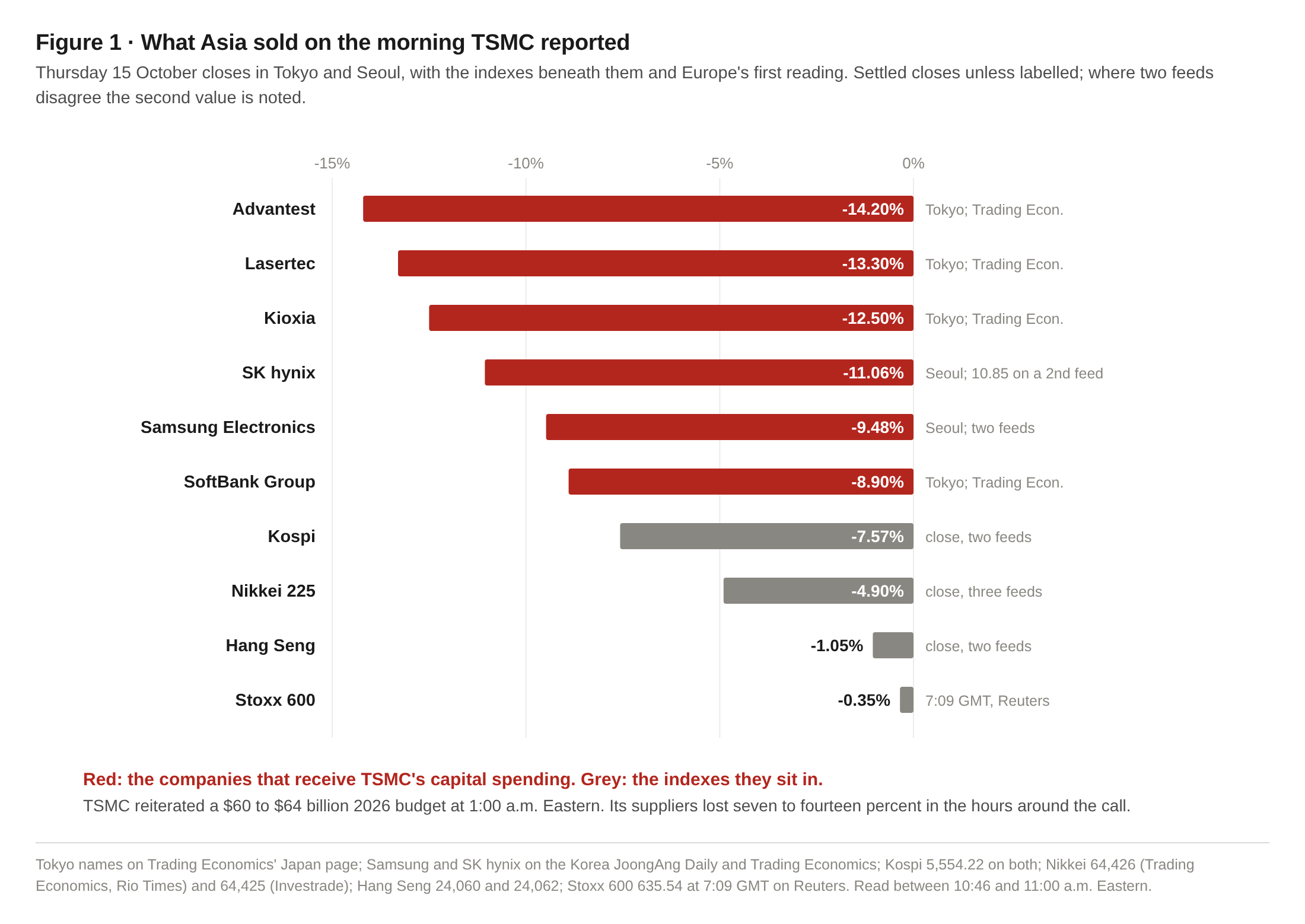
Europe opened the opposite way. The Stoxx 600 was down 0.35 percent at 635.54 by 7:09 GMT, Reuters reported, with its technology sector down 3.2 percent and the rest of the index close to flat; the DAX was off 115 points at 25,183 and the FTSE 100 up 50 at 10,778, Investrade said in an early look. Deutsche Bank's line, as Reuters carries it, is the one that explains the week: companies with heavy capital spending needs are under growing pressure from credit investors. That is a European bank describing an American trade.
US futures before the open were split the same way. At 5:40 a.m. TipRanks had Nasdaq 100 futures down 1.13 percent, S&P 500 futures down 0.30, Dow futures up 0.29. Investrade's note, published at 6:58 a.m., had the Nasdaq contract at 29,802, down 380.50 or 1.29 percent; the S&P 500 at 7,743, down 27.25; the Dow at 51,981, up 123. The dollar index was 102.05 at 3:44 a.m. on FXStreet, down 0.45 percent after reaching about 103.00 on Wednesday, its highest since April 2025; the euro back above 1.12, dollar-yen at 158.00. Wednesday's crude settlements were WTI at $95.09 and Brent at $106.06 on Newsquawk, and Investrade's overnight changes imply the same two bases, which is this desk's arithmetic. Overnight the pair moved apart: Brent $104.47, down 1.5 percent, beside WTI $94.17, down one percent, on the AP at 12:06 a.m.; Brent $104.60 beside WTI $95.21 on TheStreet at 8:04 a.m. Gold near $4,150 on FXStreet. The VIX closed at 16.87, up 10.48 percent, on Saxo.
The subject
TSMC's release is a public document and this desk read it on the SEC's site. Third-quarter revenue was NT$1,494.24 billion, up 50.9 percent on the year and 17.6 on the quarter; in dollars, $46.72 billion, up 41.2 percent on the year, above the top of the company's own $44.6 to $45.8 billion guidance and above the $45.7 billion Investrade gives as consensus. Net income was NT$763.06 billion, up 68.7 percent, versus NT$746.3 billion expected on Newsquawk. Gross margin 66.4 percent, down 1.3 points on the quarter, which the chief financial officer attributed to the first 2-nanometre ramp; operating margin 58.7; net margin 51.1; earnings of NT$29.43 a share, $4.60 an ADR. High-performance computing, the platform that holds the AI accelerators, was 68 percent of revenue and grew 22 percent on the quarter. Advanced nodes, seven nanometres and below, were 79 percent of wafer revenue; the 2-nanometre node, in volume for three quarters, is already eight percent.
Forward numbers are larger than the backward-looking ones. Fourth-quarter revenue is guided to $52.3 to $54.3 billion, which, at the midpoint, is up 14 percent on the quarter and 48 percent on the year; FXStreet expects $48.8 billion and Investrade $50.48 billion, two surveys, both printed. Full-year 2026 growth in dollars is now "around 44 percent," raised from "slightly above 40" in July and "above 30" in January. The 2026 capital budget, the number this desk cares about most, was reiterated at $60 to $64 billion, the range set in July after it rose from $52 to $56 billion in January.
Here is the check. A reiterated budget with three quarters printed is a statement about the fourth. The company's own documents give capital expenditure of NT$350.76 billion in the first quarter, about $11.1 billion at the quarter's average rate of 31.59, this desk's division; $15.7 billion in the second on BigGo Finance's account of the July call; and $13.8 billion in the third, in the chief financial officer's words on the transcript. That is roughly $40.6 billion through September. To land inside $60 to $64 billion, the fourth quarter has to carry $19.4 to $23.4 billion, this desk's subtraction, which would be the largest quarter of capital spending in the company's history by between a quarter and a half over the second-quarter record. The company did not say that. It said "reiterate," that spending for 2026 through 2028 will be "significantly higher than in the prior three years," and that N2 capacity will more than double in 2027.
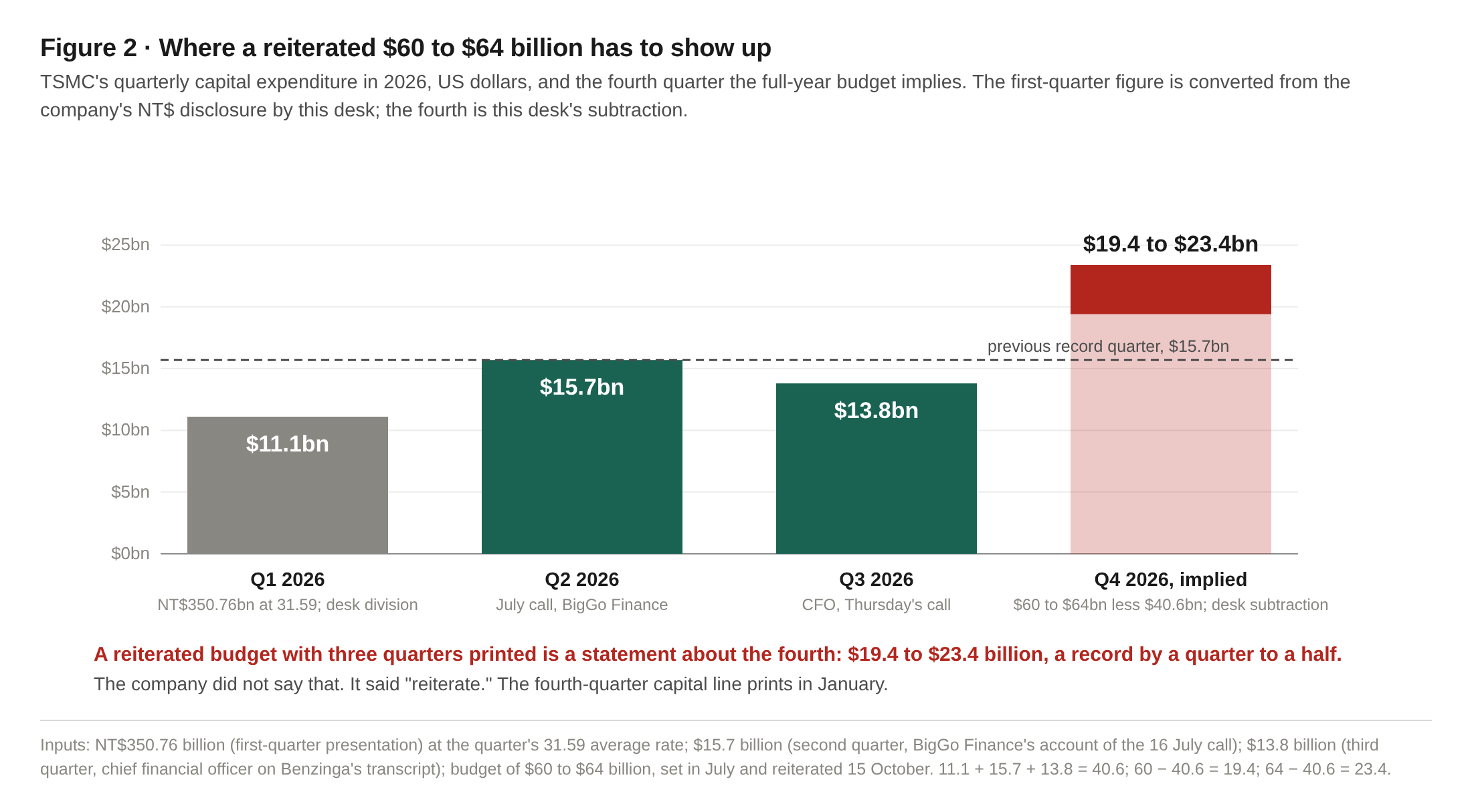
So, the number is published, and it should show up in the fourth-quarter capital line, due in January. Whether it settles this morning is uncertain, and I am not going to pretend it is. What I can say is what the market did with the implication. If TSMC spends $20 billion in a quarter, that money goes to Tokyo Electron, Advantest, Lasertec, ASML, and the memory makers whose parts sit beside TSMC's packages. Those are precisely the names that lost 7% to 14% in Tokyo and Seoul in the hours around the call. ASML reported a record quarter on Wednesday and raised its own outlook. The customer's customer reiterated. The customer's suppliers were sold as if the budget had been cut.
The sale has its own published number, and it is weaker than TSMC's. Seoul's explanation, in the Korea JoongAng Daily, runs through four items: worries about expanded memory supply from China's CXMT; a Mirae Asset strategist naming doubts about returns on AI investment as the biggest factor, with slowing third-quarter revenue growth at Anthropic cited; the consumer price index; and CoreWeave, whose shares fell 15.5 percent in New York on Wednesday on the weight of its debt, with its bond yields near 15 percent. The Seoul Economic Daily adds Gartner: a warning that "$3.5 trillion in AI infrastructure investment is at risk of impairment through 2030." I went to Gartner's own page. The document the firm publishes, dated 23 March 2026 and titled "The Potential $3 Trillion Dollar ROIC AI Gap," forecasts $6.3 trillion of hyperscaler AI infrastructure spending by 2030 and says providers "may face an asset write-down of 40% to 70% if they fall short." Forty percent of $6.3 trillion is $2.5 trillion and seventy is $4.4 trillion, this desk's multiplication; $3.5 trillion sits inside that range but is not on the page, and the figure is left open until the document it comes from can be read. Anthropic's revenue is a private company's number and no primary figure for its third quarter was read this morning. This desk's tooling is built on Claude, made by Anthropic, so we report the claim as a strategist's claim and don't weigh it.
Put the two sides of the seam next to each other. On one side, a company with $126 billion in cash, a 51 percent net margin, and a book of orders it says it cannot fill, reiterating a budget that requires a record quarter to meet. On the other hand, a renter of computing capacity whose June bond, issued at 9.625 percent, has traded to a 15 percent yield on Investrade's account, with credit-default swaps above 1,000 basis points, and whose debt is $22 billion in bonds and $26 billion in loans. The buildout is financed at both ends, and different markets are pricing each end. The Asian equity market chose, for one morning, to price the whole chain off the weaker end. That is a decision about who pays for the capacity, not about whether the capacity is ordered. TSMC's quarter says it is ordered. CoreWeave's bonds say the bill is contested.
What moved
The names that carry the subject moved on two timelines, and the distinction matters. In Asia the moves are settled: Samsung down 9.48 percent to 210,000 won; SK hynix down 11.06 or 10.85 percent, two feeds, to 1.26 million; Kioxia down 12.5; Advantest 14.2; Lasertec 13.3; SoftBank 8.9. In New York, Wednesdays are settled, and Thursdays are not. On Wednesday, Nvidia lost 3.2 percent, Broadcom 3.1 percent, and AMD 5.7 percent on the AP's wrap; CoreWeave lost 15.5 percent on the JoongAng Daily's figure, which no second feed confirmed to the decimal this morning. Before Thursday's open, CoreWeave was down 4.95 percent at 7:20 a.m. and SK hynix's New York line down 6.74 percent at 8:38 on TheStreet's blog; TSMC's ADR was down 4.14 percent at 10:08, after the open, on the same blog, and that reading is intraday and not load-bearing.
Two moves were not the trade and got swept into it. Bank of America fell 5.53 percent in Wednesday's premarket on TheStreet and as much as nine percent during the session on Yahoo Finance's account, on net income of $6.93 billion, 91 cents a share against $1.10 expected, after a $1.2 billion regulatory settlement; without the charge it earned $1.08. That is a bank taking a fine, not a bank losing faith in data centers, and it was the Dow's largest drag on a day the Dow finished flat. Dell fell 8.28 percent at 11:08 a.m. On Wednesday, a Barclays downgrade hit a server assembler on margins, sparking a debate over who captures the buildout's profit, and whether anyone does.
Money leaving a chip trade has to go somewhere. On Wednesday it went to pharmaceuticals, AstraZeneca up 4.29 percent and Merck 4.09 percent at 1:48 p.m. on TheStreet; on Thursday morning to Ericsson, up 9.9 percent in Europe. Balance sheets that do not borrow to build.
The calendar
Everything at 8:30 lands after this brief and is previewed, not reported. Times are Eastern; consensus and prior are Trading Economics', with Investrade's where they differ.
8:30 a.m. September producer prices, consensus +0.5 percent on the month against a prior of +0.5 (revised; Investrade carries +0.4); the core rate +0.3 against +0.2; headline on the year 5.3 percent against 5.6 (revised; Investrade 5.4); core on the year 4.4 against 4.8 (revised; Investrade 4.6). September retail sales, consensus +0.3 percent against a prior of +1.3 (revised; Investrade +1.2); ex-autos +0.5 against +1.4; the control group +0.3 against +1.2. Initial claims for the week to 10 October, consensus 200,000 against 198,000 (revised; Investrade 197,000); continuing claims 1,710,000 against 1,714,000. The Empire State index for October, consensus 10.3 against 7.6; the Philadelphia Fed index, consensus 28.4 against 37.8. That is nine prints at once, and the two that will set the ten-year are producer prices and the retail control group.
10:00 a.m. August business inventories, consensus +0.4 percent against +0.9 (revised). Chicago's President Goolsbee speaks at 10:00 on Saxo's list. 10:30 natural gas storage; 12:00 the EIA petroleum report, a day late for the holiday. 4:30 p.m. Cleveland's President Hammack. Chair Warsh is listed on Trading Economics for a speech at 3:30 UTC Friday, 11:30 p.m. Eastern tonight; the venue was not read.
Earnings. Before the open: TSMC, reported above; Charles Schwab, BNY, PNC, U.S. Bancorp, Prologis, Ericsson, Wipro. After the close: Interactive Brokers, Alcoa, J.B. Hunt. The next FOMC meeting is 27–28 October, with the election on 3 November and the December meeting on 8–9 December.
What we're checking next
The line of inquiry is the fourth-quarter capital line, with two ends. At TSMC's end, the January release will print the quarter's spend, and the question is whether it reaches the $19.4 to $23.4 billion the reiterated budget implies, or whether the budget comes in under the range the way "between $60 and $64 billion" allows without anyone having to say "cut." At the suppliers' end, the equipment makers that report in the next three weeks, Lam, KLA, ASML's order detail and Tokyo Electron, will say whether the orders behind a record TSMC quarter have arrived or are still being discussed, and Advantest's fourteen percent is a bet that they have not. Between the two sits the Gartner figure, quoted in Seoul at $3.5 trillion and not appearing on the page this desk could read; the desk will keep looking for the document it comes from.
Sources and data notes
This is a late edition. The run that builds the Brief fired at 7:15 a.m. and its clock was not read again until 10:46; every page below was read between 10:46 and 11:00 a.m. Eastern, after the open, and is stamped to that window or to a time the page carries. No level read after the open is used except where it is labelled intraday and said not to be load-bearing. The 8:30 releases are previewed with consensus and prior, not reported, and no post-release figure is used anywhere in the issue.
Sworn in. Wednesday's closes on the Associated Press's table on the Mankato Free Press, stamped 20:19 UTC, and TheStreet's 4:00 p.m. entry; Saxo's Dow at 51,626.17 and Newsquawk's S&P 500 at 7,724, down 1.05 percent, are earlier tables, printed and not used. The Kospi at 5,554.22, down 454.59 or 7.57 percent, on the Korea JoongAng Daily and Trading Economics; Samsung at 210,000 won, down 9.48 percent, on both; SK hynix down 11.06 on the first and 10.85 on the second. The circuit breaker, sidecars and flows are the JoongAng Daily's and the Seoul Economic Daily's, whose 5,527.12 is the level at the halt. The Nikkei at 64,426 on Trading Economics' narrative and the Rio Times, 64,425 on Investrade; the Trading Economics page also shows 64,605 in its quote field and 64,555 in its statistics beside a 3,318-point change that fits neither, which is read as fields updating at different moments and is not logged. The AP's Asia story, published 12:06 a.m. Eastern, carries intraday levels for the Kospi, Nikkei, Hang Seng, Shanghai and Taiwan and is used only where labelled so.
Wednesday's crude. WTI's November settlement at $95.09 and Brent's December at $106.06 are Newsquawk's; Investrade's overnight prints of $94.81 (down 0.28) and $104.04 (down 2.02) imply the same bases, this desk's addition. The overnight pairs are the AP's at 12:06 a.m. and TheStreet's at 8:04 a.m. as printed. The Rio Times' ticker bar carried Brent at 88.88 beside WTI at 83.11 on a page published at 12:02 UTC; see the chronicle.
Yields and the dollar. The ten-year's Wednesday close is TheStreet's 5.278, one feed. Overnight: 5.10 on the AP at 12:06 a.m.; near 5.1 on FXStreet at 7:44 GMT; 5.08 on Investrade, published 10:58 UTC, and on TipRanks, updated 9:41 UTC. The two-year at 4.73 on Investrade and Saxo. The dollar index, euro, yen and gold are FXStreet's at 7:44 GMT. The VIX is Saxo's.
TSMC. Revenue, net income, margins, node shares and fourth-quarter guidance are from the company's release on Form 6-K, dated 15 October, which notes the figures have not been approved by the board. The capital expenditure sentences, the 44 percent, the "reiterate," the demand quotations and the 2027 N2 statement are from Benzinga's transcript and MarketBeat's summary of the call, two accounts, and the cash balance of $126 billion is MarketBeat's. First-quarter capital expenditure of NT$350.76 billion and the 31.59 average rate are from the company's first-quarter presentation; the $11.1 billion is this desk's division. Second-quarter capital expenditure of $15.7 billion, the July raise from $52–56 to $60–64 billion and the "slightly above 40 percent" are BigGo Finance's account of the 16 July call; the January range is Data Center Dynamics' headline, not opened. The consensus figures for the quarter and the fourth-quarter guide are Investrade's ($45.7 billion; $50.48 billion) and FXStreet's ($48.8 billion), two surveys. Nine-month capex of about $40.6 billion and the fourth-quarter range of $19.4 to $23.4 billion are this desk's arithmetic: 11.1 plus 15.7 plus 13.8, subtracted from 60 and 64. TradingView's "key facts" card says the budget was raised; see the chronicle.
The sale's reasons. The JoongAng Daily for CXMT, Mirae Asset, the CPI and CoreWeave; the Seoul Economic Daily for Gartner; Gartner's own document page for the $6.3 trillion, the 25 percent target return, the $8.2 trillion of cumulative revenue and the 40 to 70 percent write-down; the $2.5 and $4.4 trillion are this desk's multiplication. CoreWeave's $22 billion of bonds, $26 billion of loans, the 9.625 percent June bond at 15 percent, the swaps above 1,000 basis points, Oracle's at a record 288 and SoftBank's at 424 are Investrade's. Reuters' European report on Investing.com at 7:09 GMT for the Stoxx 600, its technology sector, Ericsson and Deutsche Bank's remark. Wednesday's single names are the AP's, TheStreet's and the Yahoo Finance blog's, which served an 11:22 a.m. cache of the session and is used only for Bank of America's results. Thursday's premarket moves are TheStreet's Thursday blog at the times printed.
The calendar is Trading Economics' United States page, its display read as UTC and converted, with Investrade's estimates and priors printed where they differ and Saxo's list for Goolsbee and Hammack. Investrade's continuing-claims estimate of 1.17 million beside a prior of 1.716 million is read as a dropped digit and not logged. The FOMC dates are the Board's calendar as the runbook records them.
The chronicle. Four entries join the running record of stale or mistaken data presented as current, taking it from 218 to 222, numbered 222 to 225: Investrade's morning preview with the Kospi down "76 points or 8.13% to finish at 860," read twice, against a close of 5,554.22, down 454.59; TradingView's card saying TSMC "raised" its 2026 budget to $60–64 billion, read twice, where the raise was July's and the company's word on Thursday was "reiterate"; a Reuters report of 15 July 2026, "European shares subdued as Mideast tensions outweigh ASML's strong forecast," with oil at $85 a barrel, returned by a search for 15 October's European session without a date warning, the same calendar day three months apart; and the Rio Times' ticker with Brent at 88.88 beside WTI at 83.11 under a page dated 15 October, read twice, against $104 and $94 on every other feed. Pages reach the desk through a reader that relays their text; the quotations in the first, second and fourth entries were read twice and the third once.
The Decoy Chronicle — every entry, dated and sourced — is published as a standing register and updated with each issue.
The TrendyVest Championship is open for registration at Tournament.Trendyvest.com — 500 seats, a $100,000 simulated stake, free to enter. Trading began October 1 at the market open.
TrendyVest is an independent research practice. This is analysis and editorial opinion, not investment advice, and nothing here is a recommendation that any particular person buy or sell any security. Figures identified as this desk's arithmetic are the practice's own, and the inputs are printed alongside them.