MORNING BRIEF
Morning Brief October 14th 2026
A record quarter, a third raise for the year, and a promise of 30% more capacity. The raise is arithmetic the company had already done; the shortage rests on an order book ASML no longer publishes. Where should the claim show up, and what has so far.
Wednesday, October 14, 2026 · Before the open · September CPI 3.7 percent, printed at 8:30 a.m.
A company that sells the only machines capable of making the most advanced chips told customers at 1 a.m. that it cannot build enough of them. It reported a record quarter, raised its year for the third time, and said some buyers now want to reserve tools for 2029 and 2030. Shares fell four percent on Tuesday ahead of it, rose one to three percent in Amsterdam after it, and went the other way overnight in America. The feeds cannot agree on which direction the news points, and that disagreement is the story.
Here is the check. ASML published a set of numbers. One, the full-year figure, can be reproduced with a pencil from numbers already on the record, and adds nothing. Another, the capacity figure, cannot be checked by anyone outside Veldhoven for two years. And the one that would settle the argument, the order book, is a number ASML decided in January to stop publishing.
Overnight, sworn in
Tuesday settled flat and finished nothing. The S&P 500 closed at 7,805.45, down 1.79 points, a hundredth of a percent; the Dow at 51,670.10, down 180.45; the Nasdaq Composite at 27,204.38, down 41.52. Those three are sworn in on TheStreet's 4:02 p.m. table and the Associated Press's closing table as the Mankato Free Press carries it. The Russell 2000 is not: TheStreet has 2,786.13, down 8.35, and the AP has 2,783.37, down 11.11, and the two feeds are 2.76 points apart. Both are printed; neither is sworn.
The ten-year Treasury closed at 5.21 percent on the Treasury's par curve, as stockmarketwatch.com reports (down three basis points), and on Trading Economics; Investing.com shows 5.217 and Saxo 5.215. The two-year closed at 4.79 on both the par curve and Trading Economics, and the thirty-year at 5.56. This morning the ten-year sat between 5.20 and 5.22 depending on the screen, read between 7:21 and 7:28 a.m., and none of it mattered until half past eight; what it did after that is in the calendar section below.
Crude settled in opposite directions. Brent fell 96 cents to $105.69, and WTI rose 40 cents to $94.14, both from the same Reuters account on Oklahoma Energy Today timed 3:27 p.m. Central; Yahoo Finance's futures strip carries 94.14 as the November WTI base this morning, which swears the WTI figure. On Trading Economics at 7:27, WTI was 95.63, up 1.59 percent, while Brent was 106.26, up 0.54; the spread between the two narrowed from $11.55 at Tuesday's settlement to $10.63 (this desk's subtraction). The dollar index was 102.24 on Trading Economics at 7:28, up six hundredths after slipping two tenths on Tuesday, with the euro at 1.1191 and the yen at 158.44.
Asia split along the seam it has been drawing all week, which is memory against everything else. Seoul opened as if Tuesday's crash had been a mistake: the Kospi was up 1.83 percent at 6,146.01 by 9:15 a.m. local time, touched 6,190.65, and then gave almost all of it back to close at 6,008.81, down 26.54 points or 0.44 percent, on the Korea Times (4:03 p.m. KST) and the Seoul Economic Daily (3:57 p.m.). That is a 2.9 percent fall from the intraday high to the close, this desk's arithmetic, on a day the index was supposed to recover. Foreigners sold a net 1.18 trillion won, a seventh consecutive session of net selling. Samsung Electronics finished at 232,000 won, with the two Korean feeds disagreeing: the Seoul Economic Daily has it flat, while the Korea Times has it up 0.65 percent, so both are printed. SK hynix fell another 1.66 percent to 1,419,000 won on both counts, after Tuesday's 10.09 percent. The Kospi's sixth straight loss barely held the 6,000 line.
Tokyo did the opposite of Seoul in shape and the same in result. The Nikkei 225 closed at 67,744.29, down 0.05 percent, on AFP's 0810 GMT table and Trading Economics' closing note, the fifth decline in a row, with Kioxia down 3.2 percent, Tokyo Electron 2.7 and Lasertec 1.6 after ASML's release landed in the Tokyo afternoon. Hong Kong was off a tenth at 24,314.17, Shanghai down 0.9 at 3,767.23, both on the AFP table. Europe, with ASML in hand, opened higher: the STOXX 600 at 636.99, up 0.32 percent, at 3:13 a.m. Eastern on Reuters, technology leading at 0.8.
US futures, read on three feeds between 5:37 and 7:17 a.m., were up two tenths on the S&P 500 and three to four tenths on the Dow, with the Nasdaq 100 contract flat to slightly lower. No futures level is sworn, and none is load-bearing.
The subject
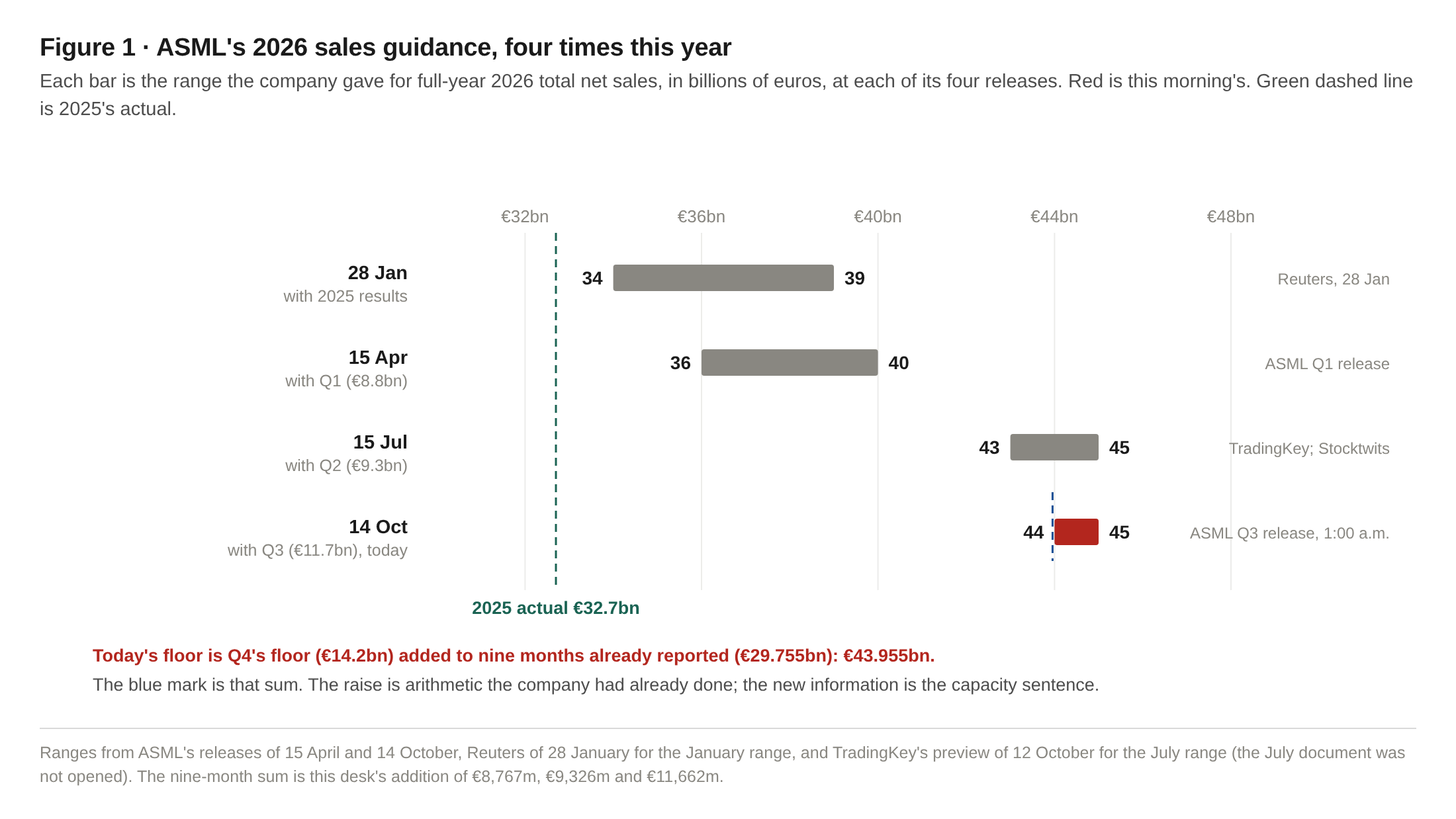
ASML's release went out at 1:00 a.m. Eastern. Third-quarter total net sales were €11,662 million, against €9,326 million in the second quarter; gross margin 57.5 percent against 54.0; net income €4,960 million, basic earnings of €12.95 a share. It sold 113 new lithography systems and eight used ones. For the fourth quarter it guides to €14.2 to €15.2 billion of sales at a gross margin around 57 percent. For the full year it now says €44 to €45 billion at around 56 percent, where in July it said €43 to €45 billion, in April €36 to €40 billion, and in January €34 to €39 billion (the January range per Reuters on 28 January; the April range from the company's first-quarter release; the July range from TradingKey's preview and the Stocktwits account).
Start with the raise, because it was the headline on every wire and it is the least informative thing in the document.
The first three quarters of 2026 are published: €8,767 million, €9,326 million and €11,662 million. Add them and you have €29,755 million. Add the fourth-quarter guidance to that and you get €43,955 million at the bottom and €44,955 million at the top. That is the full-year range, to the rounding. The "raise" of the floor from €43 billion to €44 billion is the fourth-quarter guidance floor added to the nine months already in the bank. It is not a new view of the year. It is the old view of the year, with three quarters no longer uncertain. (This desk's arithmetic; the inputs are the four figures in this paragraph, all from ASML's own releases.)
Set that against what the market was told to watch. A preview published Friday said only one number matters: bookings, and set thresholds: below €5 billion is bad, above €7 billion is good. This morning's release includes no bookings line. There is no bookings line because ASML said on 28 January, with its record €13.2 billion fourth-quarter order intake, that it would stop reporting quarterly orders, on the argument that the figure causes unnecessary volatility in the shares; an ING analyst told Reuters that morning it would be the last time ASML reported quarterly order intake. The company's chief financial officer had been saying for a year that bookings are lumpy and not necessarily an accurate reflection of business momentum. So the number the preview wanted was retired nine months ago, and the market went into this print waiting for a line that never appeared.
Instead, a sentence appeared, and that sentence is the real news. ASML says its supply as currently planned for 2027 and 2028 will not fully meet customer demand. It plans to add 30 percent to its 2026 low-NA EUV and DUV immersion capacity in 2027 and is investigating a further 30 percent for 2028. The chief executive, Christophe Fouquet, says customers are raising their short- and medium-term equipment forecasts "driven primarily by their views on the size and duration of AI-related investments," and that "some customers are expressing an interest in placing orders with us for 2029 and even 2030."
Now run the check. A published number: thirty percent more machines next year, and a shortage against demand for two years. Where should it show up? In three places, in the order they report. First, in Taiwan Semiconductor's capital spending plan, which the company updates tomorrow morning; telling a buyer to reserve 2029 slots either raises the plan or explains why not. Second, in the memory makers' capital budgets, Samsung's and SK hynix's, whose shares lost 7 and 10 percent in a session this week on a Chinese rival's claim about next-generation chips; if those two are reserving ASML tools into 2029, Tuesday's judgment was wrong, and if they are not, the shortage is narrower than the sentence. Third, in the hyperscalers' own capital spending guidance in two weeks, since every one of those tools exists to make a chip, somebody has already promised to buy. Wells Fargo's Ohsung Kwon, quoted by Fortune at 5:47 this morning, has set the bar for that third place: "If capex estimates don't get revised up by more than 10%, we see that as a risk to AI buildout stocks."
Did it show up? Not yet, and "not yet" has a precise meaning here. The guidance figure showed up exactly where arithmetic said it would and nowhere else. The capacity figure cannot show up until a customer prints a budget that depends on it, and the first such customer reports tomorrow. The order book, which would have shown it this morning, is a number the seller has chosen to keep. What we have is a claim of a shortage from the party that benefits from the market believing in one, carrying a record quarter and a 57.5 percent gross margin behind it: a very good reason to take the claim seriously and no reason at all to treat it as a figure.
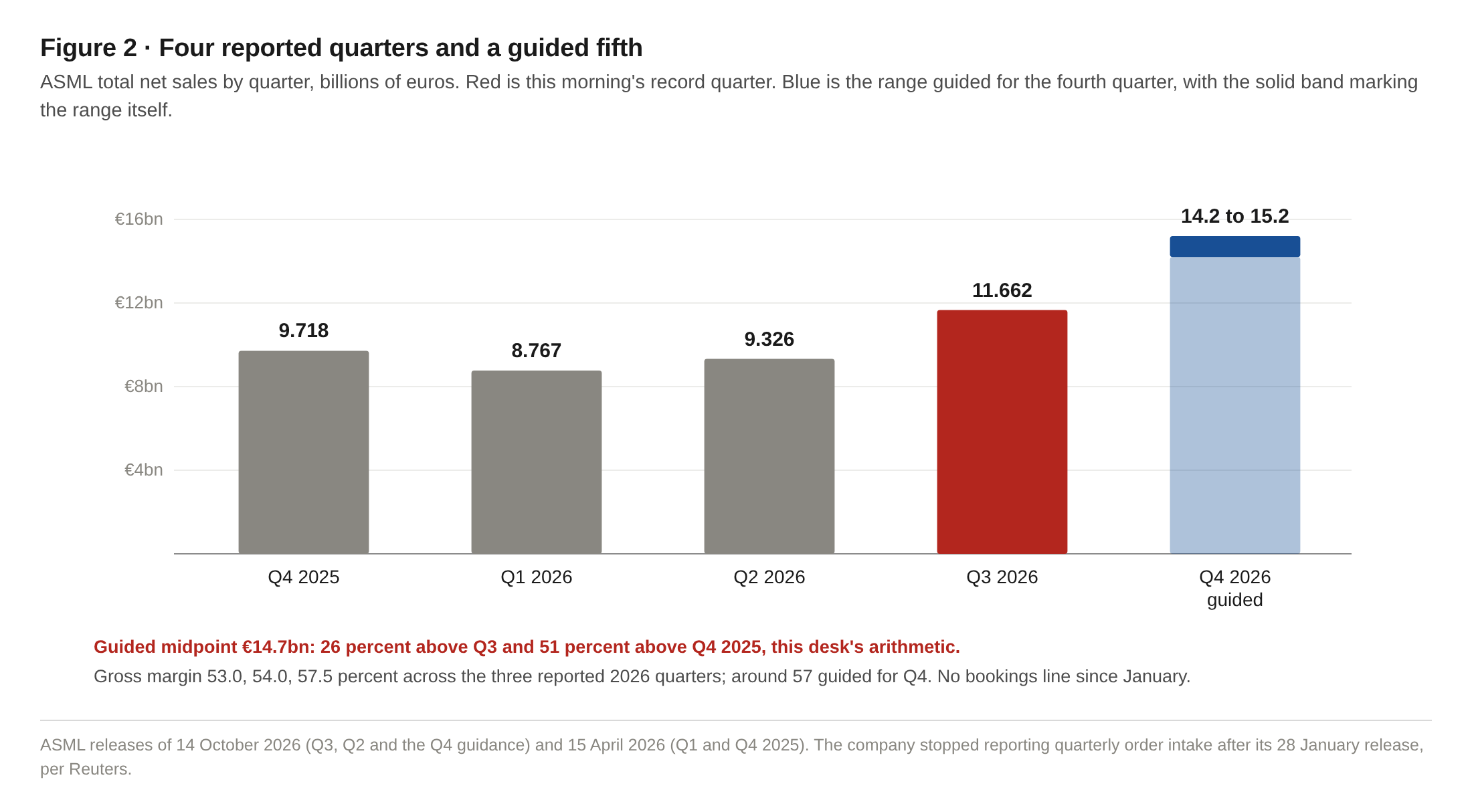
Here is the part that should make a reader careful. The fourth-quarter guidance, at its midpoint of €14.7 billion, is 26 percent above the third quarter and 51 percent above the fourth quarter of 2025 (this desk's arithmetic on €11,662 million and €9,718 million). The full year at €44 to €45 billion is 35 to 38 percent above 2025's €32.7 billion. Those are numbers that will be true or false in January. Thirty percent more capacity in 2027 is a number that will be true or false in January 2028. The market reacted this morning to the second kind of number as though it were the first kind.
ASML reports in euros. One account this morning headlined a revenue miss, because the quarter's $13.07 billion fell short of a $13.12 billion estimate from Koyfin. In euros, the €11.66 billion sat inside the company's own €11.0 to €12.0 billion guidance and inside the €11.6 to €11.8 billion range TradingKey gave as consensus on Monday; Invezz called it matching market expectations. The dollar miss is $50 million, four tenths of a percent, the distance the euro moves in an ordinary morning. That one goes in the chronicle, below.
What moved
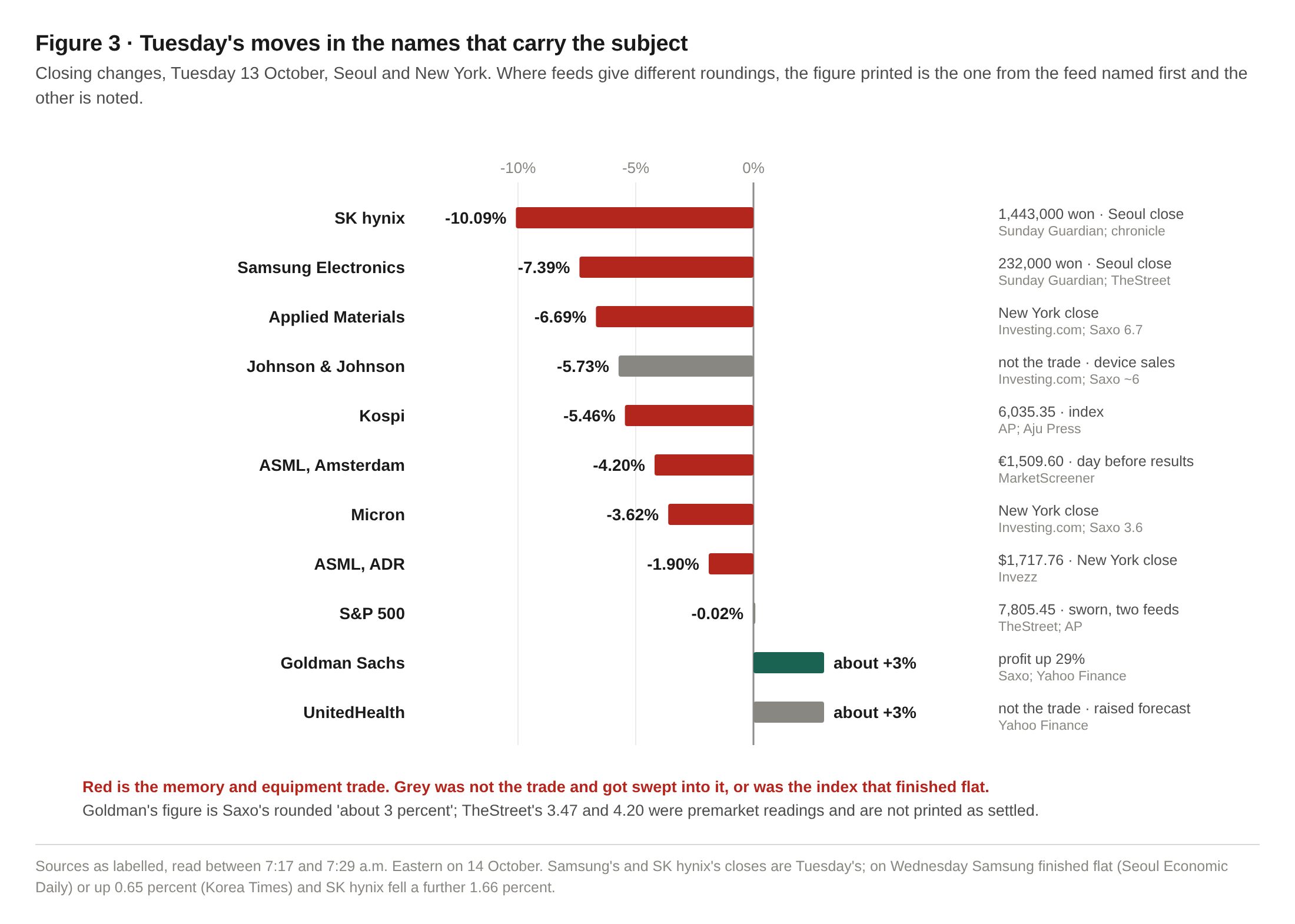
Memory was the trade on Tuesday, and it was a trade about China, not about ASML. The Kospi fell 5.46 percent to 6,035.35, its worst session in 21 months per Saxo, with Samsung Electronics down 7.39 percent to 232,000 won and SK hynix down 10.09 percent to 1,443,000, after reports that CXMT, the Chinese memory maker, has made progress on next-generation chips. It crossed the Pacific: Applied Materials lost 6.69 percent and Micron 3.62 on Investing.com's movers table (Saxo has 6.7 and 3.6), the sixth straight fall for the chipmakers as a group on Saxo's count. TheStreet had Western Digital down 7.71 percent and Seagate 7.28 at 8:56 a.m., before the open, and those are premarket readings, not closes; I did not find settled closes for either and print none. ASML itself fell 4.20 percent in Amsterdam to €1,509.60 (MarketScreener, Tuesday's close) and 1.9 percent in New York to $1,717.76 (Invezz), the day before it reported.
The banks weren't the trade, but they reported into it. Goldman Sachs rose about 3 percent (Saxo) on a 29 percent profit rise (Yahoo Finance); JPMorgan's earnings of $5.57 a share missed a $5.90 estimate (Yahoo Finance) yet shares still rose; Wells Fargo was little changed. Goldman's premarket readings on TheStreet, 3.47 and 4.20 percent, are not printed as settled.
Then this morning, at 6:45, Bank of America. Adjusted earnings of $1.08 a share vs. $1.10 expected and revenue of $30.0 billion vs. $30.58 billion on Newsquawk, which first carried the headline at 6:43 a.m.; 24/7 Wall St. has the estimate at $1.11 and revenue at $29.96 billion, a second survey, and a rounding difference. The quarter carries a $1.2 billion regulatory settlement charge, 17 cents a share, which 24/7 Wall St. describes as a non-deductible settlement with the Office of the Comptroller of the Currency and FinCEN over anti-money-laundering failures. Fixed-income trading was $2.55 billion against $2.86 billion expected and equities $2.51 against $2.63. The shares slipped in premarket trading on Investing.com's account, without a percentage. For a beat that asks whether an efficiency claim has reached an expense line, this quarter hit the expense line with a fine rather than software, and nothing in this morning's headlines mentions artificial intelligence at all. BlackRock reported adjusted net income up 37 percent to $2.62 billion on $15.49 trillion of assets and was about 3 percent higher before the open at 7:17 (Invezz). Morgan Stanley reports at 7:30 and is not read here.
Two moves that weren't the trade got swept into it. Johnson & Johnson fell 5.73 percent (Investing.com; Saxo about 6) in a quarter that beat and raised guidance, because medical device sales were weaker than expected; it was the largest fall in the Dow, and it had nothing to do with chips. And UnitedHealth, up 3 percent on Yahoo Finance's account, lifted its 2026 profit forecast; it helped keep Dow futures positive Tuesday morning, even as the Dow still closed down 180.
Another beat belongs to it. Tencent told investors on Monday that a bond sale of about $5 billion will help finance AI-related capital expenditure, mostly chips, per Bloomberg, as The Edge Malaysia reports. Its AI and computing capital spending was 52.8 billion yuan in the June quarter, up 176 percent, and the company expects slightly more than 200 billion yuan a year through 2027. That is a buyer raising the plan, in a bond prospectus. One buyer, in one country, borrowing to do it.
The calendar
Times Eastern; consensus and prior from Trading Economics, confirmed against Investing.com's preview for the inflation figures.
The September consumer price index printed at 8:30, and it is sworn in on three feeds: Trading Economics, FXStreet and StockTitan's account of the Bureau's release, read between 8:38 and 8:42. The headline index rose 0.6 percent on the month, which was the consensus, and 3.7 percent on the year against a consensus of 3.6 and a prior of 3.4. Core rose 0.3 percent on the month versus a consensus of 0.2, and 2.6 percent on the year versus 2.5, up from 2.4. Gasoline rose 9.1 percent in the month (the Bureau's seasonally adjusted figure as StockTitan and Trading Economics carry it) and the energy index is up 20.4 percent on the year (Trading Economics). Shelter rose 0.4 percent month-on-month and 3.2 percent year-on-year (StockTitan). So the headline landed where the forecasts put it and the core landed a tenth above on both measures: the number the market could see coming, fuel, came in as expected, and the number it could not, everything else, came in warm. The Bureau's own release page still showed August to this desk's reader at 8:40 and the figures above rest on the three secondary feeds until it does not.
The first reaction, on one feed and with a caveat. Trading Economics' bond table at about 8:41 had the ten-year at 5.269 percent and the two-year at 4.77, where the same provider had 5.21 and 4.79 at 7:28; its index table had the S&P 500 contract at 7,785.39 and the Dow contract at 51,614.14 against 7,818.44 and 51,845.04 at 7:21. Those are differences of about six basis points on the ten-year and about four tenths of a percent on the contracts, this desk's subtraction, and the provider's own narrative text on both pages was still written for the hour before the release, so the readings are printed as one feed's quote boxes and not as a sworn reaction. A CNBC headline seen in search at 8:42, "Stock futures fall into the red as hot inflation report sends yields higher" points the same way; the page could not be opened.
At 7:00 a.m. the Mortgage Bankers Association's weekly applications (prior −4.2 percent; thirty-year rate 7.49). Bank of America and BlackRock have reported; Morgan Stanley reported at 7:30 and is not read here.
Governor Bowman spoke at 5:40 a.m. (Trading Economics has 09:40 UTC and XTB 11:40 Central European Summer Time, which agree). President Barkin of Richmond speaks at 1:30 p.m. The Beige Book is published at 2:00 p.m. The Treasury's monthly budget statement for September is due this afternoon (Trading Economics lists no time; consensus −$29 billion, prior −$167 billion). A 17-week bill auction at 11:30 a.m. The API's weekly crude inventories at 4:30 p.m. (prior −2.09 million barrels).
Anthropic is reportedly holding an investor day today ahead of a possible listing; Bloomberg reported the date as 1st of October, and XTB's calendar lists it at 10:00 a.m. Eastern, one calendar and no company confirmation read by this desk. Disclosure: this desk's tooling is built on Claude, made by Anthropic.
The market, per Trading Economics' bond note this morning, prices about a 77 percent chance that the committee holds at its meeting on 27 and 28 October and about an 88 percent chance of an increase in December, after President Williams of New York said one more increase may be appropriate this year, and Governor Waller said expectations remain well anchored. Those are the providers' readings of the futures market, not this desk's.
Tomorrow, Thursday 15 October, carries most of the week's weight: Taiwan Semiconductor's third quarter and capital spending plan before the open; at 8:30 the September producer price index (consensus +0.5 percent, prior +0.4), retail sales (consensus +0.3 percent, prior +1.2), initial claims (consensus 200,000, prior 197,000), the Empire State survey (consensus 10.3, prior 7.6) and the Philadelphia Fed survey (consensus 28.4, prior 37.8). The election is 3 November.
What we're checking next
The first of the three places in our line of inquiry. Taiwan Semiconductor's capital budget tomorrow is the only document due this week from a company that buys what ASML is short of, and it is the one place ASML's thirty percent can begin to turn from a sentence into a figure. The desk will read the capital spending range the company gives for 2026 and whatever it says about 2027 against the range it gave in July, and against the Wells Fargo threshold Fortune quoted this morning and will print the arithmetic with its inputs.
Behind that sits the longer question, which is what ASML's decision to stop publishing orders does to a market that organised itself around orders. Every preview this week set a threshold for a number that does not exist, and this morning the substitute turned out to be the company's own description of its backlog. The desk will look at what ASML still publishes annually and whether January's release will include a backlog figure that can be set against the thirty percent.
And Seoul. A market that opens up 1.8 percent on relief and closes down on the day, with foreigners selling for a seventh session, is saying the relief was local and the selling is not. The desk will check whether Samsung and SK hynix say anything about equipment orders before their results, since they are the second place the ASML sentence has to show up, and the one the market has already voted on.
Sources and data notes
Every figure carries its feed and the minute it was observed, Eastern unless marked. The desk's clock was read at 7:16, 7:17, 7:26, 7:29, 7:38 and 8:38 a.m.; pages are stamped to the window between readings where a page carries no clock of its own. Everything outside the consumer price index paragraphs was read before 7:29; the index and the first reaction were read between 8:38 and 8:42. Where feeds disagree, both values are printed.
Sworn in. Tuesday's closes for the S&P 500 (7,805.45, −1.79), Dow (51,670.10, −180.45) and Nasdaq Composite (27,204.38, −41.52) on TheStreet's 4:02 p.m. table and the Associated Press's closing table on the Mankato Free Press, both read between 7:17 and 7:26; Saxo and Trading Economics' narrative agree. The AP's week and year figures: S&P 500 down 6.09 for the week and up 959.95, 14 percent, for the year. The Russell 2000 is not sworn: TheStreet 2,786.13 (−8.35), AP 2,783.37 (−11.11). The ten-year's close: 5.21 on the Treasury par curve as stockmarketwatch.com relays it and on Trading Economics; 5.217 on Investing.com's history; 5.215 on Saxo. Two-year 4.79 and thirty-year 5.56 on stockmarketwatch.com and Trading Economics, read 7:26 to 7:28. Tuesday's crude settlements, Brent $105.69 (−0.96) and WTI $94.14 (+0.40), on Oklahoma Energy Today's Reuters copy, 3:27 p.m. Central; WTI's 94.14 also on Yahoo Finance's futures strip as the November base; Brent's settlement is one feed. The Nikkei at 67,744.29 (−0.05 percent) on AFP via Malay Mail, 0810 GMT, and Trading Economics' Japan note. The Kospi at 6,008.81 (−26.54, −0.44 percent) on the Korea Times, 4:03 p.m. KST, and the Seoul Economic Daily, 3:57 p.m. KST; the intraday high of 6,190.65 and the 1.1831 trillion won of foreign selling are the Seoul Economic Daily's; the 9:15 a.m. reading of 6,146.01 is the Sunday Guardian's, and Bloomingbit's 9:06 a.m. reading of 6,110.41 is beside it. SK hynix down 1.66 percent to 1,419,000 won on both Korean feeds.
Not sworn, both printed. Samsung Electronics on Wednesday: flat at 232,000 won (Seoul Economic Daily) and up 0.65 percent (Korea Times). This morning's ten-year: 5.209 and 5.201 on two parts of Investing.com's pages, 5.21 on Trading Economics, 5.22 on Yahoo Finance's strip, between 7:21 and 7:28. ASML's move after the release: up 1.8 percent at 3:13 a.m. on Reuters via Yahoo Finance; more than 2 percent on Investing.com at 3:54; more than 1 percent on Investing.com at 5:37; 3 percent on Fortune at 5:47; the US receipt down 3 percent overnight on Stocktwits via TradingView and 1.86 percent lower on Yahoo Finance's untimed strip; AFP's 0810 GMT line has traders disappointed. These are different venues and hours and are printed as differences, not errors.
Oil this morning. WTI $95.63 (+1.59 percent) beside Brent $106.26 (+0.54) on Trading Economics at about 7:27; its page also shows 106.11 and 106.177 for Brent in other boxes, read as different refresh times. WTI $94.57 beside Brent $106.33 on AFP at 0810 GMT. The spread arithmetic, $11.55 and $10.63, is this desk's from the settlements and the Trading Economics pair. The dollar index 102.243 (+0.06 percent), euro 1.1191, yen 158.44 on Trading Economics at 7:28; its text has the index around 102.1. Gold is not printed: four feeds carried four levels between $4,155 and $4,210 across Tuesday and this morning, spot and futures.
ASML. All reported figures and guidance from the company's release on GlobeNewswire, 1:00 a.m., read between 7:17 and 7:26. The first-quarter figure (€8,767 million) and the April guidance (€36 to €40 billion) from ASML's first-quarter release, 15 April; the fourth-quarter 2025 figure (€9,718 million) from the same document; 2025 total net sales of €32.7 billion from the title of ASML's annual release of 28 January as Seeking Alpha and MFN carry it, not opened. The January guidance (€34 to €39 billion), the €13.2 billion fourth-quarter orders and the decision to stop reporting quarterly orders from Reuters of 28 January on WHBL; the chief financial officer's "lumpy by nature" from Bits&Chips, 29 January 2025. The July guidance (€43 to €45 billion) from TradingKey's preview of 12 October and the Stocktwits account; the company's July document was not opened. The nine-month sum (€29,755 million), the full-year reconstruction (€43,955 to €44,955 million), the fourth-quarter midpoint comparisons (26 and 51 percent) and the 2026 growth range (35 to 38 percent) are this desk's arithmetic on those inputs. The bookings thresholds are from Options Trading Report, 10 October. Tuesday's Amsterdam close €1,509.60 (−4.20 percent) from MarketScreener, 11:55 a.m. Eastern Tuesday, and TradingView; the ADR's $1,717.76 (−1.9 percent) and the consensus net profit and margin from Invezz, 1:42 a.m. The dollar "miss" and the Koyfin figure from the Stocktwits piece above; the conversion rates 1.1207 and 1.1250 are this desk's division.
What moved. Kospi, Samsung and SK hynix on Tuesday from the Sunday Guardian and Saxo; Applied Materials, Micron and Johnson & Johnson from Investing.com's movers table on the 5:37 a.m. page, undated and matched to Saxo's Tuesday figures; Western Digital, Seagate, Goldman and UnitedHealth premarket readings from TheStreet's Tuesday page at the minutes given. JPMorgan's $5.57 against $5.90, Goldman's 29 percent and UnitedHealth's 3 percent from Yahoo Finance's Tuesday live blog, 1:59 p.m. Bank of America from Newsquawk, headline 6:43 a.m., published 7:03, and 24/7 Wall St., 6:44 a.m.; the release itself on Newswire, 6:45, carries the boilerplate and links the figures, which were not opened. BlackRock from Invezz at 7:17. Tencent from Bloomberg via The Edge Malaysia, 12 October. CXMT's claim is as the Yahoo Finance and Saxo accounts describe it; the desk did not open CXMT's statement.
The consumer price index. September's figures (headline +0.6 percent on the month and 3.7 on the year; core +0.3 and 2.6; gasoline +9.1 on the month; energy +20.4 on the year; shelter +0.4 and 3.2) from Trading Economics' inflation page, FXStreet (modified 12:34 GMT) and StockTitan (updated 8:37 a.m.), read between 8:38 and 8:42; the Bureau of Labor Statistics' release page and PDF returned the August release to the desk's reader at 8:39 and 8:40 and are linked as unread for September. The post-release readings are Trading Economics' bond and index tables at about 8:41, one feed, with the pre-release readings from the same tables at 7:21 and 7:28; the differences are this desk's subtraction. Seen and not logged: StockTitan's headline, "Gas Prices and the 3.4% Inflation Rate," August's figure above a body carrying September's 3.7, on a page mid-update; FXStreet's line that the Bureau released the data "on Tuesday"; and Trading Economics' bond page, with 5.21 in its summary, 5.20 in its statistics and 5.27 in its table at one reading.
The calendar. Trading Economics' United States calendar, read at about 7:21 with its display in UTC and converted, and XTB's calendar in Central European Summer Time; the inflation consensus figures agree with Investing.com's preview. Fed probabilities and the Williams and Waller remarks from Trading Economics' bond note. Thursday's bank reporters from Saxo. The Anthropic investor day from Bloomberg's report of 1 October, not opened, as Crypto Briefing carries it, and XTB's listing. Wells Fargo's threshold from Fortune's piece above. The FOMC dates from the Federal Reserve's published calendar.
Seen and not logged. Trading Economics' United States index page, carrying Tuesday's changes (−1.79, −180.45) beside Wednesday's contract levels (7,818.44, 51,845.04), the pairing this desk has logged before and counts once; the same provider's Japan page with one item closing the Nikkei at 67,744 and another at 67,874, up 97, and a third with the index up 0.4 percent above 68,000, the later items' hours not established; NordFX's untimed pulse with the Kospi up one to two percent and the Nikkei up 0.4 percent, read as morning levels; Yahoo Finance's Wednesday blog, with futures up 0.1 percent in its text under a strip at 0.22 and 0.31; Investing.com's 10-year at 5.209 in one table and 5.201 in a sidebar; two surveys for Bank of America's earnings estimate ($1.10 Newsquawk, $1.11 24/7 Wall St.) and two for Morgan Stanley's ($2.94 Alphastreet, $3.10 ScanX); and Trading Economics' 9:40 for Bowman, read as UTC and matched to XTB.
The chronicle. Two entries join the running record of stale or mistaken figures presented as current, taking it from 216 to 218. Entry 220: the Stocktwits account on TradingView headlining ASML's quarter as a revenue miss on a $50 million dollar-translation gap against a Koyfin estimate, where the euro figure the company reports matched the published euro consensus and sat inside its own guidance; caught by dividing the dollar figures by the euro one. Entry 221: a search for Bank of America's third-quarter 2026 results returning, without a date warning, American Banker's report of the third quarter of 2025, headlined "dials up outlook slightly after solid Q3," on the morning the 2026 quarter printed a miss with a $1.2 billion charge; the page is correctly dated 15 October 2025 at source and was caught by its dateline. Pages reach the desk through a reader that relays their text; the quotations in both entries were read once.
The Decoy Chronicle — every entry, dated and sourced — is published as a standing register and updated with each issue.
The TrendyVest Championship is open for registration at Tournament.Trendyvest.com — 500 seats, a $100,000 simulated stake, free to enter. Trading began October 1 at the market open.
TrendyVest is an independent research practice. This is analysis and editorial opinion, not investment advice, and nothing here is a recommendation that any particular person buy or sell any security. Figures identified as this desk's arithmetic are the practice's own, and the inputs are printed alongside them.