MORNING BRIEF
Morning Brief October 12, 2026
Broadcom's chief executive told a Singapore audience on Monday that money may soon limit artificial intelligence. By a filing and ten days of reporting, his own company's credit now stands behind $42 billion in loans for one customer, with $30 billion to $50 billion more in talks for another. Seoul's memory makers fell more than four percent the same day.
Monday, October 12, 2026 · Second edition, read before the open · Columbus Day: stocks open, Treasuries shut
Wafers, memory, power, land. By Hock Tan's account, the artificial intelligence industry has spent two years running into one shortage after another and getting past each. On Monday in Singapore, Broadcom's chief executive named the next one he thinks will hit, and Intel's chief executive, sitting on the same panel, agreed. They said the next constraint may be money.
That is a claim, and it can be checked the way every claim on this beat is checked. Where would a shortage of capital show up, and has it? The answer this morning is that it has shown up in one place neither man is reported to have mentioned. It is in the financing of Broadcom's own customers, where Broadcom's credit has become part of the package.
A word on the day. It is Columbus Day. Stocks trade as usual. The cash Treasury market is shut, so the last word on yields is Friday's and stays Friday's until Tuesday. We read every level in this edition before the opening bell.
Overnight, sworn in
Friday's closes come first, because nothing has replaced them. The S&P 500 finished at 7,811.54, up 46.18 points. The Dow finished at 51,654.95, up 423.31. The Nasdaq Composite closed at 27,366.17, up 172.83, and the Russell 2000 at 2,806.98, up 12.85. Three feeds carry all four. The ten-year Treasury closed at 5.24 percent on four feeds, and that number will not move today.
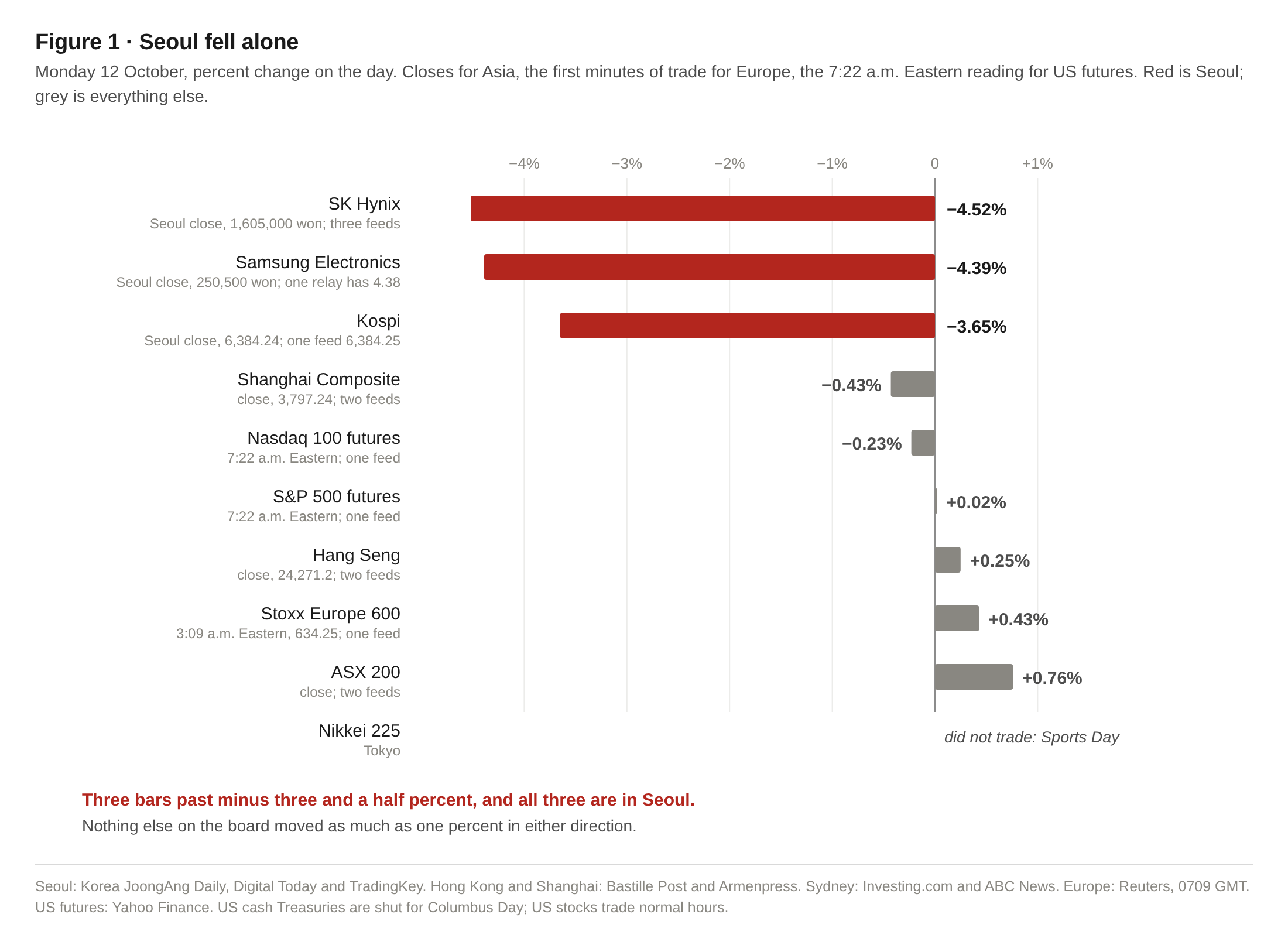
Asia split overnight, though not along the usual line. Tokyo did not trade; it is Sports Day in Japan. Hong Kong closed up 0.25 percent at 24,271, Sydney up 0.76 percent, Shanghai down 0.43. In Europe the FTSE 100 closed Friday up 1.06 percent, and the Stoxx 600 was up 0.43 percent a few minutes after Monday's open.
And then there is Seoul. The Kospi fell 241.69 points, or 3.65 percent, to 6,384.24. Samsung Electronics lost 4.39 percent, closing at 250,500 won. SK Hynix lost 4.52 percent, to 1,605,000 won. Foreign investors sold a net of 2.02 trillion won of shares.
So the seam this morning does not run between Asia and Europe. It runs around two companies. The explanations offered in Seoul are several: a Chinese rival's announcement of progress in advanced memory, foreign selling, a reshuffling of semiconductor funds, and a North Korean missile launch. None of them is a conference panel in Singapore, and I am not adding one: the index was already down more than one percent in early trade, and the panel began at three in the afternoon, Seoul time. But hold the coincidence. On the day Seoul sold the memory makers, the head of a company that depends on what they make was quoted saying, "Memory shortage today might not be that way a year from now."
American futures were little changed. At 7:22 on Yahoo Finance's page, the S&P 500 contract stood at 7,861.25, up 0.02 percent, and the Nasdaq's at 31,036, down 0.23. The dollar index was about 102.4, up 0.2 percent, after a fourth straight weekly gain.
Oil turned around. At 4:21 a.m. Eastern, Reuters had Brent at $104.50 beside West Texas Intermediate at $91.45, down 0.2 and 0.4 percent from Friday's settlements of $104.72 and $91.85. That followed the president's statements on Russian diesel supplies and on a halt to Russian and Ukrainian attacks on each other's energy facilities. By 8:29 Benzinga had West Texas up 0.79 percent at about $92.58, with no Brent beside it. Crude fell first and then turned; only the earlier pair is one feed at one minute.
The subject
The event was the first DBS Asia Future Forward Conference, and the session was titled "Where will the next trillion dollars in AI come from?" Hock Tan runs Broadcom, which builds the custom processors Google designs for itself and, increasingly, chips for Meta and OpenAI. Lip-Bu Tan runs Intel.
CNBC's account has Broadcom's Mr. Tan saying: "[What] I think might be the biggest constraint is capital." Reuters, paraphrasing, is firmer: capital "will be the biggest constraint facing the company." Bloomberg has him warning that insufficient capital could become the next constraint. Intel's Mr. Tan, on CNBC's account: "If there's any challenge in the front, it's capital and the cost of capital, and then the other part is in the longer run, people want to see the ROI."
Broadcom's chief said more. "There is more demand for compute infrastructure than we can supply." Demand, he said, will outrun supply for at least two more years. The two frontier laboratories, Anthropic and OpenAI, have shown they can generate significant revenue from their latest models; that is Reuters' paraphrase. And of OpenAI, in Bloomberg's account: "For now it's still losing money because they're spending a lot on training."
Read in a row, that is a seller describing customers who want more than they can presently pay for.
Now the published numbers. They came not from the stage but from a filing and ten days of reporting on Broadcom itself.
On 1 October Reuters reported, from Anthropic's own filing, that Broadcom will lend Anthropic up to $42 billion, in notes that can convert into Anthropic shares, toward a five-year lease of chip capacity on which Anthropic has committed $125.2 billion. The filing, Reuters said, warns of "potential conflicts of interest" in Broadcom being both hardware supplier and financing partner.
On 2 October Bloomberg reported that Broadcom's Wall Street syndicate was "starting to gather $60 billion of fresh AI chip financing to benefit Anthropic PBC and other companies": $42 billion of senior secured debt and $18 billion of junior debt led by Blackstone. On 5 October the Financial Times, as two summaries of it have it, reported that the senior piece had gone out to lenders as Broadcom-supported loans, guaranteed by Broadcom in one summary and "backed by Broadcom's A-minus credit rating" in the other. The junior piece carries no Broadcom guarantee and is expected later. Bank of America, Citigroup and Morgan Stanley had committed the money.
On 7 October, the Wall Street Journal reported, as several relays have it, that Broadcom is working to arrange more than $50 billion for the chips it is building with OpenAI. The talks are early, the size could change, and the deal could close before the end of the year. Two days later, Bloomberg put the figure at around $30 billion.
I am not adding the two $42 billion figures together. Nothing published says whether the notes and the senior loans are one obligation seen twice or two. Keep them apart, and the financing in motion around Broadcom's chips is $60 billion under way and between $30 billion and more than $50 billion in prospect: $90 billion to $110 billion, on this desk's arithmetic.
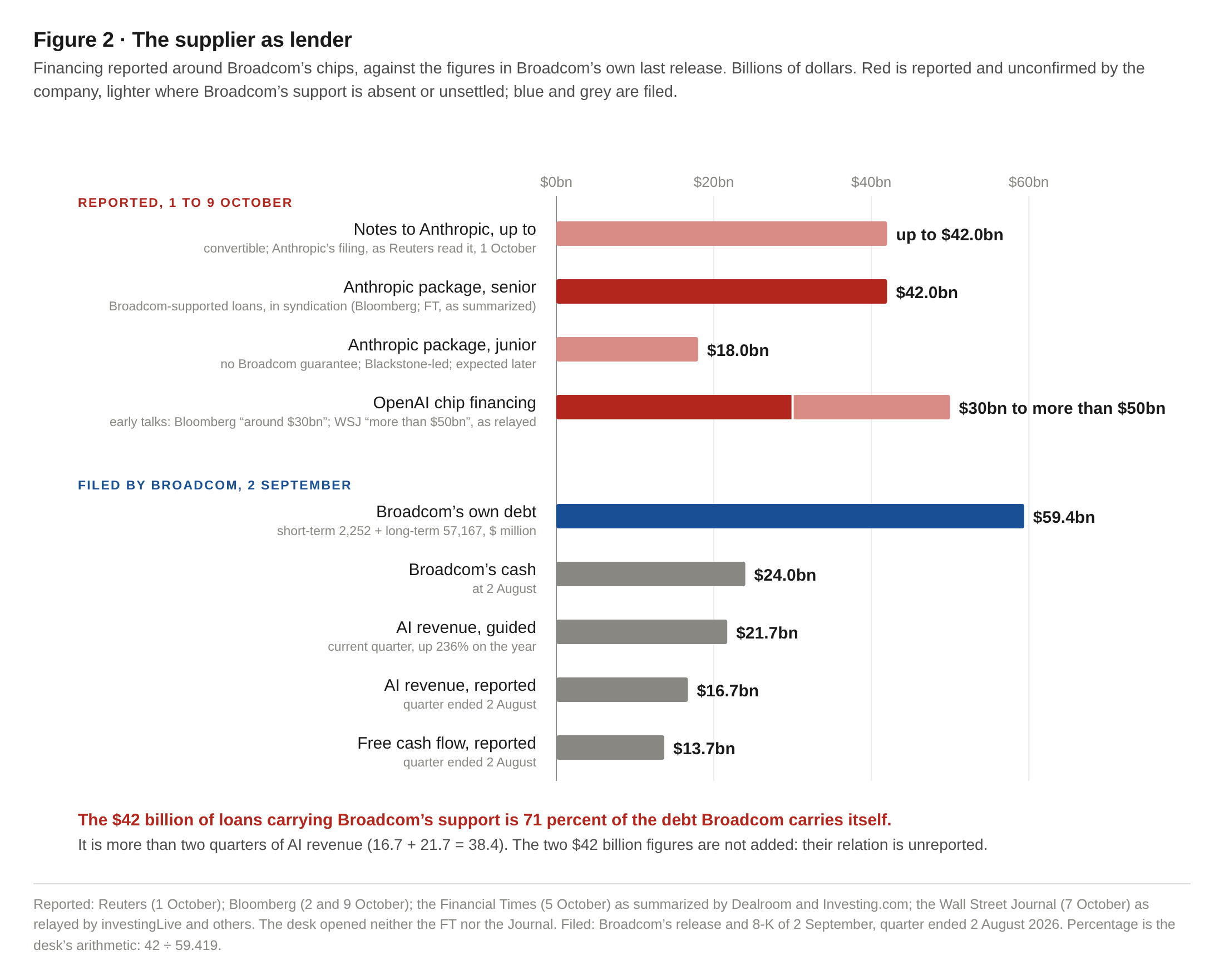
Set that beside what Broadcom has filed. In the quarter that ended on 2 August, the company reported revenue of $29.6 billion, of which $16.7 billion was artificial intelligence semiconductors, and it guided the current quarter's AI figure to $21.7 billion. Free cash flow was $13.7 billion, and cash stood at $24.0 billion. Short-term debt of $2,252 million and long-term debt of $57,167 million make $59.4 billion of borrowings.
So, the senior loans that carry Broadcom's support are 71 percent of all the debt Broadcom carries in its own name. They exceed two quarters of the company's AI revenue, the one reported and the one promised, at $38.4 billion.
Here, then, is the check. If capital is the next constraint, where should that show up?
In the price of money, and there it has. The ten-year Treasury closed Friday at 5.24 percent. On 20 August it was 4.69 on Yahoo Finance's count and 4.70 on the Associated Press's. Reuters found in late July that 78 of 91 bonds sold this year by the largest AI spenders, those with comparable pricing data, were trading at higher yields than at issue. I have no October reading. This is the Intel half of the claim, and Intel is the less constrained of the two. It sold 210.5 million shares at $95 in August, raising $20 billion (up from $15 billion), and the stock closed Friday at $104.70. The equity market gave Intel what it asked for and has since marked the shares up 10 percent.
In the order book, it has not. Taiwan Semiconductor reported September revenue of NT$511.86 billion on Thursday, 0.6 percent below August and 54.6 percent above a year earlier. Nobody in the supply chain has published a number that looks like a customer running out of money.
In the structure of the deals, that is where it is. When a customer cannot borrow in its own name, at a price it can bear, one of two things will happen. It orders less, or someone with a better name stands behind it. The reporting describes the second. A supplier's rating is doing work that the customer's own credit would otherwise have to do, at a price nobody has published. And the piece without that support, the $18 billion that would expose lenders directly to Anthropic, is the piece still waiting. The capital constraint has not stopped the orders. It has moved toward the vendor's balance sheet, or more exactly onto the page just behind it.
And in Broadcom's own filings? Not yet for these deals, and it could not have. The last quarter closed on 2 August, and the reports are dated October. Support of this kind does not sit in the debt line. It sits in a note. Until that note exists, Broadcom's obligation is just other people's description, and no outlet has printed its terms. Broadcom, Anthropic, OpenAI and Blackstone have each declined to comment or have not answered.
Because Anthropic is a party to the first of these financings, a disclosure belongs here: the desk's tooling is built on Claude, made by Anthropic.
What moved
Broadcom settled on Friday at $361.54, up 0.39 percent, on three feeds. That close is sworn. However, the shares were quoted at $364.34 on an overnight venue at 12:45 a.m., up 0.77 percent; at $359.00 at 7:37, down 0.70 percent; and at $358.75 at 9:14, down 0.77 percent. The panel began at 2:00 a.m. Eastern. From the overnight quote to the last pre-bell quote, the desk's arithmetic shows a 1.53 percent fall on holiday volume.
Intel closed Friday at $104.70, down 2.22 percent, on two feeds, and was quoted at $103.15 at 9:18, down a further 1.48.
These names came into Monday off a poor week. A widely held semiconductor fund fell about 5 percent, and a memory-makers fund fell 7.4 percent, by StockTwits' count. The reasons given there: reports that OpenAI's annualized revenue was about $50 billion at the end of September, against the $68 billion to $70 billion that had been circulating, and the Chinese memory maker's technical progress. One is whether customers can earn. The other is whether memory stays scarce. Singapore gave the first a qualified yes and the second a qualified no.
Two moves were not this trade and should not be folded into it. Seoul's fall has its own causes, including a central bank governor apologizing for inadequate warnings about leveraged single-stock funds. Oil moved on diplomacy and diesel.
One group in the trade isn't being read as part of it. Three of the banks reporting this week, Citigroup on Tuesday and Bank of America and Morgan Stanley on Wednesday, are the three reported to have committed to fund the $60 billion package and to be selling it on.
The calendar
Today: no data and no earnings of note. Stocks trade 9:30 to 4:00; cash Treasuries do not. Cleveland Fed President Beth Hammack gives a keynote to the National Association for Business Economics at 12:50 p.m.
Tuesday: the small-business optimism index at 6:00 a.m., consensus 98 against a prior 98.7. JPMorgan, Goldman Sachs, Wells Fargo and Citigroup report before the open.
Wednesday: September consumer prices at 8:30 a.m. The headline consensus is +0.6 percent on the month against a prior +0.4, and on the year +3.7 percent on one calendar and +3.6 on two others, against +3.4. Core is expected at +0.2 percent on the month, down from +0.3, and +2.5 on the year, up from +2.4. ASML, Bank of America and Morgan Stanley report. The Beige Book follows at 2:00 p.m.
Thursday: Taiwan Semiconductor reports its quarter at 2:00 a.m. Eastern. Retail sales at 8:30 a.m., consensus +0.3 percent against a prior +1.2.
The Federal Open Market Committee meets next on 27 and 28 October. A market note on Friday put the odds of no change at about 81 percent. The election is 3 November.
What we're checking next
Monday's claim names the documents that would settle it.
The first is the price. A $42 billion loan is being offered to lenders this month, and it will clear at a spread. If it clears near where Broadcom itself borrows, the support is being taken at face value and the capital is there. If it clears wide, lenders are pricing the customer through the supplier, and Mr. Tan's sentence becomes a description of his own syndication. No outlet has carried that number.
The second is an opinion. The rating agencies are reported to have spoken about Broadcom's earlier arrangements of this kind: S&P in June, calling a guarantee "mildly negative" for its credit, and Moody's in August, saying such obligations "will limit Broadcom's financial flexibility." I heard those second-hand, and neither concerns October's loans.
The third is the note. Broadcom's fiscal year ends on 1 November. The annual report is where support of this size has to be described in the company's own words, and where it should become clear whether the $42 billion of notes and the $42 billion of senior loans are one commitment or two.
The fourth is Thursday. If capital is the binding constraint, the foundry is where a customer's shortage of it would first turn into a figure: a budget held, an order moved to the right. One month's revenue, being a little below the last, isn't that signal. A capital budget would be.
Bottlenecks keep shifting, Mr. Tan said, and the industry keeps getting past them. The earlier ones were things. This one is a price. Unlike wafers, prices get published, and this one has not yet.
Sources and data notes
Times are Eastern. Pages were read between 7:16 and 7:49 a.m. and, against second sources, between 9:18 and 9:36.
Sworn in. Friday's index closes: the Associated Press's table on La Nación, Yahoo Finance and StockMarketWatch; TheStreet's 4:00 p.m. post has the Russell at 2,808.57. The ten-year: ETF Database, Mortgage News Daily (5.243), Trading Economics and Edward Jones. Seoul: Korea JoongAng Daily and Digital Today; TradingKey has the index a hundredth higher, and one relay has Samsung at 4.38. Hong Kong and Shanghai: Bastille Post and Armenpress. Sydney: Investing.com. Broadcom: Yahoo Finance, stockanalysis.com and Investing.com. Intel: stockanalysis.com and MarketChameleon.
One feed. Futures: the Yahoo Finance live page. Crude: Reuters, on Euronext, 0821 GMT, then Benzinga. The Stoxx 600: Reuters, 0709 GMT. The dollar: Trading Economics. The week's fund figures: StockTwits. Broadcom's overnight quote is Yahoo's, from Blue Ocean; the later quotes are stockanalysis.com's. Seoul's causes: those pages, Investing.com and Newsquawk. The 20 August yields: Yahoo Finance and the AP.
The remarks. The session is on DBS's page. CNBC's piece would not open and was read on two reposts; every direct quotation except the OpenAI one rests on it. Reuters and Bloomberg are on Yahoo Finance; The Standard supplies the list of bottlenecks and the two years. Broadcom's customers are per The Next Platform.
The financings. Reuters, on The Star, 1 October. Bloomberg, on Advisor Perspectives, 2 October, and on The Star, 9 October. The Financial Times as summarized by Dealroom and Investing.com. The Wall Street Journal as relayed by investingLive, Data Center Dynamics and StockTwits. The desk opened neither the FT nor the Journal. The agencies' remarks are as relayed by Tiger Brokers' news feed, here and here.
Filed figures. Broadcom's release and 8-K of 2 September. Taiwan Semiconductor's release and calendar. Intel's release. Reuters' bond count, on KFGO, 29 July.
Desk arithmetic. 60 + 30 = 90 and 60 + 50 = 110. Broadcom's debt: 2,252 + 57,167 = 59,419 million; 42 ÷ 59.419 = 70.7 percent. AI revenue: 16.7 + 21.7 = 38.4. Intel: 104.70 ÷ 95 = 1.102. Broadcom: (358.75 − 364.34) ÷ 364.34 = −1.53 percent.
The calendar. The Cleveland Fed, the Bureau of Labor Statistics, the Census Bureau and the Federal Reserve for dates and priors; Trading Economics and investingLive for consensus; 24/7 Wall St. for earnings days.
The chronicle. One entry joins the register, taking the count from 213 to 214. Number 217 is a KuCoin news flash of 8 October headlined "Broadcom to Raise Over $500 Billion"; its own body says "over $50 billion."
The Decoy Chronicle — every entry, dated and sourced — is published as a standing register and updated with each issue.
The TrendyVest Championship is open for registration at Tournament.Trendyvest.com — 500 seats, a $100,000 simulated stake, free to enter. Trading began October 1 at the market open.
TrendyVest is an independent research practice. This is analysis and editorial opinion, not investment advice, and nothing here is a recommendation that any particular person buy or sell any security. Figures identified as this desk's arithmetic are the practice's own, and the inputs are printed alongside them.