Earnings, read against the guide
Micron Beat Its Own Floor Again, and Then Raised It
Fiscal fourth-quarter revenue of $54.2 billion, $4.2 billion over the midpoint the company set in June, and a first-quarter guide of $61.5 billion that is $4 billion above the Street. The number to watch is not either of those. It is the gross margin, which Micron just guided down for the first time this cycle.
Wednesday, September 30, 2026, 4:01 p.m. release; written before the 4:30 p.m. call · AI buildout · Four figures
Micron reported its fiscal fourth quarter at 4:01 p.m. Eastern on Wednesday, and the first thing to note is this: for seven quarters, the company's own guidance has been the floor, not the finish line. That is the thesis, and the rest of the quarter, the year, and the guide all point back to it.
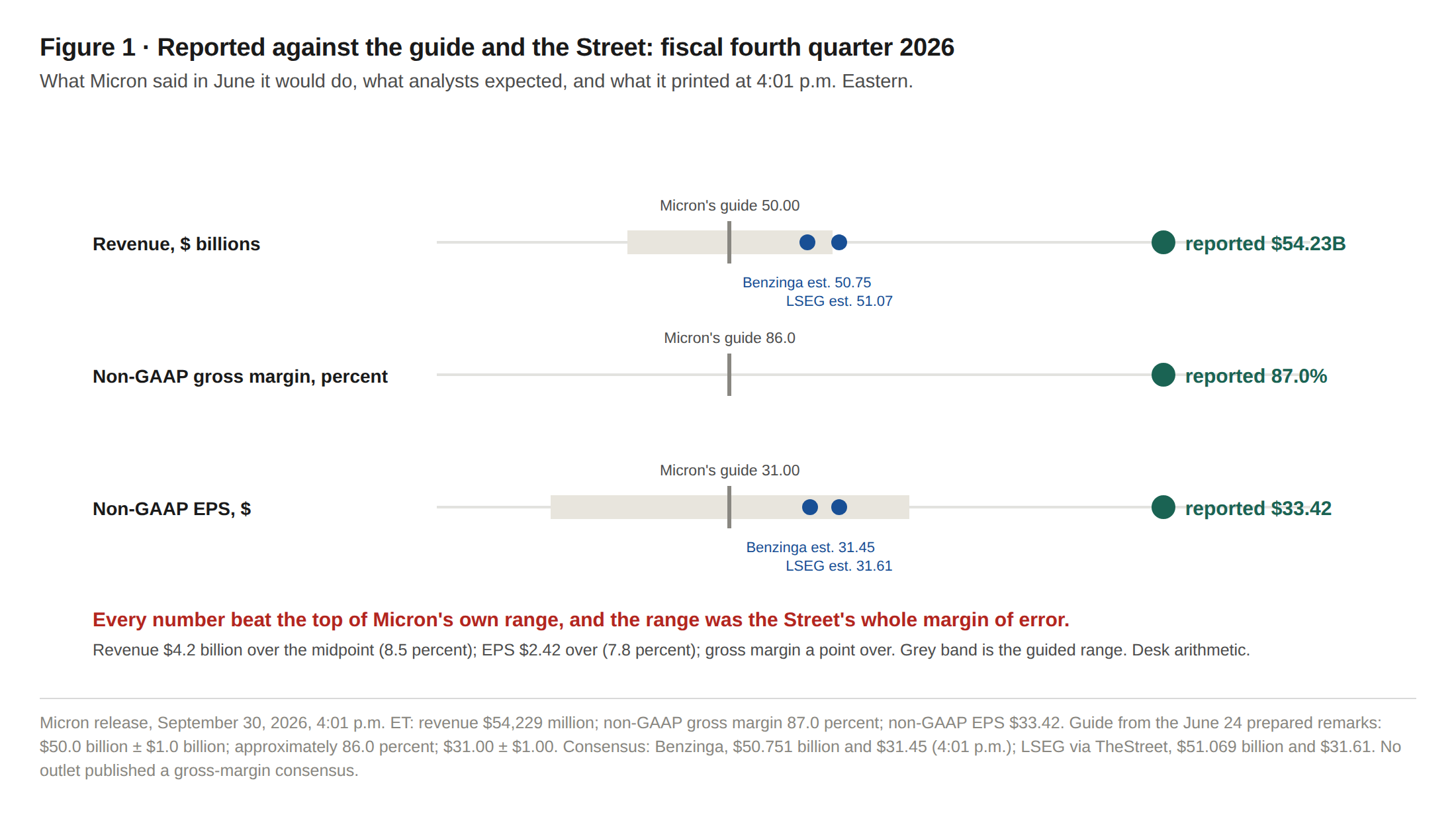
Revenue was $54.229 billion against a guide of $50.0 billion, plus or minus a billion, given on June 24. Non-GAAP gross margin was 87.0 percent against "approximately 86.0 percent." Non-GAAP earnings were $33.42 a share against $31.00, plus or minus a dollar. Every number cleared the top of its range, and the range was wider than the gap between the guide and the Street: Micron release, September 30, 2026. Benzinga's consensus was $50.751 billion and $31.45, LSEG's $51.069 billion and $31.61; TheStreet at 4:08 p.m. Beats against consensus of 6.2 to 6.9 percent on revenue and 5.7 to 6.3 percent on earnings, the desk's arithmetic.
The stock had closed at $1,069.15 and traded at $1,064.50 in the first minutes after the release, down 0.43 percent, on one feed (stockanalysis.com, read shortly after 4:01 p.m.; unsworn, and the desk will not swear an after-hours print). The options market had priced a move of 6.3 to 8 percent either way (SpotGamma, September 29; Benzinga, 12:46 p.m.). A stock that beats by seven percent and does not move has already been paid for the beat, which is the case with Micron every quarter now; that is why the beat matters less than the guide.
The year, first, because the quarter is only its last chapter
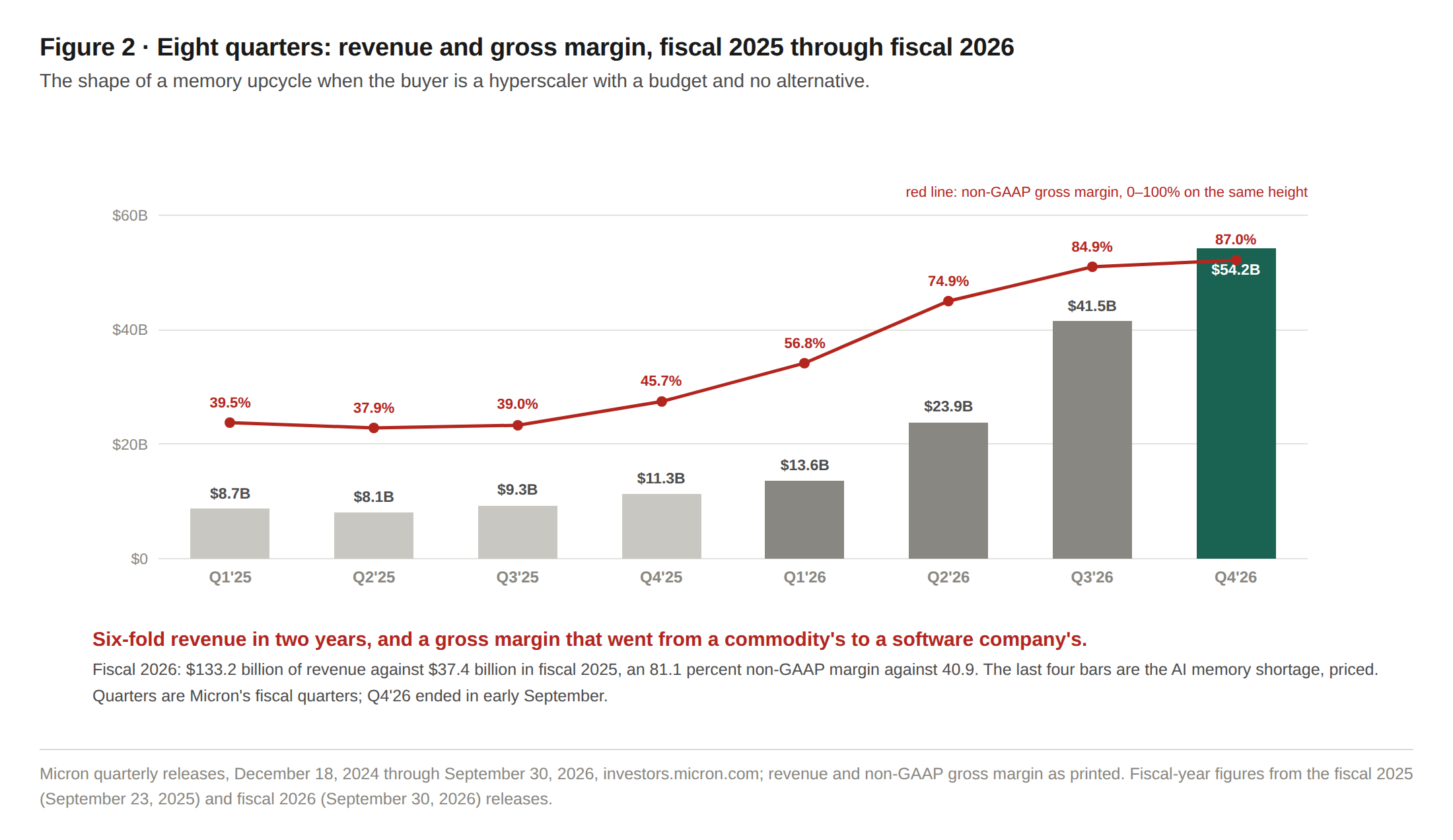
Fiscal 2026 ended with $133.188 billion of revenue. Fiscal 2025 was $37.378 billion. That is a 256 percent increase, the desk's arithmetic, in a business that makes a commodity and had a 40.9 percent non-GAAP gross margin twelve months ago. This year's was 81.1 percent. Non-GAAP earnings went from $8.29 a share to $75.52, a year that explains why the guide now matters more than the print.
Operating cash flow for the year was $89.675 billion; capital spending, net, $27.367 billion, almost exactly the "approximately $27 billion" Micron said in June it would spend; adjusted free cash flow $62.308 billion. The company ended the year with $73.453 billion of cash and investments against $5.179 billion of debt — net cash of about $68 billion, the desk's subtraction — having bought back $650 million of stock in the quarter and declared a fifteen-cent dividend. The buyback is small for a reason a bank flagged last week: restrictions attached to Micron's CHIPS Act award expire on December 9, and Bank of America expects repurchases to become possible after that (TheStreet via Yahoo Finance, September 25).
Sanjay Mehrotra's quote in the release is worth reading for what it commits to: "Micron delivered record fiscal 2026 results, and we expect an even stronger fiscal 2027. AI is becoming Super Intelligence (SI), and memory enhances this intelligence and the competitiveness of our customers' platforms. We are increasing our investments in technology, products and manufacturing to help drive SI forward with our customers, and our Strategic Customer Agreements provide added confidence in the durability of Micron's financial performance."
Two phrases in that carry money. "Increasing our investments" is the capex line, below. "Strategic Customer Agreements" are the sixteen five-year contracts Micron described in June — fourteen of them carrying about $100 billion of cumulative revenue at minimum prices, covering roughly a fifth of the company's DRAM volume and a third of its NAND (June 24 prepared remarks). They are why the word "durability" appears in a memory company's press release, a word the industry has historically been unable to use.
Where it came from
The release no longer splits DRAM from NAND; that comes on the call. It now lists the four business units, and the quarter belonged to one of them.
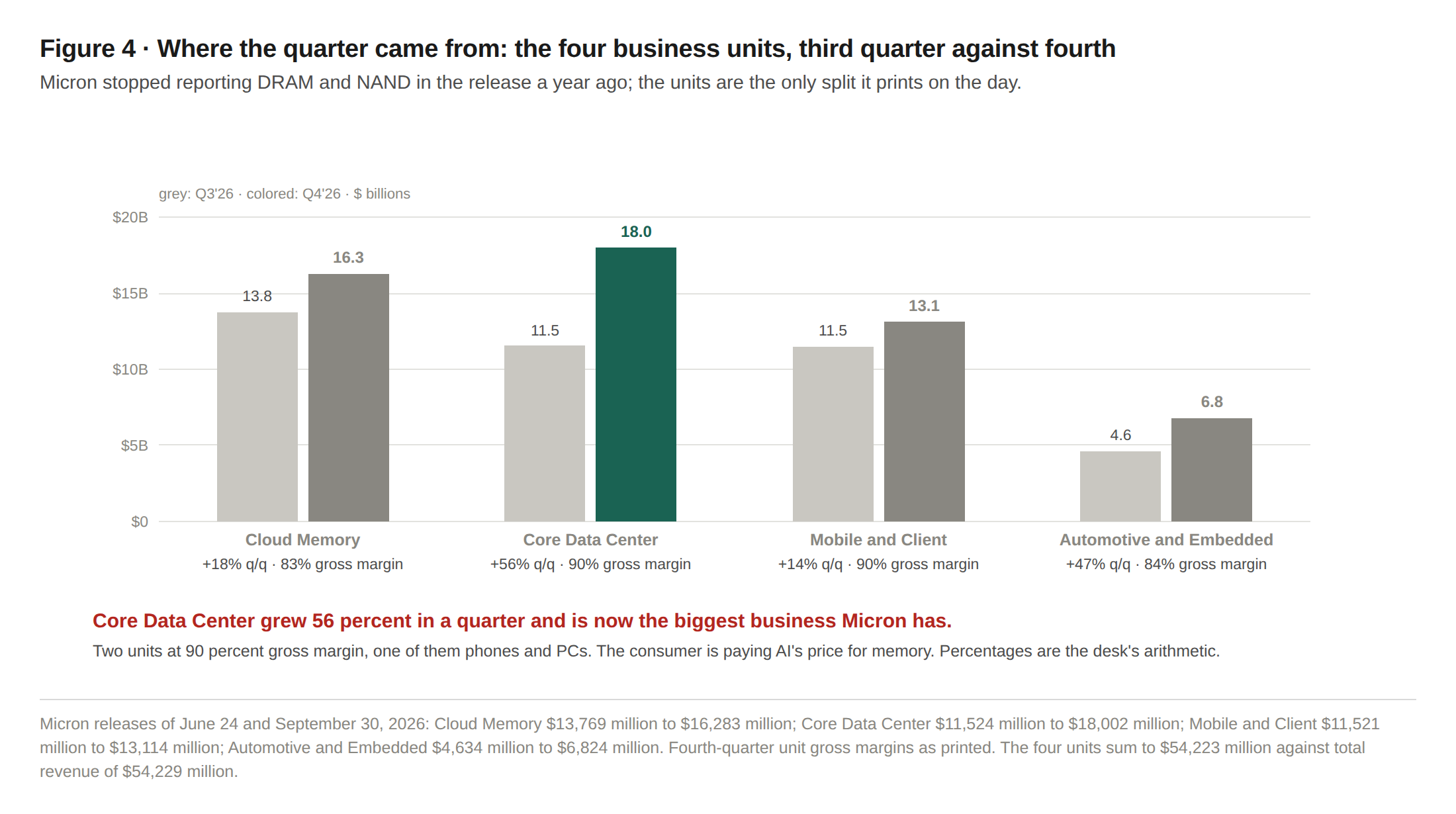
Core Data Center — the unit that sells HBM, high-capacity server DIMMs and data-center SSDs — went from $11.524 billion in the third quarter to $18.002 billion, a 56 percent sequential increase, the desk's arithmetic, at a 90 percent gross margin. It is now Micron's largest unit, ahead of Cloud Memory at $16.283 billion (up 18 percent, 83 percent margin). Mobile and Client rose 14 percent to $13.114 billion, also at 90 percent. Automotive and Embedded rose 47 percent to $6.824 billion, with an 84 percent margin.
The Mobile and Client margin is the detail to sit with. A unit that sells memory for phones and PCs earning 90 cents on the dollar means the consumer is paying the AI price. TrendForce's fourth-quarter outlook, published the same morning as the print, has conventional DRAM contract prices rising another 10 to 15 percent this quarter and NAND 15 to 20, with suppliers continuing to "prioritize advanced-process capacity for high-performance server products," which keeps "the overall market undersupplied" (TrendForce, September 30). Samsung's Kim Taewoo said last week that HBM will take nearly 30 percent of the industry's DRAM wafer capacity next year, from about 20 percent now (TrendForce, September 29). Consumers are not being served first and are paying for the privilege of being served at all.
The guide, and the one number in it that went down
For the fiscal first quarter, Micron guided revenue of $61.5 billion, plus or minus $1.5 billion; non-GAAP gross margin of approximately 86.25 percent; non-GAAP operating expenses of approximately $2.06 billion; and non-GAAP earnings of $38.15 a share, plus or minus a dollar.
The revenue guide is 13.4 percent above the quarter just reported at the midpoint, the desk's arithmetic, and between $3.6 billion and $4.7 billion above the pre-print consensus, which ran from $56.85 billion to $57.93 billion. 24/7 Wall St., September 29, and FXStreet, September 30, both had the consensus range. FXStreet had written that morning that "if Micron guides Q1 2027 revenue above $58 billion and margins stay resilient at 85%, the stock could rally sharply." Both conditions were met. The earnings guide, $38.15, is between $2.23 and $3.20 above the consensus range of $34.95 to $35.92.
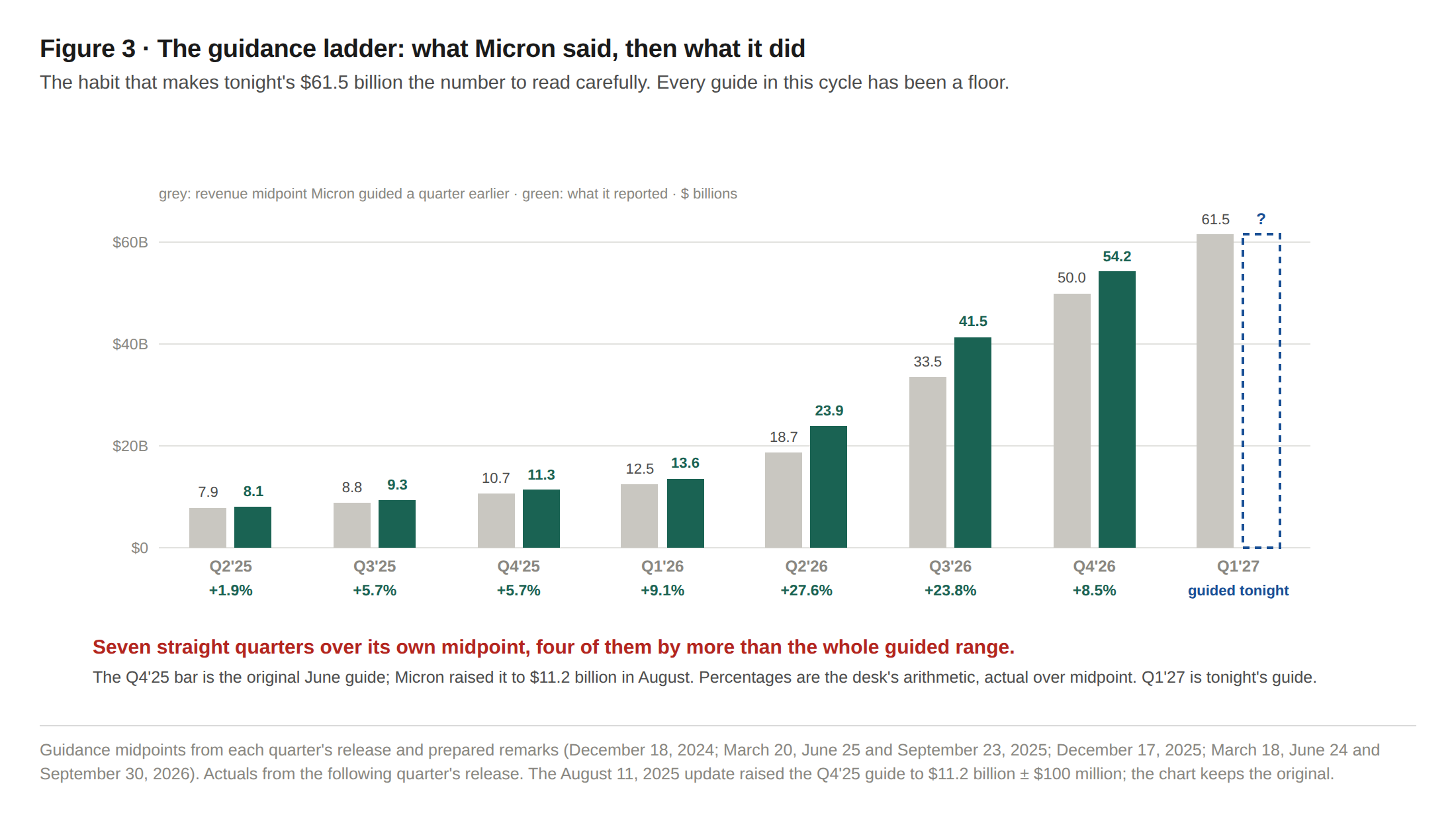
And yet. Figure 3 is the reason to read the guide as a floor rather than a forecast — seven straight quarters over the midpoint, four of them by more than the entire guided range — and it is also the reason to notice what decelerates. The fourth quarter grew 30.8 percent over the third. The guide implies 13.4 percent. Micron has beaten its midpoint by an average of 17.2 percent over the last four quarters, the desk's arithmetic; apply that habit to $61.5 billion and you get $72.1 billion, or 33 percent growth. That is a hypothetical, not a forecast, and the company's own number is the one on the record. The point is not whether Micron can beat again; it is that the guide itself is now the signal.
The gross margin is the number that went the other way. Micron just printed 87.0 percent and guided 86.25. Three-quarters of a point is nothing in a normal business. In this one, it is the first time in the cycle that the company has guided margin below the quarter it just reported: every prior guide in Figure 2's climb pointed up. Operating expenses are guided to $2.06 billion from $1.65 billion for the fourth quarter, a 25 percent step that is "increasing our investments" on the income statement. Neither is a problem at these levels. Both are the first evidence that the slope has a top, and the call at 4:30 p.m. is where the company will say whether the margin guide is mix, price, or cost. That is the number to watch because it is the first crack in the pattern.
The buildout beat: what Micron is going to spend
Fourth-quarter capex was $10.774 billion against the "around $10 billion" guidance. In June, the company said quarterly capex in fiscal 2027 would run above the fourth-quarter level, with more than half the year-over-year increase coming from construction as it pulls forward cleanroom capacity. Four quarters above $10.8 billion is more than $43 billion, the desk's arithmetic on the company's own floor; Bank of America's estimate is $45 to $48 billion (September 25). Against fiscal 2026's $27.4 billion, that is the buildout this publication covers, priced: a memory company spending a fifth of its cash flow to build the thing every hyperscaler said in September it cannot get enough of. Nvidia, on August 26: "We are experiencing extreme pricing conditions in memory. The magnitude of the price increase has exceeded our prior expectations and is headed even higher into next year." That spending is the other side of the thesis.
The release gives no fiscal 2027 capex number. That, too, is a call item.
The tape into the print
Micron closed on Thursday, September 24 at $1,080.53; Friday at $1,082.28; Monday at $1,053.98, down 2.61 percent on the day Michael Burry disclosed he had replaced his short with put options struck near $500 and expiring June 2027; Tuesday at $1,065.08; all four identical on stockanalysis.com, Yahoo Finance and Investing.com and sworn in. Wednesday's close, $1,069.15, rests on one feed at this writing and is printed unsworn. The stock is 14.8 percent below its June 25 high of $1,255, the desk's arithmetic, and up about 273 percent this year (Barchart via 24/7 Wall St., September 30). The average of 49 analysts' price targets is $1,521 (stockanalysis.com, September 30); September's actions ran from Wells Fargo's cut to $1,400 to D.A. Davidson's $2,000.
Burry's case, in his own words on September 23, was that "DDR4 now has more sellers than buyers" and that Chinese production is expanding at lower prices. The release does not speak to DDR4. The 90 percent margin in Mobile and Client, where DDR4 mostly lives, is the closest thing to an answer the numbers give tonight, and it is not his.
What the release does not say, and the desk was watching for
Three items from this desk's Whisper Register had this print as their settlement date, and the release settles none.
The reported end-of-life of Micron's two-gigabyte GDDR7 parts, first surfaced on September 23 from a reading of the company's own parts catalog, would show up on the call as commentary on graphics memory mix shifting toward higher-density parts for AI. The release does not mention GDDR7, graphics, or Nvidia's consumer boards. Register entry 10 stays open.
The two German injunctions YMTC won in Munich, first reported September 18, do not appear in the release, and the desk found no 8-K on the matter as of this afternoon. Germany-only injunctions on first-instance rulings, under appeal, against a company that just reported $54 billion in a quarter are not material at this scale, and the release treats them accordingly, which is to say not at all. Register entry 9 stays open.
HBM. The release does not give an HBM revenue figure, a run-rate, a share, or a sold-out statement. In June, the company said it had shipped over $1 billion of HBM4 and that the HBM4 ramp was tracking twice as fast as HBM3E's; Counterpoint put Micron's second-quarter HBM revenue share at 18 percent, down from 21, with SK hynix at 50 and Samsung at 33 (via TechTimes, September 7). TrendForce said Tuesday that 2027 blended HBM prices are now projected to rise 121 percent, and that suppliers finalize next year's prices around this quarter. Whether Micron's share of that is growing or shrinking is the most important thing the company can say at 4:30, and the release leaves it for then.
What would change this reading
A gross-margin guide below 86 percent for the second quarter, when it comes in December, would say the top of the slope has been passed rather than approached. A fiscal 2027 capex number above $48 billion would say the company is building for a shortage that lasts past 2028; one below $40 billion would say it is not. An HBM share figure below 18 percent on the call would say the growth is conventional DRAM pricing rather than the product the whole thesis is named for. And a week in which the stock finishes lower after a seven percent beat and a four-billion-dollar guide raise would say what it said eight times before: that the print is the floor, and the price already knew.
The calendar
Wednesday, September 30, 4:30 p.m. Eastern: the earnings call, with DRAM and NAND revenue, HBM, and fiscal 2027 capex. Mid-October: Samsung's preliminary third-quarter guidance, last year on October 14. Late October: SK hynix's third quarter. December 9: the CHIPS Act repurchase restriction expires, per Bank of America. Mid-December: Micron's fiscal first quarter, against the $61.5 billion guided tonight.
The TrendyVest Championship is open for registration at Tournament.Trendyvest.com — 500 seats, a $100,000 simulated stake, free to enter. Trading begins October 1 at the market open.
Sources and data notes
The print. Micron Technology, "Micron Technology, Inc. Reports Record Fiscal Fourth Quarter and Full Year 2026 Results," GlobeNewswire, September 30, 2026, 4:01 p.m. ET, quoted; all fourth-quarter, fiscal-year, balance-sheet, business-unit and guidance figures are as printed there. Consensus: Benzinga, September 30, 4:01 p.m. ($50.751 billion; $31.45); LSEG via TheStreet's live blog, stamped 4:08 p.m. ($51.069 billion; $31.61); first-quarter consensus from 24/7 Wall St. via Yahoo Finance, September 29 ($56.85 billion; $34.95) and FXStreet, September 30 ($57.93 billion; $35.92), quoted. No published gross-margin consensus was found; JPMorgan's 86.2 percent, cited by KuCoin on September 30, is a single estimate.
The guide. Micron's prepared remarks of June 24, 2026, for the fourth-quarter guide, the fiscal 2026 capex plan, the fiscal 2027 capex language, the HBM4 statements and the Strategic Customer Agreements. Micron's August 11, 2025 update raised the fourth-quarter fiscal 2025 guide to $11.2 billion; Figure 3 keeps the June original and says so. History from the quarterly releases of December 18, 2024; March 20, June 25 and September 23, 2025; December 17, 2025; and March 18 and June 24, 2026, investors.micron.com.
The tape. Closes for September 24, 25, 28 and 29 identical on stockanalysis.com, Yahoo Finance and Investing.com; sworn. September 30 close from stockanalysis.com's quote header only; unsworn. After-hours print, stockanalysis.com, one feed, minutes after the release; unsworn and not used for any conclusion. Implied move: Benzinga Pro, September 30, 12:46 p.m. (6.3 percent); TheStreet (6.5); SpotGamma, September 29, and FXStreet, September 30 (about 8). The 3.44 percent figure is from 24/7 Wall St. via Yahoo Finance, September 29, quoted. Price targets from stockanalysis.com's forecast page, September 30, and Yahoo Finance/StockTwits, September 23. Burry: 24/7 Wall St., September 30, quoting his September 28 post; Options Trading Report, September 24, for the September 23 remarks, quoted.
The industry. TrendForce press releases of September 30 (fourth-quarter contract prices, quoted) and September 29 (2027 HBM prices; Samsung's Kim Taewoo via Reuters). Counterpoint second-quarter HBM shares via TechTimes and CTOL, September 3 and 7. Nvidia second-quarter fiscal 2027 call, August 26, quoted from the transcript. Bank of America via TheStreet and Yahoo Finance, September 25, for the fiscal 2027 capex estimate and the December 9 date. ip fray, September 18, and JUVE Patent, September 24, on the Munich injunctions; TrendForce, September 24, on the GDDR7 report.
Arithmetic. All percentage changes, the net-cash figure, the annualized capex floor, and the $72.1 billion hypothetical are the desk's calculations from the printed inputs, and are labeled where they appear. The business units sum to $54,223 million against printed revenue of $54,229 million. We checked the weekdays named in the text against the calendar. This piece was written from the release and published before the 4:30 p.m. call; anything the call adds or corrects will run at full size in the morning Brief.
Disclosure. Micron is entry 9 and entry 10 on this desk's Whisper Register, both unresolved and unchanged by this release.