Featured analysis · AI for everyone
Ai for Everyone
AI Will Work for Two Dollars a Call. Here Is the Bill It Sends Everyone Else.
Friday, October 2, 2026 · Featured analysis · The next 24 months · Ten figures
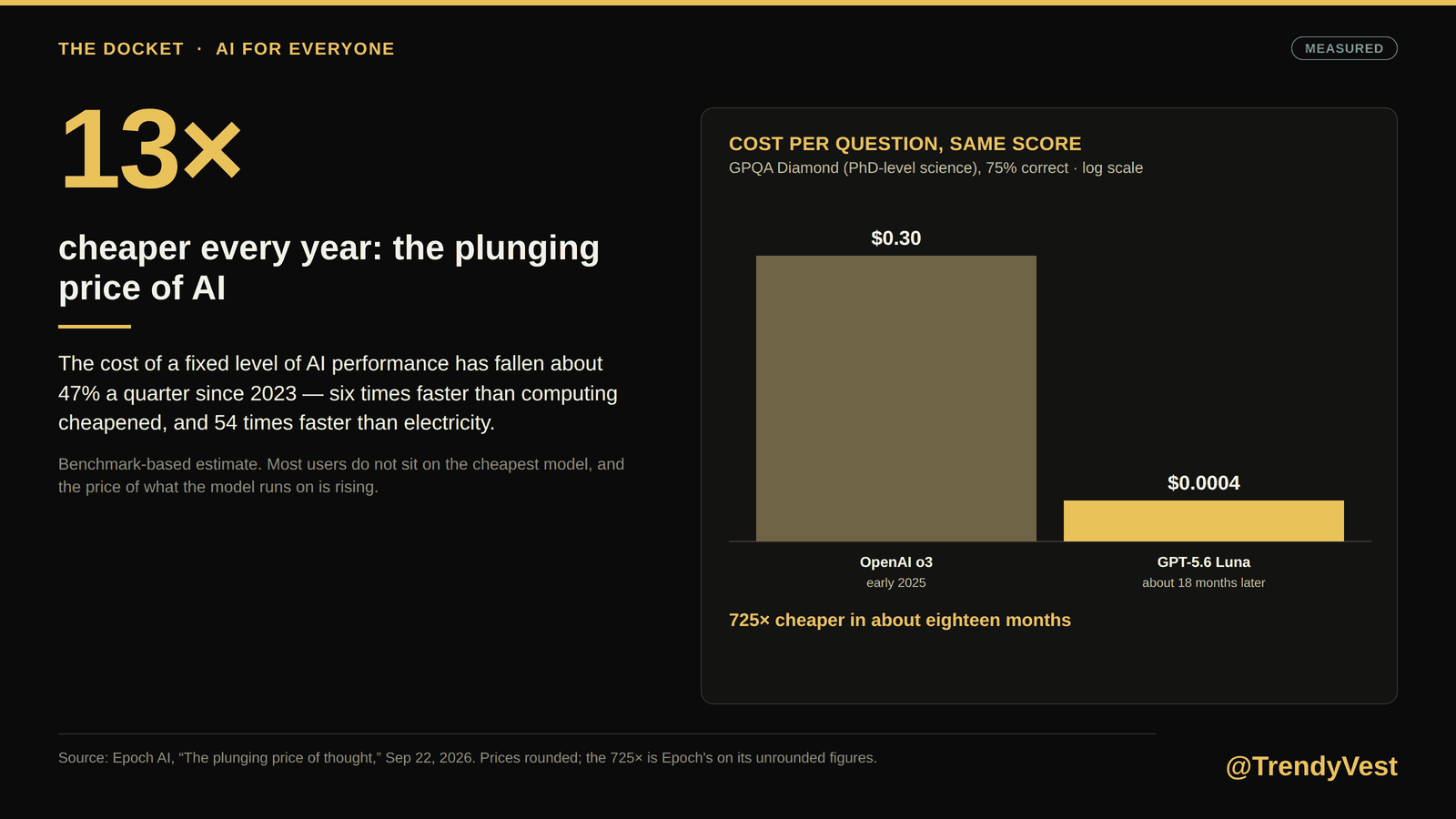
In January 2025, getting a frontier model to answer a PhD-level science question correctly three times out of four cost about thirty cents. By the middle of this year, a model that scored the same on the same test did it for about four hundredths of a cent — a 725-fold fall in roughly eighteen months, on Epoch AI's accounting. Across every benchmark Epoch tracks, the price of a fixed level of AI performance has fallen about 47 percent a quarter since 2023, thirteenfold a year, and Epoch says that may be faster than any transformative technology in history has cheapened — six times faster than computing did, fifty-four times faster than electricity (Epoch AI, "The plunging price of thought," September 22).
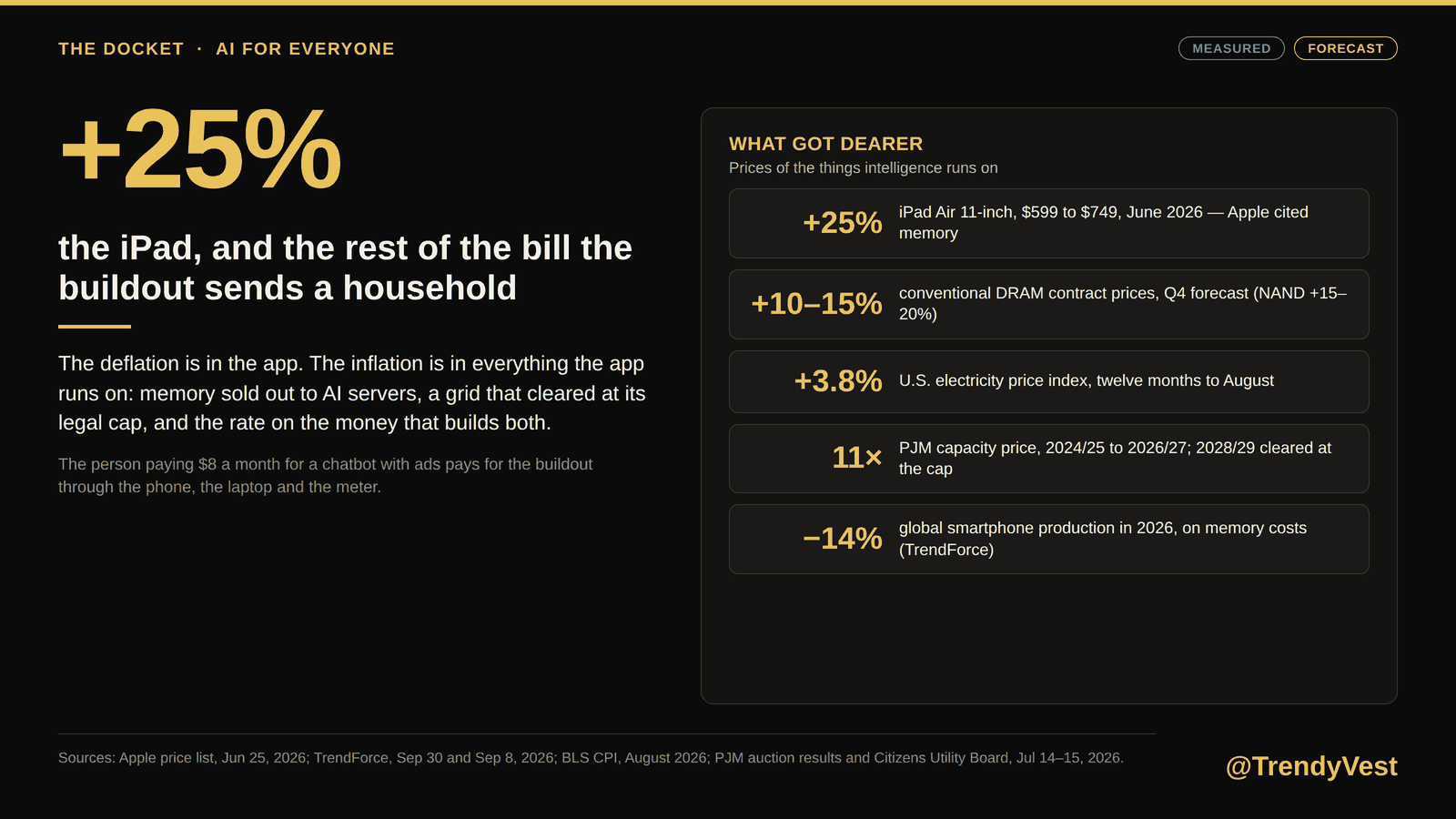
In June 2026, Apple raised the price of the 11-inch iPad Air from $599 to $749, a quarter more, and said why: memory. Nintendo raised the Switch 2 to $499.99 on September 1 for the same reason. The memory makers are sold out through next year because AI servers are taking the wafers, and TrendForce expects conventional DRAM contract prices to rise another 10 to 15 percent this quarter and NAND 15 to 20 (TrendForce, September 30). The electricity index in the consumer price index is up 3.8 percent in a year (BLS, August CPI). In the thirteen-state grid that serves Washington, Chicago and the data-center capital of the world in northern Virginia, the price of guaranteed capacity has gone from $28.92 a megawatt-day to $329.17, eleven times, in two auctions, and the latest cleared at its legal cap with a shortfall (PJM; Citizens Utility Board, July 15).
Those are the two prices, and they are moving in opposite directions. The next twenty-four months of AI's commercialization are the story of which one reaches you first. Intelligence is deflating faster than anything has. The physical world it runs on — chips, memory, power, the grid, the rate on the money that builds it — is inflating because of the same demand. Who captures the first and who pays the second is the whole question, and it has different answers for a household, a small business, a large company and the companies building it all.
This is a featured analysis, not a forecast. Every figure here is somebody's measurement or somebody's named projection, and the scenes of 2028 are built from products that are shipping, sampling or announced, not imagined. Where the desk has done arithmetic, it says so and shows the inputs.
Tokens, seats, actions, outcomes
The first way intelligence was sold was the obvious one: pay to talk to the model. Consumers bought subscriptions, companies bought seats, developers bought tokens. All three are still here, and they are still most of the revenue. ChatGPT is sold at $8 a month on a tier that "may include ads," $20, $100, $200 and, since Tuesday, $500; Google's AI tiers run $4.99 to $199.99; Claude runs $20 to $200 (pricing pages as of October 2). OpenAI sells a business seat at $20 a month and a premium seat at $100, billed annually, and tells enterprises that "credit-based pricing and token-based pricing are available." Microsoft 365 Copilot is $30 a user a month, and Anthropic's enterprise plan is a $20 seat "plus usage at API rates" (pricing pages, October 2).
But look at what the second line on each of those pages now says. Microsoft sells Copilot Credits in packs of 25,000 for $200 a month, or $0.01 a credit pay-as-you-go, and agents are "metered" for the users who do not hold a full seat (Microsoft, June 16). Salesforce prices Agentforce at "$2 USD per conversation," or in Flex Credits at $500 per hundred thousand, with an agent action costing twenty credits — a dime an action, the desk's arithmetic — and in June it introduced a help agent whose "cost is tied to outcomes, not activity," with no charge when the customer gives a thumbs-down or escalates (Salesforce pricing page; release, June 25). HubSpot, which sold software by the seat for two decades, cut its customer agent to "$0.50 per resolved conversation" from a dollar on April 14 and charges "$1.00 per lead recommended for outreach." Zendesk charges $1.50 per automated resolution on a commitment and $2.00 pay-as-you-go, and told its users in May they would pay "only for outcomes that are genuinely, confirmably resolved." Intercom's Fin is "from $0.99 per Fin outcome," no seats required (company pricing pages, October 2).
That is the ladder, and the money is climbing it: tokens, then seats, then actions, then outcomes. Each rung changes the buyer's question. A seat asks "is this worth $30 a month for Dave?" An action asks "what did it do?" An outcome asks "did it do the job?" — and the vendor only gets paid if the answer is yes. The reason this matters for everyone, not just for software buyers, is that outcome pricing is the mechanism by which intelligence gets sold to people who would never buy a subscription. A plumber will not pay $30 a seat for a chatbot. He will pay two dollars for an answered call that becomes a booked job, because the job pays for it.
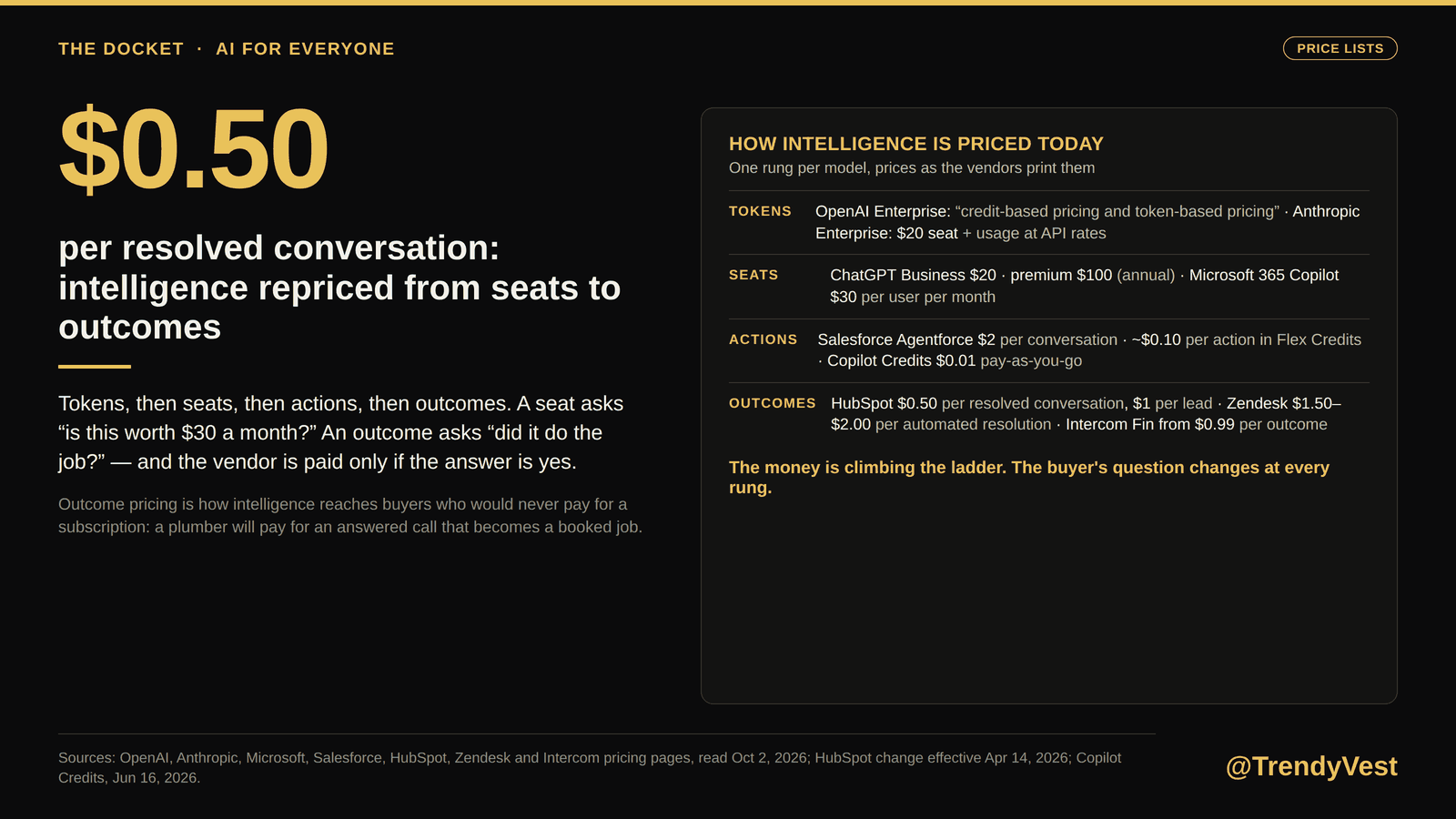
The two years ahead are the years the ladder gets climbed in public. The deflation in the cost of thought is what makes it possible: at thirteen times cheaper a year, the cost of resolving a support ticket with a model falls below what anyone would notice, and the vendor can afford to be paid only when it works. The inflation in everything else is what makes it necessary: the companies building the models have $732 billion of capital spending to earn back this year alone, and seats do not scale to that number. Outcomes might.
The consumer: the assistant that works while you don't
Start with what is measured. ChatGPT has 1.2 billion weekly users, by OpenAI's count at its developer day on Tuesday; the Gemini app passed a billion monthly in August (OpenAI, September 29; Google, August 11). Sixty-four percent of American adults used an AI product in the past six months and a quarter use one daily, and consumer spending on AI reached about $40 billion this year, three times last year's, with 55 percent of users paying for at least one product (Menlo Ventures, September 16). In-app purchases in AI apps passed $4 billion in the first half, and ChatGPT alone took about $1.4 billion in the second quarter (Sensor Tower). OpenAI's advertising business, launched in February on the free and $8 tiers, reached a billion dollars of annualized revenue in under two hundred days, and the company added more consumer revenue in the third quarter than in all of 2025 (OpenAI, August 31; Axios, September 29).
So the consumer product exists, it is enormous, and it is paid for three ways at once: subscriptions, ads, and the share of a transaction. The third is the one that changes over the next two years, because today's consumer AI is something you open, and tomorrow's is something that is working while you are not.
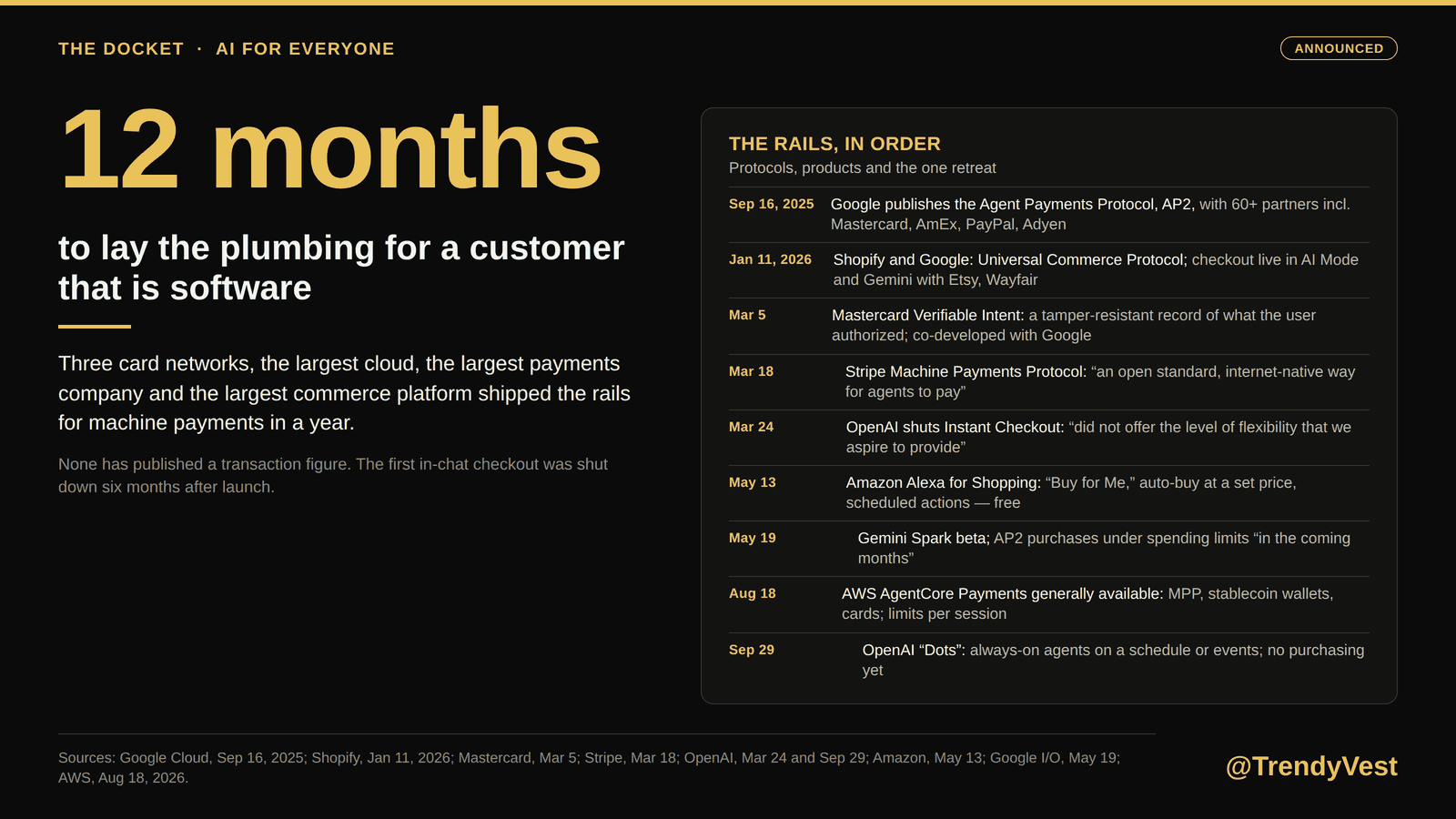
Here is what is already live, as of this week. Amazon's Alexa for Shopping, which replaced the standalone Rufus assistant in May, has a "Buy for Me" mode that "handles the entire purchase on your behalf," an auto-buy that purchases when a price you set is reached, and scheduled actions, and it is free to every signed-in American customer (Amazon, May 13). Rufus was already driving more than $10 billion of incremental annualized sales a year ago, by Andy Jassy's account. Google's Gemini Spark, in beta for its $200-a-month subscribers since May, is promised the ability to make purchases under spending limits "in the coming months," on the Agent Payments Protocol Google published a year ago with more than sixty partners including Mastercard, American Express, PayPal and Adyen (Google I/O, May 19; Google Cloud, September 16, 2025). OpenAI's new "Dots" are "always-on agents" that act "on a schedule or in response to events" — included with the $100 Pro and premium business tiers, with no purchasing yet (OpenAI DevDay, September 29). Meta's Muse, shown at Connect last week with a pendant to wear it on, has no shopping or payment capability disclosed (Engadget, secondary).
Under all of it, the rails have been laid in a single year. Stripe published the Machine Payments Protocol in March, "an open standard, internet-native way for agents to pay," because agents "need the ability to transact with businesses and one another," in stablecoins, cards or buy-now-pay-later (Stripe, March 18). Shopify and Google co-developed the Universal Commerce Protocol, "an open standard for AI agents to connect and transact with any merchant," endorsed by more than twenty retailers, and checkout through it went live in Google's AI Mode and Gemini with Etsy and Wayfair in January, with Target and Walmart to follow; Google's own line is that "in 2026, agentic commerce is no longer just a concept, it's reality" (Shopify, January 11; Google, February 11). Mastercard's Verifiable Intent "creates a tamper-resistant record of what a user authorized when an AI agent acts on their behalf," co-developed with Google and open-sourced in March, under a title that is the thesis of this whole section: "When AI starts buying for you, trust becomes the product" (Mastercard, March 5). Amazon's AgentCore Payments went generally available in August with Stripe, Coinbase, dollar-stablecoin wallets and card funding, with spending limits "enforced per session" (AWS, August 18). Visa's Tim Conard, in July: "AI agents now book travel, reorder inventory, query data providers, and buy compute for the businesses and people they work for."
Now the scene, built only from the above. It is a Saturday in the spring of 2028. Your assistant has a mandate you wrote once and it keeps forever: keep the household under a number a month, re-shop the car insurance every six months, cancel anything unused for ninety days, rebook the flight if the fare drops, order the things you always order when they are cheap, and never spend more than two hundred dollars without asking. Overnight it did four of those. It has a signed, auditable record of each — the Mastercard record, the Stripe receipt, the merchant's confirmation — and a one-line summary waiting for you with your coffee. You did not open anything. The insurer that won your renewal did not advertise to you. It answered a structured request from your agent, with a binding quote, and beat forty others. The customer was not you. The customer was software representing you.
That last sentence is where the next two years' money is, and it is worth saying plainly what has to be true for it to happen, because none of it was true two years ago and only some of it is true now. The agent needs a mandate it can prove it was given, which is what Verifiable Intent is for. It needs a way to pay that a merchant will accept from a machine, which is what MPP, AP2 and AgentCore Payments are for. It needs merchants whose prices, inventory and terms are legible to a machine rather than a human, which is what UCP is for — and which is why the marketing discipline of the next decade will be optimizing for an agent's decision rather than a person's attention. A banner is worthless to a program with an objective. Structured data, honest pricing and a delivery guarantee are everything to it. Sellers that are illegible to the agent are invisible to the customer.
The honest counterweight is that the first version of this already failed once. OpenAI shut down Instant Checkout in March, six months after launching it, because it "did not offer the level of flexibility that we aspire to provide," and sent buyers back to merchants' own sites; Walmart said purchases inside the chat converted at a third the rate of a click-out to Walmart.com (OpenAI, March 24; Walmart's Daniel Danker, via Modern Retail, secondary). Microsoft's Copilot Checkout, Perplexity's Instant Buy and Google's Universal Cart all exist and none has published a transaction figure. The agent that buys for you is a 2027–2028 product, not a 2026 one, and the market is pricing the rails before the traffic.
What the consumer already gets, measured, is advice. More than 230 million people ask ChatGPT a health question every week; 32 percent of American adults used AI for health information in the past year; 81 percent of physicians now use AI in their practice, up from 38 percent in 2023, with 2.3 uses each, 70 percent of them saying it helps with burnout and 88 percent worrying about skill loss (OpenAI, January; KFF, March; AMA, March 12). Generative-AI referrals to retail sites rose 693 percent last holiday season, and those shoppers converted 31 percent better and spent 32 percent more a visit than other traffic; Adobe expects the traffic to rise another 130 percent this season, inside $275.1 billion of online holiday sales (Adobe, January and September 28). And the public is not sold: 52 percent of Americans are more concerned than excited about AI and only 9 percent the reverse, with young adults the most worried about jobs (Pew, June).
Then there is the consumer's bill. Forty-five percent of smartphones shipped this year will be "GenAI-capable" (Counterpoint), and the memory inside them is why the phone costs more and why TrendForce now expects global phone production to fall 14 percent this year. The iPad is 25 percent dearer. The electricity index is up 3.8 percent in a year, and in some PJM states nominal residential rates rose 15 to 25 percent in the twelve months to last December (LBNL, Retail Price Trends, July). The person who pays $8 a month for a chatbot with ads is paying the buildout's bill through the laptop, the phone and the meter, whether or not they ever open the app. That is the consumer's version of the two prices, and the deflation is the one they notice least.
The small business: the missing employee
The gap between the headline and the ground is widest here, so start with the ground.
The Census Bureau asks a representative sample of American businesses every two weeks whether they used AI in the past two weeks. From last December to May the answer ran between 17 and 20 percent; the latest survey, covering August 24 to September 6, put it at 23.8 percent (Census, Business Trends and Outlook Survey). Thirty-seven percent of firms with 250 or more employees use it, and fewer than 20 percent of firms with four or fewer; use rose at firms with 20 or more employees between December and May and was flat at the small ones (Census, May 26). The U.S. Chamber of Commerce, polling 3,732 small businesses this summer through Teneo, found 66 percent using AI, up eight points on the year and nearly three times the 23 percent of 2023, with 78 percent of the users saying that limiting their access would slow their growth (Chamber, Empowering Small Business 2026). Both numbers are real. Census counts any employer firm that used AI in its business functions in a two-week window; the Chamber counts owners of firms under 250 employees who use any AI tool, chatbots included. The Federal Reserve's own note on the discrepancy attributes most of it to "differences in sampling distributions and units of analysis," with question framing and "social desirability bias" behind the rest (FEDS Notes, April 3). Read together they say the same thing: nearly every small-business owner has tried the chatbot, and most of their businesses have not yet changed how they run.
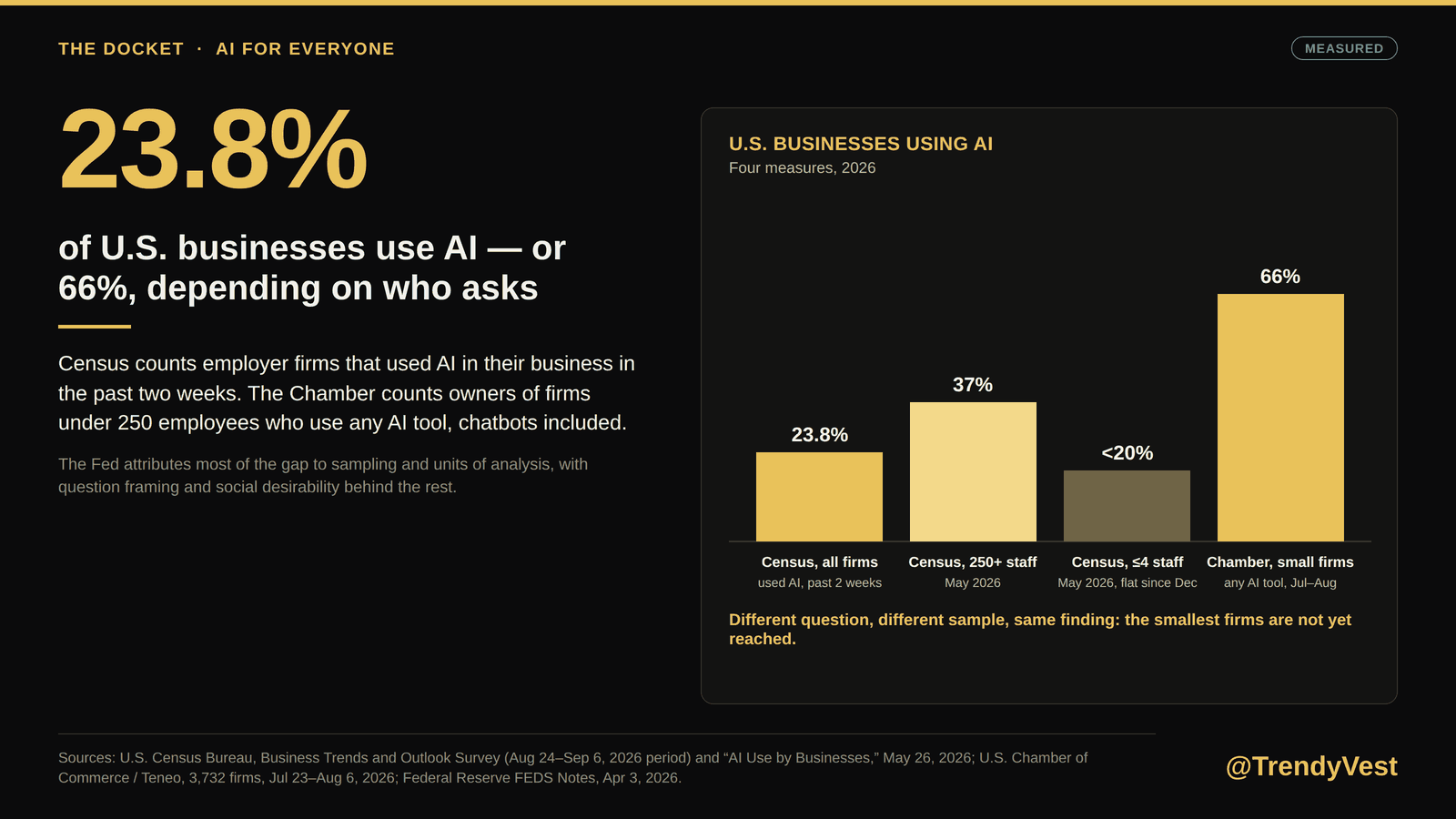
The reason is not price. A model answer is nearly free. The reason is that a small business does not have an IT department to make the model do anything, and the owner is the IT department. That is the problem the next two years of products are built to solve, and the way they solve it is by selling the model as an employee rather than as software.
Here is what that costs today, from the price lists. An AI receptionist from Smith.ai is free for the first 25 calls and $3 a call after, or $150 a month at $2 a call, or $500 a month at $1.67 (smith.ai, October 2). QuickBooks Online bundles its AI agents — categorizing, invoicing, chasing receivables — into plans from $38 to $340 a month with no per-use fee (Intuit, October 2). HubSpot's customer agent resolves a conversation for fifty cents and its prospecting agent finds a lead for a dollar. Amazon's AgentCore will let an agent buy inventory within a per-session limit. None of these is a $39-a-month piece of software. Each is priced like a part-time employee who is paid only when they do something.
Now the plumbing company, five people, built from those products. The phone is answered on the first ring at 7 a.m. and 9 p.m. and the caller is qualified and booked into a gap in Tuesday's schedule without the owner touching it: two dollars. The estimate goes out the same night with the parts priced from the supplier's live catalog, and the follow-up goes out Thursday if nobody answered: fifty cents and a dollar. The invoices are categorized, the receivables are chased, and the owner's wife no longer does the books on Sunday: inside the $85 plan. The supplier order for the month is placed when the price is right, under a limit the owner set once. And on Friday the owner reads one paragraph: Tuesday-afternoon jobs run 14 percent lower margins because of drive time, and moving four ZIP codes to Wednesday would add about $1,800 a week of gross profit. That paragraph is the product. The author's working estimate for the whole stack is $500 to $2,000 a month, which is a hypothetical, not a price list, and it is a fifth of one employee.
The possibility behind this is the one that deserves the word revolutionary, and it is not that the plumber gets cheaper software. It is that the minimum size of a functioning company falls. For a century the large firm has had a structural advantage over the small one: a legal department, a procurement department, an analytics team, professional management, an advertising agency. Those are the functions the agents above sell by the task. A three-person company with that stack has the organizational machinery of a three-hundred-person one. The entrepreneur supplies the capital, the judgment, the relationships and the hands; the machinery is rented. It is franchising without the franchisor — the systems without the royalty — and the test of whether it is real is a number Census already publishes: the share of firms with four or fewer employees using AI, which is under 20 percent today and was flat through May. When that line moves, the industrialization of entrepreneurship has started. Until it does, the small business is the customer the whole industry is building for and has not yet reached.
The enterprise: from copilot to digital workforce
The large company's problem was never access to intelligence. It is orchestration: thousands of people, hundreds of systems, a decade of data, and a model that can read all of it and change none of it without a plumbing project. The enterprise commercial opportunity is the plumbing — an operating layer over everything the company already owns, in which the employee states an objective and the agents gather, reason, act, check, escalate and record.
Measured, the enterprise is further along than the small business and further behind than the press releases. Gartner now puts worldwide AI spending at $2.67 trillion this year, up 49.5 percent, and $3.64 trillion next, with the line for "AI agents and assistants" more than doubling from $29.2 billion to $65.5 billion in 2027 — and, in the same release, places generative AI "firmly in the Trough of Disillusionment in 2026," with enterprises leaning on the AI features inside software they already own (Gartner, September 16). Forty percent of enterprise applications will carry task-specific agents by the end of this year, from under 5 percent in 2025, and more than 40 percent of agentic projects will be canceled by the end of 2027 "due to escalating costs, unclear business value or inadequate risk controls" — both forecasts are Gartner's, and both can be true (Gartner, August 2025 and June 2025). Deloitte, surveying 3,235 leaders last autumn, found worker access to sanctioned AI tools rose from under 40 percent to about 60 percent in a year; that only 25 percent of companies had moved 40 percent or more of their pilots into production, with 54 percent expecting to within three to six months; and that 34 percent were using AI to "deeply transform" the business (Deloitte, State of AI in the Enterprise, January). McKinsey's 2026 survey has 37 percent of companies reporting any effect on earnings, slightly fewer than last year, and 40 percent of large companies scaling agents somewhere against 22 percent of smaller ones (McKinsey, August 25). The chief financial officers surveyed by Duke and the Richmond and Atlanta Feds — nearly 60 percent of whose firms invested in AI last year — describe adoption as "widespread but shallow," mostly software subscriptions, and expect the aggregate effect on employment this year to be close to zero, with large firms planning to cut 0.8 percent (Richmond Fed, March 25; VoxEU, June 27).
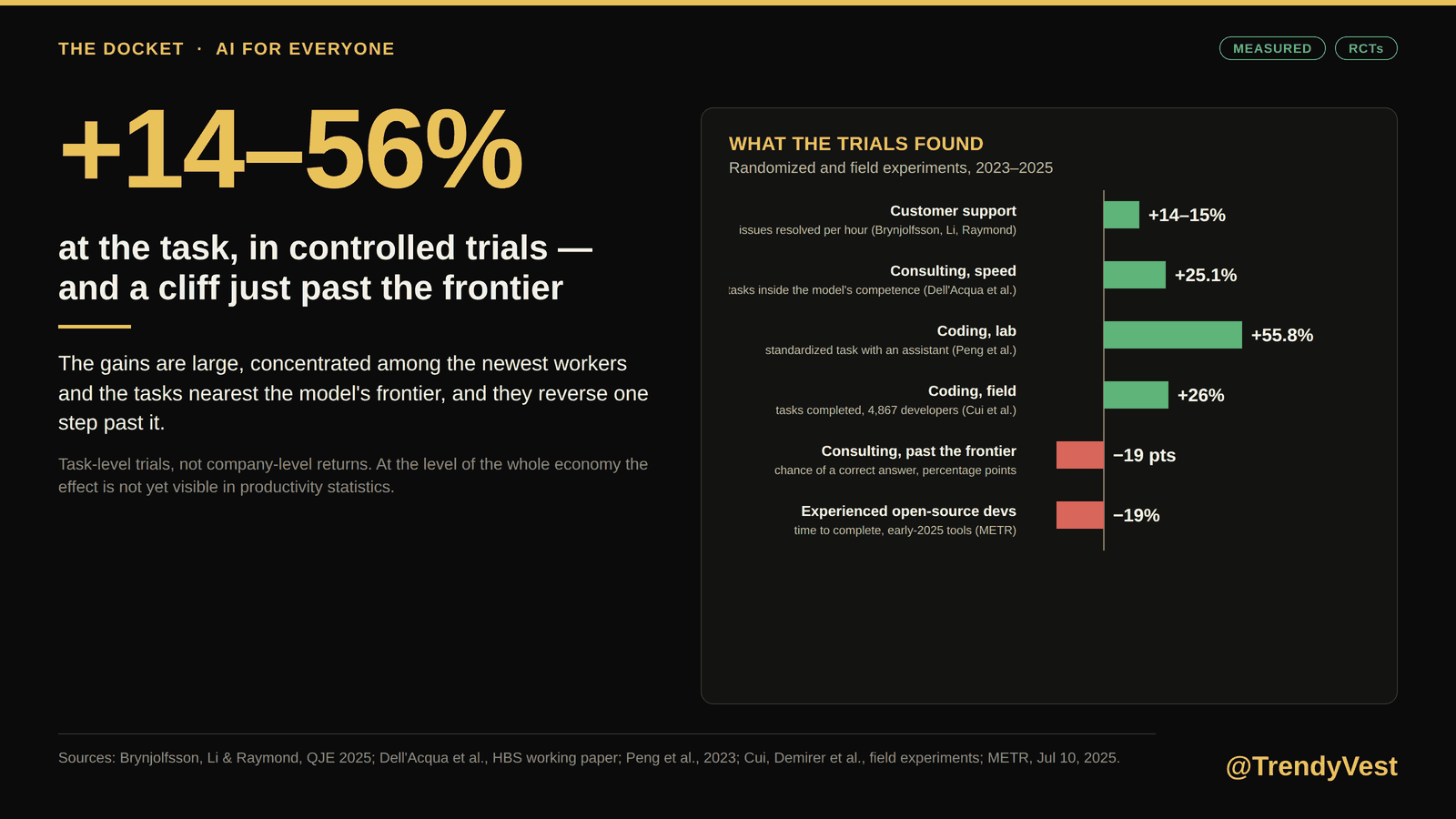
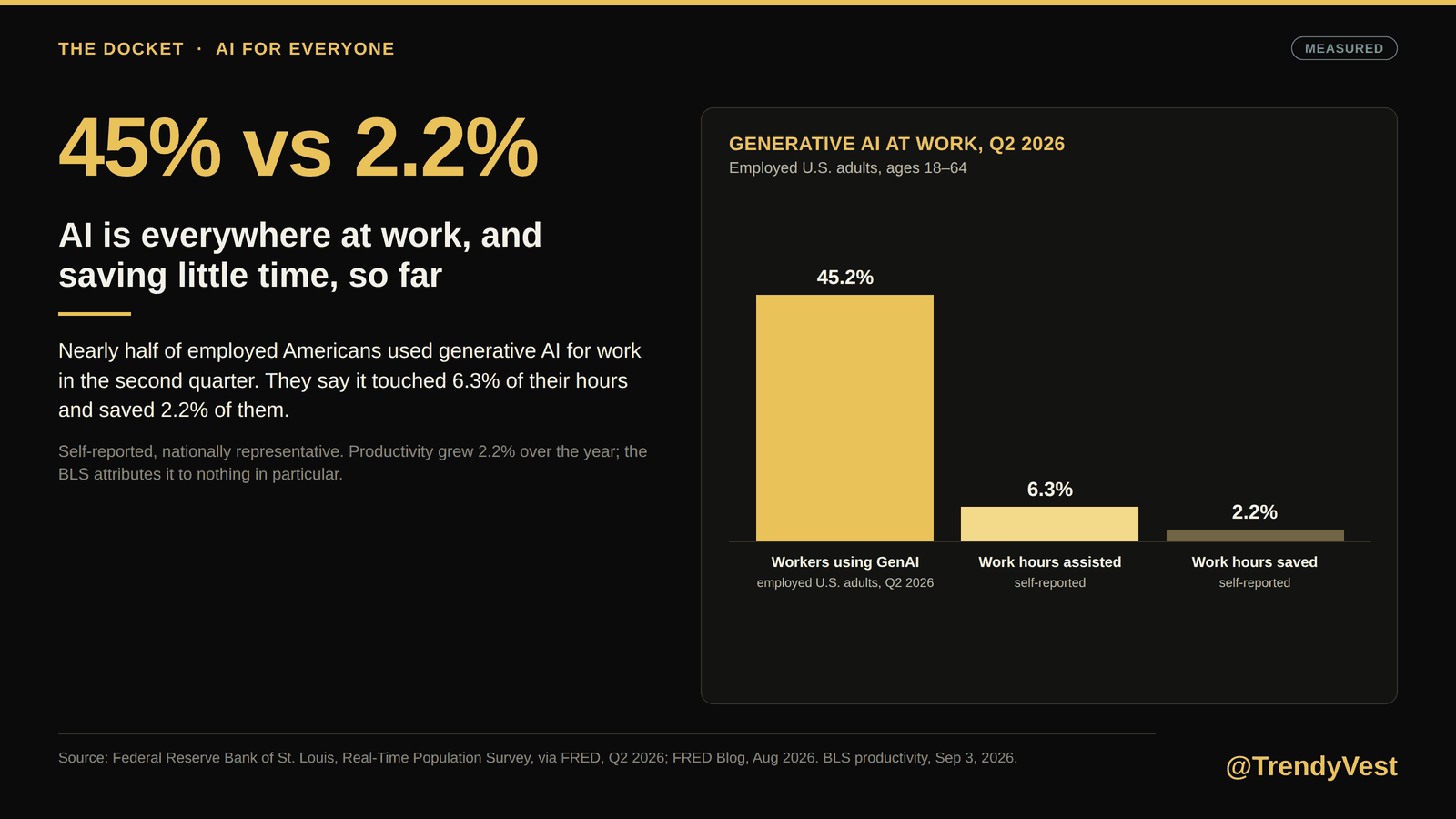
What the controlled trials found is the most useful evidence in this whole piece, because it is the only kind that is not self-reported. Customer-support agents given an AI assistant resolved 14 to 15 percent more issues an hour, with the biggest gains for the newest and least skilled and almost none for the best (Brynjolfsson, Li and Raymond, Quarterly Journal of Economics, 2025). Consultants at BCG finished 12.2 percent more tasks, 25.1 percent faster, at more than 40 percent higher quality — on tasks inside the model's competence — and were 19 percentage points more likely to get the answer wrong on a task outside it (Dell'Acqua et al.). Programmers finished a standardized task 55.8 percent faster with a coding assistant, and in field experiments across 4,867 developers completed 26 percent more tasks (Peng et al.; Cui et al.). And experienced open-source maintainers were 19 percent slower with early-2025 tools while believing they were faster (METR, July 2025). The pattern across all of it is the same: large gains at the task level, concentrated in the people and tasks nearest the model's frontier, and a cliff just past it. At the level of the whole economy, that shows up as 45 percent of employed Americans using generative AI at work and reporting that it saved 2.2 percent of their hours (St. Louis Fed, Q2), and as productivity growth of 2.2 percent over the year that the BLS does not attribute to anything in particular (BLS, September 3).
The scene, then, is not the one in the keynote. It is a Tuesday in 2028 and a procurement manager types: "Prepare our Q3 supplier renegotiation." The agent reads the contracts, the shipment and quality records, the commodity curves and three years of email, and comes back with a ranked list, a draft of each letter, and a flag on the one supplier whose terms it is not confident about. The manager reads for twenty minutes, changes two things, approves. The agents send, log and schedule. One person, fifty workflows. That is the ratio the enterprise is actually buying — not one agent for one job, but one accountable human for many — and it is the product that Microsoft's 30 million paid Copilot seats and $37 billion AI run-rate, Salesforce's per-conversation pricing and ServiceNow's "assists" are all converging on from different directions (Microsoft, April 29).
The company that loses in that scene is the one that sold the seven applications the manager used to open. The SaaS business model is one seat per employee; if one agent does the work of five people across eight systems, the buyer stops counting seats and starts asking what a business process costs. The market priced that in February: the software ETF fell 18 percent in a month after Anthropic's Cowork plugins shipped, with HubSpot down 39 percent and Atlassian 35 percent on the year by the fifth of the month (Securities.io, secondary). HubSpot's answer was the fifty-cent resolution. The outcome menu the author sketched — 0.4 percent of invoices collected, $800 a hire, $25 a contract reviewed, 5 percent of freight savings — is hypothetical, but every line of it has a real cousin on a price list this autumn, and the direction is one way: software sold tools; AI sells finished work. Software is measured in trillions a year. Labor is measured in tens of trillions. Even a small migration of digital tasks from the second column to the first is the largest addressable market anyone in this industry has named, and the next two years are when the price lists tell us how fast it moves.
The machine customer
Then it gets stranger, and the strangeness is already under contract.
An agent needs compute, and buys it from another agent — two million tokens, under 200 milliseconds, not more than three dollars — with no human in the transaction. An inventory agent sees the copper running short, queries three suppliers' agents, lets a logistics agent price the delivery and a treasury agent release the payment, and an accounting agent records all of it. Stripe's protocol was written for exactly this: agents transacting "with businesses and one another." Visa's Conard describes machine payments as "small, frequent payments that one piece of software makes to another, often for an API call or a slice of compute." AgentCore Payments ships with the x402 micropayment standard, so an agent can pay a fraction of a cent for a page, a few cents for a verification, a dime for an action. Billions of transactions too small to invoice are the natural unit of an economy in which the customer is a program.
Three markets fall out of that, and the author's framing of them is the right one. Data becomes sellable again, by the query rather than the annual license: a research agent pays 4.7 cents for the one satellite image it needs instead of $100,000 a year for the feed. The API economy becomes a skills economy, in which an agent hires a tax-law specialist agent for thirty seconds, which hires a New York specialist, which is audited by a third, and the user's assistant has assembled a temporary firm. And trust becomes the business: identity for machines, mandates, spending limits, audit logs, insurance against the agent that buys the wrong thing, dispute resolution between two programs. The cybersecurity industry's next product is not protecting AI. It is the identity-and-permissions infrastructure the autonomous economy cannot run without, and Mastercard's title says it best: trust becomes the product.
Nothing in this section has a published transaction figure. The desk prints it because the rails are real, the dates are 2026, and the money that flows over them will be measurable by 2028.
Physical AI: labor by the hour
Once intelligence is in a machine, it can be sold the way the machine's work is bought. More than 600,000 industrial robots were installed worldwide last year, 11 percent more than the year before, five million are now at work, and 59 percent of last year's installations were in China; the industry's own forecast is 655,000 this year and 806,000 in 2029 (International Federation of Robotics, World Robotics 2026, September 24). About seven thousand full-size humanoids were sold in 2025, nearly all of them into pilots (IFR, September).
The commercial change is the pricing. 1X will sell its NEO for $20,000 or rent it for $499 a month, with American deliveries this year; Figure's chief executive says a Figure 03 can be leased "for something like $600 a month"; Agility, with more than $300 million of orders for its Digit, has modeled about $8,500 a robot a month; Formic rents industrial arms at $8 to $24 an hour (1X; Adcock, May; Forbes, September 15; cobotfinder; the last three secondary). Technavio's version of the industry's own line is that robotics is shifting "from a capital expenditure to a recurring operational expense" (Technavio, May). A factory that pays $12 an hour for a machine does not compare it with a $100,000 robot. It compares it with a $22-an-hour person, outcome against outcome, and the arithmetic will be done on every loading dock in the country over the next two years.
The bill
Everything above is paid for, and the bill arrives in four places.
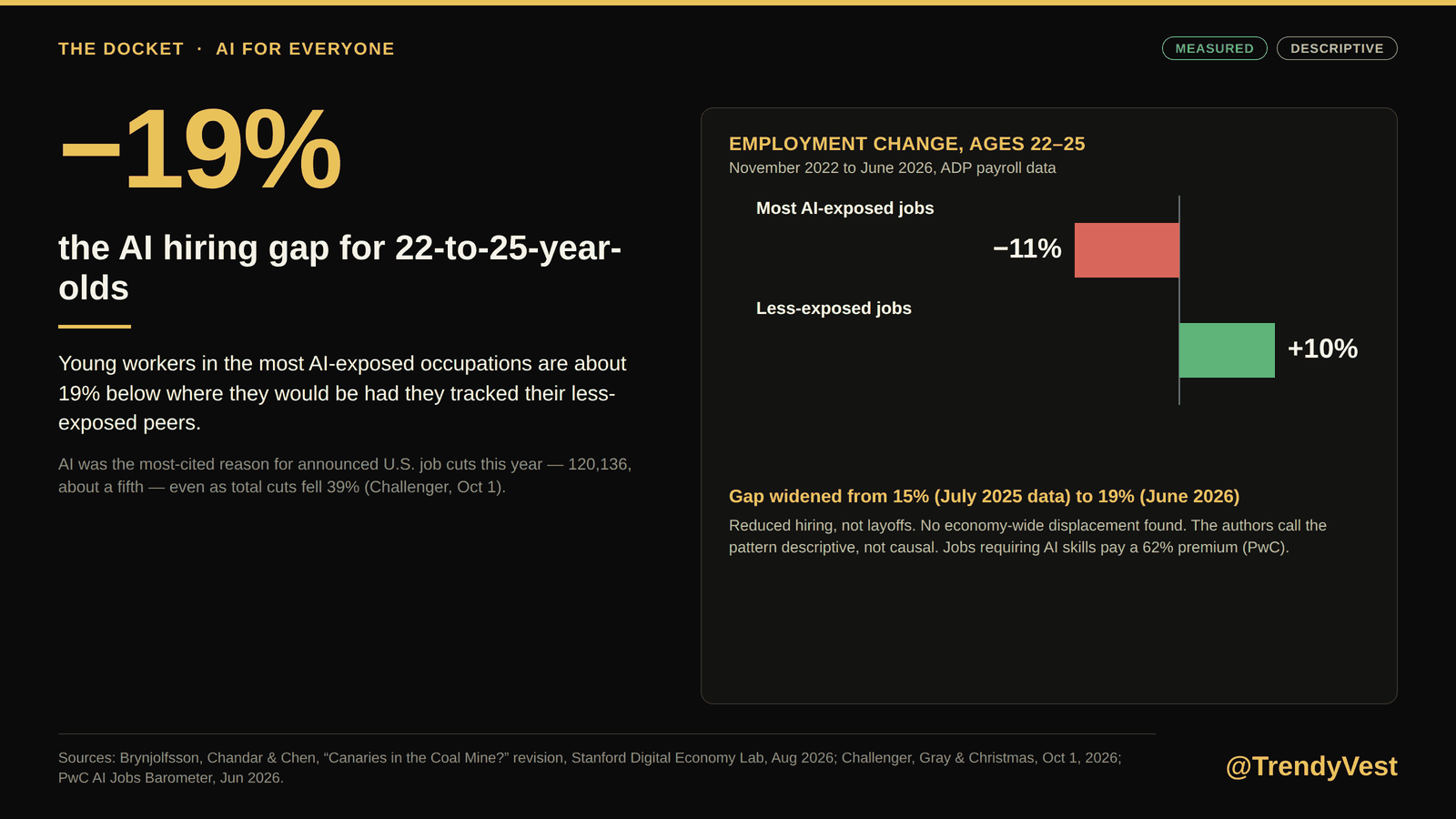
The first is the labor market, and the early readings are precise. Among 22-to-25-year-olds in the occupations most exposed to AI, employment is 19 percent below where it would be had it tracked their less-exposed peers, a gap that was 15 percent in last year's data; in raw terms their employment fell 11 percent from November 2022 to June 2026 while the less-exposed group's rose 10 percent, and the whole gap comes from reduced hiring, not layoffs (Stanford Digital Economy Lab, "Canaries in the Coal Mine," August revision, on ADP payroll data; the authors call it descriptive, not causal). AI was the most-cited reason for announced job cuts in America this year, named in 120,136 of them, about a fifth, even as total cuts fell 39 percent (Challenger, October 1). Recent graduates face 5.6 percent unemployment and 42 percent underemployment, and computer-science graduates 7.0 percent, tied for fourth-worst of 73 majors (New York Fed; Forbes). This morning's jobs report had payrolls up 29,000 in September and unemployment at 4.2 percent, with July revised to a loss (BLS, October 2). Jobs that require AI skills pay a 62 percent premium, up from 57 (PwC, June). The adjustment so far is in who gets hired, not in what anyone is paid, and it is landing on the youngest. The World Economic Forum's net of 78 million jobs created by 2030 may well be right; a 23-year-old with a computer-science degree is not living in the net.
The second is power. Data centers used about 485 terawatt-hours worldwide last year and will use about 950 by 2030, with the AI-focused ones tripling (IEA). In the United States they take 464 terawatt-hours in 2028 and 649 in 2030 on the Energy Department's reference case, 11.8 percent of all electricity, in a range of 9.5 to 15.3; EPRI's range is 9 to 17 percent (LBNL; EPRI, February). Summer peak demand rises 166 gigawatts in five years, about 90 of them data centers — and the same report warns utilities may be overstating that load by about 40 percent (Grid Strategies). The capacity price in PJM is the number a household can feel: $28.92 a megawatt-day for 2024/25, $329.17 for 2026/27, $333.44 for 2027/28, and $325.00 — the cap — for 2028/29, in an auction that came up 6,831 megawatts short of its reliability requirement (PJM, July 14). Loudoun County, Virginia, collects about $1.14 billion a year in property taxes from data centers, 42 percent of its local tax funding (county budget figures via the Loudoun Coalition); at least 75 projects worth about $130 billion were blocked or delayed by local opposition in the first quarter, a record, and 45 worth $68 billion in the second, as the number of opposition groups passed 840 (Data Center Watch; NBC News, June 12).
The third is the price of money. The Federal Reserve raised its target range to 3.75 to 4 percent on September 16, in an economy its own research arm describes this way: "In the near term, whatever increase in the productive capacity of the economy AI has brought, AI has brought a larger increase in demand" (Minneapolis Fed, Alisdair McKay, August 3). The June minutes mentioned AI more than twenty times, against once a year earlier. Governor Waller has named "pressure on technology goods prices related to the AI buildout" as an upside risk to inflation and said that "AI investment is a legitimate part of GDP today" (Waller, September 3). It is: tech investment was half of the economy's year-over-year growth in the second quarter on ING's accounting, a third once the imported chips are netted out. The buildout is lifting growth, prices and rates at the same time, and the household paying 6.5 percent on a mortgage is paying for the data center in a fourth way.
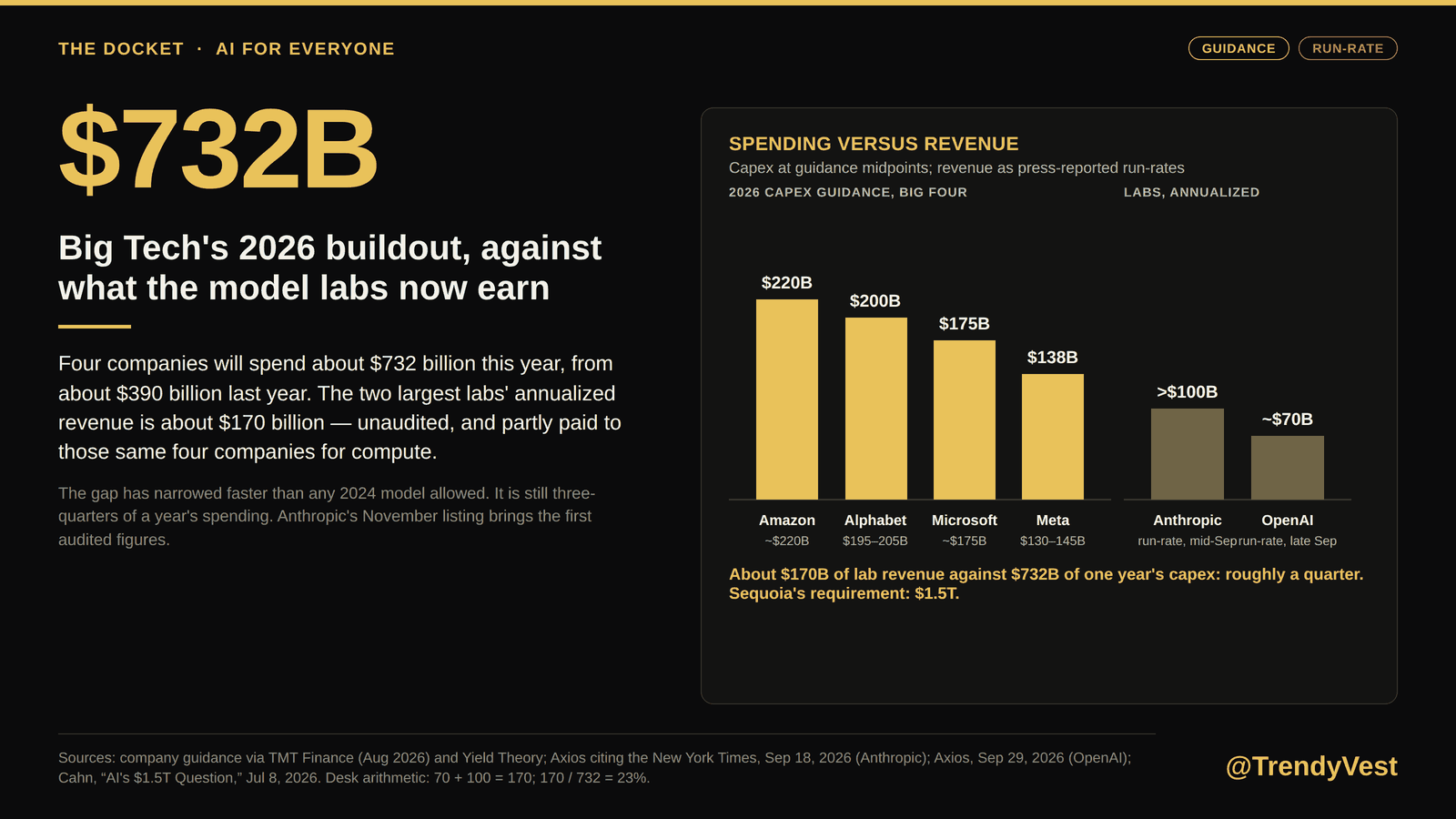
The fourth is the one investors ask about. The four largest hyperscalers will spend about $732 billion this year — Amazon about $220 billion, Alphabet $195 to $205, Microsoft about $175, Meta $130 to $145 — against about $390 billion last year and about $107 billion in 2020, with Oracle adding $90 to $95 billion gross for its fiscal year, and the top five projected to approach a trillion in 2027, a fifth of all private investment in America (company guidance via TMT Finance and Yield Theory; Minneapolis Fed). Morgan Stanley puts global data-center capital spending at $2.9 trillion through 2028, of which $1.4 trillion can come from the hyperscalers' own cash flow, leaving $1.5 trillion to be borrowed, about $800 billion of it from private credit, with nearly $570 billion of AI-related debt issued this year alone (Morgan Stanley, July 2025 and June). Alphabet's free cash flow in the June quarter was negative $5.9 billion. Sequoia's David Cahn has raised the revenue he thinks the buildout needs four times — $200 billion in 2023, $600 billion, $840 billion, and "$1.5 trillion" this July — and puts the lifetime end-customer revenue the spending since ChatGPT needs at about $3 trillion, while noting that AI coding gives "a more clear path to monetizing data center CapEx" than anything before it (Cahn, July 8).
Against that stands revenue that did not exist two years ago. Anthropic's annualized revenue passed $100 billion in mid-September, from about $9 billion at the end of last year — $47 billion in May, $65 billion in July — and its confidential filing for a November listing shows the shape of the business underneath: nearly $4.6 billion of revenue in 2025, $4.73 billion in the first quarter of this year, $11.5 billion in the second; an operating loss of about $8.06 billion last year, $7.33 billion of it compute, inside a $42 billion net loss that was mostly a non-cash charge on financing that converts to stock; a second consecutive quarter of adjusted operating profit now in sight; and $518 billion of compute commitments over about ten years (Axios via the New York Times, September 18; Reuters on the filing, September 29, via SiliconANGLE and InvestmentNews, secondary). OpenAI's annualized revenue is nearing $70 billion, up more than 70 percent since July, with business revenue more than doubled (Axios, September 29). Microsoft's AI business passed a $37 billion run-rate in April, Azure passed $100 billion for its fiscal year, and its commercial backlog is $678 billion; AWS's AI run-rate passed $25 billion on a $169 billion base growing at its fastest in eighteen quarters; Oracle's backlog is $664 billion, up $209 billion in a year; Nvidia sold $89 billion of data-center chips in a single quarter, $48.7 billion of them to the hyperscalers (company releases and filings).
The desk's arithmetic, labeled as such and with the caveat printed: the two model labs' run-rates sum to about $170 billion a year, against $732 billion of capital spending by four companies this year and Cahn's $1.5 trillion. The labs buy their compute from the hyperscalers, so Microsoft's and Amazon's AI revenue overlaps with the labs' costs and cannot simply be added. Even so, the gap has narrowed faster than anyone's 2024 model allowed: two years ago it was $500 billion against revenue that rounded to nothing. Today revenue covers roughly a quarter of one year's capital spending. MIT's "GenAI Divide" found 95 percent of organizations getting zero measurable return and only 5 percent reaching production with custom tools, in a small sample widely misquoted since; Gartner's trough and McKinsey's 37 percent say the same thing more carefully. The demand is real, the revenue is real, and the revenue is a quarter of the bill.
Who gets the deflation and who pays the inflation
The desk's view, in four sentences and then the evidence.
The deflation goes first to whoever already has the devices, the power and the data: the hyperscalers, the labs, the enterprise with a plumbing budget, and the consumer with a $1,000 phone. The inflation goes first to whoever buys memory, electricity and money at the margin: the gadget buyer, the ratepayer in PJM, the mortgage holder, the small firm with no IT department, and the 23-year-old looking for a first job. The money migrates to outcomes, which means it migrates to whoever owns the relationship with the customer and the trust rails under the transaction, not to whoever has the smartest model this quarter. And the structure that held in every other buildout holds in this one: the owner of the bottleneck keeps the margin, the customer keeps the growth, the middleman keeps the risk.
That last line is where the desk would put a dollar, and it is the same place it put one in its memory and interconnect investigations this week. The bottlenecks of this buildout are memory, power and the trust layer, and all three are being sold at prices that only a sold-out market produces. Micron reported an 87 percent gross margin on Wednesday with next year's high-bandwidth memory already sold at "significant price increases." PJM cleared at its cap. Mastercard and Stripe are writing the rails. Those are the owners. The customers — the hyperscalers — keep the growth and carry the capital; their revenue is rising faster than any software company's ever has and their free cash flow is going to zero, and both things are true. And the middlemen — the seat-based software vendor, the pluggable module maker, the staffing firm, the agency — are the ones whose product is being repriced by the task.
For the consumer, the practical reading is that the assistant will get much better and much cheaper and the things it runs on will not; buy the subscription that pays for itself in a task you actually delegate, and expect the phone and the power bill to keep rising for reasons that have nothing to do with you. For the small business, the first dollar of real return is in the phone that gets answered and the invoice that gets collected, priced per call and per collection, and the owner's job is to write the mandate once and read the Friday paragraph. For the enterprise, the test is not the pilot but the production number — Deloitte's 25 percent, which 54 percent of companies say they will have reached by the first quarter of next year, and which is the single most gradeable promise in this piece. And for the investor, the two years ahead are the years in which the ladder from seats to outcomes gets climbed in every price list, the labs file audited numbers for the first time, and the grid auctions and the Census surveys say whether the demand is a utility or a bubble. Those are dated, and here they are.
The scorecard, dated
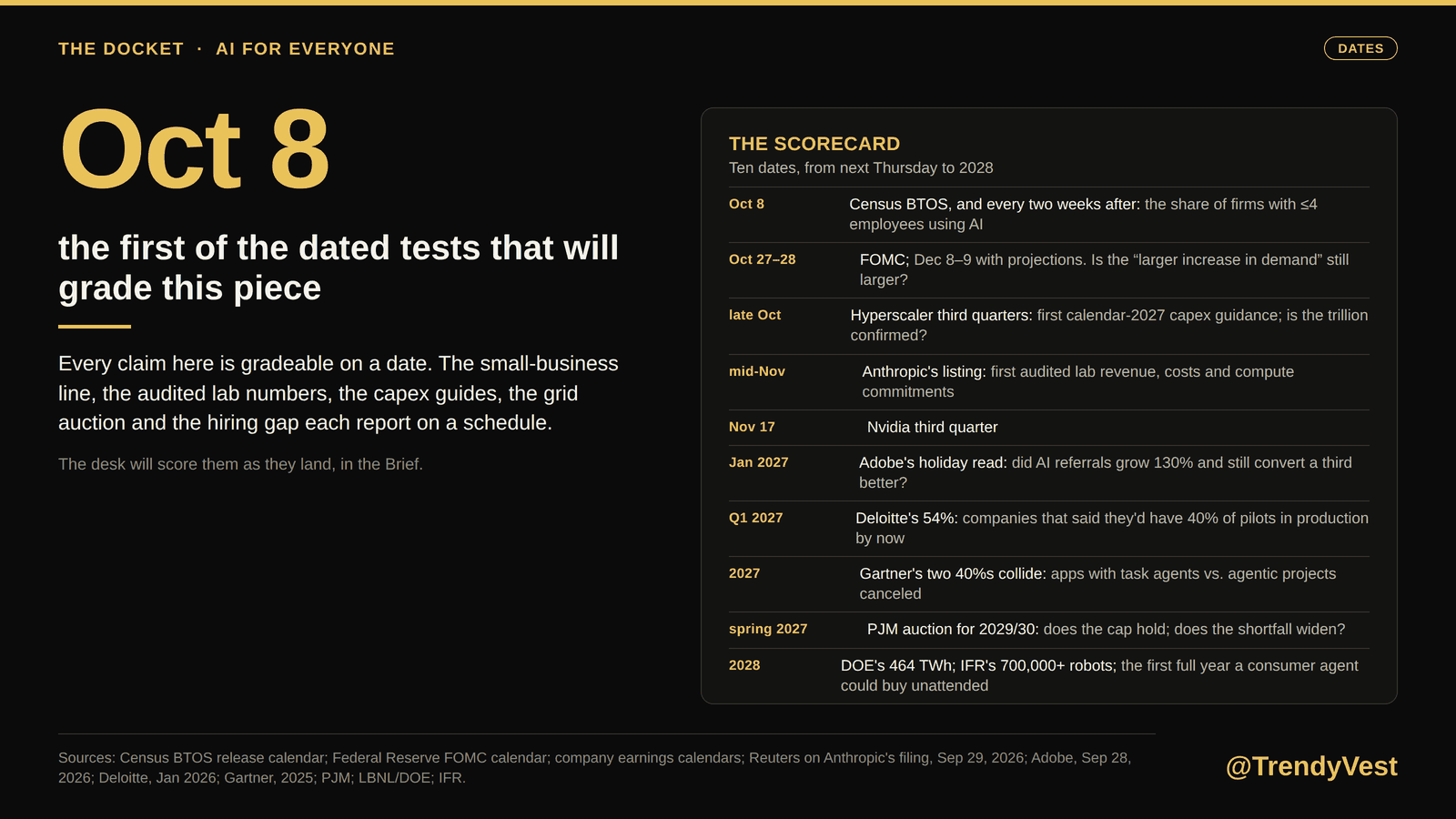
October 8: the next Census survey, and every two weeks after. The share of firms with four or fewer employees is the line that says whether the small business has been reached; it was under 20 percent and flat through May.
October 27–28 and December 8–9: the Federal Reserve, with the second meeting carrying projections. The question is whether the "larger increase in demand" is still larger.
Late October: the hyperscalers' third quarters and the first look at calendar-2027 capital spending guidance. The Minneapolis Fed's trillion is a projection until a company confirms it; Amazon says 2027 capacity is "largely reserved" and 2028 demand is already shaping its plans.
November: Anthropic's listing, targeted for mid-month, and with it the first audited revenue, cost and compute-commitment figures from a frontier lab. Every run-rate in this piece is unaudited until then. November 17: Nvidia's third quarter.
January: Adobe's reading of the holiday season — whether AI referrals grew the forecast 130 percent and whether they still convert a third better — and the first quarter in which Google's Gemini purchases under spending limits should be live.
First quarter 2027: Deloitte's 54 percent. The companies that said they would have 40 percent of pilots in production by now either do or do not, and the next State of the Enterprise will say which.
Through 2027: Gartner's two forecasts collide — 40 percent of enterprise applications carrying task agents, and 40 percent of agentic projects canceled. Both are gradeable by year-end. The spring 2027 PJM auction, for 2029/30, says whether the cap holds and the shortfall widens. The Stanford canaries get another ADP vintage; the question is whether the 19 percent becomes 23 or 15. HubSpot, Salesforce and Zendesk will disclose, or be asked to disclose, what share of their revenue is now paid per outcome; that share is the ladder being climbed, in a filed number.
2028: the Energy Department's 464 terawatt-hours; IFR's 700,000 robots; Agility's and Figure's leases in customers' hands; the Feynman generation that decides whether the inside of the rack goes optical; and the first full year in which a consumer agent has been able to buy things unattended, if it has.
The possibility
The reason to be excited about the next two years is not that the models get smarter, though they will. It is that intelligence becomes something you can buy by the outcome, which is the first time in history a capability has been sold that way to everyone at once. A household that cannot afford a chief of staff rents one by the task. A plumber who cannot afford a receptionist pays two dollars a call for one who never sleeps. A three-person company gets the back office of a three-hundred-person one. A factory rents hands by the hour. And a manager with judgment runs fifty workflows instead of one.
The reason to be careful is that every one of those is paid for twice: once by the person who delegates the task, and once by everyone who buys memory, power or money in a market the buildout has emptied. The people who get the first are, so far, not the people who pay the second. The next twenty-four months are the ones in which that starts to change, or doesn't, and the scorecard above is how the desk will know.
The TrendyVest Championship is open for registration at Tournament.Trendyvest.com — 500 seats, a $100,000 simulated stake, free to enter. Trading began October 1 at the market open.
Sources and data notes
Prices. Epoch AI, "The plunging price of thought," September 22, 2026, and "LLM inference price trends," March 12, 2025. Apple price changes, June 25, 2026, and Nintendo, September 1, 2026, as reported. TrendForce, September 30 (DRAM and NAND contract forecast) and September 8 (smartphone production, −14 percent). BLS, consumer price index for August 2026, released September 11. PJM, 2028/2029 Base Residual Auction results report, July 14, 2026; Citizens Utility Board, July 15, 2026. LBNL, Retail Price Trends 2026, July update. Vendor pricing pages read October 2, 2026: OpenAI (consumer and business), Google, Anthropic, Microsoft 365 Copilot (including Copilot Credits, June 16), Salesforce Agentforce, HubSpot (effective April 14), Zendesk, Intercom, Smith.ai, Intuit QuickBooks Online. Salesforce release, June 25, 2026 (help agent).
Consumers. OpenAI, DevDay recap, September 29, 2026 (1.2 billion weekly users; Dots); OpenAI, August 31, 2026 (advertising run-rate; one billion weekly users); OpenAI, January 16, 2026 (advertising approach) and January 2026 ("AI as a Healthcare Ally"); Axios, September 29, 2026 (annualized revenue; consumer revenue). Google, August 11, 2026 (one billion monthly Gemini users); Alphabet second-quarter release. Menlo Ventures, "The State of Consumer AI," September 16, 2026, and the 2025 edition. Sensor Tower, 2026 State of AI report and Q2 2026 index. Counterpoint, June 22, 2026. KFF, March 25, 2026. AMA, March 12, 2026. Pew Research Center, August 18, 2026, on June fieldwork. Adobe, holiday 2025 results, January 2026, and AI traffic report; Adobe 2026 forecast, September 28, 2026. Amazon, "Alexa for Shopping," May 13, 2026; Jassy on Rufus, October 30, 2025. Google I/O, May 19–20, 2026 (Gemini Spark; Universal Cart); Google, February 11, 2026 (agentic commerce); Google Cloud, September 16, 2025 (AP2). Shopify, January 11, 2026 (UCP). Stripe, March 18, 2026 (Machine Payments Protocol, co-authored with Tempo). Mastercard, Pablo Fourez, March 5, 2026 (Verifiable Intent). Visa, Tim Conard, July 14, 2026. AWS, AgentCore Payments preview May 7 and general availability August 18, 2026. OpenAI, March 24, 2026 (Instant Checkout); Modern Retail on Walmart's conversion (secondary). Microsoft Copilot Checkout, January 8, 2026. Meta Connect via Engadget, September 24, 2026 (secondary).
Businesses. Census Bureau, Business Trends and Outlook Survey, two-week periods through August 24–September 6, 2026 (released September 24), and "AI Use by Businesses," May 26, 2026. U.S. Chamber of Commerce, "Empowering Small Business: The Impact of Technology on U.S. Small Business," 2026 (Teneo survey of 3,732 firms, July 23–August 6). Federal Reserve, FEDS Notes, "Monitoring AI Adoption in the U.S. Economy," April 3, 2026. Gartner, September 16, 2026, August 26, 2025, and June 25, 2025. Deloitte, "State of AI in the Enterprise: The untapped edge," January 21, 2026 (3,235 leaders, August–September 2025). McKinsey, "The state of AI in 2026: On the road to ROI," August 25, 2026, and the November 2025 edition. Duke–Richmond Fed–Atlanta Fed CFO Survey, March 25, 2026, and the authors' VoxEU column, June 27, 2026. Brynjolfsson, Li and Raymond, QJE 2025; Dell'Acqua et al., Harvard Business School working paper; Peng et al., 2023; Cui, Demirer, Jaffe, Musolff, Peng and Salz, field experiments; METR, July 10, 2025. St. Louis Fed, Real-Time Population Survey via FRED, Q2 2026. BLS, productivity, September 3, 2026. Microsoft, April 29 and July 29, 2026. Securities.io, February 5, 2026 (software ETF; secondary). Technavio, May 2026 (robotics as a service). International Federation of Robotics, World Robotics 2026, September 24, 2026, and service-robot release. 1X order page; Adcock via ZeroHedge, May 5, 2026; Forbes, September 15, 2026 (Agility); cobotfinder (Formic) — all secondary except 1X.
The bill. Stanford Digital Economy Lab, "Canaries in the Coal Mine?" August 2026 revision. Challenger, Gray & Christmas, October 1, 2026. New York Fed, "The Labor Market for Recent College Graduates," Q2 2026; Forbes, February 23, 2026. BLS, Employment Situation for September 2026, October 2, 2026. PwC, AI Jobs Barometer 2026, June 15, 2026. World Economic Forum, Future of Jobs 2025. IEA, Energy and AI (2025) and 2026 update. LBNL/DOE, United States Data Center Energy Usage Report, 2025 update. EPRI, February 2026. Grid Strategies, National Load Growth Report 2025. Loudoun Coalition, county fiscal strategy FY27–FY30 (advocacy compilation of county figures). Data Center Watch, Q1 and Q2 2026 reports; NBC News, June 12, 2026. Federal Reserve, September 16, 2026 statement and projections; Waller, Reuters NEXT, September 3, 2026; Minneapolis Fed, Alisdair McKay, August 3, 2026. ING, "How much is AI contributing to US economic growth?" BEA, third estimate of second-quarter GDP, September 30, 2026. TMT Finance, August 2026, and Yield Theory tracker (capex guidance); company earnings releases; Oracle first-quarter fiscal 2027 call, September 10, 2026. Morgan Stanley, "Bridging the data center financing gap," July 2025, and June 10, 2026, via Reuters. Alphabet second-quarter 2026 release. Cahn, "AI's $1.5T Question," July 8, 2026, and prior essays. Anthropic figures: Axios, September 18, 2026, citing the New York Times; Reuters on the confidential filing, September 29, 2026, via SiliconANGLE and InvestmentNews (secondary). Nvidia CFO commentary, Q2 FY27 (SEC). AWS, July 31, 2026. Oracle, Q1 FY27 release. MIT NANDA, "The GenAI Divide," 2025. Micron fiscal fourth-quarter deck, September 30, 2026.
Arithmetic. $0.30 to about $0.0004 is Epoch's 725-fold on its unrounded figures. $749 against $599 is 25 percent. $329.17 against $28.92 is 11.4 times. Twenty Flex Credits at $500 per 100,000 is $0.10. $70 billion plus about $100 billion is about $170 billion; against $732 billion it is 23 percent, "roughly a quarter." Capex guidance midpoints: $220 + $200 + $175 + $137.5 = $732.5 billion. The 1,800-dollar and 14-percent figures in the plumbing scene are the author's illustration, not a measurement; the $500–$2,000 stack and the outcome-pricing menu are hypotheticals and labeled so. Weekdays named in the text were checked against the calendar.
Disclosure. This desk's tooling is built on Claude, made by Anthropic; Anthropic is discussed in this piece as a company whose figures are reported by others, and the desk has no financial relationship with it beyond that use. TrendyVest and its writers may own securities discussed here. This is analysis and editorial opinion, not investment advice.