Morning Brief
Morning Brief November 3rd 2026
Six days after telling investors that $20 billion was the final amount it would need for the rest of the cycle, Oracle filed for $10 billion of stock and $10 billion of notes in a single session and priced the shares at $116. The cap is a statement about Oracle’s share of the bill, not about the size of it. The desk ran the company’s own cash flow against the number.
Tuesday, November 3, 2026 · Before the open · Midterm election; AMD after the close
Six days ago, at its investor day in Las Vegas, Oracle told shareholders that it would need at most $20 billion of new capital through fiscal 2030, split evenly between debt and equity, and that this was the final amount required to fund the remainder of the cycle. On Monday it filed to raise all of it: $10 billion of common stock and $10 billion of senior notes, in one session. The stock lost 8.76 percent. By the evening, shares were priced at $116, 2.7 percent under Monday's close and 11 percent under Friday's.
The number to hold onto this morning is not $20 billion. It is the word cap. A company that caps what it will ask of the market has made a claim about how much the buildout costs and who pays for it, and that claim can be checked against the company's own cash flow statement. I did that below. The short version is that the cap is a statement about Oracle's share of the bill, not about the size of the bill, and the difference between those two things is where the next year of this story lives.
Overnight, sworn in
Monday's closes are sworn in on three feeds: the S&P 500 at 7,541.40, down 38.67 points or 0.51 percent; the Dow at 51,983.98, up 213.67 or 0.41; the Nasdaq Composite at 25,164.32, down 272.68 or 1.07; the Russell 2000 at 2,805.88, down 5.97 or 0.21. The Nasdaq 100 fell 1.39 percent to 27,989.82 on one feed, and two session reports say the index is now 10 percent below its peak, the conventional definition of a correction. The VIX closed at 21.15, up 8.91 percent, on two feeds.
The ten-year closed at 4.89 percent on two feeds, down three and a half basis points; one feed has 4.909 and another "about 4.91," and both are printed. The two-year is 4.581 on one feed and 4.60 on another and is not sworn. The dollar index finished at 101.78 on one feed and 101.805 on another. Crude had its worst day in three months: January Brent settled at $104.77, down 7.63 percent, on four feeds, and December WTI at $96.46, down 7.36 percent, on two, with a third feed carrying "near $96.33." The reason given everywhere is the same: hopes for the Qatar-mediated talks with Iran, which then stalled overnight after reports of American strikes on Qeshm Island, and both benchmarks have taken back part of the fall this morning. Trading Economics had WTI at $97.945 beside Brent at $106.429 when I read it at 8:14, both up about one and a half percent; Investing.com's board had $97.41 beside $105.22 with no time shown; Admiral Markets had Brent alone at $106.71 at 4:19 a.m.
The overnight seam runs through Seoul, and this time Tokyo was not there to soften it. Japan was closed for Culture Day. The Kospi fell 3.59 percent to 5,648.79, down 210.29 points, sworn on the Korea JoongAng Daily, SBS and a third wire, with foreigner’s net sellers of 1.5 trillion won. Samsung Electronics closed at 219,500 won, down 4.15 percent, and SK hynix at 1,400,000 won, down 5.03, on the JoongAng Daily alone; Business Recorder's intraday reading at 02:33 GMT had them down 3.17 and 4.14 with the index off 2.72 percent at 5,699.97, so the selling accelerated into the close. Saxo's morning note, which carries the Kospi at 5,666, down 3.3 percent, is an earlier reading of the same session and not a contradiction. Taiwan fell 1.21 percent on one feed. Hong Kong was flat at 23,393 on Saxo, and Newsquawk has Hong Kong and Shanghai "mixed" after the People's Bank said it would push lenders to use their stock-support tools more widely. Australia finished higher after the Reserve Bank raised rates, per Newsquawk, which is one feed.
Europe closed higher on Monday on the oil relief and opened lower on Tuesday on Apple. Monday: Euro Stoxx 50 up 0.78 percent to 6,179, DAX up 0.64 to 25,983, FTSE 100 up 0.29 to 10,761, CAC up 0.98 to 8,048, all on Newsquawk; Trading Economics' contract levels (6,147.80, 25,889.30, 8,035.50) carry the same percentages and are quoted off exchange. At the European open, investingLive stamped 08:30 on its site had the Euro Stoxx and the DAX down 0.9 percent, the CAC 0.5, the FTSE 0.3, Spain and Italy 1.1; Investing.com's update, timed 06:21 with no zone given, had the Stoxx 600 down 0.3, the DAX 0.6, the CAC 0.2, the FTSE 0.5. Two feeds, two minutes, same direction.
US futures at the time of writing: Trading Economics' narrative had S&P 500 futures down about 0.1 percent, Dow futures down roughly 400 points and Nasdaq 100 futures up 0.3, read at 8:14; investingLive at its 08:30 stamp had S&P futures down 0.2 and Nasdaq flat; Admiral Markets had the December mini-Dow at 51,870, down 263, at 4:12 a.m. The ten-year this morning is 4.936 on Trading Economics and 4.928 on Investing.com's board, up three or four basis points either way; the two-year is 4.62 and the thirty-year 5.31 on Trading Economics, one feed; the dollar index 101.865, up 0.12 percent, same feed, same read.
The subject
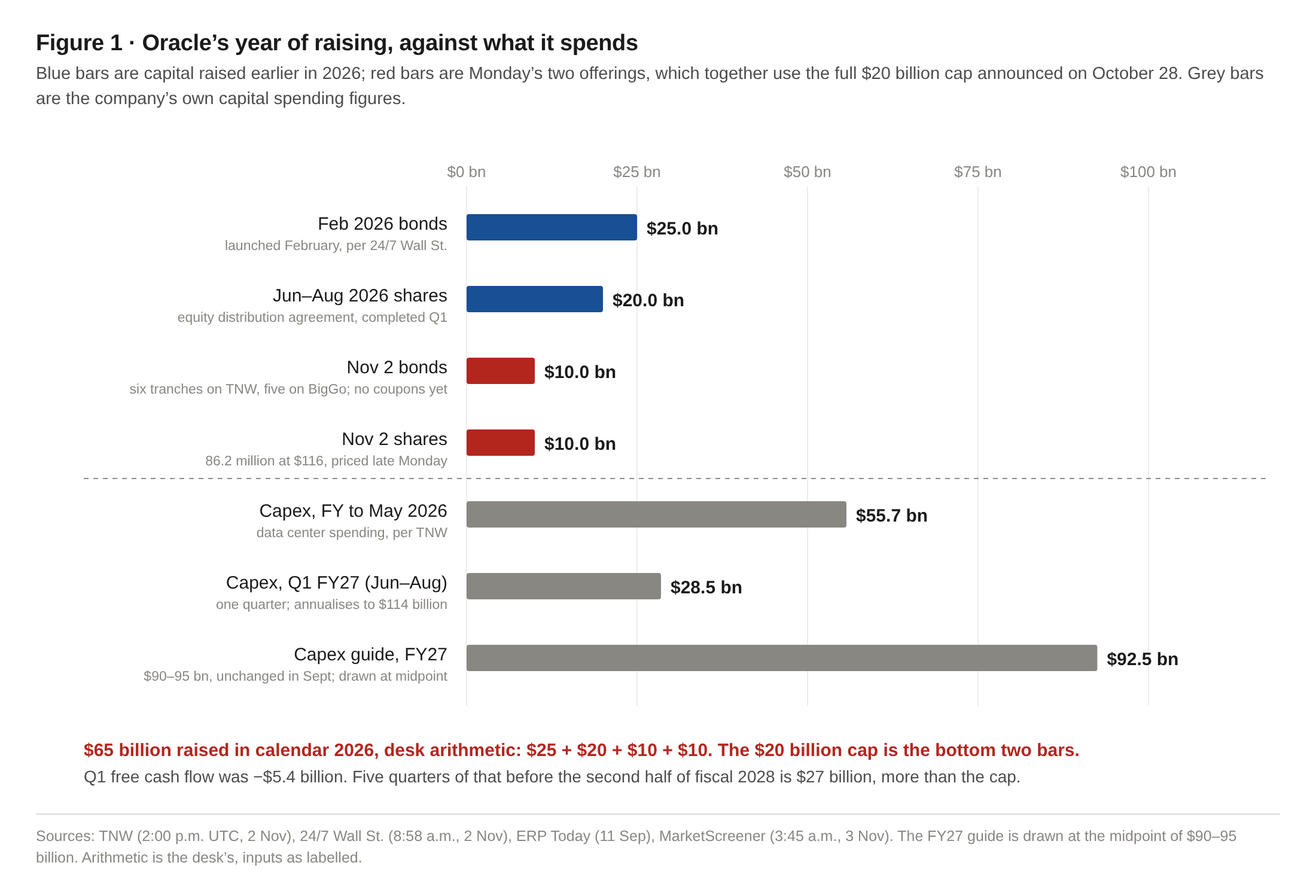
Here is the published number and here is where it should show up.
The number is $20 billion. Oracle's chief financial officer, Hilary Maxson, told the investor day on October 28 that up to $20 billion of new capital through fiscal 2030, half debt and half equity and excluding refinancing, "is the final amount needed to fund the remainder of this cycle," per TNW's account of the event. Five days later the company filed for $10 billion of common stock and $10 billion of senior notes. BofA Securities led the bonds with Wells Fargo, Citigroup, JPMorgan and Deutsche Bank. TNW counted six tranches, one floating-rate note due 2029 and five fixed-rate notes due 2029, 2031, 2033, 2037 and 2046; BigGo Finance counted five, with maturities of three to twenty years. Both are printed and neither is sworn; the pricing supplement will settle it. Either offering can proceed without the other. Use of proceeds is general corporate purposes, "which may include capital spending and paying down debt."
The shares priced late Monday: 86.2 million of them at $116, per MarketScreener's account of the release at 3:45 a.m. Eastern, which is $9.999 billion by this desk's multiplication. Newsquawk relayed Bloomberg's expectation of $116 earlier in the evening, calling it an 11 percent discount to Friday's close of $130.67; MarketScreener calls the same price a 2.7 percent discount to Monday's close of $119.22. Both are right. Oracle fell 8.76 percent on Monday, sworn on three feeds, and the discount to Friday is mostly the fall that the filing itself caused.
The $20 billion should show up on the cash flow statement, and that is where the cap stops being a cap.
Oracle's first fiscal quarter, the three months to August 31, is the most recent one reported. Capital spending was $28.5 billion. Operating cash flow was a record $23 billion, inflated by customer prepayments, and free cash flow was negative $5.4 billion against negative $362 million a year earlier, per ERP Today's account of the results. Senior unsecured borrowings stood at $125.3 billion on August 31, within $236.1 billion of total liabilities, per TNW. The company's capital spending guidance for the fiscal year is $90 billion to $95 billion, unchanged in September. The company has said free cash flow turns positive in the second half of fiscal 2028. Interest expense rose 55 percent in the quarter to $1.4 billion, per 24/7 Wall St.
Now the desk's arithmetic, with the inputs printed so a reader can reject it. If the first quarter's $28.5 billion of capital spending is to fit inside $90 to $95 billion for the year, the remaining three quarters average $20.5 to $22.2 billion each. If free cash flow runs at the first quarter's negative $5.4 billion for the five quarters between now and the second half of fiscal 2028, the cumulative gap is $27 billion, which is already more than the cap. If the gap narrows in step with the lower quarterly capex, roughly $20 billion against $28.5, it is about $19 billion, which is the cap almost exactly. So the cap holds only if three things hold at once: capex comes down from the first quarter's pace as guided, customer prepayments keep arriving at the pace that produced a $23 billion operating cash flow quarter, and nothing else goes wrong. That is not a cushion. That is a forecast.
And the forecast rests on a fourth thing, which the chief executive said out loud on the September call: "It does not have to be Oracle CapEx." The $664 billion backlog in remaining performance obligations is built on data centers Oracle does not have to own, and the cap is the company's way of saying ownership will sit elsewhere, with developers, landlords, and lenders whose names will appear in other people's filings. The $20 billion is Oracle's share. The bill is larger, and it is being split rather than shrunk.
One more number for scale, this desk's addition. In February Oracle launched a $25 billion bond offering alongside a $20 billion equity distribution agreement, and completed the equity program between June and August, per 24/7 Wall St. and TNW. Add Monday's $20 billion and the company has raised $65 billion of new capital in calendar 2026, against $55.7 billion of data center spending in the fiscal year to May. The market’s reaction on Monday, with the shares touching their lowest since July, was not to the dilution, which at $10 billion is modest against the company's size. It was to the arrival, five days after the cap was announced, of the whole amount at once.
What moved
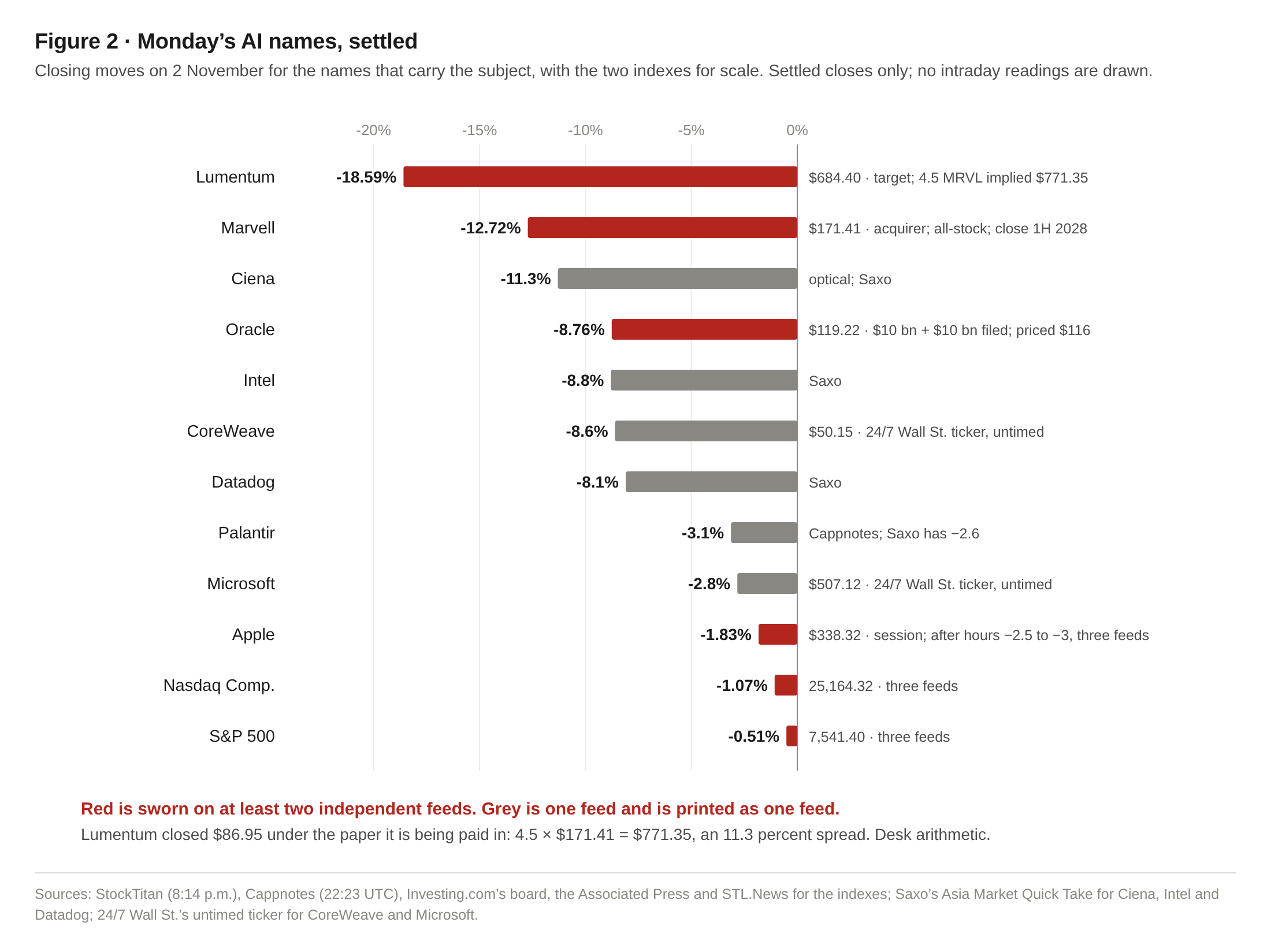
Oracle at $119.22, down 8.76 percent, is sworn on three feeds. The rest of Monday's damage in the names that carry the buildout is settled as follows, with the one-feed readings labeled.
Marvell and Lumentum fell together on the deal that joined them. Marvell will buy Lumentum for 4.5 of its own shares per Lumentum share, an implied $1,132 and a 23.9 percent premium to October 28, the last close before the speculation, at an enterprise value of about $115 billion, with the close expected in the first half of 2028 and more than $1 billion of annual cost synergies, per Yahoo Finance and Investing.com. Marvell closed at $171.41, down 12.72 percent, and Lumentum at $684.40, down 18.59, sworn on three feeds. The desk's arithmetic: 4.5 times $171.41 is $771.35, so Lumentum closed $86.95 below the value of the paper it is being paid in, an 11.3 percent spread for a deal eighteen months from closing. Some of that is time and regulatory risk. Some of it is the market's view of what Marvell's shares will be worth by then.
The rest of the optical and chip complex followed. Ciena fell 11.3 percent, Intel 8.8, Datadog 8.1, on Saxo's reading of the S&P 500's worst performers, one feed. The Philadelphia semiconductor index fell 3.4 percent after a 7.2 percent fall on Friday, per the JoongAng Daily, and CNBC-TV18 has a gauge of US chipmakers down 12 percent over three sessions. CoreWeave closed at $50.15, down 8.60 percent, and Microsoft at $507.12, down 2.83, on 24/7 Wall St.'s ticker, one feed, with the time not shown.
Two moves that were not the trade and got swept into it. Apple fell 1.83 percent in the regular session to $338.32 on two feeds, then reported revenue of $114.5 billion and earnings of $2.10 a share against expectations of $113.4 billion and $1.99 and guided the holiday quarter's gross margin to 45 to 46 percent against 47.9 in the quarter just ended, citing memory prices. Cappnotes, modified at 5:23 p.m., had the shares up 0.87 percent after hours; Newsquawk, Saxo and Admiral Markets had them down 2.5 to 3 percent, and Trading Economics had them down about 3.9 percent premarket this morning. The early reading is not wrong; it was taken before the margin guidance landed on the call. That is a difference between minutes, not an error, and it is printed as one. Palantir fell 3.13 percent in the session on one feed, 2.6 on another, then reported revenue up 96 percent with US commercial revenue above government revenue for the first time and was down about 3.8 percent premarket on Trading Economics. The AI-money frame will claim both of these this morning. Apple's problem is the price of memory, a buildout cost landing on a company that isn't building. Palantir's is valuation.
Away from the beat, the oil fall did what it does: Exxon down 4.05 percent, Occidental 5.13, United up 4.80, Delta 4.08, on StockTitan's tape, one feed. EVgo rose 46.83 percent on a $2-a-share buyout proposal from its controlling shareholder and IDEXX 21.85 on a raised forecast, same feed. Gold finished at $3,956.90, up 1.49 percent, on Cappnotes and $3,948, up 1.87, on The Rio Times, printed both.
The calendar
The election is the day's event, and it has no release time. Polls close through the evening, and the first consequential counts arrive after the cash close; nothing in the US calendar before then is scheduled for 8:30, which means the Brief previews nothing this morning that will have printed by the time it goes out.
At 8:55 a.m. Eastern, Redbook retail sales for the week to October 31, prior +9.3 percent year on year, no consensus. At 10:00, September job openings: consensus 7.164 million on XTB's calendar and 7.10 million on Trading Economics', prior 7.079 million; quits, prior 3.066 million, Trading Economics' own forecast 3.05 million. Also at 10:00, September factory orders, consensus +1.2 percent on both calendars, prior +0.1; durable goods orders, final, consensus +1.8 percent, prior +1.8; ex-transport +0.5 against +0.5. October vehicle sales through the day, consensus 15.9 million, prior 16 million, Trading Economics. At 4:30 p.m., the API's crude inventory, prior a draw of 2.031 million barrels. The Treasury's quarterly borrowing estimate, out Monday, has $618 billion for the fourth quarter, $10 billion under August's estimate, per Trading Economics’ narrative.
No Federal Reserve speaker is listed on XTB's or Admiral Markets' calendars for today. The committee's next meeting is 8 and 9 December, and the October meeting is behind us. The Bank of Canada's Macklem speaks at 11:00 a.m. Eastern.
Earnings before the open: Pfizer and Shopify. After the close: AMD, Arista Networks, Amgen and Booking Holdings. AMD is the one on the beat. MarketBeat's consensus is $1.95 a share on revenue of $13.09 billion, against $1.20 and $9.25 billion a year earlier; the call is at 5:00 p.m. Its data center line and its own fourth-quarter guide land on a tape that has sold chipmakers for three sessions, and the stock was up about two percent premarket on Trading Economics.
Ahead: ADP for October at 8:15 Wednesday, consensus 69,000 against a prior of 90,000, with Trading Economics' own forecast at 80,000; ISM services at 10:00 Wednesday, consensus 54.8 against a prior of 54.9. The Bank of England decides at 7:00 a.m. Eastern Thursday. The October employment report is Friday, 6 November, at 8:30: consensus 65,000 on Admiral Markets and Trading Economics, prior 29,000, unemployment 4.2 percent against 4.2. Nvidia reports 17 November. Clocks changed on Sunday, so every time above is Eastern Standard.
What we're checking next
Oracle's pricing supplement, when it posts, settles the tranche count and gives the coupons, and the coupons are the number to read. BigGo Finance has Oracle's 2066 bonds yielding about 8.4 percent against 6.1 on Apple and Microsoft paper due 2062, and its credit default swaps at about five times Microsoft's. If Monday's new notes price near that curve, the cost of the half of the cap that is debt is the first hard figure on what the market now charges to fund this buildout at an investment-grade name, and it goes into the desk's running table beside the February tranches.
The second line of inquiry is the one the chief executive opened: whose capex it is, if not Oracle's. The $664 billion backlog sits on sites that someone will own and finance, and over the next quarter those arrangements will begin to appear in the filings of the developers, the lenders and the landlords. Each one that surfaces is a piece of the bill that the $20 billion cap does not count. We will be reading for them.