MORNING BRIEF
Morning Brief November 2nd 2026
Friday was a bloodbath for anyone who buys compute. Amazon spent $77bn on property and equipment in a quarter and went to the bond market for another $48bn to cover the gap. OpenAI went out looking for $30bn and came home with $11bn. That money didn't just vanish: Sunday's export figures from Seoul show you precisely where it went. Same AI circus, different ring
Monday, November 2, 2026 · Before the open · ISM manufacturing at 10:00, Apple and Palantir after the close
AI has two ledgers. On Friday Wall Street only cared to look at one.
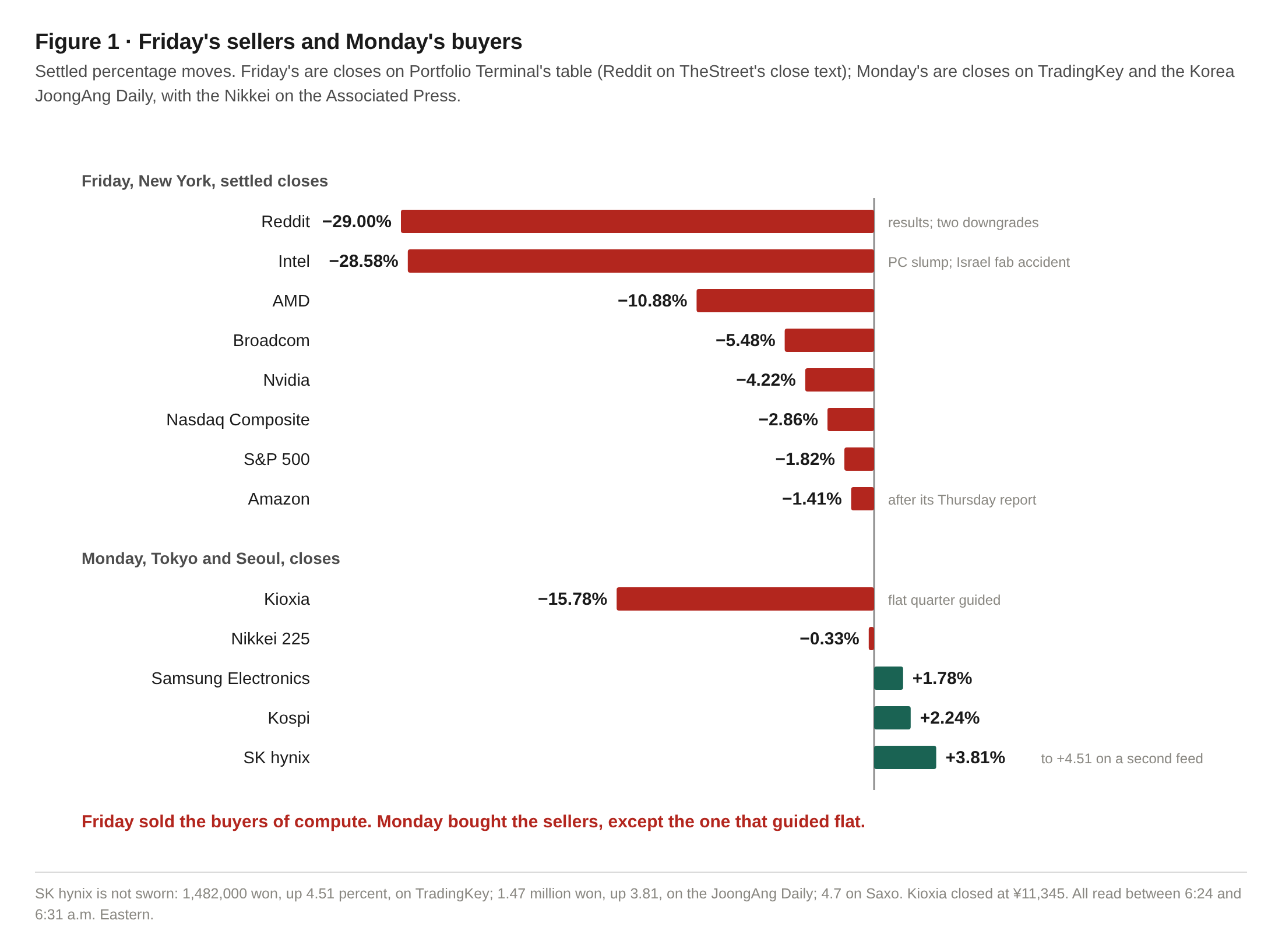
Let's start with the buyers. The labs and the cloud guys are absolutely pouring it on the hardware side, hoping the revenue comes in before the credit card bill does. Friday was a complete and utter disaster compared to Thursday. Amazon's third quarter showed it spending nearly twice what it brought in and borrowing the rest. OpenAI raised a third of what it was after (well done to the Journal for that). Intel was absolutely trashed, down nearly 29% in a day. Nasdaq down 2.86%. VanEck semi fund down nearly 8% by mid-afternoon. Blood all over the place.
Now flip it. The sellers' ledger came out of Seoul on Sunday. Korean exports up 94% y/y. Chips up 259% to $56bn. The buyers' borrowed money went into chips. Kospi up 2%. Kioxia in Tokyo got absolutely creamed for saying next quarter would be flat.
So where's the money? Buyers have paid up. Still no payback. OpenAI's fundraising fiasco is the first indication that the money people are finally looking at the score.
Overnight, sworn in
The Friday closes are all in line on the AP's table and Portfolio Terminal's, and Investrade's figures are consistent to the nearest point: S&P 500 at 7,580.07 (down 140.32 or 1.82%), Dow at 51,770.31 (down 572.25 or 1.09%), Nasdaq at 25,437.00 (down 747.73 or 2.86%) and Russell 2000 at 2,811.84 (down 47.37 or 1.66%). TheStreet's 4:03pm table is 7,578.97, 51,785.82, 25,442.31 and 2,801.16, and Newsquawk's overnight note has the same early figures, rounded. Those are pre-settlement numbers, not a divergence. For the week the S&P 500 was down 0.6%, the Dow 0.9% and the Nasdaq 2.0%, and the Russell 2000 was up 1.3% (all AP). The Nasdaq 100 was down 3.46% to 28,385 on Newsquawk (Saxo has it at 3.5%).
The 10yr isn't sworn at Friday's close. Four readings fall between 4.913 and 4.929: Portfolio Terminal at 4.929, Investrade's table at 4.928, TheStreet at 4.917 (2:31pm) and Investrade's own narrative at 4.913. The 2yr closed at 4.569 on TheStreet at 2:31pm and 4.579 on Investrade. At 6:28 this morning Trading Economics had the 10yr at 4.925 and the 2yr at 4.60. Newsquawk and Saxo both had 4.93 at around 1:20am Eastern, and Saxo's Asian edition had 4.95 with the 30yr at 5.33. The dollar index was 101.913 on Trading Economics at 6:28 and 101.84 on Newsquawk at 1:20am. The yen was 157.75 and 157.83 on the two feeds respectively, with the AP at 157.83 at 2:33am.
Oil is the one market where the weekend absolutely needs a proper read. The Investrade settlements on Friday were WTI at $104.12 (up $2.12) and Brent at $117.64 (up $2.76). That Brent price is the December contract on its final day of trading. It expired Friday, and the January contract, now the one trading, was at $110.24 at 2:33am on the AP (down 2.8%), with WTI at $100.85 (down 3.1%). TipRanks at 5:41am had WTI at $99.77 and Brent at $108.68 (down 4.18% and 4.27% respectively). Those are two readings three hours apart, and the move was still going on between them. The explanation in all the reports is the same: Iran's foreign minister said negotiators were in Qatar with a proposal that could reopen the Strait of Hormuz within two days if US conditions are met, and that no direct talks are under way. Gold fell 3.29% on Friday to $3,898.90 for December delivery and is back at $3,915 on Saxo this morning.
Asia split along the seam this morning rather than along the lines of geography. Tokyo went down and Seoul went up for the same reason. The Nikkei 225 closed at 63,081.86 (down 208.25 or 0.33% on the AP and BigGo Finance; 63,081.64 on TradingKey), and the Topix was down 0.88% at 3,930.28, its lowest since July. Kioxia did that. The NAND maker reported July-to-September revenue of ¥2.48 trillion (up 453%) with an 80% operating margin, then guided the current quarter to around ¥2 trillion of operating profit: roughly 1% above the quarter just reported, and well short of the near ¥2.35 trillion consensus BigGo Finance cites. The shares closed at ¥11,345 (down 15.78% on TradingKey). SoftBank was down 1.58% at ¥4,410.
The Kospi closed at 5,859.08 (up 128.34 or 2.24%) on the AP, the Korea JoongAng Daily and TradingKey, after opening lower near 5,616. Samsung Electronics closed at 229,000 won (up 1.78%) on two feeds. SK hynix is not sworn: TradingKey has it at 1,482,000 won (up 4.51%), the JoongAng Daily at 1.47m (up 3.81%) and Saxo at 4.7%. Institutions bought 1.23 trillion won of stock, and foreigners and retail combined sold 1.72 trillion (JoongAng Daily). Hong Kong was up 0.5% to 23,411.49 and Shanghai up 1.1% to 3,638.03 on the AP; Taiwan was down 0.7% and Australia down 0.6% to 8,856.50. Europe opened flat to lower at 3:26am on investingLive (DAX and CAC down 0.2%, FTSE 100 down 0.3%), and by 6:28 Trading Economics had the Euro Stoxx 50 at 6,142 (up 0.17%), the DAX flat at 25,818 and the CAC down 0.14% at 7,958. On Friday the Stoxx 600 was down 0.4% and the DAX down 0.9%, and ASML was down 6.1% on Saxo's European note and 4.7% on its Asian one; both are left as read.
US futures were up all night. At 6:28am Trading Economics had the S&P 500 at 7,610.88 (up 30.81 or 0.41%), the Dow at 51,907 (up 137) and the Nasdaq 100 at 28,620 (up 235 or 0.83%). TipRanks at 5:38am had the three up 0.51%, 0.55% and 0.84%. The VIX closed Friday at 19.42 (up 2.22).
The subject
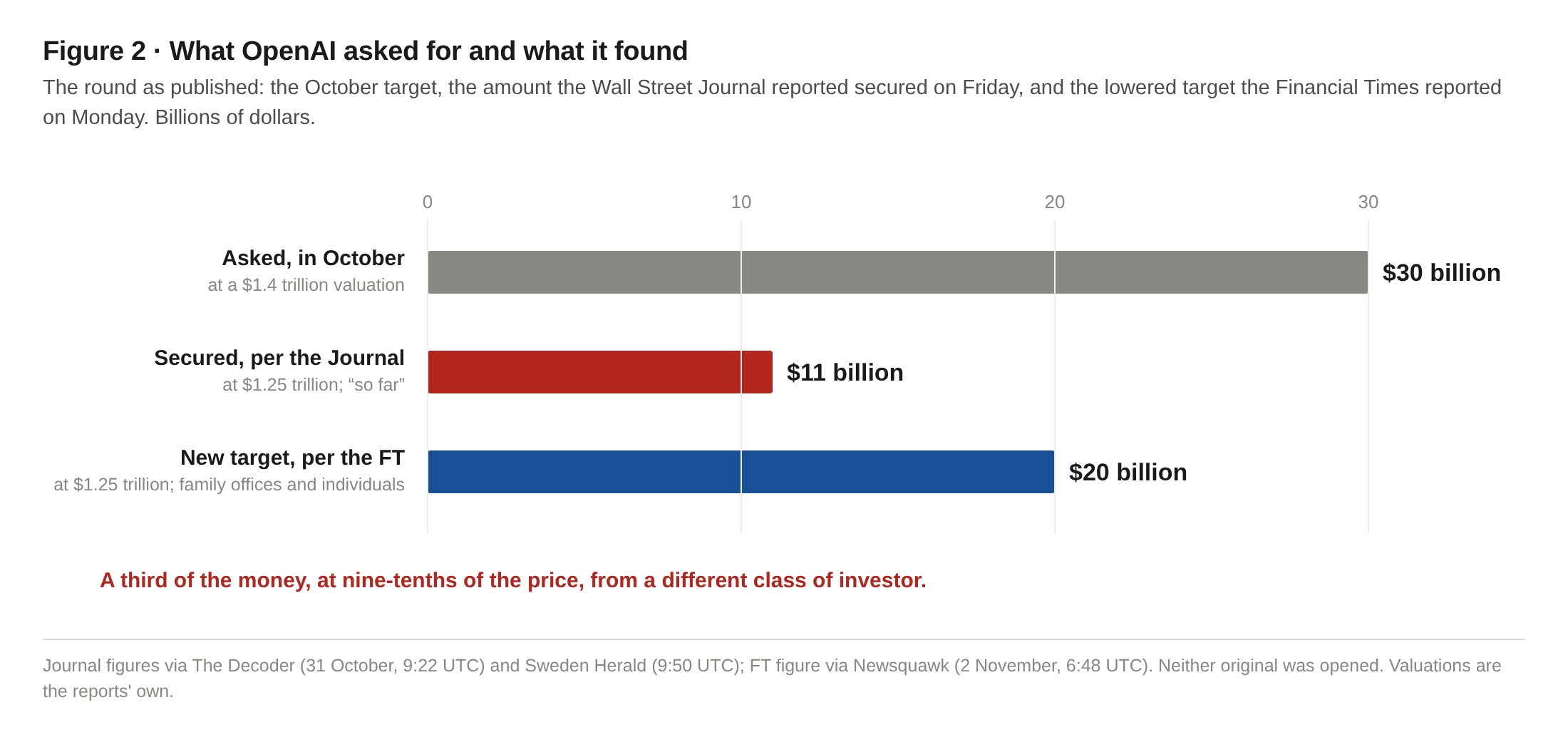
The number was published a month ago. OpenAI went to market for $30bn at a $1.4tn valuation. Where it should show up is in commitments, and on Friday the WSJ reported where it did: around $11bn secured at $1.25tn. The Decoder and the Sweden Herald had the Journal's numbers on Saturday morning, and Newsquawk relayed the FT's follow-up at 1:48am ET on Monday: the target has been cut by $10bn to around $20bn at the lower valuation, with the balance to come from family offices and wealthy individuals rather than the institutions that funded earlier rounds.
Let's be clear: it's not a total brick. The Journal said "so far." It's a price check. OpenAI, the biggest compute buyer on the planet, wanted a $1.4 trillion sticker. The money people said $1.25 trillion and offered only a third of the cash.
Here's why that number matters. OpenAI has already signed up for a mountain of commitments to the chip and cloud guys, and those commitments sit on the sellers' books as revenue promised later. Microsoft has $677bn of commercial remaining performance obligation booked (up 73%), but bookings in the quarter were down 12%. Microsoft said in October 2025 that OpenAI was about 45% of that line, and nothing read this morning restates the share. Every dollar of it is one OpenAI still has to raise or earn. So when the round comes in at a lower price, from a new set of investors, that's the first real indication that those promises may be the sellers' risk rather than their assets.
Now check Amazon. Same movie, different actors. It doesn't need to pass the hat; it has $114bn of cash and marketable securities. The actual numbers, though: in three months, $42bn of cash from operations and $77bn spent on property and equipment. $48bn borrowed, almost none of it paid back. Over twelve months it's $42bn underwater on free cash flow, by its own definition. Those are Amazon's numbers, not mine. It still plans about $220bn of capex this year and is guiding to $240-247bn of sales in Q4.
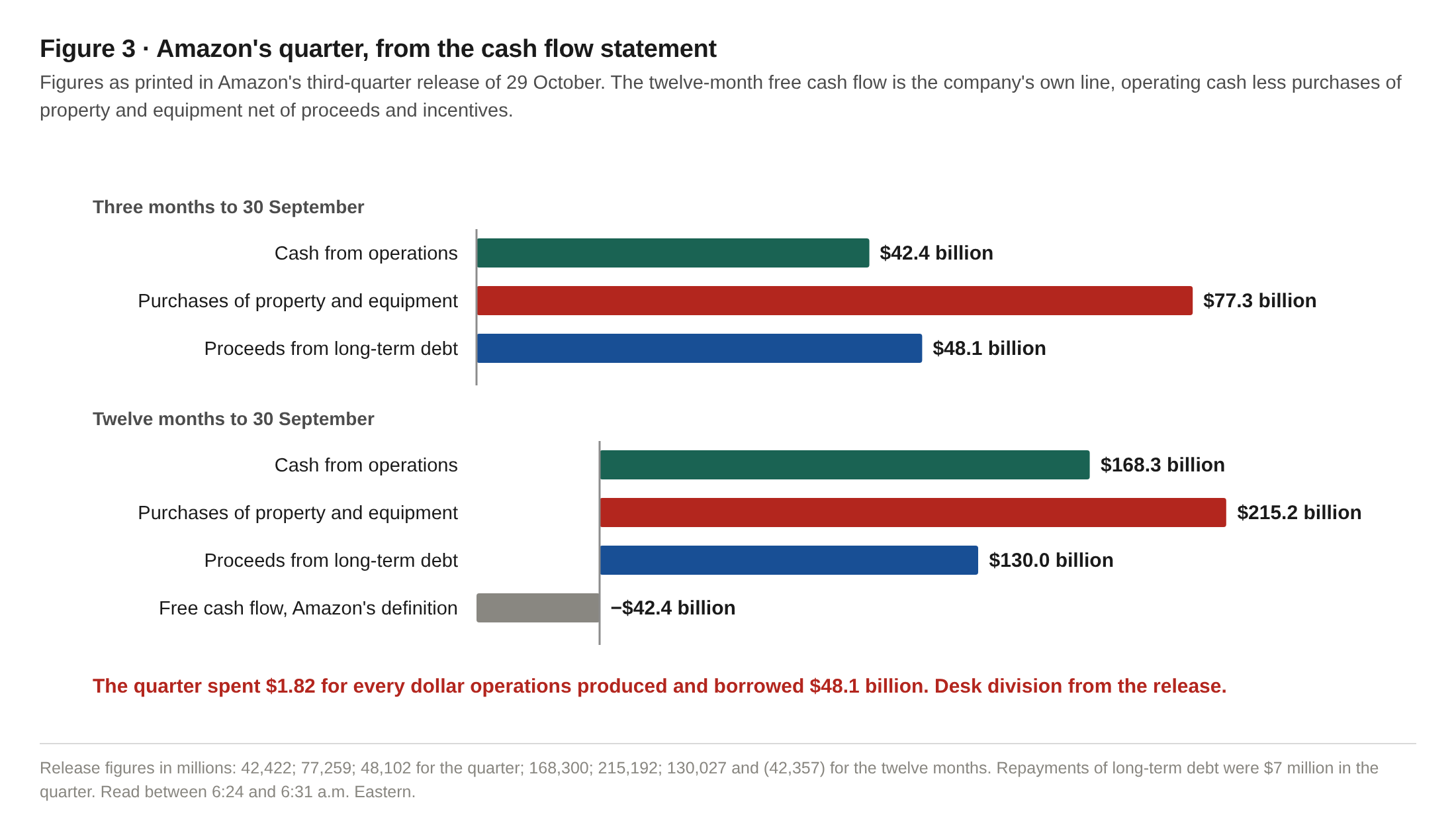
This is what you get when "spend now, get paid later" actually makes it onto the balance sheet. AWS just reported 39% growth, $46bn in sales and $17.8bn in operating profit. Big numbers. Amazon spent far more than that building capacity for the next round, though. The stock was down 1.41%: the market had already priced in the spend, and the revenue line was the surprise. Alphabet reported the same shape the day before and was pummelled 12.61% over the week. Microsoft? It said on Wednesday that it will spend about $170bn on capex in calendar 2026, having spent $45.2bn in the September quarter ($7.4bn of it on finance leases). Everyone's building, everyone's spending, and the market is treating the bill as if it has only just seen it.
Here's your Monday morning scoreboard. Private buyers are borrowing against a price that has just been posterised. Public buyers are borrowing against cash flow that is now underwater. It's not a new game, just a bigger one. The OpenAI number is the first time the money side has come in under the sticker. That's the twist.
If it's real money, it will appear in the sellers' bank accounts. Spoiler: it does. Korea just released its October numbers: exports up 94%, chips up 259%, computers up 497%, exports to the US up 186%. Chip exports have been over $50bn for two months running. The trade surplus is still very solid, even if it's down on last month's record. Why? Because Big Tech is spending like a fool on AI and Korea is collecting on every dollar. Every dollar Amazon or Microsoft spends on kit becomes a dollar for Korea the moment those memory chips leave the dock.
The sellers are locking it in as well. SK hynix has signed long-term deals, typically five years, with 14 customers (mostly the big cloud guys), and it isn't finished. The JoongAng Daily says DRAM and HBM are effectively sold out through 2029 if you count the deals still in the pipeline. Samsung has 10 deals signed and 10 more in negotiation, is aiming to put 60-70% of its capacity under long-term contract by 2030, and plans to open the wallet in 2027. SK hynix and Samsung made about $142bn of operating profit between them last quarter. At Friday's close their shares were still roughly 52% and 40% off their highs. That's why you saw a 2% pop on Monday: the sellers have the cash and the contracts, but the market is behaving as if they're the ones left holding the bag.
Here's the catch: the big seller numbers don't mean the party goes on if the buyers run out of cash. SK hynix has essentially said: we've got the volume, we've got the deals, but the price floats inside an agreed band. Five years of volume is one thing, but it isn't a revenue commitment. The price is still a mystery. That's the real story.
What moved
The settled moves are as follows. Intel was down 28.58% on Portfolio Terminal's table; TheStreet and Saxo round it to 29 and 28.6, Investrade calls it the steepest one-day fall on record for the stock, and FX Leaders dates it against 1974. This is not the AI trade, and that's important. Intel's Q3 revenue of $16.5bn beat its own guidance, with data centre revenue up 78% to $7.3bn. Q4 guidance was $15.0-16.0bn with a non-GAAP gross margin of 38% against 44.1%. The accident that shut its factory in Israel accounted for roughly $300m of the revenue shortfall, and Intel's own explanation was a severe PC slump. "Still PC dependent" was Benchmark's Cody Acree's take on CNBC. The stock was sold as a chip-capex casualty, and the chip-capex names were sold with it. AMD was down 10.88% on Portfolio Terminal after trading down 12.02% at 1:36pm on TheStreet. Broadcom was down 5.48%. Nvidia was down 4.22%, having been down 4.95% at 1:36pm. Reddit was down 29% on its own results and two downgrades and has nothing to do with any of this.
Amazon's 1.41% and Apple's 1.23% are the quiet ones. Apple reports tonight.
Two of the moves weren't the trade and got sucked into it anyway. Twilio was down 17.39% at 10:21am on TheStreet on a lower fourth-quarter organic growth guide, a software number that came out the same morning and was swept into the chip rout. The gold miners were down for their own reasons: December gold lost $132.50 an ounce and silver $3.10, and Agnico Eagle, Newmont, Barrick and the silver names led Investrade's list of heavy decliners.
The early Monday readings, none of them settled, all run the other way: SanDisk and Micron were up over 2% in the premarket on TradingKey despite Kioxia's warning, and SK hynix closed up between 3.81% and 4.51% depending on the feed.
The calendar
Times are Eastern, and the clocks changed on Sunday, so a release stamped 15:00 on a UTC calendar is 10:00 this morning, not 11:00. Consensus and prior are from Trading Economics (read at 6:27am), with Investing.com as the second feed where it carries one.
At 9:45am, S&P Global's final October manufacturing PMI: consensus 56.0 (prior 55.9). At 10:00am, the ISM manufacturing index for October: consensus 54.6 (prior 54.5); Investing.com has the same prior and no consensus. The same release has prices paid (prior 77.9, consensus 77), new orders (prior 55.3) and employment (prior 52.7). Also at 10:00am, construction spending for September: consensus +0.4% (prior +0.9%). Austan Goolsbee of the Chicago Fed speaks at 11:15am, the only Fed speaker on the day's schedule. The three- and six-month bill auctions are at 11:30am. At 2:00pm the Fed releases the Senior Loan Officer survey, and at 3:00pm the Treasury releases its refunding financing estimates ahead of the quarterly refunding announcement later in the week.
After the close we've got Apple and Palantir, both with calls at 5:00pm. Apple's consensus EPS is $1.98 against $1.85 a year ago; Palantir's is $0.33 against $0.18. Palantir is the one disclosed "AI revenue" line reporting tonight, and the number to watch is whether US commercial is still growing faster than the company as a whole.
Tomorrow's the midterms. The data calendar has JOLTS job openings for September at 10:00am (consensus 7.13m, prior 7.079m) and factory orders. AMD, Super Micro, Arista Networks and Astera Labs all report after Tuesday's close; Arm and Qualcomm after Wednesday's. The October employment report is out Friday, November 6, at 8:30am: Trading Economics has a consensus of 65k against a prior of 29k, and a second survey seen in a week-ahead note has 55k (different surveys). The Federal Open Market Committee meets next on December 8 and 9.
What we're checking next
The line of inquiry is the band. SK hynix has told its investors that its five-year agreements float within an agreed price range. Samsung has said it has had "requests for additional supplies during existing contract periods." Neither has published the range, the volumes, or what happens to either if a customer's funding comes in at a third of its target. The next documents that could are the quarterly filings from SK hynix and Samsung, which carry the contract-liability and customer-concentration lines the calls don't, and Microsoft's 10-Q, which will say how much of the $677bn is due in the next twelve months. That's what this desk is reading for the number the OpenAI round moved. Nothing is forecast here; the Errata is where that happens.
Sources and data notes
Every figure carries its feed and the minute it was observed, Eastern. This run's clock was read at 6:23 and 6:31 a.m.; every page was read inside that window and is stamped to it unless the page carries its own time, which is given where it does. The scheduled run fired at 11:15 UTC, which is 6:15 a.m. now that the clocks have changed, an hour earlier than its intended slot.
Sworn in. Friday's closes (S&P 500 7,580.07, Dow 51,770.31, Nasdaq Composite 25,437.00, Russell 2000 2,811.84) on the Associated Press via Yahoo Finance (4:21 p.m. Friday) and Portfolio Terminal (4:00 p.m.), with Investrade's rounded table agreeing; the AP's Nasdaq point change is 747.73 and Portfolio Terminal's 747.72, the Russell's 47.37 and 47.38. TheStreet's 4:03 p.m. table and Newsquawk's overnight note (6:48 UTC) carry earlier readings. The Nikkei at 63,081.86 on the AP (2:33 a.m.) and BigGo Finance (7:25 UTC); TradingKey has 63,081.64. The Kospi at 5,859.08 on the AP, the Korea JoongAng Daily (5:33 p.m. KST) and TradingKey. Samsung at 229,000 won on the JoongAng Daily and TradingKey.
Not sworn. The ten-year's Friday close, four values between 4.913 and 4.929 (Portfolio Terminal; Investrade's table and text; TheStreet at 2:31 p.m.); the Treasury's par curve was not read. SK hynix's close, 1,482,000 won and 4.51 percent on TradingKey against 1.47 million won and 3.81 percent on the JoongAng Daily and 4.7 percent on Saxo. ASML's Friday fall, 6.1 percent on Saxo's European note and 4.7 on its Asian one, whose page metadata is dated 19 October under a 2 November body. Kioxia's guidance appears as three different measures: about ¥2 trillion of October-to-December adjusted operating profit, up about one percent, against a consensus near ¥2.35 trillion (BigGo Finance, 4:25 UTC); October-to-December net profit about fifteen-fold to ¥1.36 trillion (Newsquawk); April-to-December net profit nineteen times the prior year (BigGo's Nikkei note). They are not reconciled here.
Morning levels. Yields, the dollar, the yen, the won and the index contracts from Trading Economics' bond, currency and stock tables at 6:28 a.m.; its Japan contract at 62,996 and Hong Kong at 23,374 are contracts beside the cash closes above and are not used. Futures percentages from TipRanks (5:38 a.m.), investingLive (3:26 a.m.) and Newsquawk (1:20 a.m.).
Oil. Friday's settlements, WTI $104.12 beside Brent $117.64, from Investrade; the Brent figure is December's expiry (Thursday's $114.88 settlement plus the $2.76 change), and January's Friday level is implied at about $113.4 by the AP's Monday change, which is this desk's division. Monday's pairs: $100.85 beside $110.24 on the AP at 2:33 a.m.; $99.77 beside $108.68 on TipRanks at 5:41 a.m. Saxo's Asian note has WTI at $102.31 with no Brent and is not printed in the text. Goldman Sachs' Brent forecast for December 2026, raised to $105 from $90, is Saxo's relay.
The subject. OpenAI's round from the Wall Street Journal as carried by The Decoder (31 October, 9:22 UTC) and Sweden Herald (9:50 UTC), and the Financial Times' $20 billion as carried by Newsquawk; neither original was opened, and the Journal's post on X is the only first-party text seen. Amazon's figures are from the company's third-quarter release of 29 October: operating cash flow $42,422 million, purchases of property and equipment $77,259 million, proceeds from long-term debt $48,102 million, trailing-twelve-month free cash flow minus $42,357 million, cash and marketable securities $55,783 million and $58,443 million; the $114 billion is this desk's sum. Microsoft's capital spending, finance leases, remaining performance obligation and bookings from GuruFocus' summary of the 28 October release; the "$170 billion" quotation from FourWeekMBA's weekly account of the call, the transcript not opened. Korea's exports from the Ministry of Trade, Industry and Energy as carried by Reuters via Yahoo Finance (31 October, 9:29 p.m.) and the Seoul Economic Daily (9:16 a.m. KST, 1 November). SK hynix's and Samsung's agreements, quotations and profits from the JoongAng Daily (1:01 p.m. KST); an Elec article of 30 July with "more than 10 customers" surfaced in the same search and is the July figure, dated correctly at source.
What moved. Single-name closes from Portfolio Terminal; intraday readings from TheStreet at the minutes given; Intel's quarter and guidance from Yahoo Finance (9:39 a.m. Friday) and Investrade; the Alphabet weekly figure from TheStreet's wrap; the premarket memory names from TradingKey, seen in search and not opened.
The calendar. Trading Economics at 6:27 a.m., its display read as UTC and converted to Eastern Standard Time, first figure as the prior and second as consensus; Investing.com's ISM page for the second feed; StockTitan's week-ahead (30 October) for earnings and consensus per-share figures; the 55,000 payroll figure from a week-ahead note seen in search and not opened. The December meeting dates are the Federal Reserve's published calendar.
The chronicle. One entry joins the register this morning, taking the count from 264 to 265: Investrade's Friday market review carries the ten-year at 4.913 percent, down six basis points, in its narrative and at 4.928 in its macro table on the same page, read once, between 6:24 and 6:31 a.m. A page that disagrees with itself is an error; the four feeds disagreeing about the close are a difference, and they are printed above as one. Seen and not logged: TheStreet's and Newsquawk's early closing tables; Trading Economics' Japan and Hong Kong contracts beside the cash closes, and its FTSE 100 row still dated 30 October at 6:28; Saxo's two ASML figures and its Asian note's October metadata date; Investrade's Brent settlement with no contract named on the December expiry; and Yahoo Finance's AP page, whose ticker had December crude at $100.62, down $3.50, under an article that says oil rose, a live widget under a Friday story.
Disclosure. The subject sets OpenAI's round beside the sellers of compute and names Anthropic nowhere in its argument, but the FT's report that Blackstone has told Anthropic it may not receive an investment-grade rating, relayed by Newsquawk, was read in the same note. The desk's tooling is built on Claude, made by Anthropic.
The Decoy Chronicle — every entry, dated and sourced — is published as a standing register and updated with each issue.
The TrendyVest Championship is open for registration at Tournament.Trendyvest.com — 500 seats, a $100,000 simulated stake, free to enter. Trading began October 1 at the market open.
TrendyVest is an independent research practice. This is analysis and editorial opinion, not investment advice, and nothing here is a recommendation that any particular person buy or sell any security. Figures identified as this desk's arithmetic are the practice's own, and the inputs are printed alongside them.