Intelligence Brief · weekend long read
The End of Bitcoin
Not the network. The trade. The crew that pumped it to $126k? Gone. Miners? Off chasing AI money. The 'hedge' story? Flunked its first real test. Binance just lost $6.3bn because an engineer's laptop got hacked. My number is $46k, right where the ETF party started. Time to run the numbers.
trendyvest.com · Sunday, November 1, 2026
On Thursday evening blockchain watchers noticed some cash exiting the world's largest crypto exchange and the exchange itself suspended withdrawals.
By Friday morning the figure was $6.3bn, the largest heist in the industry's history (four times the Bybit heist of February 2025 and twelve times Mt. Gox). In Binance's initial report they state that the hackers had accessed the system via a compromised laptop of one of their engineers. They had drained wallets across ten blockchains: $1.66bn of Tether, $767m of USDC, 17,985 BTC at around $1.45bn and a long tail of smaller tokens. By Saturday the FBI had identified the perpetrators as TraderTraitor, the North Korean state's hacking unit. By Sunday morning Binance had restarted withdrawals in 15 currencies and co-CEO Richard Teng said "Binance will absorb the financial impact of the stolen funds, not our users".
Bitcoin at $76,368. Six-week low. October strikes again. Down two years straight. So much for digital gold.
Forget the hack for a second. That's not why Bitcoin's toast. This is how it ends: no buyers, miners bailing, the 'hedge' story in shambles, price down $48k from the top. All at the worst possible time. Classic crypto.
Here's the argument in one paragraph. Bitcoin went from c. $46k on the day the SEC approved the spot ETFs (Jan 10 2024) to $126,080 on Oct 6 2025. That move was driven by three things: $57bn of net ETF inflows, a corporate treasury trade (Strategy being the driver of that, who now has 848,517 coins) and the belief that Washington would buy. In 2026 the ETF flows turned negative, the treasury trade became a seller and Washington didn't buy a coin. Along the way the asset failed the one test it was designed to pass (the miners who secure the network signed over $70bn in contracts to do something else with their power and the largest exchange got robbed). A price built on three engines doesn't last when all three engines stop. Our case comes back to where the engines started at $46k (41% below Sunday's price). The path goes through two floors and both floors are made of other people's leverage.
The buyers? Casper and friends.
Start with the ETFs as that was the story. From launch in January 2024 through Friday the US spot Bitcoin funds have taken in a net $57.0bn and now hold $98.1bn in assets. September was $2.6bn. October was a month of outflows.
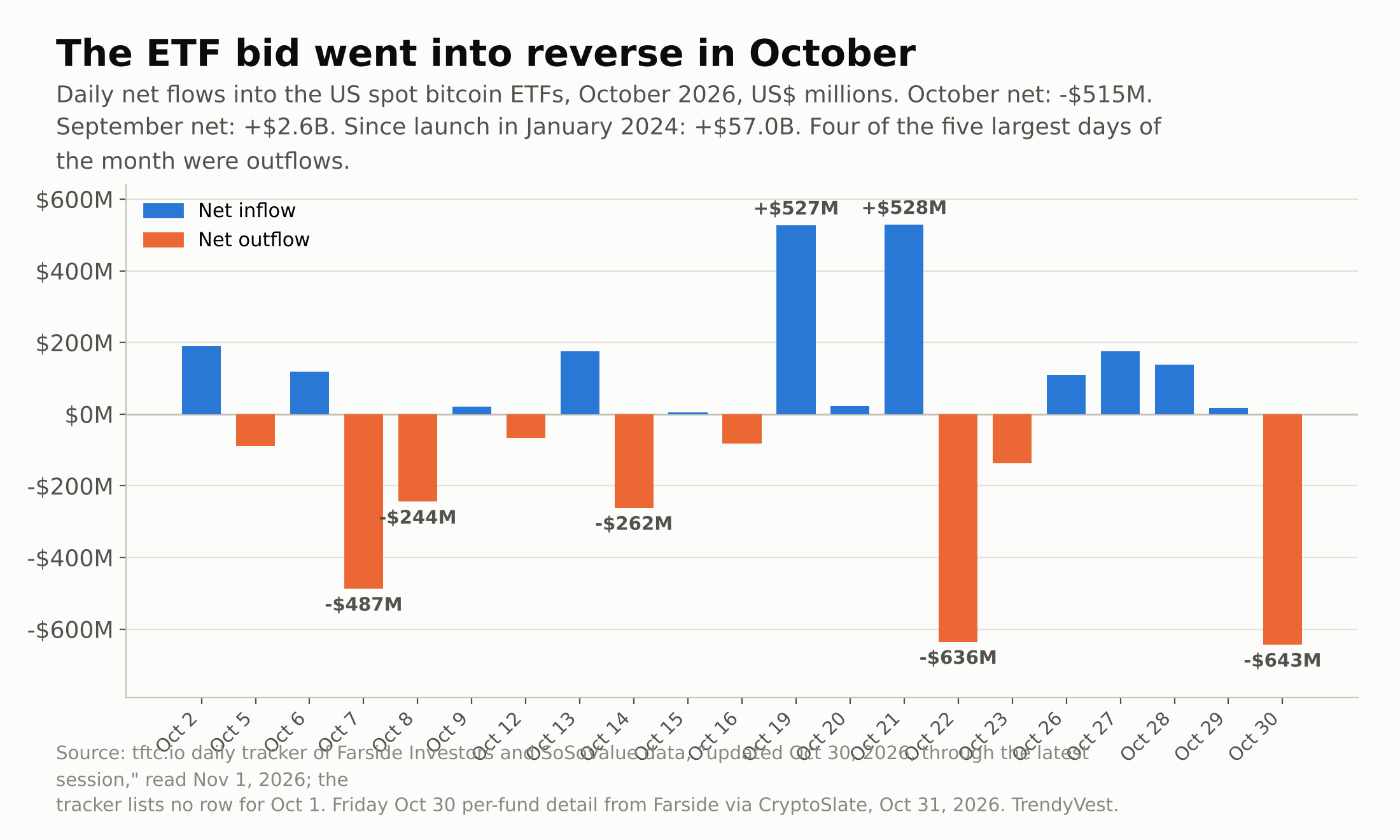
Friday saw the funds bleed $643m, the worst day of the month. IBIT (BlackRock) was down $233.7m and FBTC (Fidelity) $201.0m. Five funds had outflows and none had inflows. That turned a week which had been running +$440.8m through Thursday into a -$202.4m week. The tracker we use has October at -$515m and four of the five largest days of the month were outflows. Flows follow price down and then they in turn drive the price down.
The second engine is treasury trading and its engine room is Strategy. As of Oct 25th they had 848,517 BTC which they'd bought for $64.02bn, at an average of $75,446 per coin. When they marked that position for their Q3 report on Oct 23rd Bitcoin was at around $81,200 and the position was worth $68.90bn. At the price on Sunday it's worth $66.17bn. The cushion over cost is $2.15bn or 3.4%. Below $75,446 every one of those coins is a loss and $75,446 is 3.3% away.
That's crucial in terms of how the coins were funded. Strategy have been selling what they refer to as Digital Credit (a notional value of $16bn across ten listed securities in the form of preferred stock which pays up to 12% per annum in dividends). The dividend cost in Q3 was $419.6m (up from $140m in Q3 last year) which at an annual run rate is approaching $1.7bn. They have a $4.83bn reserve against that and claim that covers 3.4 years of obligations. They've also started to sell the asset they're in business to hold. So far they've sold approximately $431.8m of bitcoin to fund part of the dividend and to buy back $2bn of STRC (the 12% paper) which is trading below its $100 face value. Their own measure of the yield they earn per share from bitcoin (BTC Yield) is -3.7% for 2026. The stock finished Friday at around $131 (down 7.8% on the day and 48.7% over the past year). MSCI will publish the final list of companies exiting their indexes on November 11 and earlier simulations had Strategy on that list. Michael Saylor's take on all of this in Thursday's release was "We're at the beginning of the next bitcoin bull market".
Strategy is the largest of the treasury companies (not the only one). Metaplanet (the Japanese version of the trade) sold 10,000 BTC for circa $790m in Q3, less than it had paid for them, then bought 11,000 back. The stated rationale for the trade was to demonstrate liquidity. When a company whose sole purpose is to hold Bitcoin has to go and prove it can sell Bitcoin, the trade has changed.
The miners? They're out. Packed up and gone.
The only folks who really get Bitcoin? The ones running the rigs. They're selling out for AI money.
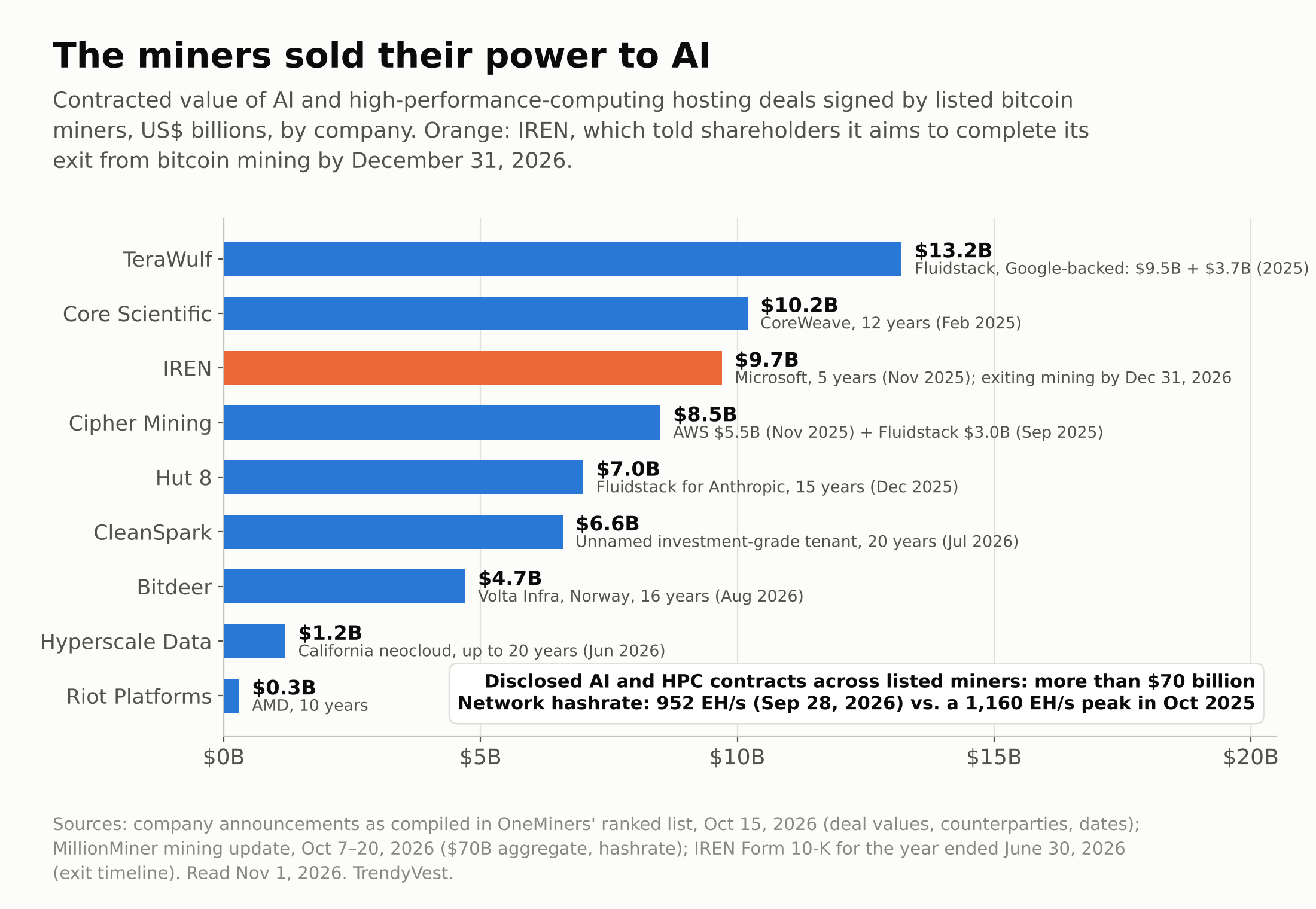
IREN (23.2 EH/s, 380MW) has told its shareholders in its annual report that it has "commenced decommissioning Bitcoin mining hardware and reallocating power and data center capacity toward AI Cloud Services" and plans to "substantially complete the transition by December 31, 2026". It has a $9.7bn 5 year contract with Microsoft to support this. Core Scientific has a $10.2bn 12 year contract with CoreWeave and is now deriving 83% of its revenue from hosting. TeraWulf has $13.2bn of contracts with Google-backed Fluidstack, 71% of its revenue is from HPC and it is in the process of winding down its remaining mining. Cipher has $8.5bn with AWS and Fluidstack. Hut 8 has $7bn hosting Anthropic via Fluidstack. CleanSpark signed a $6.6bn 20 year contract in July. The total value of contracts disclosed by the listed miners is now well over $70bn and CoinShares counts over 4GW of miner power committed to AI.
The network shows it. Public miners moved about 75 exahash off Bitcoin in the first half of the year. Total hashrate was 952 exahashes per second at the end of September (down 18% on the peak of 1,160 the network hit in October last year). Miner revenue per unit of hashrate was around $40 per petahash per day in early October (up from a record low monthly average of $27.70 in June) and of course the next halving in April 2028 will halve the block reward again. As one mining services CEO put it, AI pays more per megawatt than mining. The miners have done the sums and the sums say leave.
If the people who are keeping the lights on want out, this isn't what you pitched to pension funds in 2024. Bitcoin was positioned as digital gold, a hedge against the dollar, inflation, and the Fed. This is the first year since the ETFs launched to test that theory. Inflation is at 3.7%, the Fed raised in September and oil is well over $100. Gold, the very thing bitcoin was supposed to be a better version of, hit $5,331.27 on Jan 28 and was down to $3,880 on Friday (its lowest since Oct 6th 2025, the day bitcoin hit its peak). Bitcoin didn't hedge any of that at all. It went down with gold and it went down faster. As of Oct 23rd (per Charlie Bilello's count at Creative Planning) Bitcoin was down 7.3% for the year and gold was down 7.5%, making them the two worst performing major assets of 2026. By Sunday it was down 11.4%.
Stocks? No hedge there at all. Bitcoin's 30 day correlation with the S&P 500 is 0.68. Nasdaq down on Intel and Amazon news, Bitcoin down on a hack. Different stories, same chart. It's all one trade now.
This is what happens when you hold stuff that doesn't pay. The Fed's at 3.75 to 4 and still hungry. Ten-year yields? Pushing 5. Oil ripping. Markets betting on more hikes. Gold's got 5,000 years of respect and it's still down 27%. Bitcoin? Seventeen years, zero yield, and a 12% cost of carry if you're Strategy. Good luck.
Six point three billion dollars, through a laptop
Now, about that hack. That's where the real risk lives.
The whole point of Bitcoin was that you didn't have to trust anyone. In reality the system is run through a very small number of exchanges. The largest of those, Binance, with 335m registered users and $162.8bn of customer assets according to its 2025 annual report, lost $6.3bn when an engineer's computer was compromised. Teng says the attackers wiped the evidence and got past the security checks. The wallet they emptied was Binance's own hot wallet (although CoinDesk found it had previously been listed as one of the wallets backing customer balances). Withdrawals were frozen from Thursday evening until Sunday morning. Binance has set aside over $6.34bn to make users whole (around $5bn of that in the affected coins Binance already held, with the rest bought on exchanges and over the counter, drawing on an emergency fund of around $1bn in bitcoin, its corporate treasury and its futures insurance fund). Around 95% of the loss is covered. The remaining 5% is in tokens which are too illiquid to replace.
Then we get to the bit that should be alarming to anyone who's got bitcoin for the reasons outlined on the box. Around $3bn of the stolen funds were frozen within hours (not by the blockchain, but by the companies themselves). Tether froze ~$1.57bn, Circle ~$800m and Ripple ~$200m. Three companies with the power to censor have effectively saved censorship resistant money. The money was frozen. The Bitcoin wasn't because you can't freeze Bitcoin, that's why North Korea takes it. The FBI are saying the perpetrators are converting the funds into Ether. The same group took $1.5bn from Bybit in February 2025. There are now 17,985 freshly stolen coins (roughly $1.4bn at Sunday's price) in the market with no ETF bid.
That's three major exchange heists since early 2025. TRM Labs counted $2.9bn taken in nearly 150 attacks last year alone, before this one. The CFTC chair says that's precisely why offshore exchanges need US rules (per Decrypt). He's absolutely right and it's very bad for the price.
Washington never bought
The 2025 rally priced in a buyer that never showed. The Strategic Bitcoin Reserve (created by executive order in March 2025) holds only the coins the government already had from seizures. Public tracker data attributes 328,372 coins to it and there have been zero confirmed open market purchases. The BITCOIN Act (which would have seen the Treasury buying 200k coins a year for 5 years) didn't pass. The CLARITY Act (the market structure bill that the industry had been working on for two years) failed a procedural vote in the Senate on 15th September, 49 to 50. Its principal sponsor, Senator Cynthia Lummis, said "It's over".
What did DC actually pass? The GENIUS Act for stablecoins. That says it all. $299bn of stablecoins out there, roughly the same as last year, and they moved $46tn in a year (nearly triple Visa). The dollar's won. Bitcoin is just collateral for dollar leverage now and when the leverage unwinds, bitcoin unwinds with it. Friday's $1.57bn in liquidations? Perfect example.
Here's the risk nobody wants to talk about.
The market has decided not to think about any longer dated risk. BIP-360 was merged into the Bitcoin code repo on Feb 11th 2026 (a new address type which is designed to be quantum resistant with no activation date). Project Eleven have estimated that around 6.9 million BTC (a third of the supply) are currently in addresses where the public key is already on chain. Google researchers have estimated that the curve used for those keys could be broken with fewer than 1,200 logical qubits and Google have set 2029 as their own transition date to quantum safe crypto. Bitcoin can't move anyone's coins for them. The coins of the dead and the coins of those who have lost their keys will remain exposed until someone comes along and takes them. That's not a 2026 story. That's why the asset doesn't get a terminal multiple.
The arithmetic
Let's talk about where the floor really is. First: $76,368, Friday's low. Next: $75,446, Strategy's average cost. Below that and the biggest holder is in the red on $64bn of coins, with $1.7bn a year in dividends to pay. They're already selling. Then down to $69,225, the 2021 cycle top (11% down from here). Final stop: $46,000, the ETF approval-day price (41% down from today). The entire $46k to $126k run? That was the ETF era. Inflows, treasury buyers, political noise. Now the flows are out, the buyers are the sellers and the politics never really came into it. We think the ETF gains will go out the same door they came in through.
Not saying this all happens in a week. Not saying the network is dead. Bitcoin's dropped 38% before and bounced hard. The difference? Who's selling. In 2022 it was hedge funds and scammers. Now it's the big dogs: treasury companies dumping to pay dividends, miners cashing out to Microsoft, exchanges scrambling to buy back stolen coins, and ETF holders who bought at $100k and now just want the Nasdaq. At least the Nasdaq drops for reasons you can actually explain.
What would change our mind is a month of net ETF inflows above $2bn, Strategy buying bitcoin with equity rather than selling it to pay the credit, or a Fed that cuts. None of that is on the calendar. The halving is.
Registration for the TrendyVest Championship is open at Tournament.Trendyvest.com: 500 seats, a $100,000 simulated stake, free to enter; trading began October 1, 2026, at the market open.
Sources
All sources were read on Sunday, November 1, 2026, Eastern time. Bitcoin prices are spot prices as shown on the pages cited; where two feeds differ, both are given.
The price. CoinGecko's bitcoin page, read November 1: $77,982.89, all-time high $126,080, trading 38.2% below it; MarketScreener's price widget, November 1: $77,827.30, down 11.39% since January 1. CoinDesk's live blog of October 30 for the October 6 top, the second consecutive October decline and the 8.4% October loss at $76,300; Reuters via Yahoo Finance, October 30, for the six-week low of $76,368. Axios, March 5, 2024, for the November 10, 2021 record of $69,225; CoinDesk, January 10, 2024 ("Bitcoin wobbles below $46K, ether and Grayscale's GBTC jump as SEC approves spot bitcoin ETFs"), for the approval-day price. The 38% drawdown and every percentage measured from Sunday's price are the desk's arithmetic from $77,982.89.
The ETFs. The tftc.io daily tracker of Farside Investors and SoSoValue data, "updated Oct 30, 2026, through the latest session," for the daily October rows, the October month-to-date figure of −$515.0 million, September's +$2.6 billion, total net assets of $98.1 billion and cumulative flows of $57.0 billion since January 11, 2024; the tracker lists no row for October 1, and its October rows sum to a larger outflow than its printed monthly total. CryptoSlate, October 31, citing Farside, for Friday's $643 million, the per-fund figures and the week's $202.4 million net outflow.
Strategy and the treasury companies. Strategy's third-quarter release of October 29, 2026, for holdings, cost, average price, the October 23 mark, the $431.8 million of bitcoin sold year to date, BTC Yield, the $419.6 million of preferred dividends, the $16 billion of Digital Credit, the USD reserve and 3.4 years of coverage, the $2 billion of STRC repurchases and the Saylor quotation; Strategy's 8-Ks of October 19 and October 26, as summarized by StockTitan, for the most recent purchase and the week without one; 24/7 Wall St, November 1, for the October 30 close of about $131, the one-year decline of 48.7%, the $140 million year-earlier dividend figure, STRC trading below face and the MSCI date. The position's value at each price level is the desk's arithmetic: 848,517 coins times the price, less $64.02 billion. The Block, October 5, for Metaplanet's sale of 10,000 bitcoin for ¥124.7 billion ($790 million) below cost, the repurchase of 11,000 and the stated purpose.
The miners. IREN's annual report on Form 10-K for the year ended June 30, 2026, for the decommissioning language, the December 31 target, 23.2 EH/s and 380 MW; OneMiners' ranked list of miner AI deals, October 15, 2026, compiled from company announcements, for the contract values, counterparties and dates in the figure, the CoinShares four-gigawatt figure and the "AI pays more per megawatt" line; MillionMiner's mining update of October 7–20, 2026, for the $70 billion aggregate, the 75 EH/s moved off the network, hashrate of 952 EH/s versus the 1,160 EH/s peak, hashprice near $40 and the June low of $27.70, Core Scientific's 83% and TeraWulf's 71%, the TeraWulf and Bitfarms wind-downs and the April 2028 halving. The 18% hashrate decline is the desk's arithmetic.
Gold, rates and the tape. Kitco, October 30, 6:18 p.m., for spot gold at $3,880, down 3.5%, its lowest since October 6, 2025, and the rate expectations; the January 28, 2026 record of $5,331.27 as reported by ROIC.ai, with Reuters via Deccan Herald reporting the same day's record above $5,300; Bitcoin.com News, October 26, citing Charlie Bilello of Creative Planning, for the year-to-date figures as of October 23; CoinCentral, October 13, citing Newhedge, for the 0.68 correlation. The Federal Reserve's statements of September 16 (a quarter-point increase to 3.75% to 4%, by a 12–0 vote) and October 28 (unchanged, 10–2, Cook and Hammack preferring an increase); September CPI of 3.7% as reported in FHLBank Boston's meeting analysis, October 28. Investrade's market review of October 30 for WTI at $104.12 and Brent at $117.64 from the same feed, the S&P 500 and Nasdaq moves and the ten-year at 4.913%; WRE News, October 31, citing the Treasury's daily table, for 4.94%; FinanceFeeds, October 31, for October's gains in WTI (15.2%) and Brent (13.6%). Investopedia via Yahoo Finance, October 30, for the index closes and the Intel and Amazon context.
Binance. Reuters via Yahoo Finance, October 30, for the $6.3 billion figure, the laptop, the Tether, Circle and Ripple freezes, the user and custody figures from Binance's 2025 annual report, the Mt. Gox comparison and TRM's $2.9 billion; CoinDesk, October 30, 12:31 p.m., for the hot wallet, the erased evidence, the $6.34 billion reserved and its composition; CoinDesk's markets desk, October 30, 7:09 a.m., for the $1.57 billion of liquidations and the overnight low; Investing.com via Yahoo Finance, October 29, citing Glassnode, for the asset breakdown; CCN via Yahoo Finance, October 30, for the ten chains, the roughly $3 billion frozen and the Bybit figure; CNN via ABC17 News, November 1, for the resumption of withdrawals, the 95% coverage and its sources, the FBI attribution and Teng's "absorb the financial impact" line. The CFTC chairman's remark is as reported by Decrypt, October 30.
Policy and stablecoins. Decrypt, September 15, 2026, for the 49–50 cloture vote and the Lummis quotation; Coinpedia, September 29, 2026, for the 328,372 bitcoin attributed to the government by public trackers, the zero purchases and the status of the BITCOIN Act. The Motley Fool, November 1, for stablecoin supply of $299.2 billion as of October 28; DL News, October 24, 2025, citing DefiLlama for the year-earlier supply above $308 billion and a16z for the $46 trillion of volume and the Visa comparison; the two supply figures come from different trackers. Crypto.News via Bitget, June 8, 2026, for BIP-360, Project Eleven's 6.9 million coins, the Google qubit estimate and the 2029 target.
Not printed. Bitcoin's level on Thursday afternoon, reported in places as near $82,000, could not be confirmed; the feeds the desk read show it below $81,000, and no figure is used. Friday's regular-session closes for Coinbase, Robinhood and Circle, Strategy's current premium to its bitcoin holdings, bitcoin's share of total crypto market value and the Treasury's own count of reserve holdings could not be found in a form the desk would print, and none is used.
Disclaimer: This article is for educational and informational purposes only and does not constitute investment, tax or legal advice, or a recommendation to buy or sell any security or digital asset. The price scenario described is the author's opinion, not a forecast, and may be wrong. Digital assets are volatile and can lose all of their value. Past performance does not guarantee future results. The author and trendyvest.com may hold positions in assets mentioned. Do your own research and consider consulting a licensed financial professional.