Morning Brief: November 5, 2026 — jobless claims fall to 189,000
New U.S. claims fell to 189,000 as preliminary productivity rose. Here is the labor-data split, overnight earnings and calendar before Thursday’s open.
Thursday, November 5, 2026 • Research cutoff: 8:40 a.m. Eastern. U.S. stock markets are scheduled to open at 9:30 a.m. and close at 4 p.m. today.
Thursday starts with a useful split in the labor data: fewer people filed new unemployment claims, but more remained on benefits. Productivity also improved, giving investors fresh evidence about labor costs before the opening bell. After Wednesday’s strong stock-market close, the question is whether today’s details support the optimism.
The overnight snapshot: a strong close is yesterday’s news
These are Wednesday, November 4 regular-session closing levels, not this morning’s prices. The Dow led the three major indexes:
| U.S. index | Previous close | Daily change |
|---|---|---|
| Dow Jones Industrial Average | 53,356.12 | +3.03% |
| S&P 500 | 7,688.62 | +1.58% |
| Nasdaq Composite | 25,736.51 | +1.44% |
Chase’s IDC market display, the Nasdaq index page and FRED’s Dow series provide the closing context. In Reuters’ earlier 7:04 a.m. Eastern snapshot, Dow and S&P 500 E-mini futures were higher while Nasdaq 100 futures were lower. That reading preceded today’s 8:30 releases; it cannot tell us how traders digested the new numbers.
New claims fall; continuing claims tell a different part of the story
The Labor Department’s 8:30 a.m. release put seasonally adjusted initial unemployment claims at 189,000 for the week ended October 31, down 6,000 from the prior week’s revised 195,000. The previous estimate was 194,000. The four-week average, which smooths weekly noise, fell to 194,750 from a revised 197,000.
Continuing insured unemployment rose by 23,000 to 1,718,000 for the week ended October 24. Its prior week was revised down to 1,695,000. Notice the different reference weeks: new claims arrive a week ahead of the continuing-claims series.
The practical distinction is straightforward. Initial claims help track new entries into the benefits system; continuing claims track people still receiving benefits. A decline in the first measure does not make a rise in the second disappear. Together they give a more useful picture than a single celebratory number.
Productivity improves, with an important rate label
The Bureau of Labor Statistics’ preliminary third-quarter report, also released at 8:30 a.m., showed nonfarm business productivity rising 3.6% at a seasonally adjusted annual rate. Output rose at a 3.7% rate while hours worked rose 0.1%. Unit labor costs fell at a 0.7% annualized rate.
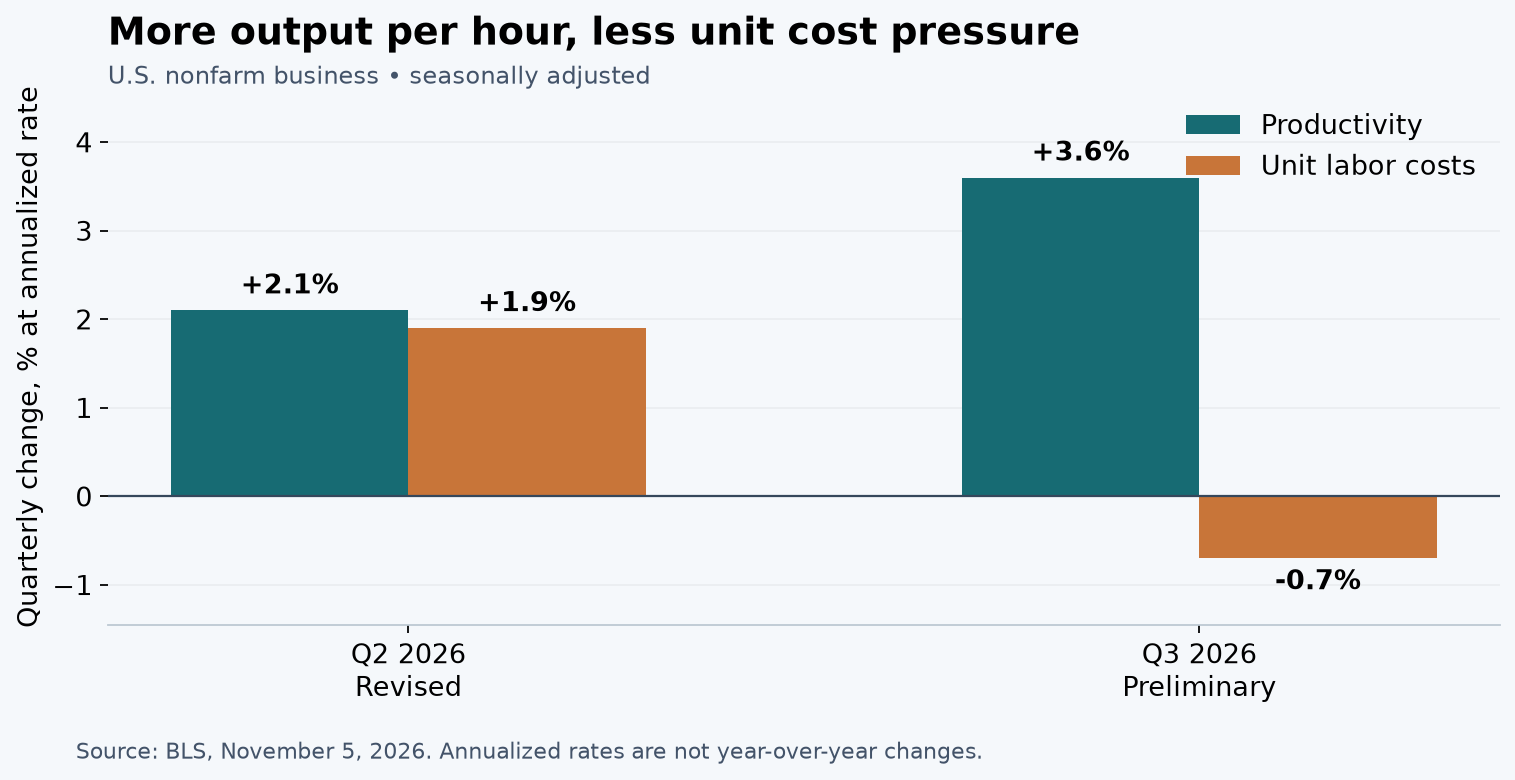
Higher output per hour can help businesses meet demand without a matching increase in labor cost per unit. That is a constructive combination for margins and price pressure, but this preliminary quarterly report is not proof that inflation is solved—or that AI caused the improvement. Compared with a year earlier, productivity rose 2.1% and unit labor costs rose 2.4%. Those are separate comparisons, not the numbers in the chart.
Two healthcare earnings updates worth reading past the headline
Oscar Health (NYSE: OSCR) reported third-quarter results at 6 a.m. Eastern. Revenue was $5.139 billion versus $2.986 billion a year earlier, and diluted earnings were $0.49 per share versus a $0.53 loss. Revenue included a $250 million benefit from updated risk-adjustment estimates—an accounting detail that belongs beside the growth number, not buried below it.
Oscar raised its full-year earnings-from-operations outlook to $850 million–$950 million from $600 million–$800 million. It also raised its revenue outlook to $19.0 billion–$19.3 billion from $18.7 billion–$19.0 billion. Those are company forecasts; operating earnings are not the same measure as diluted EPS.
STERIS (NYSE: STE) disclosed its fiscal 2027 second-quarter results in a release furnished with an SEC filing accepted Wednesday evening. Revenue rose 8.8% to $1.589 billion, with GAAP diluted EPS of $2.19 versus $1.94. Adjusted diluted EPS, a non-GAAP measure, rose to $2.94 from $2.47.
STERIS raised its full-year adjusted EPS outlook to $11.35–$11.55 from $11.10–$11.30, while keeping its reported revenue-growth forecast at 7%–8%. The revised EPS forecast includes about $0.18 per share in tariff refunds received year to date. A higher profit outlook with unchanged sales-growth guidance deserves that distinction. Its earnings call is scheduled for 9 a.m. Eastern.
The calendar: what has happened, what comes next
| Eastern time | Event | Status at cutoff |
|---|---|---|
| Today, 8:30 a.m. | Weekly jobless claims; preliminary Q3 productivity and costs | Released; actual results above |
| Today, 9 a.m. | STERIS earnings call | Upcoming; no call comments included |
| Today, 9:30 a.m. | U.S. stock-market opening bell | Scheduled normal session |
| Tomorrow, 8:30 a.m. | October U.S. employment report | Upcoming; no result or consensus asserted |
The BLS release calendar places the employment report on Friday, November 6. The NYSE calendar supports today’s normal session. This is a selected calendar, not every event scheduled today.
Into the open: watch the response, not just the release
The next useful evidence is how stocks and rates respond after the 8:30 data, and whether strength extends beyond yesterday’s leaders. Earlier futures cannot answer that. In company earnings, separate the underlying business from estimate changes and refunds before treating a higher outlook as a clean acceleration. Friday’s jobs report is still ahead; Thursday’s numbers offer clues, not its conclusion.
Sources and timing: Original DOL and BLS releases, the issuer disclosures linked above and the linked market/calendar sources were checked during the 8:30–8:40 a.m. research window. STERIS’ SEC acceptance was November 4 at 4:38:50 p.m. Eastern; that is a filing clock, not a verified press-wire release clock. Oscar’s quarter and STERIS’ fiscal quarter both ended September 30. Monetary figures are U.S. dollars; billions are rounded from the financial tables. Company disclosures establish attributed results and forecasts, not independent proof of every company claim. No consensus beat/miss, current stock reaction or clinical outcome is asserted. Market levels are narrow factual context, not a synchronized live feed. This brief prioritizes verified developments and does not claim to capture every overnight story or release.