Morning Brief: November 16, 2026 — New York factory growth slows
New York manufacturing growth slowed in November while hiring strengthened. Early tech futures fell, and Baidu and POET reported fresh AI-linked earnings.
MORNING BRIEF · Monday, November 16, 2026
Evidence cutoff: 8:40 a.m. Eastern. U.S. stocks are scheduled to trade from 9:30 a.m. to 4:00 p.m. Eastern today.
New York manufacturers reported slower growth in November, with the Empire State survey's headline index falling to 7.8 from 25.5 in October. Employment strengthened even as orders grew only slightly—a mixed reading arriving before a session that already had technology shares under pressure in early futures trading.
The morning's business question is equally mixed: AI demand is producing revenue, but the spending, delivery schedules and accounting behind that growth still deserve separate attention. Baidu and optical-engine supplier POET offer two fresh examples.
Overnight: keep the market clocks separate
At 6:56 a.m. Eastern, Reuters reported the following E-mini futures changes. These are an earlier premarket snapshot, not opening prices or an 8:40 a.m. quote.
| Futures contract | Change at 6:56 a.m. ET |
|---|---|
| Dow | +0.15% |
| S&P 500 | −0.35% |
| Nasdaq 100 | −0.95% |
Associated Press reporting independently described technology-led futures weakness. Its figures did not carry a matching observation time, so they are not combined with the Reuters snapshot.
For the previous regular session, Friday, November 13, the S&P 500 closed at 7,561.67, down 0.4%; the Dow finished at 52,347.55, up 0.1%; and the Nasdaq Composite ended at 25,136.27, down 0.9%. The Nasdaq Composite cash index and Nasdaq 100 futures are different instruments.
The lead: slower activity, stronger hiring
The New York Fed's November report showed new orders at 3.0 and shipments at 8.8. Positive readings indicate more respondents reporting increases than decreases; these are survey indexes, not percentage growth rates.
The employment index reached 18.1, its highest since June 2022, while the average workweek index rose to 13.5. Input and selling prices continued to increase, although the survey described a slower pace than in October. The prices-paid index was 45.9 and prices received was 27.2.
TrendyVest's reading: softer growth does not automatically mean shrinking factories or disappearing price pressure. This report combines modest expansion with stronger labor demand. It covers New York manufacturers, with responses collected November 2–9, so it should not be treated as a nationwide output estimate or a real-time reaction to today's markets.
Baidu: cloud growth meets the advertising decline
Baidu's third-quarter release reported revenue of RMB30.807 billion, down about 1% year over year. AI Cloud Infra revenue rose 94% to RMB8.2 billion, while online marketing fell 22% to RMB11.9 billion. The company trades on Nasdaq as BIDU.
Consolidated operating cash flow was RMB2.778 billion against RMB7.349 billion of capital spending. That leaves a RMB4.571 billion deficit under Baidu's non-GAAP free-cash-flow definition. The fast-growing cloud business is meaningful, but the consolidated cash figures do not establish cloud-specific profitability. Management's AI revenue categories also come from unaudited internal accounts.
POET: record revenue, with delivery still ahead
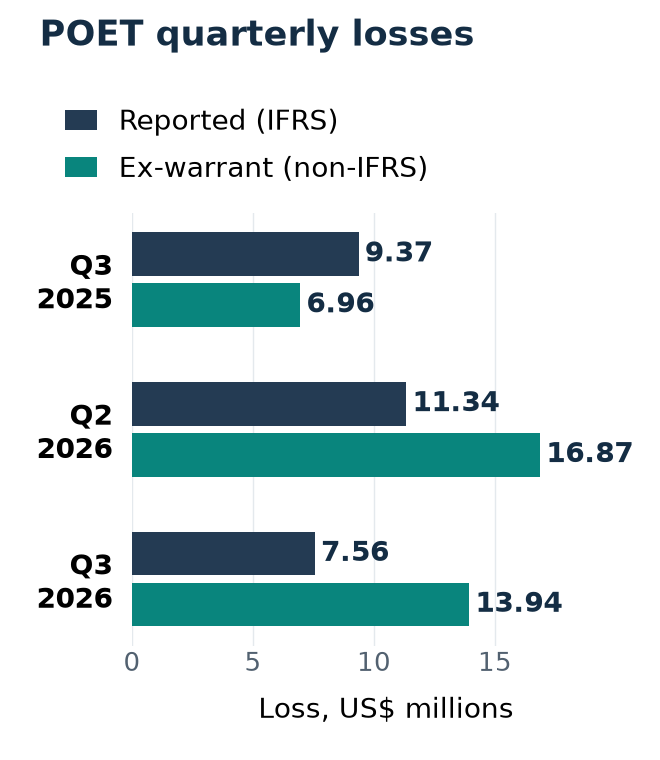
POET Technologies, Nasdaq: POET, reported third-quarter revenue of $1.026 million, up 244% year over year. Its IFRS net loss narrowed to $7.561 million from $9.370 million, helped by a noncash warrant-valuation gain.
Removing that warrant effect reverses the annual direction: the company's non-IFRS loss was $13.939 million, versus $6.955 million a year earlier. It did improve from $16.870 million in the June quarter. That adjusted loss retains other noncash charges; it is not cash burn.
Operating cash use was $12.7 million, and cash plus short-term investments totaled $774.3 million. Management expects its backlog, including 30,000 engines originally targeted for 2026, to ship by the second quarter of 2027. That remains a delivery forecast. Funding the production buildout and proving accepted shipments are different milestones.
Today's calendar
- 8:30 a.m. scheduled release: Empire State Manufacturing Survey, now verified above.
- 9:30 a.m.: Scheduled U.S. equity open; regular close at 4:00 p.m., per the NYSE calendar.
- 11:00 a.m.: New York Fed SCE Credit Access Survey, according to its release calendar.
- Noon: Federal Reserve Chair Kevin Warsh's opening remarks at the Productivity and Jobs Task Force Conference, listed on the Fed's November calendar. Remarks were still forthcoming at this edition's cutoff.
Into the open: ask what has become cash or delivery
The regional factory survey gives investors a reason to separate slower expansion from outright contraction. The company releases make a parallel demand: separate revenue from cash generation, and funded capacity from finished deliveries. Those distinctions matter more than treating every AI headline as the same trade.
Source notes: Company financial figures above are unaudited and refer to the quarter ended September 30, 2026. Baidu amounts are in renminbi; POET amounts are in U.S. dollars. Baidu's release was timestamped 4:00 a.m. Eastern. POET's release date is known to the day; its exact original posting time was not independently established. The chart is an original TrendyVest calculation from POET's financial reconciliation. This is a selected morning briefing, not an exhaustive news or earnings census.