Who Can Afford To Own The Future.......
Lam Research posted its best operating margin ever but lost 12% in a day. Meta, TSMC, Micron, and Bloom were all sold off at record levels. The AI trade has stopped asking who has exposure and started asking who has cash.
On Wednesday evening, October 21, Lam Research reported its best quarter ever. Revenue of $8.22 billion, up 54 percent. An operating margin above 40 percent for the first time since the company was founded. A December guide of $8.6 billion (Lam 8-K, October 21). Then the chief financial officer, Doug Bettinger, said one sentence: "This revenue guide would have been a bit higher if not for some near-term supply chain constraints that we are actively managing." The chief executive, Tim Archer, added that clean room space and component shortages would continue to limit chipmakers "as we move into calendar year 2027" (call transcript).
On Thursday, the stock fell 11.76 percent. The Philadelphia Semiconductor Index lost 6.72 percent, its worst day since June. AMD fell 8 percent, Intel 8, Marvell nearly 9, Nvidia 4.4. The Nasdaq dropped 2.6 percent, its steepest fall since early June, and Meta, which had reported a record of its own the night before, lost 7 percent in the same session (Reuters via Investing.com; CappNotes closing look).
On the sidelines of GTC Berlin that Thursday, Jensen Huang told CNBC that demand from the neoclouds was "off the charts." Then he said the sentence that explains the month: "what is missing in the middle is the working capital to fuel that growth, to fund that growth" (CNBC, via Briefs).
Demand is not the question anymore. Money is.
For three years the AI trade asked one thing of a company: do you have exposure. It was a forgiving question. If you made chips, rented compute, poured concrete, pulled fiber, or generated electricity, you went up, because the story was the same for everyone. Demand acceleration. Capacity constrained. Backlog growing. The market has started asking a harder question, and October's record quarters are the evidence. Jabil, Micron, TSMC, Meta, Lam, Bloom. Every one of them beat. Every one of them fell.
The new question has three parts. Who is making money? Who is paying for their growth out of their own pocket? And who is paying for it with somebody else's.
The credit market got there first. The Financial Times, citing Morgan Stanley data, reported that weekly trading in credit default swaps on seven AI-linked companies, Oracle, SpaceX, Alphabet, Amazon, Meta, Broadcom and Nvidia, averaged more than $9 billion a week in September, up from under $2 billion a week in July. Oracle's five-year protection reached 322 basis points on October 19 by the FT's count, more than double where it started the year, and CoreWeave's traded near 1,090 (Hedgeweek on the FT report), after an intraday record of 1,194.5 on October 15 in ICE's data (The Next Web). Insuring $10 million of CoreWeave debt now costs $1.82 million upfront and $125,000 a quarter. Swaps are not bankruptcy forecasts; they carry hedging, new issuance, and thin liquidity. But the stock market spent three years celebrating how much capital these companies would deploy. The credit market has started asking how much they can afford to.
So, take the three questions in order.
Who is growing? Everyone, still. Nvidia's July quarter did $96.2 billion, up 106 percent, with data center at $89 billion and a 75 percent gross margin and guided $108 billion for the quarter now closing (Nvidia). Broadcom grew 86 percent to $29.6 billion with AI chip revenue up 221 percent to $16.7 billion (Broadcom). TSMC reported $46.7 billion, up 41%, at a 66.4% gross margin, and guided fourth-quarter revenue to 58% above last year (TSMC). Micron did $54.2 billion at an 87% gross margin (Micron 8-K). Oracle's cloud infrastructure grew 121%, and its contracted backlog reached $664 billion (Oracle). CoreWeave more than doubled. Nebius grew 454 percent. Bloom grew 138 percent. Growth is the entry fee. It no longer distinguishes anyone.
Who has cash? A much shorter list, and it is the list of companies that were not sold for long.
Nvidia generated $21.3 billion of free cash flow in the quarter and $69.9 billion in six months, held $56.6 billion of cash and marketable debt securities, and returned about $26 billion to shareholders in ninety-one days. It issued $25 billion in notes in the quarter, so it is not debt-free; it is borrowing from a position of overwhelming strength, which is different (Nvidia CFO commentary). Broadcom converted 46 percent of revenue into free cash flow, $13.7 billion, on $532 million of capital spending, which is the dream: a business that grows at 86 percent without pouring concrete. TSMC generated NT$920 billion in operating cash against NT$443 billion in capital spending, covering the largest buildout in semiconductor history twice over from its own till (TSMC management report). Microsoft produced $19.6 billion in free cash flow in its June quarter, down about 23 percent from a year earlier, by the desk's arithmetic on its two 8-Ks, on $155.2 billion in operating income for the fiscal year (Microsoft 8-K).
Then the list ends, and the hyperscalers begin.
Since Meta's record quarter came with $34.91 billion of capital spending against $32.79 billion of operating cash flow, free cash flow was negative $2.12 billion, the first negative quarter since 2012, the year it went public, and the 2026 capital guide was narrowed upward to $135 to $145 billion (Meta 8-K). Alphabet spent $44.9 billion in the June quarter against $39.1 billion of operating cash, negative $5.9 billion, and guided $195 to $205 billion for the year with capital spending "to increase significantly in 2027" (Alphabet exhibit 99.1; call highlights). Amazon's trailing free cash flow is negative $7.6 billion, yet it will spend about $220 billion in a year (Amazon). Reuters puts the hyperscalers' 2026 capital spending at around $800 billion (Reuters, October 23). Three of the four largest buyers of AI infrastructure now consume more cash than they produce.
Which brings up the third question, the one nobody was asking in June. How are they paying for it?
With paper.
Alphabet's balance sheet shows $242.5 billion of cash and marketable securities, a number that reads as invincibility until you find the line beneath it: in June the company "issued a combination of Class A stock and Class C stock and mandatory convertible preferred stock for aggregate net proceeds of $49.6 billion," alongside $20.3 billion of new notes, and set up a $40 billion at-the-market program it had not used as of June 30 (Alphabet exhibit 99.1). The most profitable advertising business on earth sold stock to pay for compute. Meta, on the day it reported, approved a new class of publicly listed non-voting shares; its special committee wrote that debt "of the magnitude that Company management was considering could have an adverse effect on the Company's credit ratings and would be a less attractive alternative," and that Mark Zuckerberg "would not support a significant equity financing that would have the effect of reducing his voting power" (Meta PRE 14C). So it built a share it can sell without giving up a vote. Oracle sold $20 billion of common stock through an at-the-market program in the quarter to August 31, a quarter in which it spent $28.5 billion on capital, ran free cash flow of negative $5.4 billion on top of negative $23.7 billion for the prior fiscal year, and carried $125.3 billion of borrowings (Oracle). Nebius raised $2.85 billion by selling shares and $2.0 billion in prefunded warrants in the first half, plus $4.3 billion in convertible notes, to fund $8.1 billion in capital spending against $981 million in revenue (Nebius 6-K).
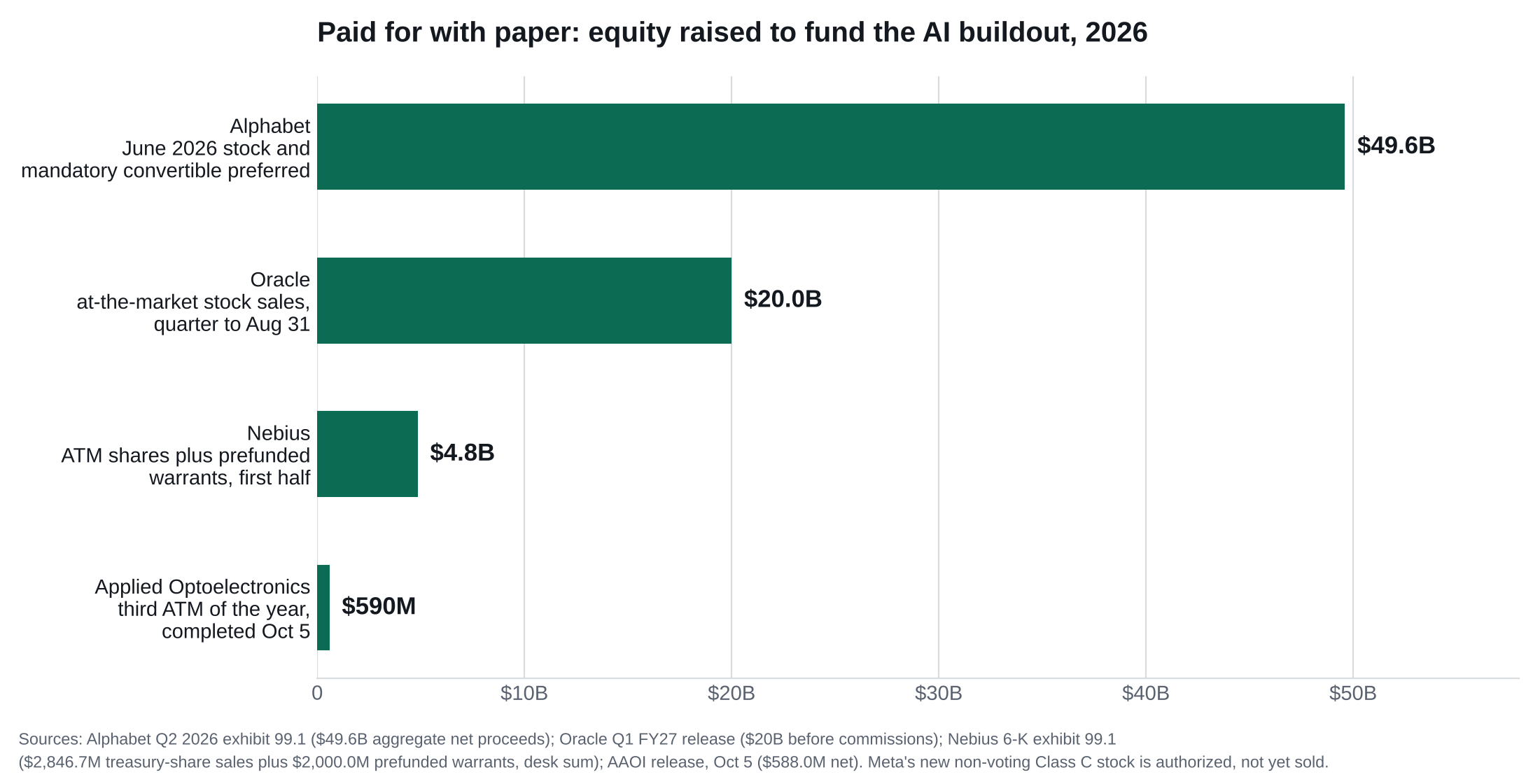
At the small end, Applied Optoelectronics completed its third at-the-market offering of the year on October 5, selling 5.69 million shares at an average price of $105.36 for $588 million net (AAOI). The stock closed at $130.16 the next day and $67.51 on Friday, down 48 percent by the desk's arithmetic and far below what the buyers in that offering paid (stockanalysis.com). Coherent fell 9.63 percent and Lumentum 5.62 percent on October 8 in the same wave, with no company-specific news, just profit-taking and rising yields (24/7 Wall St). They are bigger and better run. The market didn't stop to sort them out first. That is what selectivity feels like in real time.
CoreWeave is where all three questions meet. Second-quarter revenue of $2.58 billion, more than double. Adjusted EBITDA of $1.51 billion, a 59 percent margin. A net loss of $626 million, because interest expense was $640 million, a quarter of revenue by the desk's arithmetic. Capital spending of $6.4 billion in ninety days. Debt of $35.1 billion plus $16.3 billion in operating lease obligations, against $5.5 billion in cash, and a $104 billion backlog that must be built before it can be billed (CoreWeave 10-Q; Q2 release). It builds most data centers with someone else's money, and in October the cost of that money rose to 16 percent. That is the difference between operating momentum and financial freedom.
Bloom Energy is the same story at one-tenth the scale. Revenue up 138 percent to $1.24 billion, a third guidance raise this year to $4.4 to $4.6 billion, operating income in one quarter larger than all of last year's by the chief financial officer's own comparison (Investing.com), and free cash flow of negative $181 million by the desk's arithmetic from an operating outflow of $27 million and $153 million of capital spending (Bloom 8-K). The stock lost 19 percent in two sessions, closing Friday at $193.30 (stockanalysis.com). It did not fall because the business shrank. It fell because the business grew faster than it could pay for itself, in the month that stopped being free.
Tesla, of all companies, showed what the market now rewards. It cut its 2026 capital guide to about $20 billion from more than $25 billion and produced $1.53 billion of free cash flow when Reuters had the Street expecting a $4.92 billion burn (Tesla 8-K; Reuters via Investing.com). Reuters also noted that "preserving cash at the expense of investment" could undermine the growth story investors are paying for. Both things are true. That is the new tension, and every AI buyer will be asked to resolve it.
Nick Giorgi, chief equity strategist at Alpine Macro, put it to Reuters this way: "The market's just not giving the benefit of the doubt to companies that are spending a ton of money on building this all out, which to us is actually very healthy, but still does augur for some short-term pain" (Reuters, October 23).
The divide that is opening is not between AI winners and AI losers. It is between companies with the financial room to make a mistake and companies that can scarcely afford one. A delayed gas pipeline, an under-used data center, a refinancing window that closes for a quarter: a company with $70 billion of half-year free cash flow absorbs those. A company paying 16 percent does not. None of this says the revolution is ending. The internet transformed the economy without making every internet company a good investment, and artificial intelligence will do the same, rewarding the companies that turn an enormous technological opportunity into cash rather than into commitments.
Wednesday is the test. The Fed decides at 2pm with markets pricing a hold at about 91 percent (TradingEconomics). Microsoft and Alphabet report after the close the same day; Amazon and Intel follow Thursday (StockTitan). All four will post revenue growth that would have been cheered in June. The grade will be on three lines nobody used to read: operating cash flow versus capital spending, next year's capital guide, and how the gap between them is funded.
The first phase of the AI trade rewarded companies for joining the revolution. The next will reward those who can pay for it. Growth still matters. It just must come with a receipt.
The market is no longer asking who can build the future. It is asking who can afford to own it.
Registration is open at Tournament.Trendyvest.com for the Trendyvest Championship: 500 seats, a $100,000 simulated stake, free to enter. Trading began October 1 at the market open.
Trendyvest publishes research, not investment advice. Every figure above carries its source; prices carry the session they were observed in.