THE WHISPER
The Whisper 09
Taipei Raised TSMC’s 2nm Number by a Third, and That Is the Version America Printed
Monday, September 28, 2026 · 12:30 p.m. · No. 9 · Corroborated, lag closed
The feature
On 14 September, a Taiwanese business daily put a number on how much two-nanometre capacity Taiwan Semiconductor Manufacturing Company would have at the end of this year. This register has carried that number since, as rumor number 6, and re-checked it on five separate mornings without finding a document behind it or a mainstream American outlet in front of it. Over the weekend the same newspaper published a different number for the same thing, a third larger, and within nine hours an American financial site had the bigger one in a headline.
That is the whole of today's piece, and it is worth more than it sounds. The claim did not get confirmed. Its own source revised it, and the revision traveled overnight what the original could not in nine trading days.
Here is the trail.
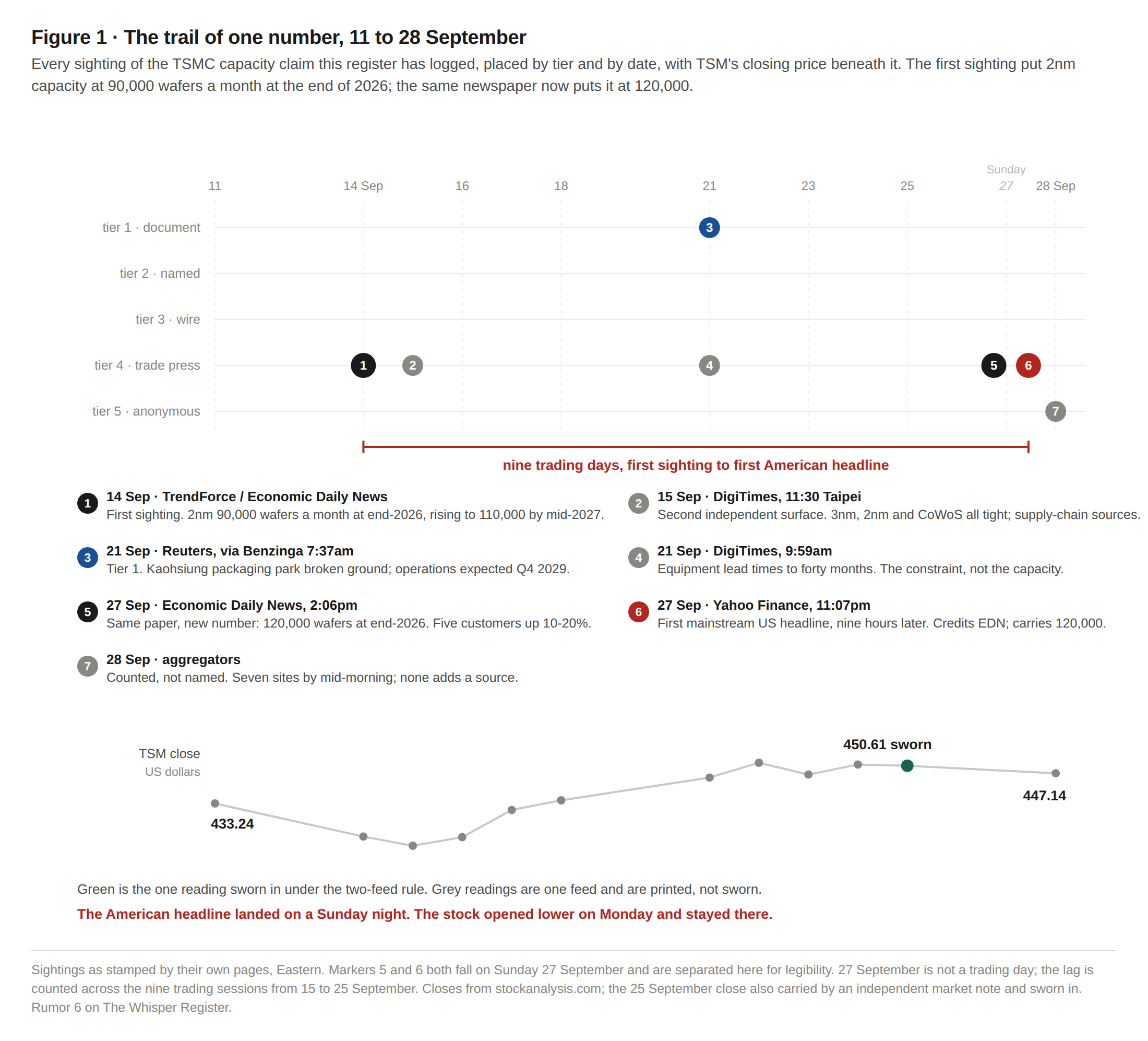
The first sighting is 14 September, tier 4: TrendForce, citing Taiwan's Economic Daily News. Three legs to it. Two-nanometre capacity rising from 90,000 wafers a month at the end of 2026 to 110,000 by mid-2027; three-nanometre from more than 180,000 to 210,000; CoWoS advanced packaging from roughly 130,000 a month to 260,000 by the end of 2028. TSMC has published none of those figures. On this desk's arithmetic from the published numbers, that is a 22 percent lift at 2nm, 17 percent at 3nm and a doubling of CoWoS.
15 September, 11:30 a.m. by its own Taipei stamp, tier 4: DigiTimes, the second independent source that carried the claim over this desk's floor. Its item did not cite the Seoul or Taipei reporting and named no source beyond the supply chain. It said 3nm, 2nm, and CoWoS were all tight through the third quarter.
21 September, 7:37 a.m., tier 1 and the only document-grade item in the trail: ground broken on an advanced-packaging industrial park at Kaohsiung anchored by TSMC, reported by Reuters under a Taipei dateline and carried by Benzinga at that minute. Operations expected in the fourth quarter of 2029 — a year past the end of the claim's window, and evidence about direction rather than about any of the claim's numbers.
Then nine trading days of nothing. The desk checked on the 22nd, the 23rd, the 24th and the 25th against TrendForce's own current news file; its items those days ran to DRAM spot prices, LPDDR6 validation, glass substrates, a NAND patent ruling, Chinese memory capacity and twelve-inch wafer contract pricing. Not one touched the capacity figures.
27 September, 2:06 p.m. Eastern — 28 September, 2:06 a.m. in Taipei — tier 4. The Economic Daily News itself, byline Yin Hui-chung (尹慧中), under the headline 大廠追加訂單 台積電2奈米擴產進度超前 年底月產能上看12萬片: major customers have added orders, TSMC's 2nm expansion is running ahead of schedule, year-end monthly capacity is looking at 120,000 wafers. The piece says the market had originally expected about 90,000 to 100,000 at year-end, and the target is now a sprint to 120,000. It names five customers raising 2nm-family orders by 10 to 20 percent — Apple, Nvidia, AMD, Qualcomm and MediaTek — and puts 3nm at close to 180,000 a month in the fourth quarter of this year, heading for 200,000 to 210,000 next. Its sourcing language is 業界傳出 and 消息人士透露: the industry says, sources disclose—no firm named, no person named, no document.
27 September, 11:07 p.m. Eastern, tier 4 by source and the first mainstream American headline this claim has reached: Investing.com's report, carried on Yahoo Finance's technology pages under the byline Ayushman Ojha — "TSMC 2nm wafer capacity to exceed earlier estimates, EDN reports." It credits EDN by name, carries the 120,000 against prior forecasts of 90,000 to 100,000, carries the 10-to-20-percent order increase, and adds the one named voice anywhere in the trail: TSMC senior vice-president Hou Yung-ching, on first-year 2nm output running 45 percent above 3nm's first year in 2023, with capacity compounding at about 70 percent a year through 2028. Those remarks are the company's, and they are about growth rates, not about the 120,000.
I want to be exact about what that last line does and does not do. This desk tiers a sighting by source and marks the lag by where a claim reached. They are different fields, and this one splits them: a relay of a Taipei trade paper is not wire-grade reporting, but Yahoo Finance is one of the American outlets this desk uses to mark the end of a lag, and the claim is now in front of American readers. The lag closes there — on the 2nm leg. The 3nm figures have traveled with it. The CoWoS leg still has no American headline at all, and it has the biggest number in it.
By Monday morning the aggregator layer had done its usual work. TipRanks, GuruFocus by way of TradingView, CoinCentral, Blockonomi, KuCoin, Parameter and EconoTimes all carried the 120,000 within hours; every one credits EDN and none adds a source. Invezz, at 12:10 a.m. Eastern, is the exception worth reading, because it goes past the capacity number to the argument underneath it: TechInsights vice-chair Dan Hutcheson on more than fifteen customers working on N2, and Stifel's Sahej Singh keeping a Buy and a $515 target while making the case that the question has moved from demand to margins. Invezz's own headline reads that the stock slipped.
The market's testimony. It is thin, and what there is of it points the other way. TSM closed Friday at 450.61, sworn — stockanalysis.com's daily table and a separate market note headlined "TSMC stock at USD 450.61 on September 25, 2026" carry it identically. Thursday's 451.15 on stockanalysis.com reconciles against a second note describing a 0.12 percent loss into the next session: 451.15 less 450.61 is 0.54, and 0.54 divided by 451.15 is 0.12 percent, this desk's arithmetic. The base is softer. The 11 September close of 433.24, the session before the first sighting, and the 14 September close of 418.01 are one feed only and are printed, not sworn. From that unsworn base to Friday's sworn close, the move is +17.37, +4.01 percent, 17.37 divided by 433.24, and the desk attributes none of it: two weeks of a semiconductor tape that has run for everyone.
This morning, one feed and unsworn: 447.14, down 3.47, minus 0.77 percent, previous close 450.61, open 448.39, range 443.11 to 449.60, volume 3,084,181, Yahoo Finance at 11:41:27 a.m. Eastern. A report that five of the world's largest customers raised their orders by up to a fifth landed before the open, and the stock opened lower and stayed there. No options print, no volume anomaly, and no prediction-market contract on any of it was found.
The highest tier reached is 1, and it belongs to a groundbreaking in Kaohsiung for a facility due in 2029. Every number in the claim itself sits at tier 4. Status: corroborated, unchanged. A revision is a sighting, not a document.
What would confirm it, named as documents: TSMC's September monthly revenue release, Thursday 8 October, 13:30 Taipei, per the company's own financial calendar; its third-quarter results and call in October, where capacity and capital expenditure are stated by the company rather than about it; the monthly releases on the tenth of each month thereafter. What would kill it: TSMC guiding year-end 2nm capacity materially below 120,000, or the October call leaving the earlier 90,000 standing.
One more thing about the two numbers, because it is the part a reader can check. This register carried 90,000 for nine trading days as the end-2026 figure. The paper that published it now writes that 90,000 to 100,000 was what the market had expected and 120,000 is where it is going. Both sentences are that paper's. Neither is TSMC's. What moved in thirteen days was not capacity; it was an estimate of capacity, and the estimate moved 33 percent.
Also in motion
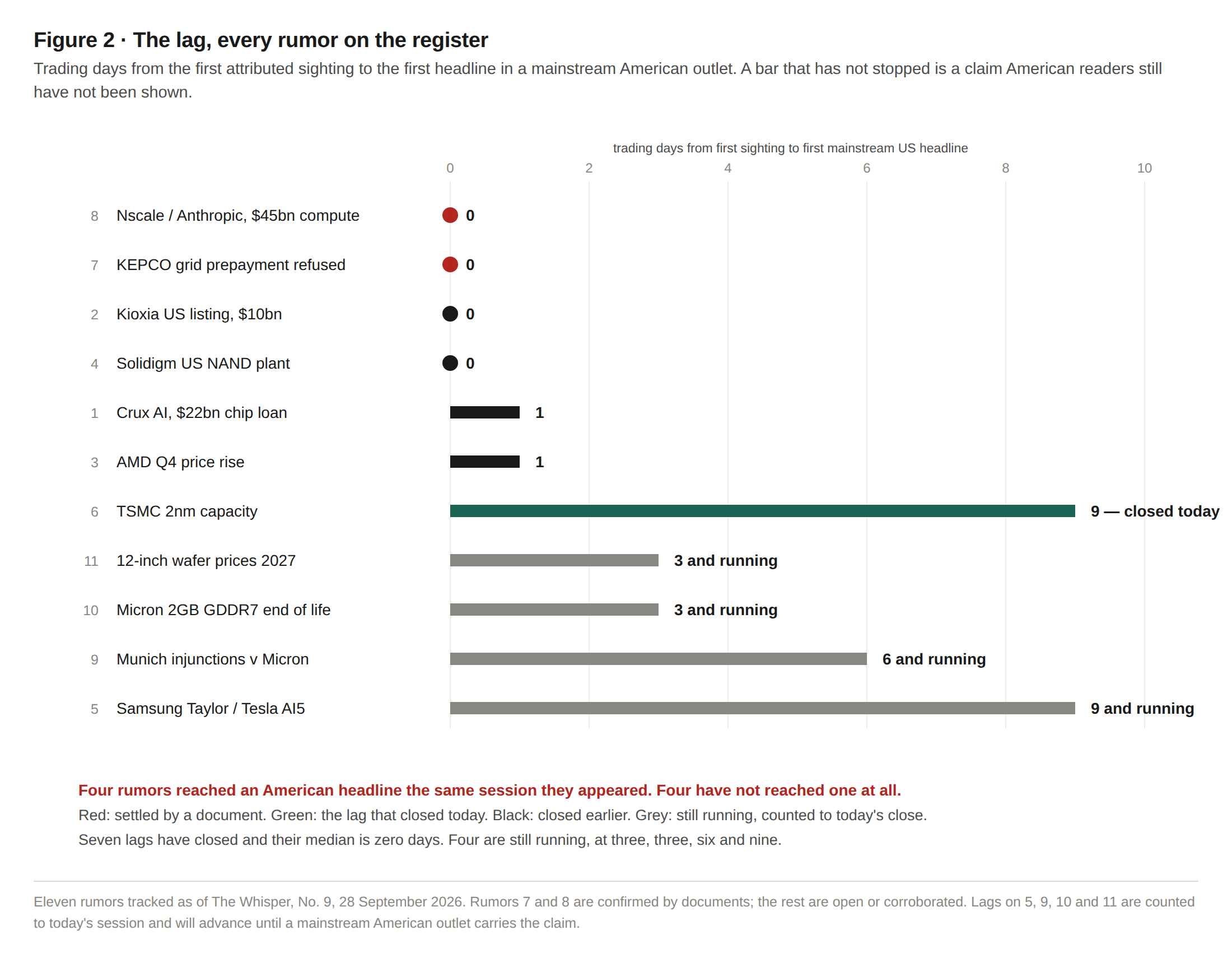
Twelve-inch wafer contract prices for 2027 — rumor 11, corroborated, first seen 23 September. The Commercial Times of Taipei's claim of 15 to 25 percent on epitaxial wafers and above 40 percent on polished stands where it stood, carried furthest into American publishing by Wccftech and TrendForce. Lag: 3 trading days and running. Recorded beside it today, and not as evidence for it: on 24 September DigiTimes reported that TSMC will raise its own wafer foundry prices by 3 to 6 percent from January 2027, with order visibility out to 2030, a claim relayed the same morning at 9:02 Taipei by the Economic Daily News and carried in American markets coverage by Benzinga. One origin, several relays, no document, no second source — it does not clear the floor and is counted below, not printed as a rumor. It is worth a reader's attention anyway, because 3 to 6 percent from a foundry and 40 percent on the silicon it buys are two claims about the same cost stack pointing in very different magnitudes.
Micron's 2-gigabyte GDDR7 parts — rumor 10, corroborated, first seen 23 September. Still no Micron notice, no product change notification, no distributor catalog mirroring the end-of-life flag with a last-time-buy date, and no Nvidia comment. Micron's own parts catalog, the document every report is reading, still requires an account and remains unreadable to this desk and any other reader outside the company. Lag: 3 trading days and running. The date that matters is Wednesday.
The Munich injunctions — rumor 9, corroborated, first seen 18 September. The specialist and enthusiast layer has widened again, with Guru3D and a forum write-up of Micron's appeal joining Electronics Weekly; both are downstream, and neither is an independent source. No judgment text, no ruling on a stay, no Micron 8-K and no verbatim company statement. Not Reuters, Bloomberg, CNBC, Yahoo Finance, MarketWatch, or Barron's. Lag: 6 trading days and running. Micron's fiscal fourth-quarter results on Wednesday, 30 September, are the first occasion when someone will be in a position to ask.
Samsung's Taylor fab and Tesla's AI5 — rumor 5, corroborated, first seen 15 September. Re-checked today against CNBC, Yahoo Finance, MarketWatch, Barron's, Reuters and Bloomberg. None carries the September wafer-start claim. Electrek's 13 July tape-out piece remains the nearest American surface, and it makes a different claim. The enthusiast layer still treats the trial start as settled fact. Lag: 9 trading days and running — the longest open count on this register.
Also re-checked and unchanged: the Crux AI facility (rumor 1) — eight sessions after Bloomberg's report, no closing release, no rating, no offering document, no named bank either way, and no filing naming Crux AI on a domain-restricted search of sec.gov; Kioxia's American listing (rumor 2) — no Form F-1, no exchange application, no company item since the 15 September notice; AMD's reported fourth-quarter price rise (rumor 3) — no AMD statement, no denial, no partner or OEM price list, on the seventh session since the first attributed sighting; Solidigm's American NAND plant (rumor 4) — no Empire State Development award, no site or construction permit, no board resolution.
Resolved
Nothing. No rumor on this register reached a document, a denial, or an expiry between Friday's issue and this one. Rumors 7 and 8 were settled in earlier issues and stay on the page with their trails. The closest thing to a settlement today is a revision that isn't one.
Seen, not printed
Below the floor and counted, with no names and no claims: three trade-press items resting on a single origin with no independent second surface and no market signal, two of them about pricing and one about a console memory order; one wire-grade siting report that this desk could not open to establish whether it rests on an on-the-record executive statement or on unnamed sources, and which in any case describes a plan a company discussed at the opening of its own plant, which is news rather than a whisper; one claim whose subjects are private with no listed security anywhere in the trail. Aggregator and social repetitions of claims already on this register ran to more than twenty across the morning's reading; not one was independent, and none is named here.
What would settle it?
Wednesday 30 September: Micron's fiscal fourth-quarter results and call, which sit in front of two open rumors on this register — the German injunctions, where a legal-proceedings note or an 8-K would fix the exposure, and the GDDR7 end-of-life, where a deliberate shift of graphics memory toward higher-density parts belongs in the commentary on mix. Thursday 8 October, 13:30 Taipei: TSMC's September monthly revenue. The tenth of October: GlobalWafers' monthly revenue, the customer-side test of the wafer-price claim. Late October: TSMC's, Samsung's, GlobalWafers', SUMCO's and Shin-Etsu's quarterly results, in that order of relevance to what is open here. Tuesday 3 November: AMD's third quarter, where a ten percent price rise would reach the gross-margin line. This is a line of inquiry and not a prediction; the desk will report what the documents say when they exist.
Sources and data notes
Sightings, in the order they appear. TrendForce, citing Economic Daily News, 14 September, the capacity figures. DigiTimes, 15 September 11:30 by its own Taipei stamp. Reuters via Benzinga, 21 September 7:37 a.m. Eastern, the Kaohsiung groundbreaking. Economic Daily News (money.udn.com), page stamp 28 September 02:06 Taipei, equal to 27 September 2:06 p.m. Eastern, byline Yin Hui-chung; read in the original Chinese by this desk. Investing.com via Yahoo Finance, 27 September 11:07 p.m. Eastern, Ayushman Ojha. Invezz, 28 September 12:10 a.m. Eastern. TipRanks, updated 28 September, Kirti Tak. CoinCentral, 28 September 08:36:54 UTC. All other relays counted by category and not named.
Prices. TSM 25 September close 450.61, sourced from stockanalysis.com's daily table and an independent market note carrying the same figure for the same date. TSM 24 September close 451.15, stockanalysis.com, reconciled against a second note describing a 0.12 percent loss into the following session. TSM 11 September close 433.24 and 14 September close 418.01, stockanalysis.com only, printed and not sworn. Today's reading 447.14, minus 3.47, minus 0.77 percent, previous close 450.61, open 448.39, range 443.11 to 449.60, volume 3,084,181, Yahoo Finance at 11:41:27 a.m. Eastern, one feed and unsworn. Desk observations today were stamped between 11:10 a.m. and 12:20 p.m. Eastern.
Desk arithmetic, inputs shown. 450.61 minus 433.24 = 17.37; 17.37 divided by 433.24 = 4.01 percent. 451.15 minus 450.61 = 0.54; 0.54 divided by 451.15 = 0.12 percent. 120,000 divided by 90,000 = 1.333, a 33 percent revision; against the top of the paper's own prior range, 120,000 divided by 100,000 = 1.20. Lag on rumor 6: first sighting Monday 14 September, first mainstream American headline Sunday 27 September at 11:07 p.m. Eastern, after Friday's close and before Monday's open; the trading days between are 15, 16, 17, 18, 21, 22, 23, 24 and 25 September, which is nine.
The Whisper Register stood at eleven rumors tracked before this issue and stands at eleven after it: no new claim cleared the floor today, and rumor 6's lag is filled at nine trading days. Two confirmed, none denied, none expired, nine open, median lag of resolved rumors zero.
The Decoy Chronicle stood at 150 entries before this issue and stands at 151 after it. Entry 152 is a market piece published at 4:36 a.m. Eastern today headlined "TSMC (TSM) Stock Rises as Apple, Nvidia Order Surge Hits 20%," over a body stating that the stock "ticked lower by 0.12%" — the previous session's fall, printed under a headline saying the opposite, with the top of a 10-to-20-percent range taken into the headline as the figure. Headline against body, one page, two failures.
The Decoy Chronicle — every entry, dated and sourced — is published as a standing register and updated with each issue.
The TrendyVest Championship is open for registration at Tournament.Trendyvest.com — 500 seats, a $100,000 simulated stake, free to enter. Trading begins October 1 at the market open.
TrendyVest is an independent research practice. This is analysis and editorial opinion, not investment advice, and nothing here recommends that any particular person buy or sell any security. Figures identified as this desk's arithmetic are the practice's own, and the inputs are printed alongside them, and nothing here asserts that any rumor is true.