EDITORIAL · SATURDAY, NOVEMBER 7, 2026 · THE WEEK
The Market Asked AI For Its Cash Flow
A one-day relief rally gave way to the worst session since spring, and the reasons came in a rush: a blue sweep, a zoning board, a hedge fund, a valuation. All down to one question this desk has been asking all year, really: not whether people want AI, but whether the people paying for it will get the money back. The market didn't change its view on AI this week. It changed its view on the price.
Saturday, November 7, 2026 · Editorial · New York · Two figures
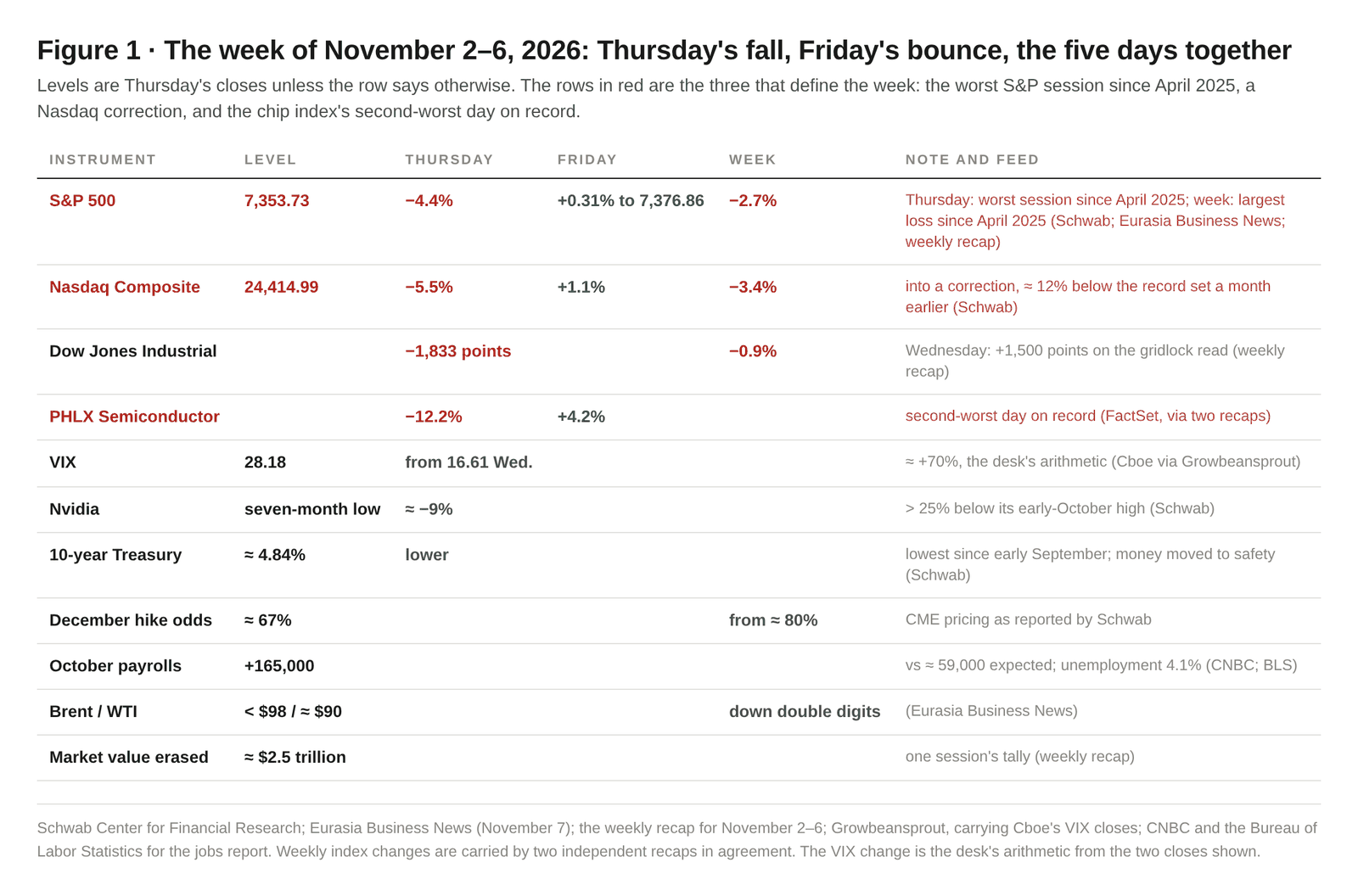
Thursday's session was a disaster for the major indices. The S&P 500 fell 4.4% to 7,353.73, its worst single-day drop since April 2025. The Nasdaq Composite fell 5.5% to 24,414.99 and was in correction territory (12% below the record it had set just a month earlier). The Dow was down 1,833 points. The Philadelphia Semiconductor Index fell 12.2% on the day, the second-worst day in its history. The VIX jumped from 16.61 on Wednesday to 28.18 on Thursday (Schwab; Eurasia Business News; chip index via FactSet, per two recaps; VIX via Cboe, per Growbeansprout).
Then on Friday, most of it stopped. S&P up 0.31% to 7,376.86, Nasdaq up 1.1%, the semiconductor index up 4.2% (Eurasia Business News). For the week the S&P was down 2.7% (its biggest weekly loss since April 2025), the Nasdaq down 3.4%, the Dow down 0.9%, two independent recaps in agreement (Eurasia Business News; weekly recap). A week that erased some $2.5 trillion of market value in a single session (weekly recap) is not a quiet week. But the shape of it, one horrific day with a rally and a bounce on either side, is the shape of a repricing rather than a rejection.
Nine explanations, four causes
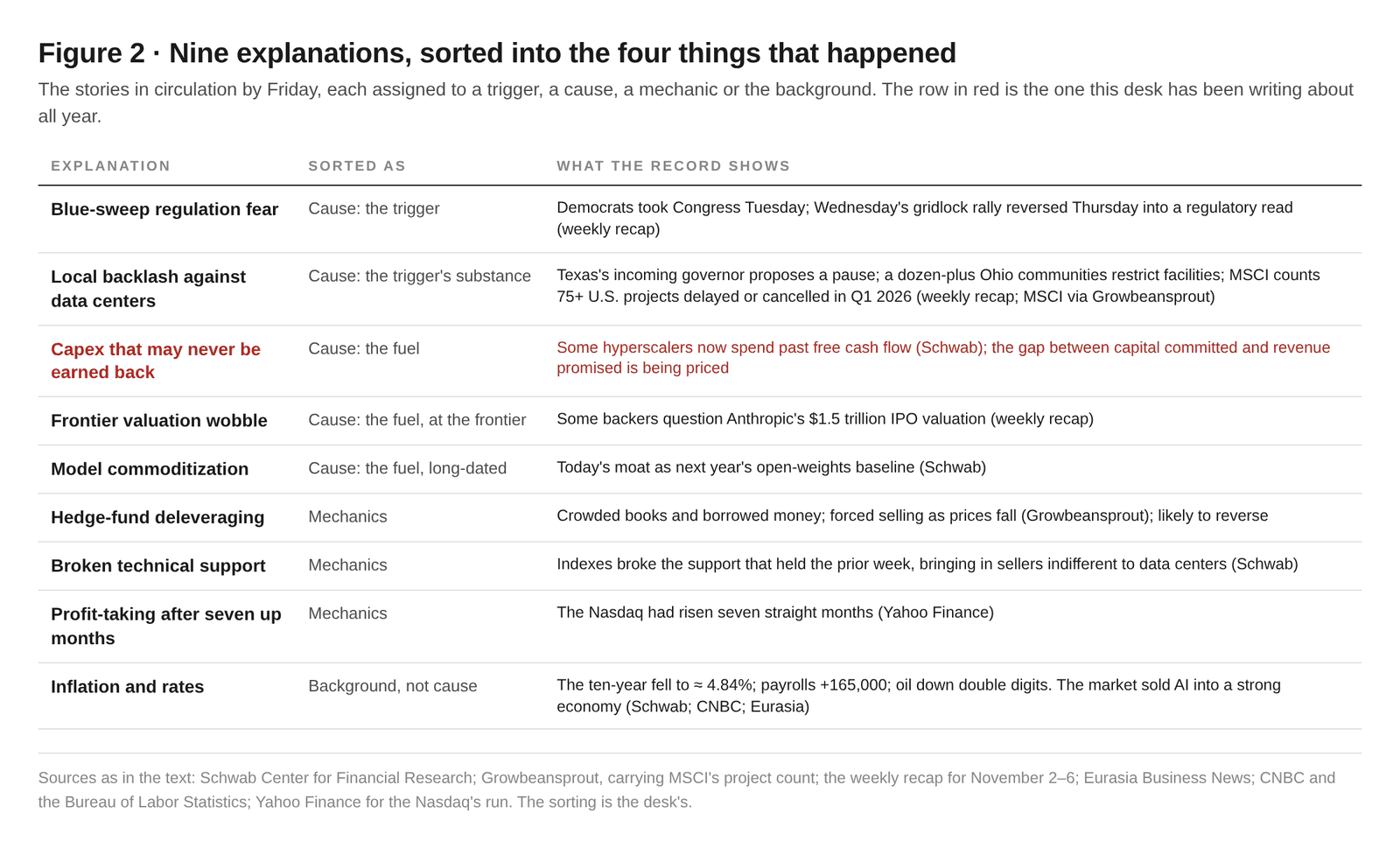
By Friday, the catalysts were stacked high enough to pick the one you liked. The desk counted at least nine in circulation. A blue-sweep regulation fear after Democrats took Congress against a Republican White House. A groundswell of anger at the data centers from Texas all the way down to small-town Ohio. Doubt that the capital spending behind the buildout will ever be recouped, with some hyperscalers now spending beyond their own cash flow. A frontier valuation wobble as backers questioned the price at which Anthropic would go public in its IPO. Fear that the models themselves would end up commoditized. Hedge fund deleveraging and forced selling. Broken technical support. Profit taking in the face of a Nasdaq that had been up for seven months straight (Yahoo Finance). All against a backdrop of still-elevated inflation and rates.
All nine are genuine. None of them on their own would move a market 5% in a session. What follows is the desk sorting them into the four things that actually occurred.
The rally that lasted one day
The sell-off has a very clean political trigger. The midterms on Tuesday saw Democrats take control of Congress against a Republican White House. On Wednesday the market interpreted that as gridlock (which it likes) and it surged, the Dow up over 1,500 points (weekly recap). By Thursday it had re-read that same outcome as a regulatory threat to the one trade which was propping up the index.
The details are very much local and are all on paper. The incoming Democratic governor of Texas has proposed a moratorium on new data center projects. Over a dozen Ohio communities have already voted to restrict or ban new facilities (weekly recap). This isn't some abstract notion. MSCI have counted at least 75 data center projects in the US that have been delayed or cancelled in the first quarter of 2026 alone, as many as in all of 2025 (MSCI via Growbeansprout). The complaint is simple: it's all about power, it's all about water, it's all about utility bills. A valuation can weather a bad quarter. It's much harder to weather a zoning board.
The question is older than the election
Here's where this desk diverges from the headline. Politics lit the fuse. The fuel had been in place since spring.
The AI trade is all about a bet: money put in now in the hope of a future return. For two years the market was quite happy to fund the promise. This week it's started to price the gap. The hyperscalers (Alphabet, Amazon, Meta and Microsoft) who are underwriting the buildout have got capital spending up to such a level that some of them are now running free cash flow negative (Schwab). That's the entire argument in one line. You can spend your way into a boom. You can't spend more than you earn indefinitely and then call it growth.
Same doubt at the frontier. Some of the people who are involved in Anthropic's IPO are reportedly questioning the $1.5trn valuation (weekly recap). Underneath it all is the fear that the models will end up being completely commoditized, that today's moat is tomorrow's open weights baseline (Schwab). Strip the week back to its bones, and every explanation leads to one fundamental question: not whether people want AI, but whether the people paying for it will actually get their money back. That's the entire beat of this desk, and it hasn't got any easier this week.
What was selling, and who had to
The third explanation is mechanical and that's the one most likely to reverse. The semiconductors were down. Nvidia was down 9% to a seven-month low (Schwab), over 25% below its early October high. Micron and AMD led the broader chip rout. When the biggest winners are down the most, it's almost always a positioning story rather than a fundamentals story: crowded books, borrowed money, and stop levels all in the same place. Reports of hedge funds cutting back on their AI exposure fueled fears of forced deleveraging (Growbeansprout) where falling prices trigger more selling. The indexes also broke support that had held the previous week (Schwab), bringing in sellers who care nothing about data centers.
I wouldn't overstate this at all. Deleveraging is very real and very loud, but it's a verdict on nothing other than how much of that borrowed money was on the same horse.
What did not break
It's worth naming what didn't cause this, as the absences point to what's coming.
Not a rates tantrum. The 10 year Treasury yield dropped to around 4.84% (its lowest since early September) as money flowed to safety (Schwab). Not a growth scare in the hard data either. Friday's October jobs report showed 165k payrolls added, against expectations of around 59k, nearly triple the forecast by the desk's own arithmetic, with unemployment down a tenth to 4.1% (CNBC; Bureau of Labor Statistics; Eurasia Business News). Not an energy shock at all. In fact energy eased, with Brent below $98 and WTI near $90, both down double digits on the week (Eurasia Business News).
That combination is the uncomfortable bit. A strong labor market keeps the Fed in the game: the chance of a December hike was still sitting at around 67% late in the week (down from about 80% before the rout) and very much not dead (Schwab). The market sold AI into a strong economy. It can't blame the economy.
What to watch
The watch list writes itself out of the causes.
Watch the capex not the keynotes. The question isn't whether demand exists anymore; it's how much of the announced pipeline turns into poured concrete (Growbeansprout). Delayed-project counts like MSCI's are the leading indicator, and they are already moving in the wrong direction.
Watch the hyperscalers' free cash flow. If Alphabet, Amazon, Meta, and Microsoft are still spending more than they earn, then what broke this week will break again (with or without a zoning board). It's going to be settled in the next round of segment disclosures, not on an earnings call.
Watch the quality of "AI revenue". The one to be distrusted is AI revenue which is simply existing revenue reclassified. An efficiency claim has to be in a margin line or it's just a slogan.
Watch the Fed on 8th and 9th December and the October inflation print that comes in prior to that. A rate hike into a correction is the sort of thing that makes a December memorable.
Watch the tape. The S&P may not find any real support until around 7,300 (Schwab), that being near the 200 day moving average. Friday's bounce did nothing, just one green day after a red one.
And watch the slow fuses: state and local data center rules, the final valuation on Anthropic's IPO, and oil (which never travels alone). Both Brent and WTI were down quite a bit this week, and a reversal there would put inflation back on the table as the Fed meets.
The bill, presented
The bill for the AI buildout is now being put forward. That was always going to happen; a wager will eventually settle. This week the market has moved from "what can AI do" to "what does it cost and who pays". That's a far better question to ask, even if it comes in at 5% in a day. The desk's job remains the same: somebody's published a number, here's where it has to show up, and here's whether it did. For the next few quarters, the place it has to show up is a cash flow statement.
Not investment advice.
Sources and data notes
Schwab Center for Financial Research, "Stocks plunge on AI fears, volatility erupts"; Growbeansprout, "Global stocks sell off: what's driving the decline and what to look for next", with the Cboe VIX closes and MSCI's delayed project count; weekly market recap (Nov 2–6, 2026); Eurasia Business News, "AI stocks rebound after brutal Nasdaq selloff" (Nov 7, 2026); CNBC, "Jobs report October 2026: U.S. economy added 165,000 jobs"; U.S. Bureau of Labor Statistics, Employment Situation. The semiconductor index's 12.2% fall and its status as the second worst day on record are FactSet figures per two recaps; the seven-month Nasdaq run is from Yahoo Finance. The VIX change and the payrolls multiple are the desk's own arithmetic on the figures provided. Weekly index changes are taken from two separate recaps; where the two recaps differed on any figure, that figure is not included.
TrendyVest provides market research and commentary for information purposes only. Not investment advice. Research with receipts.