The Closing Edge
The Closing Edge #31
For four sessions, the highest Treasury yields in twenty-four years set the terms, and the major averages bled toward a losing week. Then September payrolls landed at a third of what the Street expected, the October-hike trade fell from a coin flip to one-in-seven, and Friday ripped. The averages still closed the week red. The bond market, pointedly, did not rally.
Friday, October 2, 2026 · 4:15 p.m. ET · No. 31 · The weekly close
The week that was
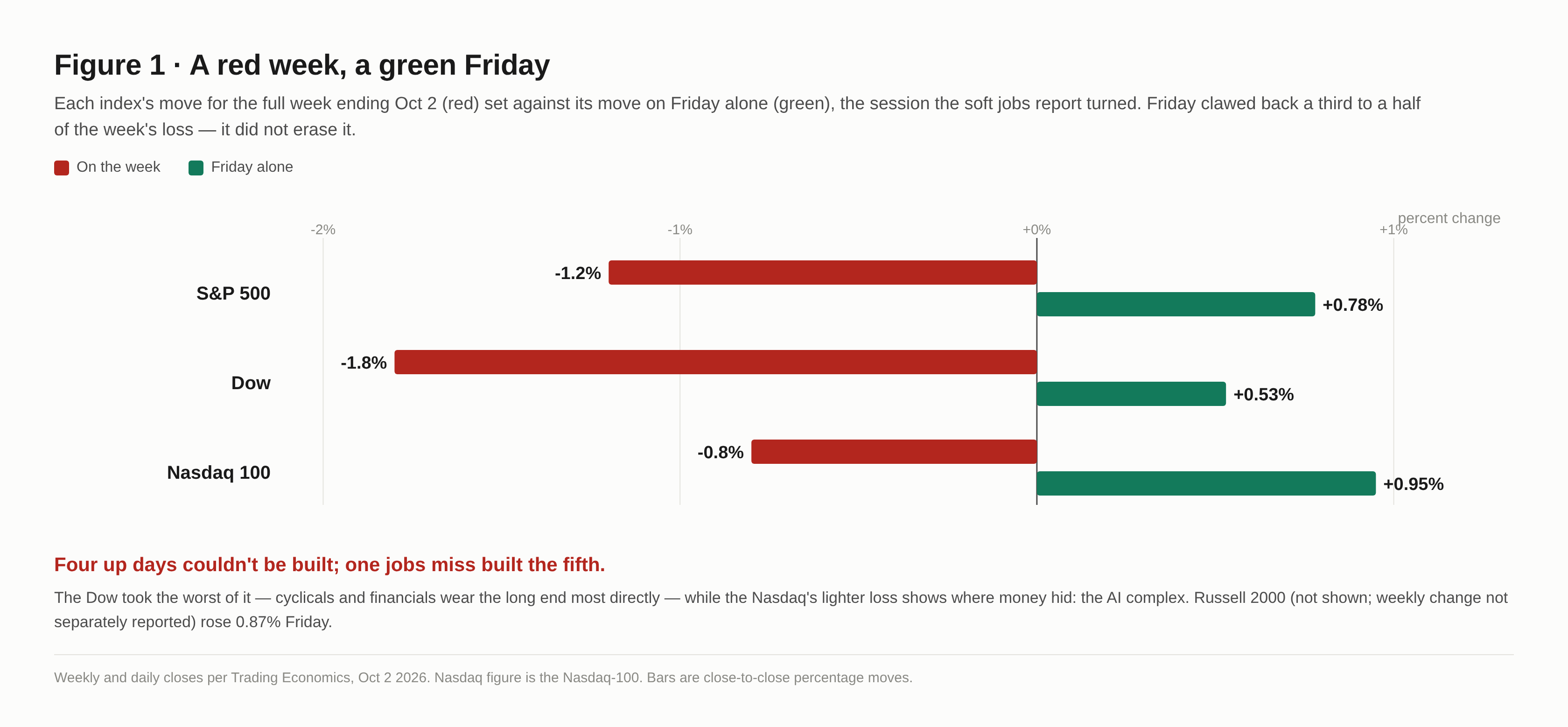
The arc. The week opened in the long shadow of the September 25-basis-point hike — the Fed's, delivered unanimously — and a ten-year Treasury yield pressing 5.33 percent, a level unseen since 2002. Those yields, not earnings, dictated the tape: for four sessions a market that could find no buyers for the long bond repriced everything behind it, and the Dow, the most rate-sensitive of the headline averages, bled hardest. Wednesday's cooler-than-feared PCE at 3.0 percent took some urgency out of the hike trade; Friday's payrolls miss finished the job. Net of it all, the S&P closed the week down 1.2 percent, the Dow down 1.8, the Nasdaq-100 down 0.8 — even after Friday's broad rally (Figure 1).
The tell of the week. Here is the signal worth carrying into Monday. Odds of an October hike collapsed from roughly 47 percent to 14, the clearest dovish repricing in months — and the long end would not fall on it. The ten-year dropped as much as eight basis points intraday on the jobs print, then round-tripped to close near 5.28 percent, four basis points higher on the day; the two-year, which should be most sensitive to the vanished hike, likewise closed near 4.84 percent. A bond market that refuses to rally on a weak labor report is telling you its problem is no longer the policy rate. It is supply, term premium, and the price of financing a deficit — and that is a problem a soft payrolls number does not solve.
Beneath the averages. Leadership was narrow and specific. The money that stayed in the market paid up for the AI capital-spending complex — Accenture and Synopsys were the week's marquee winners on the enabler trade — while the consumer tape cracked, Nike sliding to roughly twelve-year lows on soft guidance. The storage group split cleanly: Seagate and Western Digital fell double digits late in the week on a wire report that Toshiba would expand hard-drive capacity, even as memory names held the AI-demand bid. Across assets, gold pressed records near $4,177, the dollar sat close to a fourteen-week high, and WTI held around $93 into an OPEC+ weekend — a cross-asset picture of a market hedging a strong-economy, higher-for-longer outcome and a policy-mistake tail at the same time.
The number that flipped it
The print. September nonfarm payrolls rose 29,000 against a consensus near 90,000, and the same release cut the prior two months by 60,000 jobs combined — July revised all the way to minus 10,000, August down to 133,000. The unemployment rate ticked up to 4.2 percent and average hourly earnings cooled to 0.1 percent in the month, 3.0 percent on the year (Figure 2). Three readings, each weaker on a second look than the headline first suggested.
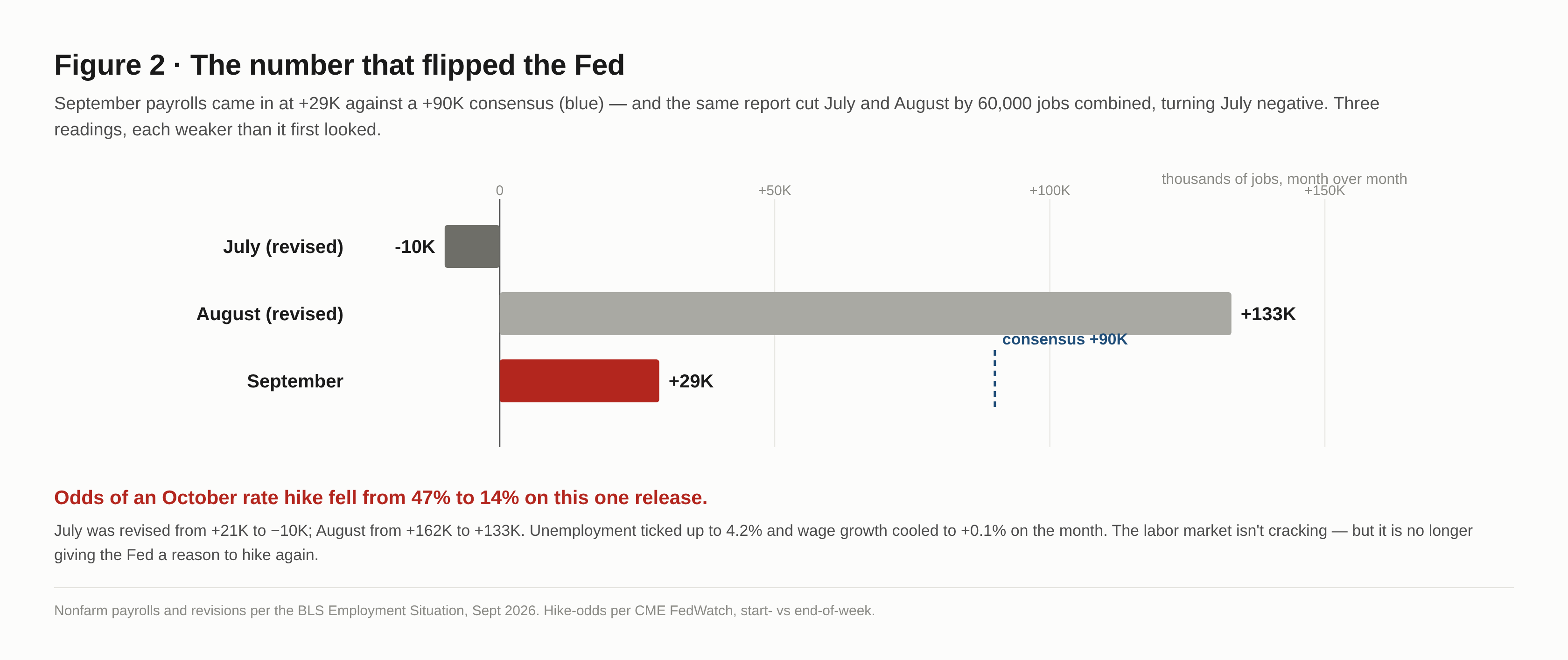
What changed. One release took the October encore off the table: having hiked in September, the Fed now has neither the labor-market heat nor the inflation acceleration that a back-to-back move would require, and the debate shifts to December or to nothing at all. New York's Williams had already said policy 'has time.' But note the asymmetry the week exposed — the labor market is cooling, not cracking, and a cooling labor market paired with 3.0 percent inflation and a bond market that won't rally is the uncomfortable middle, not the all-clear. The hike scare is gone; the yield problem is not.
The AI desk
Silicon, models and megawatts. The week's AI flow hit all three layers of the stack. Synopsys jumped roughly 13 percent on a revenue-sharing pact with OpenAI to build a chip-design model and a greater-than-$1 billion AWS deal for its silicon IP, pairing the news with a fiscal-2027 guide above the Street — the clearest sign yet that electronic-design automation is the toll booth on every custom AI chip. Alphabet shipped Gemini 4 'Argon,' its first flagship model since February, and the market read it as Google climbing back onto the frontier leaderboard. Constellation locked Amazon into a 20-year nuclear power-purchase agreement anchored on Maryland's Calvert Cliffs, roughly $3 billion of upgrades to feed data-center load — a reminder that power, not GPUs, is the binding constraint now. Underneath, Nvidia was reinstated as a top semiconductor pick at Morgan Stanley and closed the week near highs; Accenture's blowout quarter was itself an AI-consulting story, and the storage split — memory bid, hard drives sold — was the market deciding which part of the data center still has pricing power.
The week ahead
The calendar. It is a data-and-minutes week, not earnings one. OPEC+ meets on Sunday with crude already nearly $93, so Monday's oil open is the first tell. Monday also brings ISM Services for September — and the flash services gauge had already jumped to 58.7, a 59-month high, so a hot services print would re-arm exactly the inflation-and-term-premium worry the jobs miss just eased. Wednesday brings the minutes of the September meeting, when the Fed hiked 25 basis points; the value is in how close a further move was and how split the committee is, read against a labor market that has since weakened. Friday closes the week with preliminary University of Michigan sentiment. Earnings are light and pre-bank — PepsiCo, Delta and Levi Strauss are the names that matter before the mega-bank kickoff the week of October 13 — and the next policy decision is the October 27-28 FOMC.
The paths. The base case is that a soft-but-not-alarming labor read keeps the pause narrative intact, long yields drift, and the index grinds while leadership stays in the AI enablers over the consumer. The bearish path runs through the long end: a hot ISM services number or minutes that read more hawkish than the data now warrant pushes the ten-year decisively back above 5.30 percent, and the AI-capex rally gives back as discount rates rise. The bullish path is the one the bond market has so far refused to grant — long yields finally following the lower front end, which would hand leadership to the rate-sensitives and small caps that have lagged all month.
The tell to watch. With hike odds down to 14 percent, the question is no longer whether the Fed hikes — it is whether long yields will finally fall. The ten-year would not rally even on a 29,000 payrolls print; if it cannot rally on next week's softer inputs either, the term-premium story is the real one and the equity rebound is living on borrowed time. Watch the ten-year against Monday's ISM services as the primary tell, and the Russell 2000 as the secondary one: small caps are the purest gauge of whether the market believes relief at the long end is coming.
Sources
Index and yield closes and weekly moves per Trading Economics (Oct 2, 2026); September payrolls, revisions, unemployment and earnings per the BLS Employment Situation; hike-odds per CME FedWatch; week-ahead calendar per Newsquawk; movers and AI deals per Schwab, Invezz/Reuters, Yahoo Finance, Benzinga, Morningstar and BLS. The Nasdaq figure is the Nasdaq-100.
The Closing Edge is market observation, not investment advice. Closes are as of the bell; values marked with a tilde are near-close estimates, and settlements may adjust.