Morning Brief · weekend long read
Sold out versus sold off: the week the AI trade stopped paying for promises
Marvell laid out an $80 billion plan and got 1% for the week. Lumentum said it has nothing left to sell until 2029 and got 5% in a day. Here is the week with receipts, and a Moonshot for October 12–16.
trendyvest.com · Saturday, October 10, 2026
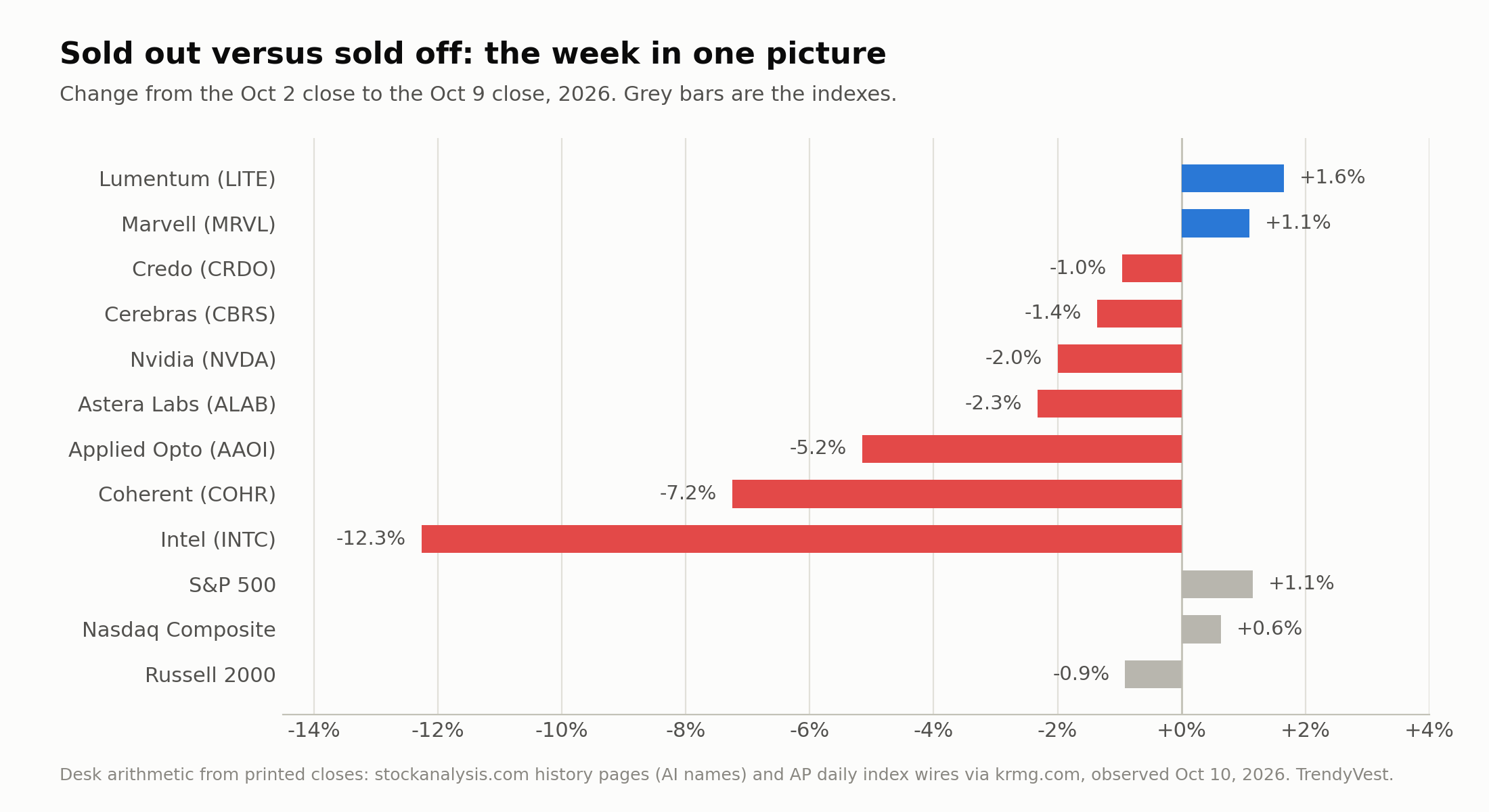
On Tuesday, Marvell laid out the most ambitious long-range plan in semiconductors: $70 billion to $90 billion of revenue in fiscal 2031. The market paid it 1.1% for the week.
On Friday, Lumentum's chief executive told Bloomberg Television his company is "completely sold out." The stock rose 5.2% in a session.
That contrast is the week. Promises were discounted. Scarcity was paid for. Companies that added supply were sold, whether the supply was new shares (Applied Optoelectronics), newly unlocked shares (Cerebras) or a possible new foundry rival (Intel). Keep that lens for everything below.
A note on the numbers. Every weekly stock move here runs from the October 2 close to the October 9 close and is the desk's arithmetic from closes printed on stockanalysis.com history pages, read on Saturday, October 10, 2026. Index closes are printed only where two feeds carry the same figure.
The tape: records, then a reality check
The headline indexes rose. The leadership was defensive.
The S&P 500 closed Friday at 7,811.54, up 0.59% on the day (Investing.com, 4:30 p.m. ET, Oct 9; AP via KRMG, 3:16 p.m. CDT). The Nasdaq Composite closed at 27,366.17 and the Dow at 51,654.95 (same two feeds). For the week, AP counts the S&P 500 up 1.2%, the Dow up 0.9%, the Nasdaq up 0.6% and the Russell 2000 down 0.9%. Small caps have now fallen five straight weeks, "the longest streak since 2022" (TheStreet Pro, Oct 9, 6:38 p.m. ET).
The record came Tuesday: 7,818.93, the first record close since August (AP via KRMG, Oct 6; Yahoo Finance). The intraday high was 7,844.52 (Investrade; Yahoo Finance quote page). The index spent the rest of the week below both.
Sectors tell the story the indexes hide. Utilities gained 3.97% for the week, consumer staples 3.60%, energy 3.60%, health care 2.79%. Technology lost 0.52% and industrials 0.41% (SPDR sector ETFs; Current Logic, Oct 10; The Glass Desk, Oct 9). The equal-weight S&P 500 gained 1.6% while the semiconductor ETF lost 4.5% (Bull Bear Report, Oct 10). That is a rotation, not a rally.
Money is expensive and getting more so. The 10-year Treasury par yield ended the week at 5.24%, after 5.31% on Monday; the 30-year ended at 5.60% (U.S. Treasury daily par yield curve). AP's Friday wrap put the 10-year "near its highest level since 2002" (AP via DTN, Oct 9, 3:25 p.m. CDT). The Federal Reserve is hiking, not cutting. Minutes of the September 15–16 meeting, released Wednesday, say "most participants assessed that another increase in the target range for the federal funds rate would likely be appropriate by year end"; the range stands at 3.75% to 4% after September's quarter-point move (Federal Reserve, Oct 7).
Households feel it. The University of Michigan's preliminary October sentiment index came in at 46.3, from 48.1 in September. The current-conditions index fell to 44.7 from 50.9. Year-ahead inflation expectations rose to 4.7% from 4.6% (University of Michigan Surveys of Consumers, preliminary October). The VIX closed Friday at 14.84 (Yahoo Finance; Investing.com). Fear is cheap. Money is not.
Oil, both benchmarks from one feed at one reading: Brent $104.43 and WTI $91.66, last prices for October 9 on Trading Economics, page updated October 10, which counts Brent up about 1.5% on the week. The war with Iran is why it sits there. On Friday the IRGC said it had set a tanker ablaze and that ships on unauthorised routes "would be pursued and 'punished' anywhere in the region" (Euronews, Oct 9).
With money this expensive, the AI complex had no room for error. On Thursday it got one.
OpenAI's $20 billion definition problem
The Financial Times reported Thursday that OpenAI told investors its annualized revenue was "approaching $50 billion" at the end of September (FT, via TechCrunch, Oct 8). Ten days earlier the number in circulation had been "approaching $70 billion" (Axios, Oct 8, citing its own September 29 reporting; Reuters via KSL). Axios put the gap at "about $20 billion."
The gap is a definition. Anthropic counts sales made through its cloud partners at the gross amount and books the partner's cut as an expense; OpenAI "records only its share of certain partner sales" (Axios, citing accounting professor Francine McKenna). Reuters put it the same way: "OpenAI, unlike Anthropic, does not include, for instance, revenue from sales via cloud partners." Same customers, same dollars, two numbers.
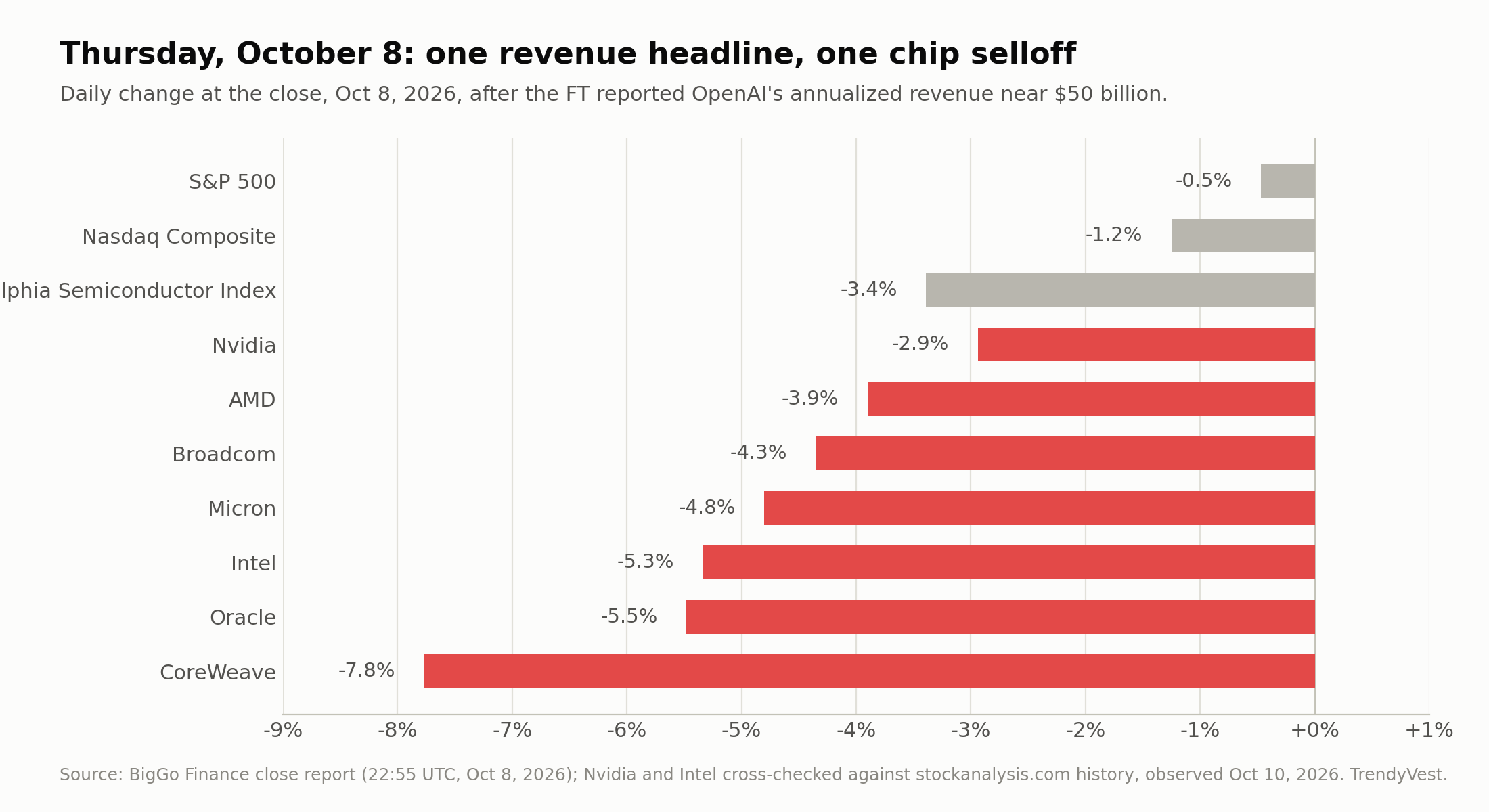
The market did not wait for the footnote. The Nasdaq fell 345.35 points, or 1.25%, to 27,193.34 (AP via KRMG, Oct 8; BigGo Finance, 22:55 UTC). The Philadelphia Semiconductor Index lost 3.39%. Nvidia fell 2.94%, AMD 3.9%, Broadcom 4.35%, Micron 4.8%, Intel 5.34%, Oracle 5.48% and CoreWeave 7.77% (BigGo close report; Nvidia and Intel match the stockanalysis.com daily rows).
Thursday night, Bloomberg reported OpenAI expects "to reach or exceed $70 billion in annualized revenue by the end of the year," with the end-September figure "roughly $50 billion" (Bloomberg via Yahoo Finance, Oct 8, 9:43 p.m. ET). Oracle rose more than 4% on Friday. The chip index did not follow; it slipped another 0.4% (TheStreet Pro). Nvidia finished the week at $229.28 from $233.95, down 2.0%.
Read it plainly. This was not a demand shock; nothing about data-center orders changed between Wednesday and Thursday. It was a reminder that a supply chain financed with "nearly half a trillion dollars of new debt this year" (Bloomberg via Yahoo Finance UK, Oct 8) reprices on how one private company defines one metric. That fragility does not go away until OpenAI and Anthropic report audited numbers as public companies.
Marvell: the year's biggest promise, and a 1% week
The numbers from Tuesday's Investor Day were enormous, and they were management's own.
Fiscal 2028 revenue of "approximately $20 billion," against an $18.2 billion consensus (CEO Matt Murphy, Investor Day transcript; consensus per Benzinga, Oct 6). Fiscal 2031: "a path to $70 billion–$90 billion in annual revenue with $80 billion at the midpoint" (Murphy). Piper Sandler had modeled about $45 billion (Benzinga). Non-GAAP earnings above $30 a share in fiscal 2031 (CFO Dan Durn, per Newsquawk, Oct 6). The mix at the midpoint: about $37.5 billion of interconnect and about $30 billion of custom silicon (Murphy). Custom silicon "more than $12 billion" in fiscal 2029, raised from "more than $10 billion" (Will Chu). A total addressable market of "approximately $400 billion" by 2030 (Murphy).
The stock traded between $267.26 and $301.27 on the day and closed at $287.01, up 5.81% (stockanalysis.com). Astera Labs closed up 7.58% and Credo up 3.93% (ALAB; CRDO).
Then the promise met the tape. Marvell closed Friday at $275.28: up 1.1% on the week and 4.1% below its Investor Day close. Astera finished the week down 2.3%, Credo down 1.0%.
The detail the headlines skipped is where the plan asks the most. Marvell sees the interconnect market at "approximately $65 billion by 2030" (Murphy). Its $37.5 billion against that $65 billion is about 58% share, the desk's arithmetic, with the caveat that the revenue target is a fiscal 2031 figure and the market figure is calendar 2030. Management also said scale-up optics is a business with "virtually no revenue in this area today, with strong growth beginning next year" (Murphy). The headlines were about custom chips. The bet is optics inside the rack. Which brings us to the week's sharpest split.
Optics: "sold out" beat "raised capital"
Lumentum's Michael Hurlston told Bloomberg Television in Tokyo on Friday: "We're completely sold out, and we see no end in sight" (as quoted by All Weather Finance, Oct 9). Benzinga's account has the components "effectively sold out through early 2029," against the 2028 he cited six months ago, and says the company cannot meet roughly 70% of demand for some products through next year and about 30% of demand for others through 2028 (Benzinga, Oct 9, 8:54 a.m. ET; Quartz). LITE rose 5.22% Friday to $1,103.36 and finished the week up 1.65% (stockanalysis.com).
Applied Optoelectronics went the other way, for doing what a shortage asks. On Monday it said it had completed its third at-the-market equity program of the year: 5,694,845 shares at an average $105.36, for $587,999,985.89 net of commissions and fees, with proceeds for debt repayment, working capital and "new equipment and machinery for production and research and development use" (company release via Finviz, Oct 5). That is $600 million gross, the desk's multiplication. The stock had closed Tuesday at $130.16, the week's high. On Thursday it fell 13.58% to $105.90. It ended the week at $109.64: down 5.1% for the week and 15.8% from Tuesday's close (stockanalysis.com). Coherent lost 7.2% on the week (stockanalysis.com).
Same product category. Opposite weeks. The difference was who added supply.
Hold the AAOI thought. It comes back in the Moonshot.
Cerebras: an Altman rebound, then a slow leak
Cerebras came into the week at $166.43, down 19.5% from its September 25 close (stockanalysis.com), after SemiAnalysis reported that OpenAI would run the "Ultrafast" mode of its GPT-6.1 Sol model on Nvidia GPUs rather than Cerebras hardware (Stocktwits, Oct 4). Late on Friday, October 2, Sam Altman posted on X: "Cerebras is a close partner, and we have a deep engagement pushing on the frontiers of speed" (Stocktwits).
The post bought one day. The stock rose 9.08% Monday to $181.55, then fell four straight sessions to $164.17, down 1.4% for the week and about 2% above the bottom of its 52-week range, $160.81 (stockanalysis.com). The disclosed business has not moved. Third-quarter core revenue guidance is "approximately $214 to $216 million," full-year core revenue $880 million to $890 million, and remaining performance obligations were $25.4 billion at June 30, with OpenAI named first among significant customers and no percentage given (Cerebras second-quarter results, via SEC, Aug 12).
What has moved is supply. The May prospectus schedule puts 19.4 million shares eligible for sale on September 30, another 19.4 million on October 14, another 19.4 million on October 28, and everything remaining at the earlier of third-quarter results or November 9 (prospectus schedule via CryptoTicker). Wednesday is a supply event with a date on it.
Intel: down 12%, and the threat wears a TSMC badge
Intel fell from $119.33 to $104.70, down 12.3% on the week and down four sessions of five (stockanalysis.com). Friday's low was $104.00.
The trigger was a Sunday post on X. Replying to a report that TSMC was in talks to join Terafab, Elon Musk wrote: "Just discussions, but something may come of it" (Finviz, Oct 5). Terafab is the chip project SpaceX and Tesla are building in Grimes County, Texas; an August 6 announcement committed $16.8 billion to its first phase, and the total "could reach $119 billion" (Finviz; Bisnow, Aug 7). Intel joined in April, when its 14A node "was named the project's sole manufacturing process technology" (Finviz). TSMC's Taiwan shares closed 3% higher Monday on the talk (Finviz).
Why one node matters that much: Intel Foundry booked $293 million of external revenue in the second quarter on $5.8 billion of foundry revenue, and lost $2.1 billion (Data Center Dynamics, July 24). Terafab is the only named external anchor for 14A.
Two Intel stories remain rumors and are printed here as rumors. A Piper Sandler note, reported by Wccftech, says 14A is being evaluated by eight companies including Apple, Nvidia and Amazon; none has confirmed it (via Digg). A leaked 28-core "Core Ultra 9 4970K" Nova Lake part comes from a leaker, not from Intel (HotHardware, Oct 2). Intel reports third-quarter results on Thursday, October 29, after the close (Intel, Oct 6).
The rest of the week, briefly
The money. Companies have "priced nearly half a trillion dollars of new debt this year to pay for the infrastructure powering artificial intelligence," by Bloomberg's count; Broadcom launched a $60 billion debt financing to help fund Anthropic's buildout, and SpaceX is in talks to raise $40 billion to buy Nvidia chips (Bloomberg via Yahoo Finance UK, Oct 8). Tuesday's bank earnings are the first look at who is underwriting it.
The power. Google and Constellation signed a 20-year power purchase agreement for 890 megawatts of new nuclear capacity, delivered by uprates at 11 Constellation units in Illinois, Pennsylvania and New Jersey, "more than $4.3 billion of new investment by Constellation," first uprate expected by 2028, plus a separate 15-year supply agreement for 2,700 megawatts (Constellation, Oct 6). Shares were indicated about 5% higher before the open (Investing.com via Yahoo Finance, Oct 6, 7:14 a.m. ET). Utilities led every sector for the week.
The phones. SpaceX agreed Thursday to buy all of Grain Management's 800 MHz holdings, "up to 14 megahertz of paired low-band frequencies" (Investing.com, Oct 8, 4:33 p.m. ET). On Friday T-Mobile fell 13.3%, AT&T 9.8% and Verizon 8.8%, while Crown Castle rose 15.6% and American Tower 9.3% (TheStreet Pro). The market priced a fourth national carrier in one session.
The supply chain. AMD's Lisa Su, to reporters in Taipei on Tuesday: "The demand is even higher than our supply" (Benzinga, Oct 6). TSMC's September revenue was NT$511.86 billion, up 54.6% from a year earlier (TSMC, Oct 8), which put third-quarter revenue at a record NT$1.49 trillion, above the company's own guidance (TrendForce, Oct 8). The physical buildout has not blinked. The question is who gets paid for it.
Moonshot of the week: the market sold AAOI for doing what a shortage demands
This section is a speculative hypothetical for educational purposes. It is not advice and not a recommendation to buy any security or option, and it is the kind of position that can lose all of the premium paid.
Put Thursday and Friday together. On Thursday the market sold Applied Optoelectronics 13.58%, two days after the company closed a $600 million raise, in a session that punished every chip name. On Friday the industry's best-known supplier said it cannot meet about 70% of demand for some products through next year.
If the leader cannot fill orders, the overflow goes to whoever has capacity. AAOI says the raise buys exactly that: capacity of "around 650,000 pieces of 800G and 1.6 Tb products per month" by the end of 2026, from "approaching 200,000 units per month" today, and it forecast in August that "demand will continue to outpace our production capacity through mid-2027" (second-quarter results, via SEC, Aug 6). Third-quarter guidance is revenue of $255 million to $290 million at a 29% to 30.5% non-GAAP gross margin (same release). In that framing, dilution is the cost of taking share, not a tax. That is the desk's speculation, not a forecast.
The catalyst is the third-quarter report. StockAnalysis lists November 5 as an estimated date (stockanalysis.com); the company had not confirmed a date at this writing.
One hypothetical way to express it: out-of-the-money December or January calls, which span the early-November print and cap the loss at the premium paid. For scale, the 52-week range is $18.50 to $233.67 (stockanalysis.com). Rosenblatt's $220 target dates from May 8, 2026, raised then from $140, and is not a new call (Yahoo Finance, May 11).
What breaks it. Options can expire worthless, so size for a total loss. The capacity target is the company's, not a delivered number, and AAOI's own component supply could cap the ramp. The level that matters is Thursday's close, $105.90: a daily close below it says the market is still pricing the dilution, not the opportunity. A fourth raise would end the thesis.
How to trade it next week, October 12–16
Educational set-ups, each labeled hypothetical. Levels are the closes and intraday prints cited above.
| Day | What lands |
|---|---|
| Monday, Oct 12 | Treasury market closed for Columbus Day; stocks trade (TheStreet Pro). |
| Tuesday, Oct 13 | JPMorgan, Goldman Sachs, Citigroup and Wells Fargo report (Reuters via Yahoo Finance, Oct 9; Newsquawk). |
| Wednesday, Oct 14 | September CPI: a Reuters poll looks for 3.6% headline and 2.5% core, year over year (Reuters); Newsquawk's consensus is +0.6% and +0.2% on the month. Bank of America and Morgan Stanley report. Fed Beige Book (Newsquawk). Cerebras lockup tranche of 19.4 million shares (prospectus schedule). |
| Thursday, Oct 15 | TSMC third-quarter call at 2:00 a.m. ET (TSMC). September PPI and retail sales (TheStreet Pro; Newsquawk consensus: PPI 5.3% year over year, retail sales +0.3% on the month). Fed Chair Warsh in a fireside chat with the IMF's Kristalina Georgieva late Thursday (TheStreet Pro). |
| Friday, Oct 16 | Import and export prices; industrial production (Newsquawk). |
The next FOMC meeting is October 27–28 (Reuters).
1. CPI is the hinge. The set-up is a 5.24% ten-year in a hiking cycle, with minutes that promise another move by year-end. Nasdaq's Chartstopper put the odds of an October hike "below 20%" and said that "could change with next Wednesday's CPI report" (Nasdaq, Oct 9). Hypothetically, a reader heavy in AI names hedges before Wednesday, not after; defined-risk index puts are one structure. The risk is a soft print that squeezes crowded shorts in the names that fell Thursday.
2. Banks as the AI-financing tell. Nearly half a trillion dollars of AI-related debt has been priced this year (Bloomberg). What JPMorgan and Goldman say Tuesday about underwriting fees and data-center lending is the first public read on whether that pipe is still open. The risk is that bank results turn on consumer credit and interest income, so the read-through is indirect.
3. Marvell: trade the gap between promise and price. MRVL closed at $275.28, below its $287.01 Investor Day close; the October 6 high was $301.27 and the October 5 close $271.25. Hypothetically, a close above $287.01 says the market is starting to believe the plan; a close below $271.25 says it is not. The catalyst is TSMC's Thursday call. A relative-value version is long Marvell against Astera Labs, which gave back its entire Investor Day move. The risk is that five-year frameworks are not guidance, and one lost hyperscaler socket resets the stock.
4. Optics pair: scarcity against supply. LITE, sold out and up 1.65% on the week, against AAOI, diluting and down 5.1%. The hypothetical structure is long the supplier with pricing power and short the one that just issued, which is the exact opposite of the Moonshot above; a reader has to pick one. The risk is that both legs are high beta, and a four-figure Lumentum leaves no room for a stumble.
5. Cerebras: let the unlock pass. About 19.4 million shares become eligible for sale on Wednesday, with another tranche on October 28 and full expiry by November 9 (prospectus schedule). Hypothetically, the trade is to wait and see whether $160.81, the bottom of the 52-week range, holds; a reclaim of $181.55, Monday's close, flips the tape. The risk is that OpenAI headlines are binary, and the company's own filing names OpenAI first among the customers it depends on.
6. Intel: the Terafab pair. Long TSM against short INTC into Thursday's TSMC call is the hypothetical, with $104.00, Friday's low, as the line and $112.50 to $113.12, the October 6 and 7 closes, overhead. Listen for any comment on Terafab or U.S. capacity. The risk is a confirmed 14A customer, which would trigger a violent squeeze in a stock that just lost 12%.
The bottom line
The market spent the week separating what is promised from what is scarce. Next week CPI tests the price of money, the banks test the flow of money, and TSMC tests demand itself. Trade the receipts, not the narratives.
Registration for the TrendyVest Championship is open at Tournament.Trendyvest.com: 500 seats, a $100,000 simulated stake, free to enter; trading began October 1, 2026 at the market open.
Sources
All sources read on Saturday, October 10, 2026, between 10:00 a.m. and 3:30 p.m. ET. Weekly stock moves are the desk's arithmetic from closes printed on stockanalysis.com history pages: NVDA 233.95 to 229.28; MRVL 272.29 to 275.28; ALAB 350.33 to 342.21; CRDO 218.64 to 216.55; LITE 1,085.42 to 1,103.36; COHR 337.04 to 312.62; AAOI 115.59 to 109.64; CBRS 166.43 to 164.17; INTC 119.33 to 104.70. Index closes: Investing.com close report (Oct 9, 4:30 p.m. ET), AP wires via KRMG (Oct 5–9) and Yahoo Finance quote pages; TheStreet printed the S&P 500 at 7,811.51 and the Russell 2000 at 2,808.57, and 24/7 Wall St. printed figures that match no other feed; those are not used. Weekly index percentages are AP's; the desk's arithmetic from AP's daily closes gives +1.15%, +0.93%, +0.64% and −0.91%. Oil: Trading Economics last prices for Oct 9 (Brent 104.43, WTI 91.66), page updated Oct 10; the market's official settlements for Oct 9 were carried by one feed at this writing and are not printed. Fed minutes: federalreserve.gov, released Oct 7. Treasury yields: U.S. Treasury daily par yield curve for October 2026. Michigan sentiment: sca.isr.umich.edu, preliminary October. OpenAI revenue: TechCrunch (FT report), Axios, Reuters via KSL, Bloomberg via Yahoo Finance (Oct 8, 9:43 p.m. ET), Yahoo Finance (Oct 9). Thursday chip moves: BigGo Finance close report (Oct 8, 22:55 UTC). Marvell: Investor Day transcript via stockanalysis.com, Benzinga (Oct 6, 12:35 p.m. ET), Newsquawk (Oct 6). Lumentum: All Weather Finance, Benzinga (Oct 9, 8:54 a.m. ET), Quartz (Oct 9). Applied Optoelectronics: company release of Oct 5 via Finviz; second-quarter results exhibit via SEC (Aug 6); stockanalysis.com quote page; Yahoo Finance (May 11) for the Rosenblatt target. Cerebras: Stocktwits (Oct 4), second-quarter results via SEC (Aug 12), prospectus lockup schedule via CryptoTicker, stockanalysis.com. Intel and Terafab: Finviz (Oct 5), Bisnow (Aug 7), Data Center Dynamics (July 24), Wccftech via Digg, HotHardware (Oct 2), Intel (Oct 6). TSMC: pr.tsmc.com (Oct 8), TrendForce (Oct 8), investor.tsmc.com. Constellation: investors.constellationenergy.com (Oct 6); Investing.com via Yahoo Finance (Oct 6, 7:14 a.m. ET). SpaceX spectrum and telecoms: Investing.com (Oct 8, 4:33 p.m. ET), TheStreet Pro (Oct 9, 6:38 p.m. ET). AI debt: Bloomberg via Yahoo Finance UK (Oct 8). AMD: Benzinga (Oct 6). Sectors: Current Logic (Oct 10), The Glass Desk (Oct 9), Bull Bear Report (Oct 10). Calendar: Reuters via Yahoo Finance (Oct 9, 6:02 a.m. ET), Newsquawk (Oct 9), TheStreet Pro (Oct 9), TSMC investor relations, Nasdaq Chartstopper (Oct 9). Iran: Euronews (Oct 9).
Disclaimer: This article is for educational and informational purposes only and does not constitute investment, tax or legal advice, or a recommendation to buy or sell any security or derivative. Trading involves substantial risk, including loss of principal. Options can expire worthless, and short positions and pairs can lose more than the initial investment. Ideas labeled hypothetical or speculative reflect the author's opinion, not a forecast. Past performance does not guarantee future results. Do your own research and consider consulting a licensed financial professional.