ANALYSIS · SUNDAY, NOVEMBER 8, 2026 · ORACLE (ORCL)
Oracle: Sell. And Microsoft is the smallest problem.
Bloomberg reported Friday that Microsoft is shutting down the 2023 arrangement in which it rented Oracle's cloud to run Bing (i.e., not renewing it and turning off the capacity, as the chips are a generation old). That, in itself, is a fairly trivial story about an unpublicized arrangement, and Oracle's comment that demand for the older GPUs is strong is borne out by the rental market. The real reason to sell Oracle is the one the report reveals rather than the one it says: the customer with the
Sunday, November 8, 2026 · Analysis · New York · Four figures
Start with the Bloomberg report itself, because the headline has already run ahead of it. On Friday, November 6, at 12:36 p.m., Brody Ford reported that "Microsoft Corp. is winding down an arrangement to rent AI computing from Oracle Corp., part of a larger reassessment of billions of dollars in cloud partnerships" (Bloomberg, via Yahoo Finance). That was the multi-year arrangement Oracle announced on November 7, 2023, under which Microsoft would run inference for Bing's conversational search on Oracle Cloud Infrastructure (OCI) via Oracle Interconnect to Azure (Oracle release, via Nasdaq). Microsoft has been turning off the rented capacity over the last few months after deciding not to renew the agreement. The reason given is that the hardware used older-generation Nvidia chips. Bloomberg said the deal size "could not be determined," and it was never disclosed in 2023. Microsoft has declined to comment. Oracle told Reuters: "Demand for OCI's (Oracle Cloud Infrastructure) AI infrastructure remains strong, including for earlier-generation GPUs" (Reuters, via Investing.com).
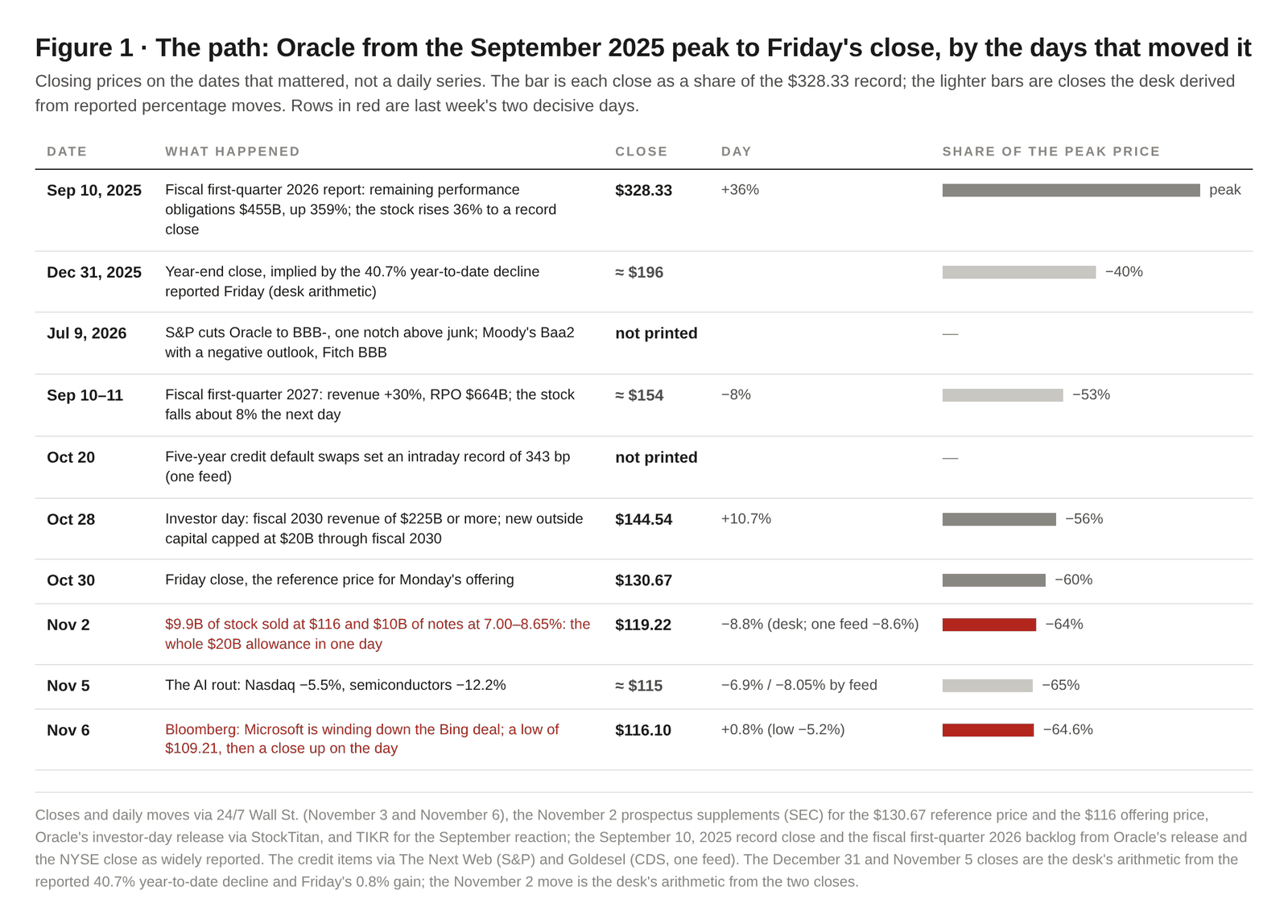
The stock fell 5.2% to $109.21 (a level not seen in over a year) and then closed up 0.8% at $116.10 (24/7 Wall St.). That's a clear signal that the market read the report as the minor story it is. The week around it wasn't minor at all. It was down about 9% on Monday (Oracle's $20bn stock and bond offering), down 7-8% on Thursday, by feed, with the rest of the AI complex, down 11.2% for the week, 40.7% for the year and 64.6% below the closing peak of $328.33 on September 10, 2025. A stock doesn't lose two-thirds of its value on one customer. The question is whether what's left is cheap, and the answer depends entirely on who pays Oracle's bills. That's the subject of this piece.
What Microsoft's exit does and does not tell you
Start with the smaller story and give it its due. Microsoft's reason (according to Bloomberg) is specification. The Oracle capacity they leased in 2023 was on the 2023 generation of Nvidia hardware and their own fleet has since moved on. That is not a statement about demand for compute at all and the rental market bears that out. Silicon Data's H100 index (the benchmark for the price of the H100 chip, which was new in 2023) has gone from $2.00 an hour in December last year to $2.88 on October 24 (up 44%) and the H200 index is near $3.48 (as compiled from Silicon Data by explainx.ai). Oracle's own assertion on their September call that the GPUs that were due for renewal in Q1 were "renewed or resold at a 20% premium to prior contracts" and that "the majority of those GPUs are 4 years or older" is perfectly consistent with that index (Clay Magouyrk, September 10 call, via Longbridge). Those are Oracle's numbers and unverified, but the market they describe is very much there. Whatever Microsoft turned off, Oracle can almost certainly re-lease it and will probably be able to do so at a higher price than Microsoft was paying.
What the exit does tell you is about the customer list and that's the thing the bulls haven't priced. Microsoft was the Oracle AI infrastructure customer with the strongest balance sheet: investment grade, $18.6bn of positive free cash flow in the quarter just reported and no need to borrow to service its bills. It's exiting, and the reason isn't price. Bloomberg has the exit down as part of "a larger reassessment" of Microsoft's cloud partnerships. The reassessment has seen Microsoft tighten its oversight of CoreWeave, Nebius, Nscale and IREN on cost and schedule, decline an Nscale expansion in Texas, and watch IREN push over $4bn of annualized capacity into next year after Microsoft asked for network changes (Reuters, via Investing.com). Amy Hood on October 28 said Microsoft's capex came in below guide in part because "some third-party capacity deliveries we expected in Q1 were delayed" and that Azure grew 48% "even with the 3P capacity delays" (Fortune). A company that can grow its cloud 48% while its third-party capacity is arriving late has clearly learned it doesn't need the third party as much as the third party needs it. Oracle is the biggest of those renters and the customer who stays when Microsoft goes is OpenAI.
The balance sheet, read as a landlord's
Here's Oracle's balance sheet as at August 31, 2026, from the 10-Q. I'll give the numbers in the order a creditor would (Oracle Form 10-Q, quarter ended August 31, 2026). Cash and marketable securities: $37.1 billion. Notes and borrowings: $125.3 billion. Operating and finance lease liabilities on the balance sheet: $43.8 billion. And then the number that's the big one: $288 billion of additional lease commitments that have been signed but which have not yet commenced. "Substantially all" of those are for data centers, expected to start between this quarter and FY29 with terms of 15 to 19 years. Add those in and Oracle has about $457 billion of fixed obligations by the desk's arithmetic against $37 billion of cash and a business that generated $23.1 billion of operating cash flow in the quarter and spent $28.5 billion on capex. Free cash flow is therefore around negative $5.4 billion. Interest expense in the quarter was $1.43 billion, a run rate near $5.7 billion a year before the $10 billion of 7 to 8.65% paper was sold last week.
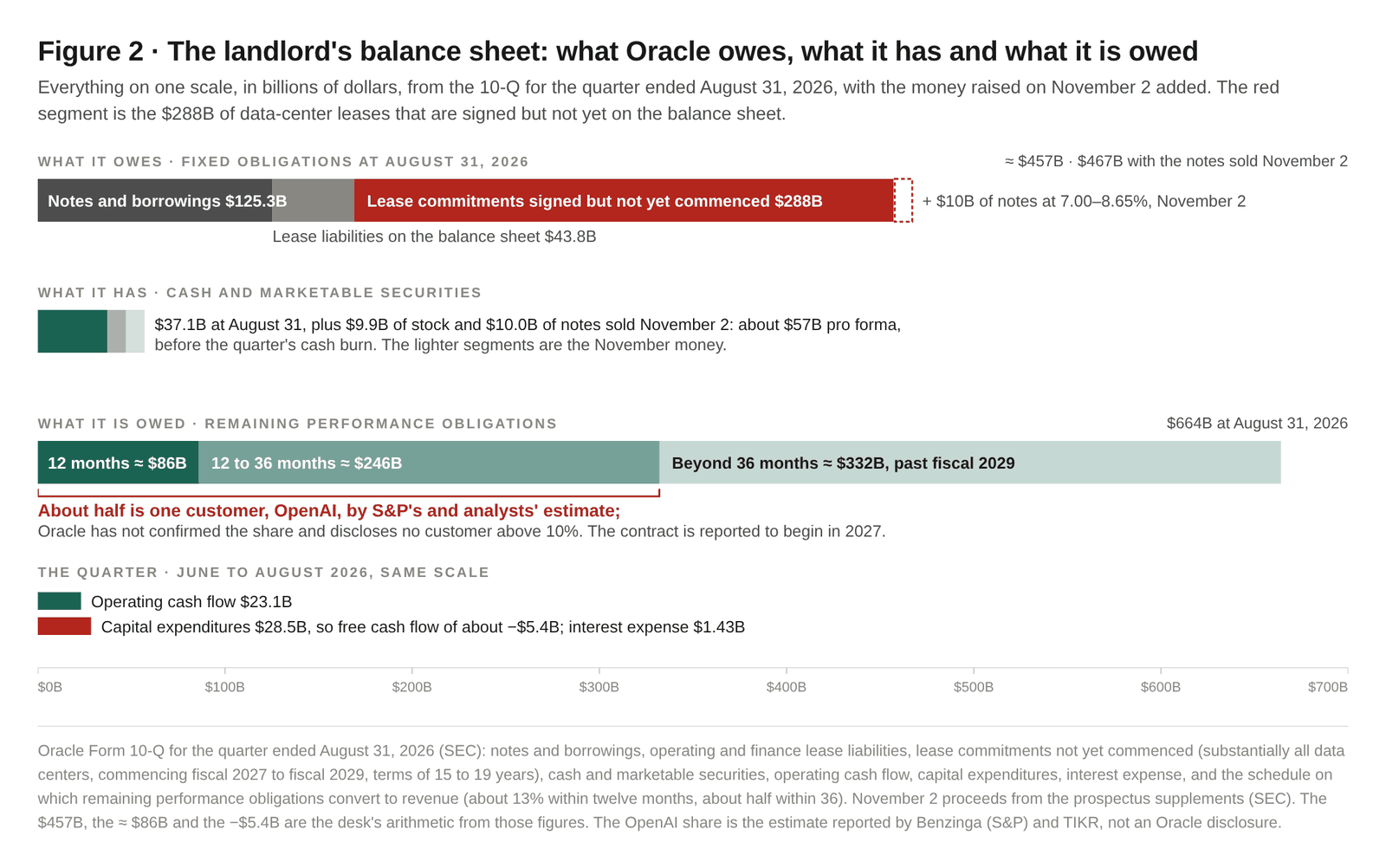
Against those obligations is the asset the bulls own the stock for: $664bn of remaining performance obligations (up $209bn in a year) with over $30bn of new AI contracts signed in the quarter (Oracle release, September 10). Three caveats from Oracle's own docs: 13% of that backlog is expected to convert to revenue in the next 12 months (approx. $86bn), with around half in the 36-month window; the remainder is beyond FY29. About half of that (per S&P and the analysts) is attributable to one customer, OpenAI, whose contract is worth roughly $300bn over five years starting in 2027 (Benzinga; TIKR); Oracle has never confirmed the share and discloses no customer at over 10%. The new contracts, Hilary Maxson said on the call, were "via prepay or bring-your-own-hardware or similar mechanic" and "won't impact our CapEx or revenues until fiscal 28 or beyond" (Longbridge transcript), which is good for Oracle's cash and indicates that the customers who can afford to pay are now doing so upfront or by bringing their own chips, which is not what a customer does when the landlord's credit is unquestioned.
The structure is: Oracle has committed to build and lease around $457bn of capacity (financed via debt at 7-8.65% and stock at a 52-week low) to deliver on $664bn of contracts (half of which is owed by one customer and 87% of which arrives after next August). Oracle's own plan from the October 28 investor day was for free cash flow to turn positive in the second half of FY28, to hit $30bn or more in FY29 and revenue to reach $225bn in FY30 with capex peaking in FY27 and FY28 (Oracle investor day release, via StockTitan; 24/7 Wall St.). All those dates depend on the tenant paying rent on time. That's the entire case for the equity.
The funding, and the five days
Oracle told investors on October 28 that it would cap new outside capital at $20bn through FY2030 (excluding refinancing) at "currently expected" levels of $10bn in equity and $10bn in debt. The stock rocketed up 10.7% to $144.54 on a plan which put a ceiling on dilution and said the spending would peak and then fall. Five days later, on November 2, they used the entire allowance at once: 86,206,897 shares at $116.00 (an 11% discount to Friday's $130.67 close) for net proceeds of approximately $9.9bn (prospectus supplement, SEC), and $10bn in notes in five tranches (7.000% due 2029, 7.450% due 2031, 7.850% due 2033, 8.000% due 2037 and 8.650% due 2046) at spreads of 240 to 335bps over Treasuries (prospectus supplement, SEC; 24/7 Wall St.). Use of the proceeds is "general corporate purposes, which may include capital expenditures." The stock closed at $119.22, down about 8.8% on the desk's arithmetic from Friday.
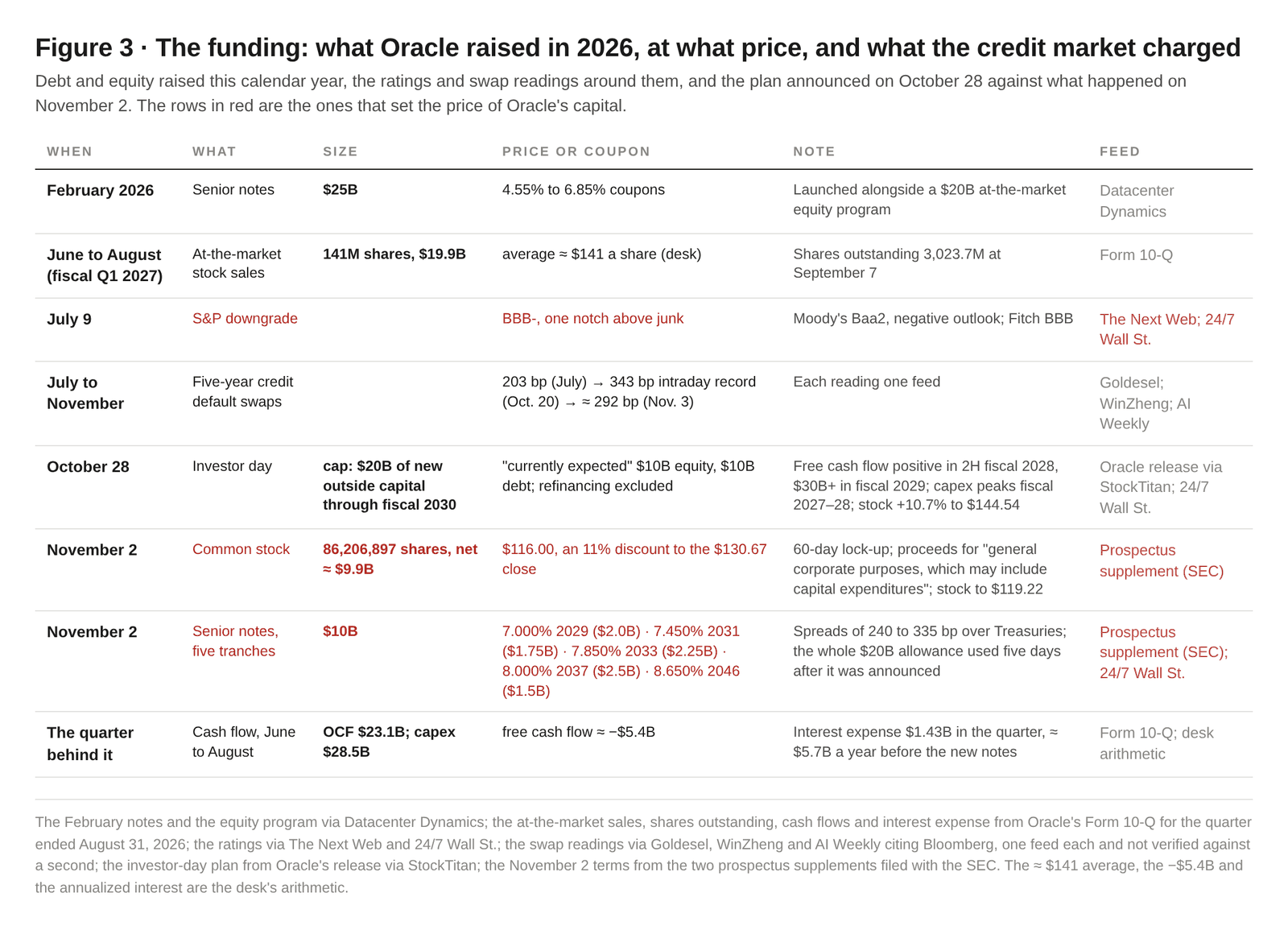
Add the two raises of the year together. In Q1 Oracle sold 141m shares through its at-the-market program for $19.9bn (average near $141); on November 2 it sold another 86m at $116. That's 227m shares (roughly 7.9% of the company by the desk's arithmetic) sold over six months at falling prices to fund a build whose cash return Oracle itself places in fiscal 2028. The debt side ran the same way: the $25bn of February bonds carried coupons of 4.55 to 6.85%; November's carry 7.00 to 8.65%. S&P downgraded Oracle to BBB- (one notch above junk) on July 9; Moody's has it at Baa2 with a negative outlook; Fitch at BBB (24/7 Wall St.; The Next Web). Five-year credit default swaps, 203bps in July, hit an intraday record of 343 on October 20 and were down to about 292 at the start of this month (Goldesel; WinZheng; each one feed). The stock is trading at around 14x Oracle's fiscal 2027 earnings guidance of $8.10, which looks cheap until you realize the earnings are an accounting number and cash is negative $5bn per quarter. A company spending 1.2x its operating cash flow on capital expenditure doesn't have earnings in the sense that a shareholder can spend.
The tenant
Now the tenant, because the verdict turns on it. OpenAI's contract with Oracle is reportedly in the region of $300bn over five years from 2027 (i.e. circa $60bn per annum) for up to 4.5GW of capacity across the Stargate sites (Benzinga). Here's what the record shows about the tenant's ability to pay. The FT reported in October that OpenAI's annualized revenue peaked at around $50bn in September, about $20bn below the figure it had provided to investors (Yahoo Finance). PitchBook has OpenAI's total infrastructure obligations above $1.15tn and quotes Morgan Stanley's Todd Castagno as saying that even non-cancellable AI contracts can be renegotiated in the event of a major customer going into difficulty (PitchBook). In March, Oracle and OpenAI called off the planned expansion of the Abilene site from 1.2GW to 2GW after financing discussions broke down and OpenAI's capacity forecasts changed, with Meta reportedly very interested in the site (Tom's Hardware, citing Bloomberg). Of the seven Stargate sites, Epoch AI's April survey found one in partial operation, five at foundations, and Lordstown, Ohio, not under construction and in some doubt (Epoch AI). Oracle reportedly issued a force majeure notice in September on a New Mexico project being built by a Blue Owl-backed group. Sam Altman was asked in September whether the buildout could go wrong, and he answered: "If the whole economy blows up, yes."
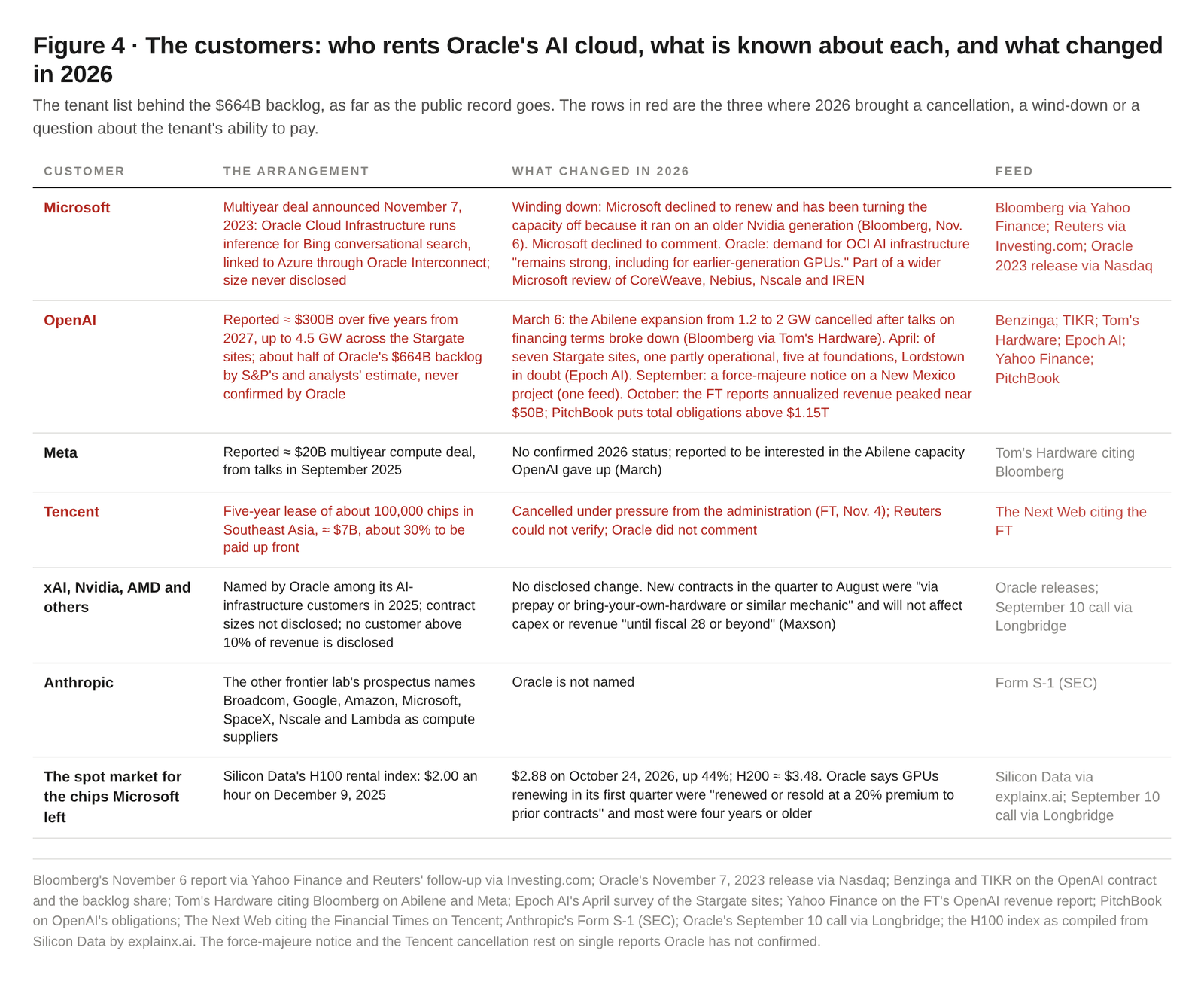
The rest of the list doesn't offset the concentration in any way. The reported Meta $20bn deal dates to talks in September 2025 and has no confirmed 2026 status at all. The FT reported on November 4 that Oracle had called off a five-year, roughly $7bn deal to lease about 100,000 chips to Tencent in Southeast Asia under pressure from the administration (with about 30% of the sum due up front); Reuters couldn't verify it and Oracle didn't comment (The Next Web). Anthropic's prospectus (the other frontier lab's document) lists Broadcom, Google, Amazon, Microsoft, SpaceX, Nscale and Lambda as its compute suppliers and makes no mention of Oracle. And Microsoft, the one tenant who could always pay, is turning the lights off. What's left is a landlord with $457bn of fixed commitments, borrowing at 8.65%, whose anchor tenant generates about $50bn of revenue against over a trillion in promises and whose other tenants are a dead Chinese lease, an unconfirmed Meta and whoever re-rents Microsoft's old chips.
The verdict
Sell. Not because Microsoft left, but because of who stayed and what it costs Oracle to keep the building open for them.
The case in one paragraph. Oracle's equity is the residual claim on approximately $457bn of debt and lease obligations (half of which are not yet on the balance sheet), financed at 7-8.65% and with stock sold at a 52-week low, to build capacity for a backlog that is half one customer, whose revenue is a fraction of its commitments and whose own expansion with Oracle was already cancelled once over money. The plan is to reach positive free cash flow in two fiscal years and the first meaningful cash return in three. In the meantime, it has used up in a single week the entire amount of external funding it said it would need through 2030. The customer that could pay is leaving. The price of renting old chips is going up, which helps the quarter but doesn't change the structure. At $116, the stock is 14x earnings that sit alongside negative cash flow, and the credit market is charging Oracle up to 335bps over Treasuries. I wouldn't own it, and a bounce off the 65% drawdown is a reason to sell into strength rather than wait.
What tears this up is simple: OpenAI pays. If the 2027 ramp starts when the contract says and lands in fiscal 2028 revenue with the terms untouched, the structure holds, and the stock is cheap. Everything else is partial credit. Last generation's chips renting above $3 an hour, with renewals at a premium, would make Oracle's installed base worth more than its book, including Microsoft's leftovers. Prepaid and bring-your-own-hardware deals large enough to fund the build would turn the $20 billion cap from a hope into a budget. Five-year swaps back under 200 and a refinancing below 6 percent would say the lenders have relaxed, and equity follows lenders. None of it is in the record today. The December quarter is the exam, and three things mark it: free cash flow, how much of the backlog is due inside a year, and whether Oracle finally names a customer.
TrendyVest provides market research and commentary for informational purposes only. Not investment advice. Research with receipts.