ANALYSIS · SUNDAY, NOVEMBER 8, 2026 · NVIDIA (NVDA)
Nvidia board investigation of Jensen Huang: what is proven, what is alleged, and what to do with NVDA stock
Jensen Huang told his Nvidia staff on Sunday that he'd been unfaithful to his wife. In the same hour, the Nvidia board commenced an independent investigation into the reports that the company's founder and CEO had been the target of a Chinese intelligence operation via a Singapore cloud exec known as Alice Huang. One is an admission; the other is an allegation (reported from a classified memo which no agency has confirmed and which no court has tested). The market reopens Monday on both counts,
Sunday, November 8, 2026 · Analysis · New York · Three figures
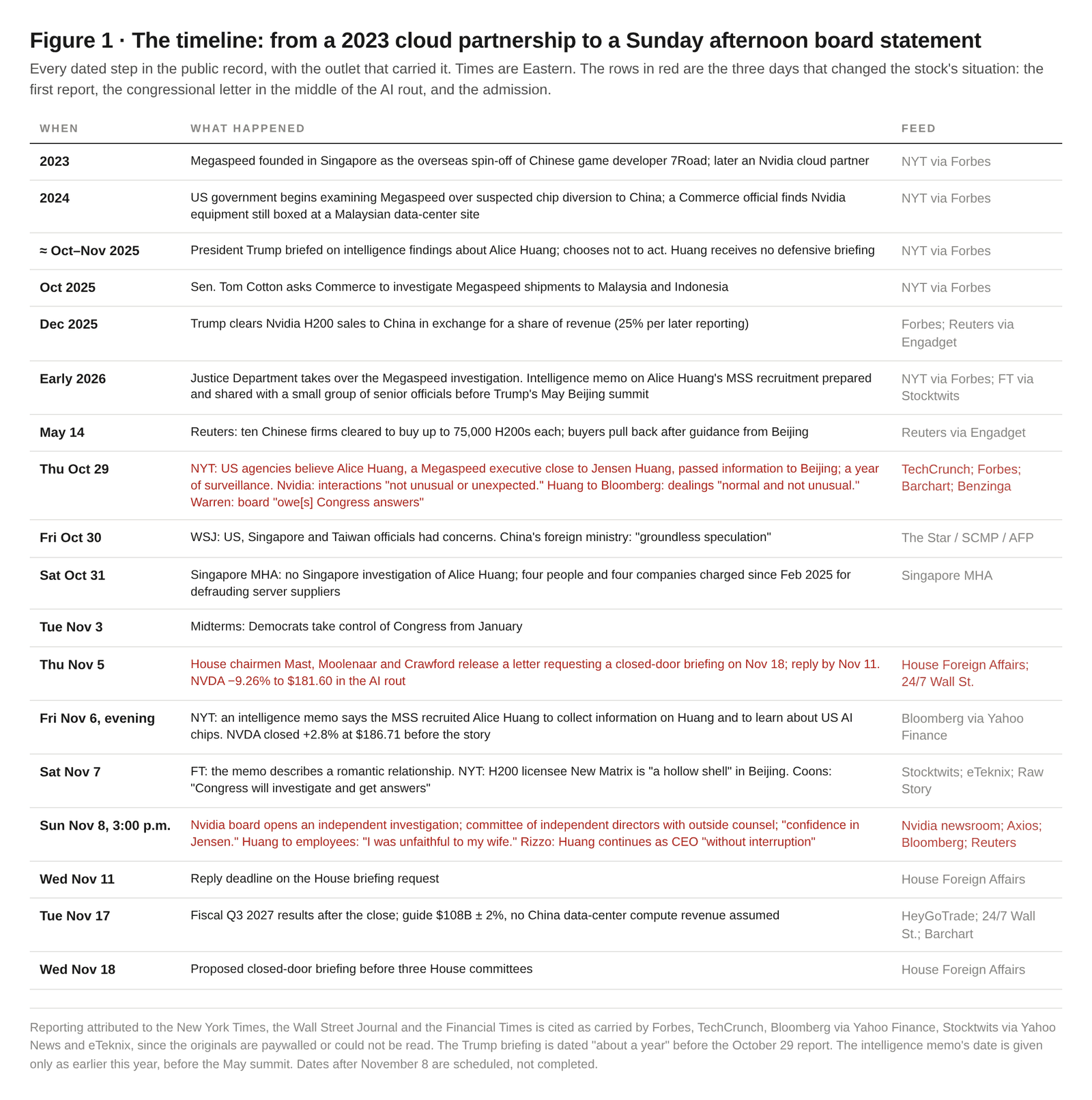
At 3:00 p.m. ET on Sunday, November 8, Nvidia issued a six-sentence statement from its board (Nvidia newsroom). Within six minutes Axios and Bloomberg had Huang's message to staff and within 16 minutes Reuters had both (Axios; Bloomberg Law; Reuters, via Investing.com). It wasn't by accident. Ten days of reporting from the NYT, the WSJ and the FT had put a US intelligence memo into the public domain, three of the House committee chairs had requested a closed-door briefing from Huang and the man who runs the most valuable company in the world had said absolutely nothing in his own voice since the Bloomberg interview on October 29. The apology and the investigation came together because the board needed the first before it could move on to the second.
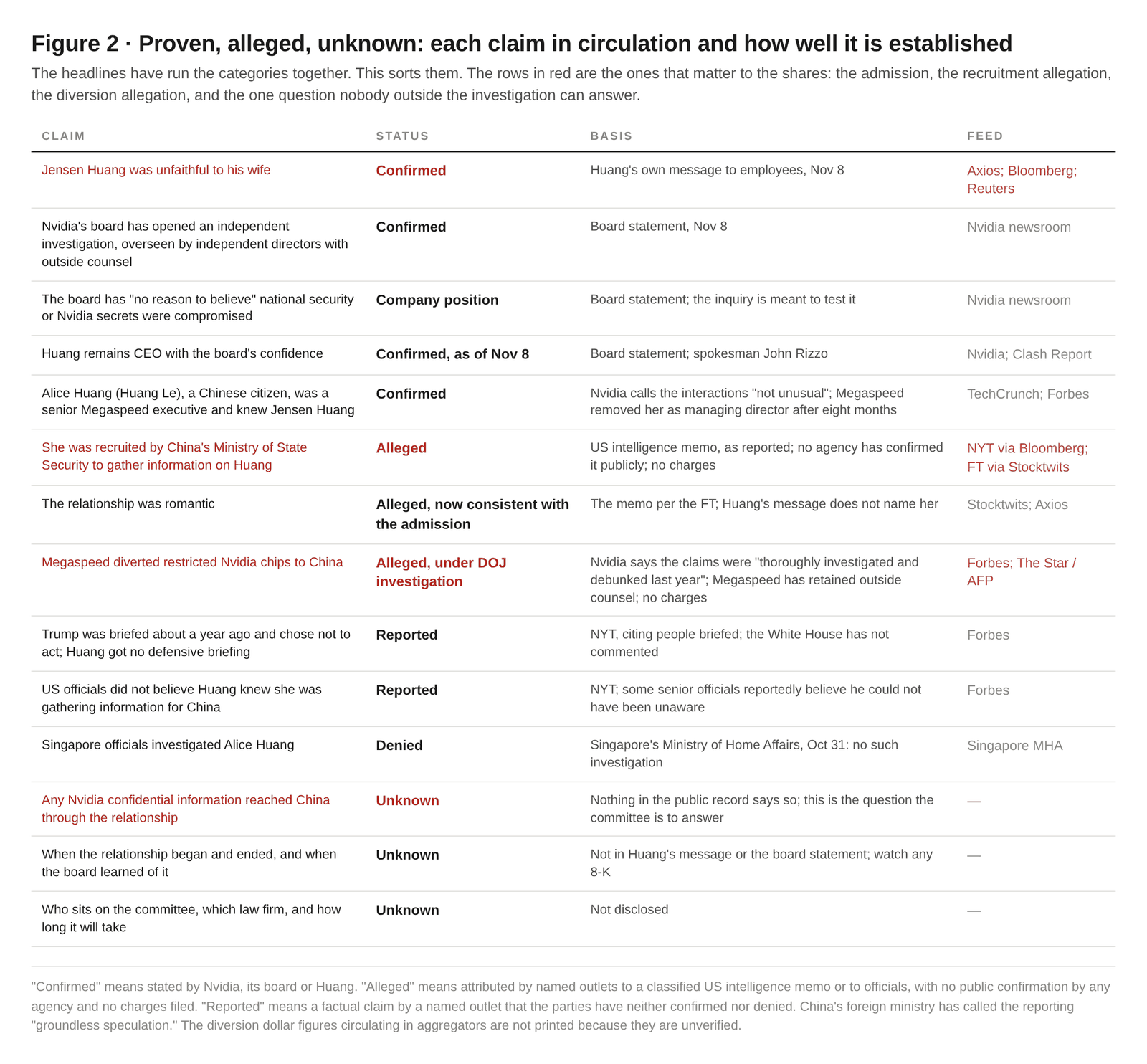
What follows is the separation of three very distinct categories which the headlines have effectively blended together: what Huang and Nvidia have confirmed, what the US officials are reported to believe and what nobody outside of a classified briefing room actually knows.
What did Jensen Huang actually say?
The message is extremely short and very personal in nature. It's a note to the Nvidia staff (not a press release) and has been obtained by Axios (who describe it as a draft email), Bloomberg (who describe it as a memo to staff) and NBC (who say Nvidia shared it) (Axios; NBC News). The text that all the outlets report is the same: "I owe my family and all of you an apology. I was unfaithful to my wife. My actions hurt her and our children. There is no excuse for what I did." He says he is "deeply sorry", that "Leading NVIDIA is the privilege of my life", that he is "fully committed to NVIDIA" and that he will "work to earn back" the trust that has been lost (OfficeChai, carrying the Axios text; Bloomberg Law). According to Axios' summary he takes full responsibility and says he fell short of his duties to the board, the shareholders and the employees. On the national security matter he merely states that the board has launched an independent investigation and that he supports that and will co-operate fully.
Read what isn't there. The message makes no mention of the other person. It gives no indication of when the relationship began or ended. There's no mention at all of whether any company information was passed on and it says nothing about whether he knew, or ought to have known, who she was alleged to be. Those are the questions now being passed on to someone else by the board.
Nvidia's John Rizzo said that Huang is "committed to continuing to lead NVIDIA as CEO without interruption" and that the news "will not slow NVIDIA" (Clash Report; OfficeChai).
What did the Nvidia board say? Who's looking into it?
The board statement, in full (Nvidia newsroom; GlobeNewswire, 3:00 p.m. ET):
"The NVIDIA Board is initiating an independent investigation in light of recent reporting that founder and CEO Jensen Huang has been the target of a foreign intelligence effort. A committee of independent directors, assisted by outside independent counsel, will oversee the investigation. The Board prioritizes U.S. national and economic security, which is paramount to the interests of NVIDIA and its shareholders. While the Board has no reason to believe that either national security or NVIDIA secrets were compromised, the Board's inquiry will examine all available information. Jensen fully supports the review and has committed to cooperating with it. The Board has confidence in Jensen and his leadership team and will provide further updates as appropriate."
Three things are clear to the shareholder. First, the scope as set out is whether "national security or NVIDIA secrets were compromised" rather than whether the CEO's conduct was in breach of company policy or whether the relationship should have been disclosed to the board at an earlier stage (the committee with outside counsel will very likely go on to look at those issues as well, but that is not promised in the statement). Second, no committee members are named, no law firm and no timeline is provided. The proxy statement (May 12, 2026) names Stephen C. Neal as Nvidia's lead independent director and chair of the nominating and governance committee; Brooke Seawell is chair of audit and Dawn Hudson is chair of compensation (Nvidia proxy statement, SEC). It's not stated whether or not Neal will be leading the review. Thirdly, the board have expressed their confidence in Huang on the very same day that the file was opened, which is the usual position if the board intend to keep the CEO and the odd one out if they don't. No Form 8-K had been reported as of Sunday evening; one may follow on Monday.
Who is Alice Huang and what do the US intelligence reports allege?
Everything in this section is reporting on intelligence (not intelligence per se) and that distinction is absolutely vital to the stock.
The first story was the NY Times on Thursday, October 29. It was citing people briefed on the classified intel to report that Alice Huang (also known as Huang Le), a Chinese citizen and a senior executive at Megaspeed (a Singapore-based cloud company), had developed a close relationship with Jensen Huang and that US agencies believed she was passing information to Beijing. She had been under US surveillance for about a year and had been photographed at a number of dinners with Huang in the region (TechCrunch on the Times report; Forbes). The two are not related. The Times also reported that President Trump had been briefed on the findings about a year earlier and had decided not to do anything, reportedly on the grounds that it would have a negative impact on Nvidia's chip sales and on the trade relationship with China. Huang had never received a defensive briefing (the warning that US officials will sometimes give to a citizen who is being targeted by a foreign intelligence service). US officials did not believe Huang knew that she was gathering information for China, although some of the more senior people in the administration did believe he could not have been unaware (Forbes).
The WSJ picked up the next day (October 30) with a report that US, Singapore and Taiwan officials were all concerned about her. Singapore's MHA responded the following day to state that "neither the Singapore Government nor its officials said this" and that "there were no such investigations conducted in respect of Alice Huang". They added that Singapore does not unilaterally enforce the export controls of other countries, but that it has already charged four individuals and four companies since February 2025 for fraud against server suppliers (Singapore MHA, October 31). China's foreign ministry spokesman Guo Jiakun dismissed the Times report as "based on groundless speculation" and "aimed at smearing and slandering China" (The Star, via SCMP and AFP).
Then the memo. On Friday evening (November 6) the Times reported that administration officials had learned of the allegations from an intelligence memo which stated that the Chinese Ministry of State Security had recruited Alice Huang to gather information on Jensen Huang and that the agency was looking into US AI chips and potentially looking to get Nvidia to make its most advanced chips available to China (Bloomberg's account, via Yahoo Finance). The FT followed up shortly afterwards with the detail that the memo described the two as being in a romantic relationship, that it was prepared earlier in the year (just prior to the Trump summit in Beijing) and that it had been passed to a small group of senior officials prior to that trip (Stocktwits, via Yahoo News; TechCrunch). Neither the CIA nor the ODNI responded to requests for comment on Friday night and the White House has said nothing.
Nvidia's position up until Sunday was the same. "Jensen's interactions with Ms. Huang are not unusual or unexpected," they said on October 29 (TechCrunch). Regional cloud customers "receive ordinary business information", not trade secrets (Rizzo). After the memo story Nvidia said its cloud partners "do not ask us to seek changes in US law or advocate for sales to China", that it neither holds nor shares classified information with its customers and that if you went through the partner network looking for such information you would have "hit a dead end" (Bloomberg, via Yahoo Finance). Huang himself told Bloomberg on October 29 that the dealings with Megaspeed were "normal and not unusual" and that Nvidia had checked the chips at Megaspeed and found none had been diverted to China (Barchart, via Yahoo Finance). That was the position for ten days. Sunday's statement was different in one small respect. The relationship was not ordinary.
What is Megaspeed and what are the chip diversion allegations?
Megaspeed International is a Singapore-based AI cloud provider which was set up in 2023 when the Chinese game developer 7Road spun off its overseas operations. It is an Nvidia cloud partner and works by purchasing Nvidia systems and then leasing out the compute power to Chinese companies and others (the Times, via Forbes). The US government has been looking at it since 2024 on the basis of allegations that it had diverted restricted chips to China. A Commerce Department official in 2024 reportedly found Nvidia equipment still in the boxes at a data-center site in Malaysia. Senator Tom Cotton asked Commerce in October 2025 to look at its shipments to Malaysia and Indonesia and the Justice Department has taken over the investigation this year (Forbes). No charges have been brought. Megaspeed says it is "committed to getting to the facts behind these allegations", that "outside counsel has been retained to conduct a thorough internal investigation" and that it is working with the US government. Alice Huang was removed as managing director in its filings after just eight months, though she described herself as the CEO (Forbes; Barchart). Nvidia's position is that "the diversion allegations against this regional cloud were thoroughly investigated and debunked last year" (The Star, citing AFP). There are a number of dollar figures in the aggregators relating to the alleged diversion (one says $2bn, the other $4.8bn) but none of these are verified and none are presented as fact.
The diversion issue is critical to the stock in a way the romance isn't. Nvidia's Southeast Asian cloud partners are a sales channel and the US government's appetite to license chips into that channel is a policy issue. That's where Washington comes in.
What is Washington doing?
On November 5 the chairs of the House Foreign Affairs Committee, the Select Committee on China and the Intelligence Committee (Brian Mast, John Moolenaar and Rick Crawford) issued a letter requesting that Mr. Huang attend a joint closed-door briefing on November 18 on his interactions with Alice Huang (whom the letter refers to as a publicly reported PRC intelligence asset) and on Nvidia's own safeguards against espionage, with a request for a response by November 11 (House Foreign Affairs Committee). "Recent reports raise significant national security concerns regarding the PRC's access to sensitive U.S. technology," they state; "it is vital that Congress determines the extent to which U.S. national security has been placed at risk." That's a request for a briefing. It's not a subpoena. It's not a hearing. It's not a charge.
The politics have changed under it. Democrats took control of Congress in the midterms. Warren announced on October 29 that "Huang and NVIDIA's board owe Congress answers" (Benzinga, via Yahoo). Chris Coons, who is due to take over as chair of Foreign Relations in January, said on Saturday that "Congress will investigate and get answers" (Raw Story). You've got a company whose CEO lobbied the White House for China sales and whose political cover was a President who was briefed and did nothing, about to be faced down by a legislature which sees both of those as the scandal.
The very same week we also had another piece of reporting that was much more on the revenue side of things. On Saturday the Times reported that the Commerce Department had approved some two dozen Chinese companies to go ahead and buy or otherwise deal in Nvidia's H200 chips under the December 2025 arrangement which gives the US government a cut of the sales. One of the companies approved (New Matrix, a server assembler based in Beijing) was found to be operating out of a "hollow shell of a building with wires dangling where the lights should be" and the owners of that company were linked in the filings to Wise Road, a private equity fund which was placed on the Commerce Department entity list in 2024. A second licensee, Maginfra, was reportedly just as deserted when it was visited in September (eTeknix, citing the Times; TechCrunch). BIS said every application is "carefully reviewed for national security risks". For Nvidia the actual exposure is trivial as the China business is already effectively zero. Reuters reported in May that 10 Chinese firms had been approved to buy up to 75,000 H200s each with a 25% cut to the US Treasury and that those firms had in fact backed off following guidance from Beijing (Engadget, citing Reuters). H200 shipments to China were less than 1% of data center revenue in the July quarter according to one source (eTeknix) and Nvidia's $108bn guidance for the quarter it reports on November 17 assumes zero data center compute revenue from China (Barchart). The China upside that Huang spent two years fighting for is simply not in the numbers. That's the irony of the memo. Whatever Beijing thought it was going to get through him, it hasn't got it.
What's Nvidia's share price?
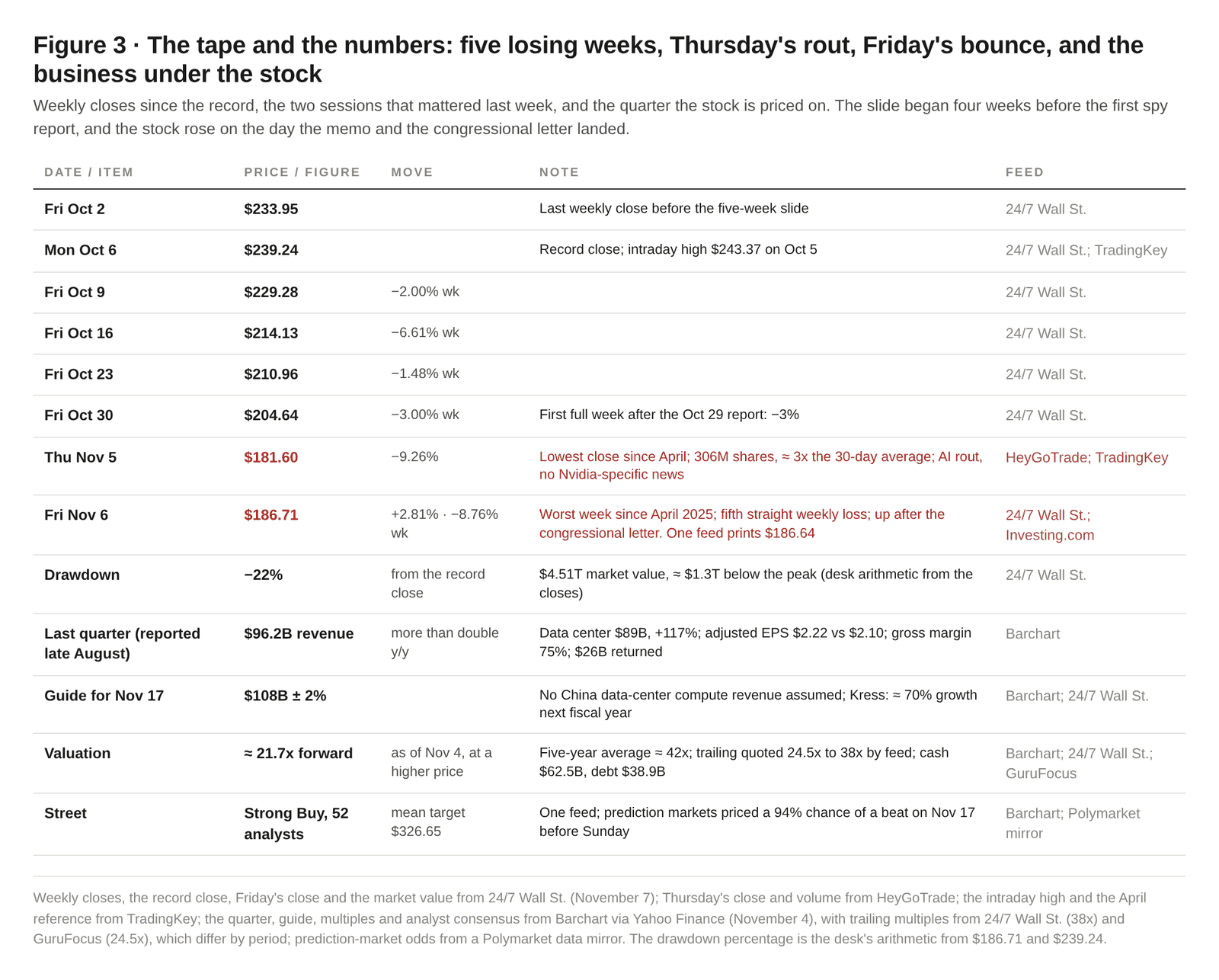
Nvidia closed Friday at $186.71 (up 2.8% on the day) following Thursday's 9.26% fall to $181.60 (its lowest close since April) on 306m shares (about 3x the 30-day average) (24/7 Wall St.; HeyGoTrade). The week was down 8.76% (the worst since April 2025 and the fifth consecutive weekly loss), a run that began from a $233.95 close on October 2 (the record close being $239.24 on October 6 and the intraday high being $243.37 the day prior), so it's down around 22% from its peak and the company is now worth around $4.5tn (roughly $1.3tn less than at the peak) (24/7 Wall St.; TradingKey). Note the makeup of that drawdown. The spy story came out on October 29 and the stock was already down for four weeks. The 9% drop on Thursday was the AI rout (the Philly semiconductor index down 12% that day, with nothing Nvidia-specific reported) and the stock actually went up on Friday after the memo and the letter to Congress. The market has so far treated the Huang story as just noise in the context of a repricing of the AI trade. The first day where the admission (rather than the allegation) is the story is Monday.
Same story under the stock as the one that reported in late August: $96.2bn in revenue (more than double the year prior), $89bn in data center revenue (up 117%), $2.22 in adjusted earnings (vs $2.10 expected), 75% gross margin, $26bn returned to shareholders in the quarter, a guide of $108bn (+/-2%) for the quarter it reports on Tuesday, November 17 (after the close), and a CFO who said next year's growth should be near 70% (Barchart; 24/7 Wall St.). Cash was $62.5bn against $38.9bn of debt. The multiple has compressed with the price: Barchart had it at 21.7x forward earnings on November 4 (at a higher price) as opposed to a five-year average of near 42; trailing multiples vary from 24.5 to 38 depending on the feed and period. 52 analysts have a consensus Strong Buy with a mean target of $326.65 (one feed) and prediction markets were pricing in a 94% chance of an earnings beat on November 17 prior to the news on Sunday (Barchart; Polymarket data, via a mirror).
What to do with NVDA stock now
The desk says Hold, and the reason why is far more important than the word itself.
Split the two events. The admitted one (the infidelity) is a personal failing which has absolutely nothing to do with how many Blackwell and Rubin systems get shipped this quarter. The other one (that a foreign service targeted the CEO) is a statement about the adversary, not about Huang's behavior, and the board says it has no reason to believe that anything has been compromised. Neither of those is a fact about demand, supply, margin or the capital spend of the five companies that buy the vast majority of what Nvidia sells. The 22% drawdown in the stock was the result of a completely different question, namely whether the AI buildout is going to be able to make its money back. That question will be answered by the hyperscalers' cash flows and the Nvidia report due on November 17, not by a committee of independent directors.
The risk that's new. Nvidia is the most founder-dependent large-cap company in the world and no successor has been named. The inquiry opens up a path which didn't exist on Friday, a path by which the board could conclude that Huang misled them, that he withheld a material relationship or that he exposed the company, and that path ends in a CEO transition which the market has never had to price. I'd put a very low probability on that happening: the board expressed confidence on the day the inquiry was opened, the government which holds the intelligence declined for a year to warn him and the reporting itself states that the officials didn't believe he knew. Very low is not zero and that's why this isn't a Buy on the Monday dip. You can't analyze a sealed file from the outside and the company's own problems this month are still there. That's also why it's not a Sell. The pattern in the prior CEO conduct cases at large companies has been a one-day markdown and a recovery wherever the business was intact, and in this case the business is growing 100% with a 75% gross margin. If your position is too large to sit through a 10% gap on a Monday headline then that was true before this story and that's the thing to fix.
So: hold what you own. Don't get caught up in the scandal as that's not what's caused the share price to fall and you'd be buying the wrong dip. Don't sell on it either, as the admitted facts in no way affect the franchise, and the alleged facts are still all about Beijing's intentions rather than Nvidia's secrets. Let November 17 and 18 do the talking. The 17th will tell you whether the business is what the guide says. The 18th will tell you whether Huang can walk into a room with the China committee and come out as CEO.
What would change the view?
Any finding that information moved. If the committee, Congress or the DOJ ever find evidence that Nvidia confidential information, roadmaps or export control strategy reached Chinese intelligence via that relationship, then the key-person risk stops being a tail risk and the shares should be sold regardless of what the quarter says.
A disclosure issue. If it turns out that the board or Huang knew about the relationship, or indeed about the government's interest in Alice Huang, at a time when that was material and not disclosed, then the legal exposure is a very different beast. Derivative suits are possible and so is a different kind of investigation. Watch Monday's 8-K (if there is one) to see what the board knew and when.
The briefing. November 18 is the first time Huang is up before Congress on this. The base case is a reply by November 11 that accepts that date. A refusal or a subpoena are not the base case.
Licensing. The New Matrix story is the one that can touch revenue (not via the China sales, which are already out of the guide) through Commerce's willingness to license the Southeast Asia cloud channel. A revocation of the H200 licenses would be a very low cost for Nvidia. A review of the cloud partner program would be a higher cost.
The quarter. $108bn +/-2%, gross margin right around 75% and January guidance that still has 70% growth in sight would completely bury the argument that this month's drawdown was all about Nvidia. Anything less and the Huang file becomes the second issue rather than the key one.
Quick answers
Is Jensen Huang stepping down as CEO? No. The board has stated that it "has confidence in Jensen and his leadership team" and Nvidia has confirmed that Jensen will remain CEO "without interruption" throughout the course of the investigation.
Did Nvidia confirm that Huang was involved with a Chinese spy? No. Huang admitted to infidelity. The spy allegation is from a US intelligence memo which the NY Times and the FT have reported. It's not something that's been formally found, charged or stated by any agency. China has of course denied it.
Did Nvidia's secrets get to China? The board has "no reason to believe" they did and Nvidia itself says it has no classified information. The probe is meant to put that to bed. It hasn't yet.
When does Nvidia report? Tuesday, November 17, 2026, post-close, with a call at 5 p.m. ET. Guide is $108bn +/-2% (ex China data center compute).
What's the stock doing? NVDA closed at $186.71 on Friday, November 6. That's some 22% down on its record close of $239.24 set on October 6 and down for the fifth week in a row.
Not investment advice. That's the author's opinion. The allegations set out above are reported, not proven, and no charges have been brought against Jensen Huang, Alice Huang or Megaspeed.
Sources and data notes
Nvidia board statement, November 8, 2026 (3:00 p.m. ET), also on GlobeNewswire; Jensen Huang's message to employees via Axios, Bloomberg Law, Reuters via Investing.com (3:16 p.m.), NBC News, Forbes (3:34 p.m.) and OfficeChai; Nvidia spokesman quotes via Clash Report; board composition from Nvidia's 2026 proxy statement (SEC).
The NYT October 29 report (via TechCrunch and Forbes); the NYT November 6 memo report (via Bloomberg on Yahoo Finance); the FT November 7 report (via Stocktwits on Yahoo News and TechCrunch); the Times' New Matrix report (via eTeknix); Singapore Ministry of Home Affairs, October 31; China's foreign ministry (via The Star); House Foreign Affairs Committee release, November 5; Warren (via Benzinga on Yahoo); Coons (via Raw Story); H200 licensing (via Engadget citing Reuters, May 14, 2026).
Market data: 24/7 Wall St., November 7 for the closes, the weekly series and the market value; HeyGoTrade for Thursday's volume and the earnings date; TradingKey for the record high and support levels; Barchart on Yahoo Finance, November 4 for the quarter, the guide, the multiples and the analyst consensus; CappNotes for Friday's index closes. Friday's close is $186.71 on one feed and $186.64 on two others (the difference is after hours). The drawdown and the five-week decline are the desk's arithmetic from the closes shown. The unverified dollar figures are not presented as fact. Nothing in this piece is in any way asserting what any classified document says beyond what the named outlets have reported.
TrendyVest provides market research and commentary for informational purposes only. Not investment advice. Research with receipts.