Intelligence Brief · weekend long read
Micron's $1,500 sprint: the coil, the cash and a buyback switch that flips on day 60
MU must rally 46% in 42 sessions to get there. It already did that once inside this same range; it trades at 5.8 times next year's consensus earnings, and the capital-return window the company wrote into its 10-K opens on the last day of the clock. Here is the bull case, with receipts, and what must go right.
trendyvest.com · Sunday, October 11, 2026
Micron just reported the kind of quarter that usually gets a stock re-rated. Revenue of $54.23 billion, almost five times the $11.32 billion of a year earlier. Adjusted earnings of $33.42 a share. Guidance for the current quarter of $61.5 billion in revenue and $38.15 a share. The stock closed at $1,065.11, up 3 cents from the previous day.
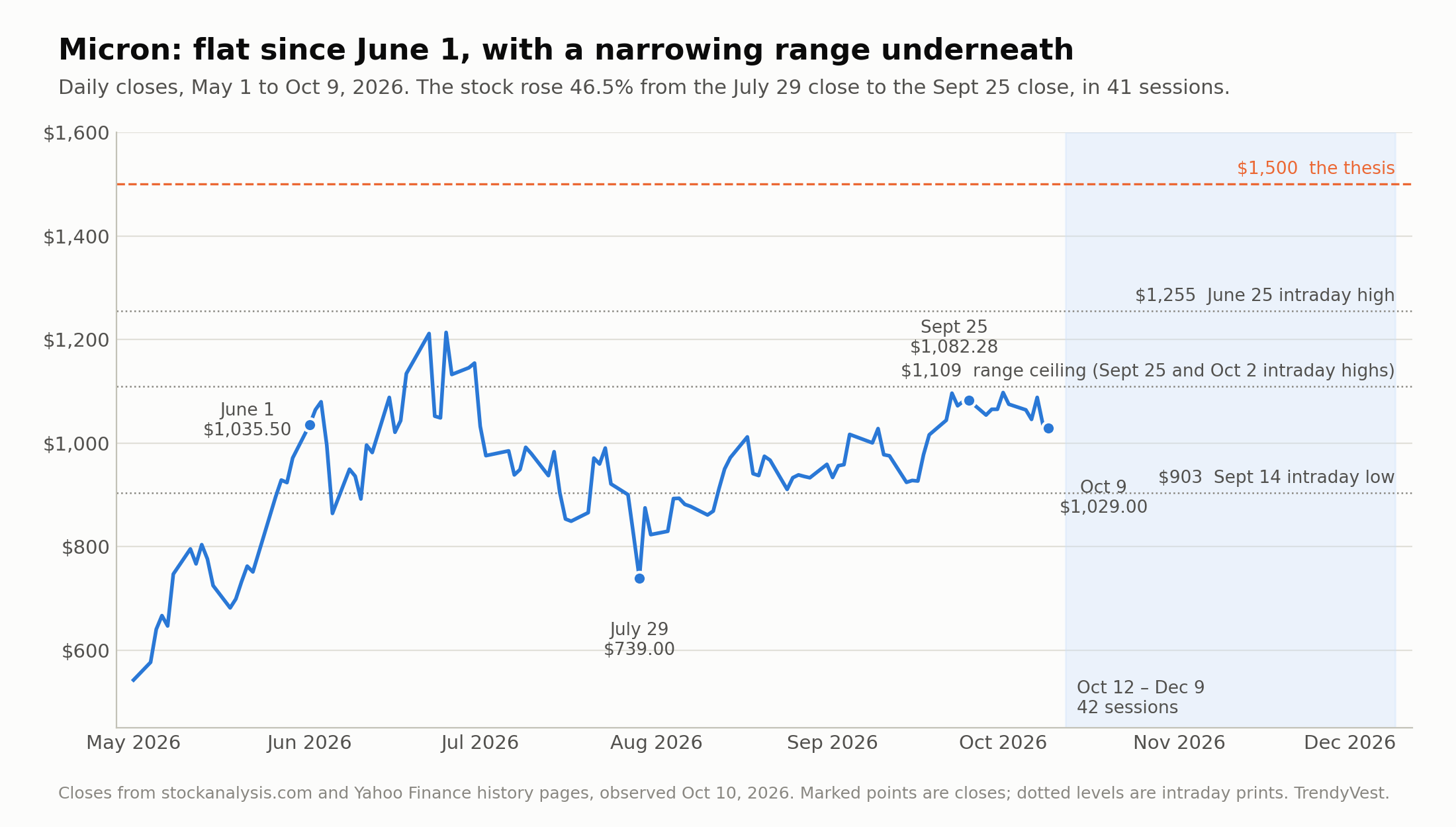
That non-reaction is the set-up. Micron closed on Friday, October 9, at $1,029.00, down $6.84. On June 1 it closed at $1,035.50. Four months later, after a 41% drawdown and a full recovery, the stock sits 0.6% below where it started. The earnings estimates underneath it have kept rising.
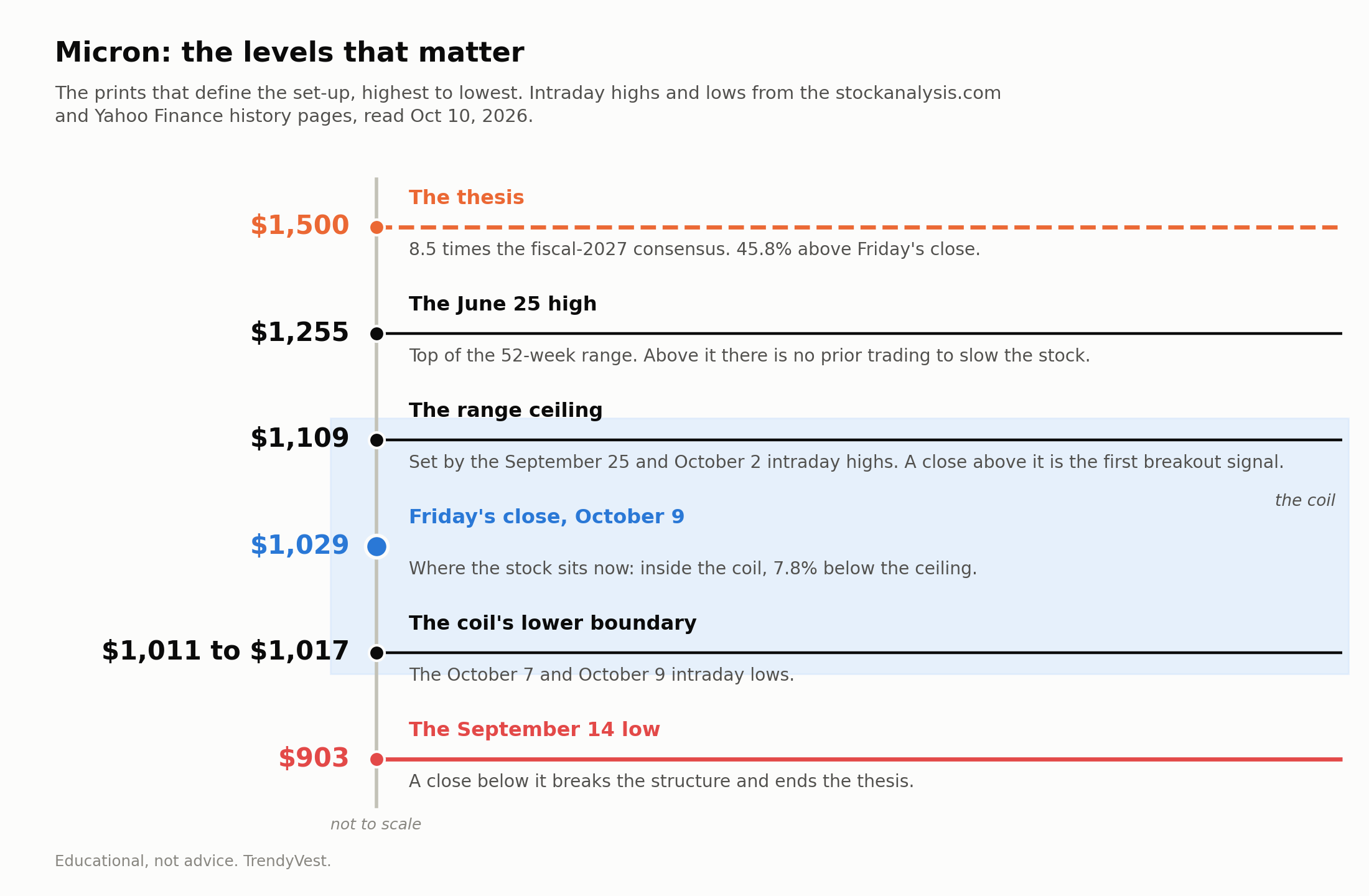
Our thesis is aggressive, so we state it plainly. Micron can trade above $1,500 by December 9. That is 45.8% above Friday's close and 19.5% above the June 25 intraday high of $1,255. We are not calling it the base case. We argue it is a credible upside scenario and lay out exactly what has to happen for it to play out.
A word on the numbers. Every price in this piece is a closing print unless it says intraday, every percentage is our own arithmetic from those prints, and every figure is sourced in the note at the end.
First, the receipts: what is true and what is not
Two parts of the popular bull story need tightening before anything gets built on them.
"Analysts see $3,000." One does. On October 7, D.A. Davidson's Gil Luria raised his 12-month target to $3,000 from $2,100, the highest on the Street, and kept his Buy rating. His target assumes about 19 times fiscal-2027 earnings, versus roughly six times today, and rests on an earnings estimate near $158 a share, in line with the Street rather than above it. The stock rose 4.06% that day, to $1,088.00. The next highest targets are $2,000 at Cantor and Barclays, $1,950 at Phillip Securities and $1,900 at Rosenblatt. The averages run from $1,408 across 46 ratings at MarketBeat to $1,555 across 49 analysts at StockAnalysis and $1,622 across 28 at TipRanks. All of these are 12-month targets. None of them are 60-day calls.
"It has been trading sideways." On a net basis, yes. Since June 1 the stock is flat. It has not been quiet. Over those four months, it has traded from an intraday low of $737.88 on July 29 to an intraday high of $1,255.00 on June 25, so sideways here means a wide, violent base. The base is interesting because of its shape. The highs keep getting lower, and the lows keep getting higher.
The coil, with levels
Here is the structure, from the daily prints.
The highs: $1,255.00 on June 25, then $1,108.72 on September 25, then $1,108.00 on October 2, all intraday. The lows: $737.88 on July 29, then $902.60 on September 14, then $1,011.42 on October 7. The spread between each month's highest and lowest close is shrinking: $350 in June, $293 in July, $182 in August, $172 in September, and $68 so far in October.
Chartists call this a contracting triangle. In plain terms, buyers and sellers are converging on a price, and the resolution usually arrives as a sharp move in one direction. Volatility is compressing along with the range. Based on daily closes, annualized realized volatility over the last 20 sessions is about 48%, versus about 72% over the last 60.
The detail most bulls miss is that the 46% move has already happened once inside this range. From the July 29 close of $739.00 to the September 25 close of $1,082.28, Micron gained 46.5% in 41 trading sessions. The window in this piece, Monday, October 12 through Wednesday, December 9, holds 42 sessions. The stock has the velocity. What it needs is a reason.
Why $1,500 is a multiple call, not an earnings call
A price target is earnings multiplied by a multiple. Micron's earnings are not the bottleneck.
Start with the run-rate. The fiscal first-quarter guide of $38.15 a share, multiplied by four, is $152.60. At $1,029, that is 6.7 times, and management has described the first quarter as the floor for fiscal-2027 gross margins.
Then the consensus. The fiscal-2027 estimate, for the year ending in August 2027, is $176.15 a share, inside a range that runs from $161 to $214.70. That puts the stock at 5.84 times forward earnings, the figure StockAnalysis prints on its quote page.
Then the bulls are above consensus. On October 1, Morgan Stanley's Joseph Moore raised his fiscal-2027 estimate to $182.52 from $168.52 and kept an Overweight rating with a $1,200 target, a $1,650 bull case, and a $675 bear case.
Now the bridge. Divide $1,500 by $176.15, and you get 8.5 times forward earnings. On Morgan Stanley's number, it is 8.2 times. On the Street's low estimate of $161, it is 9.3 times. Luria's $3,000 needs about 19 times his own estimate, or 17 times the consensus. Reaching $1,500 requires less than half of that.
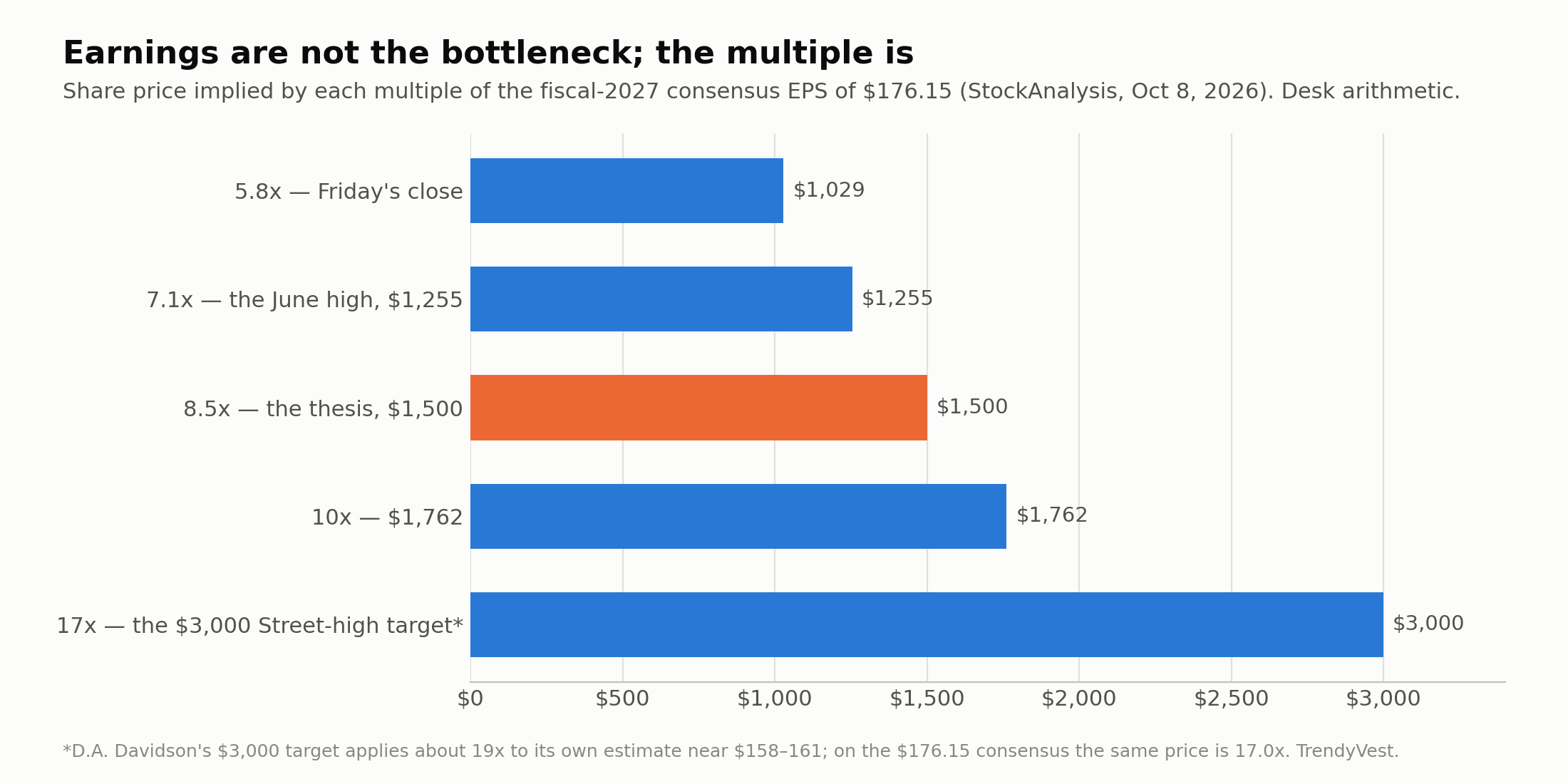
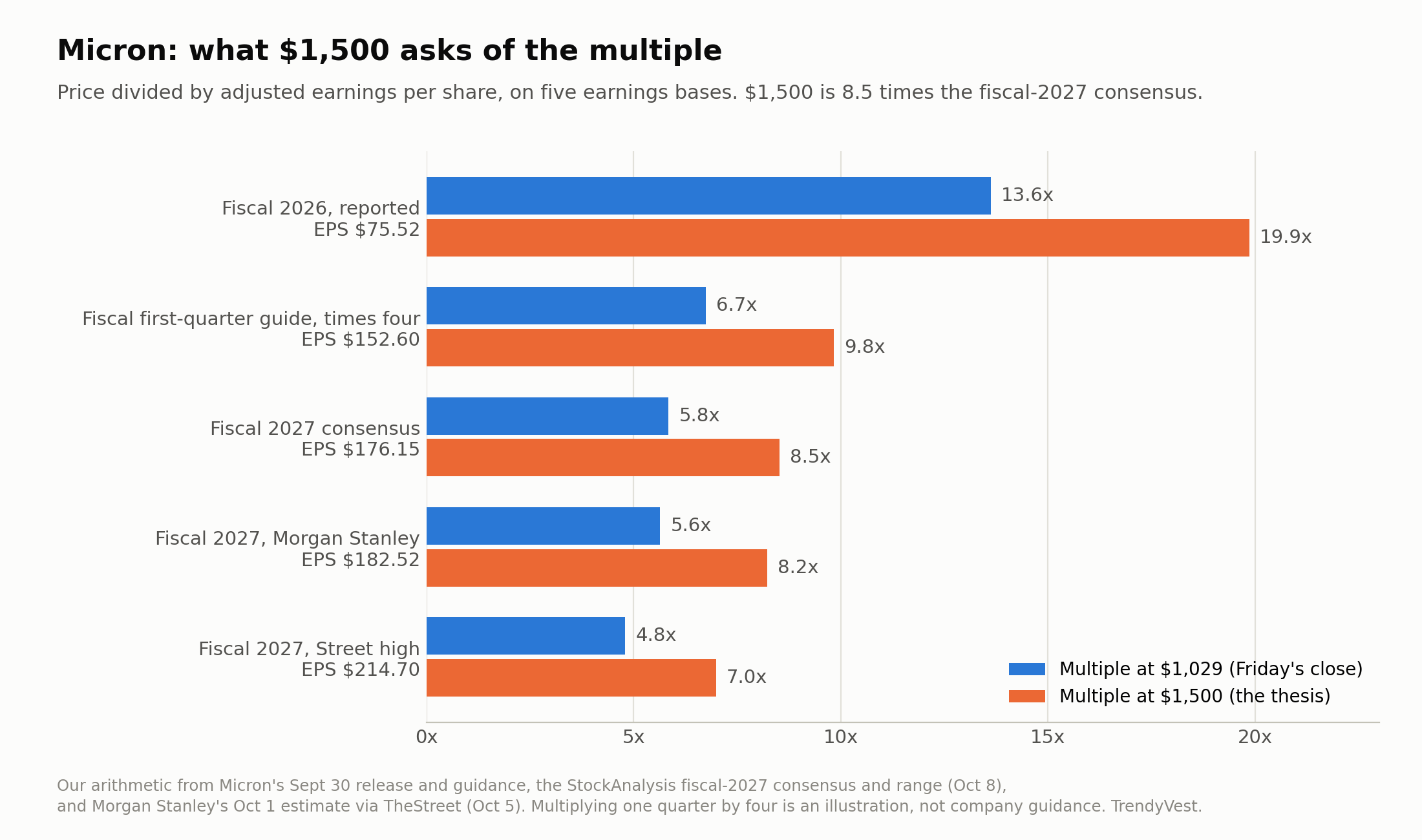
Our arithmetic is based on company-reported results, guidance, and published estimates. Multiplying one quarter by four is an illustration, not company guidance.
The $1,500 case does not need the market to treat memory like Nvidia. It needs the market to treat Micron a little less like a commodity than it does today. The trailing multiple is 13.8, and the forward multiple is 5.8 because earnings have grown faster than the price. Low multiples do not fix themselves. The market can keep discounting earnings it believes are temporary. The question for the next 42 sessions is whether something changes that belief.
The analysts: who is where
Fourteen of the 22 targets we could verify sit at or above $1,500. Dates are the most recent action published by each firm.
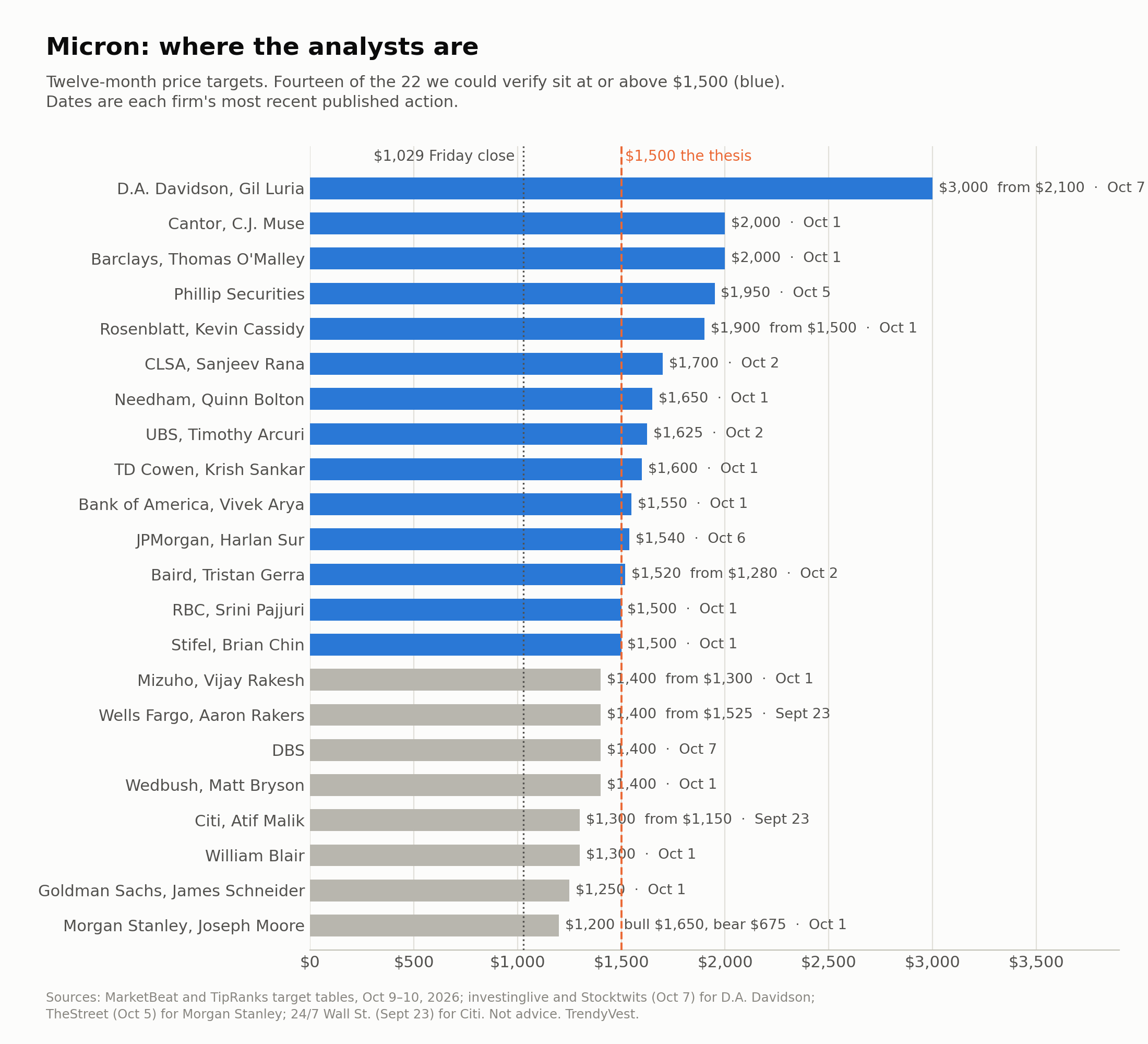
The number that should catch your eye is in Luria's own math. The Street's most bullish target rests on a fiscal-2027 estimate near $158, below the $176.15 consensus. The whole debate is about the multiple, and multiples can change in a week. This one did in May, when the stock went from $542.21 to $971.00 in 20 sessions.
What the market is missing
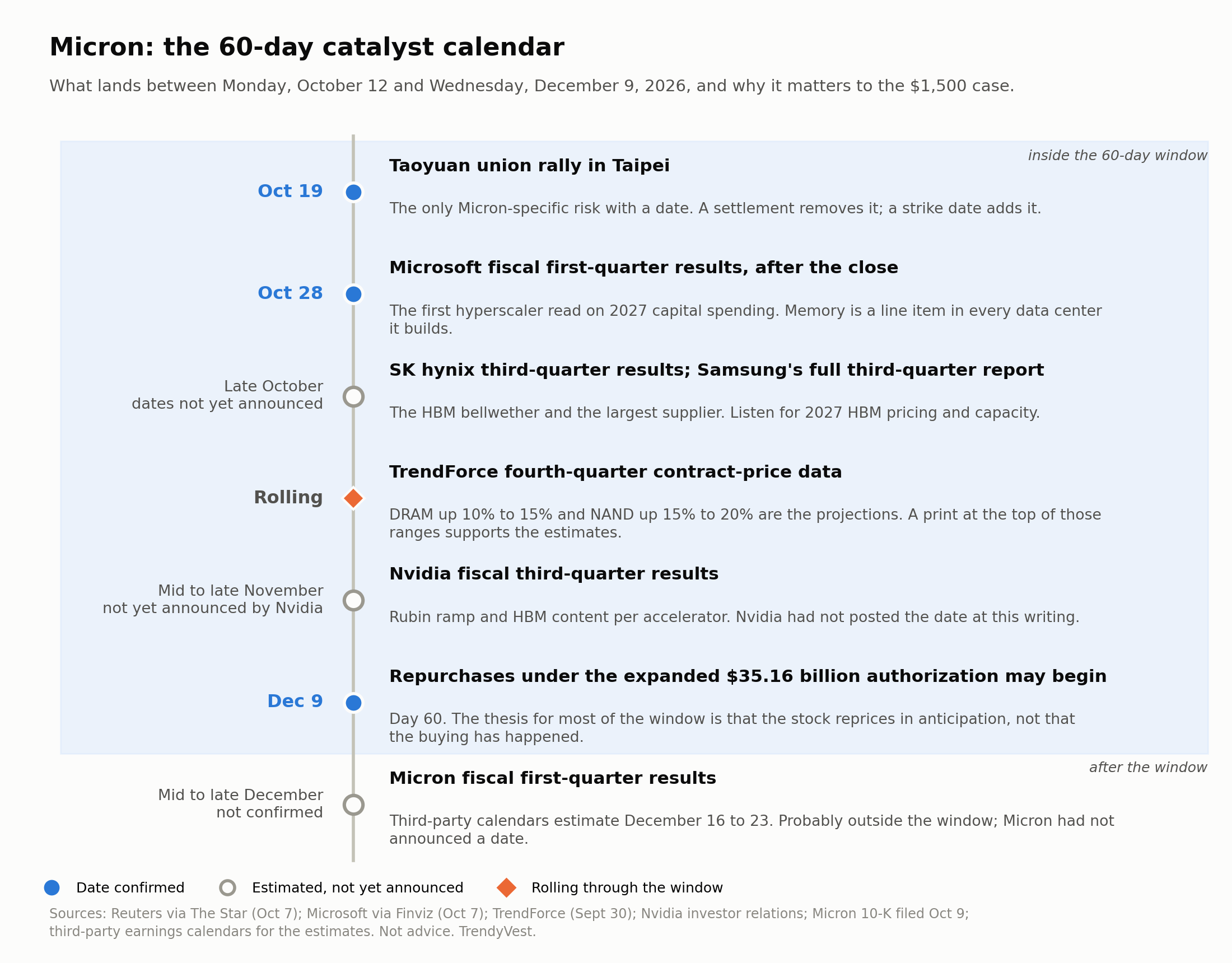
1. The buyback switch is written into the 10-K, and it flips on day 60. On the September 30 call, management had about $2.2 billion left on a 2018 authorization and said it would seek more. It said it intends to increase capital returns starting December 9, 2026, and that it expects to return 100% of excess cash over time, mainly through buybacks. The 10-K filed on October 9 answers the first part. On October 8 the board authorized an increase in the maximum amount of discretionary repurchases to be made from December 9, 2026, to $35.16 billion. The program has no expiration date, does not obligate the company to buy, and operates under Micron's CHIPS Act direct funding agreements. The 2018 program authorized $10 billion and used $7.84 billion through September 3, leaving $2.16 billion, based on my subtraction.
The cash to fund it is already there. Micron ended the year with $73.48 billion of cash and investments against about $5.18 billion of debt. That is $68.3 billion net, or about $60 a share on the 1,131 million shares outstanding as of October 2. Fourth-quarter operating cash flow was $43.97 billion and adjusted free cash flow was $33.20 billion. Full-year free cash flow was $62.31 billion. At Friday's price, $35.16 billion retires 34.2 million shares, about 3% of the count. That arithmetic alone does not produce a 46% move. It creates a demand floor with a start date from a buyer whose last quarter of free cash flow, annualized, is about 11% of its market value. Funds underweight as of that date will compete with the company for stock. This is an illustration, not a purchase forecast. The pace is management's call.
2. A $150 billion backlog changes what kind of company this is. Micron has signed 26 strategic customer agreements covering about 35% of its total production bit volume through 2030, slightly less for DRAM, and most pricing frameworks include floor and ceiling bands. The 10-K puts it in filing language: pricing subject to minimum and maximum bands, with some agreements structured as take-or-pay, carrying binding commitments for contractually enforceable volumes over multi-year terms. Management put remaining performance obligations at about $150 billion on the call. The 10-K's accounting figure is approximately $134 billion, of which $13 billion has already been recognized as contract liabilities, with about a quarter expected to become revenue over the next twelve months. Customer financial commitments total $32 billion, mostly cash deposits, and nearly all are scheduled to be repaid between 2029 and 2031. For 2027, more than 75% of shipments are already committed, and the company says it has significantly increased pricing. Commodity businesses do not take deposits years in advance.
3. HBM pricing is about to step up, industry-wide. TrendForce raised its 2027 high-bandwidth-memory outlook on September 29. Blended average selling prices are now projected to jump 121% year over year, the market is expected to remain supply-constrained through 2027, and even the worry that GPU makers will cut stack heights carries a price: 8-high products are expected to command a 10% to 20% premium per gigabit over 12-high products next year. Micron is the smallest of the three suppliers, with an 18% share of HBM revenue in the second quarter, behind SK hynix at 50% and Samsung at 33%, by Counterpoint's count. Smallest share, same price curve.
4. Conventional memory is still rising, and the one accelerating category is the AI one. TrendForce's September 30 projection has conventional DRAM contract prices growing 10% to 15% quarter-on-quarter in the fourth quarter, and NAND flash 15% to 20%. The pace of increases is expected to moderate, and consumer categories are under pressure, but enterprise SSDs are the only category where price growth is expected to accelerate. Micron's own words on the call matched that view. Growth continues, in the chief financial officer's phrase, albeit at a more moderate pace, and management expects supply and demand to be tighter in calendar 2027 and 2028 than in 2026.
5. The latest selloff came from headlines, not from Micron. The stock fell 4.79% on October 8, to $1,035.84 from $1,088.00. That was the day the Financial Times reported OpenAI's annualized revenue near $50 billion rather than $70 billion, a gap that came down to how partner revenue is counted, and the day Samsung guided a third-quarter operating profit of about 107.4 trillion won on sales of about 195 trillion won. Neither changes Micron's contracted 2027. The one Micron-specific item is labor. Members of the company's Taoyuan union in Taiwan voted 99% to authorize a strike over profit-sharing, with no strike date set and a Taipei rally encouraged for October 19. That one is real and belongs on the calendar.
The bear case: why this might not happen
The math is steep. A 46% move in 42 sessions on a $1.16 trillion company adds about $533 billion of market value. In a simple lognormal model with no drift, our estimate of the odds of closing above $1,500 on December 9 is about 2% using the 20-day realized volatility of 48%, and about 8% using the 60-day figure of 72%. The odds of touching $1,500 at any point in the window are roughly double those. The inputs are Friday's close, 42 sessions and the volatilities above. Treat the thesis as a tail outcome with a fundamental case, not as a forecast.
Peak-cycle multiples exist for a reason. Skeptics argue the market understands earnings and is choosing a low multiple because memory has always gone bust once supply catches up. Citi's Atif Malik, who carries a $1,300 target, wrote in August that he sees prices peaking in the second quarter of next year, with Micron's gross margin falling from the mid-80s to the mid-70s. Micron's own guidance has the margin dipping first: 87.0% in the fourth quarter, about 86.25% guided for the first.
Capex is rising. Management guided about $11.5 billion for the first quarter and about $25 billion for the first half of fiscal 2027, with more in the second half. Full-year 2026 capital spending was $27.37 billion. Every dollar of that competes with the buyback for the same cash.
The company controls the buyback timing. December 9 is when Micron may start. The 10-K says the program does not obligate the company to acquire any stock and is subject to market conditions and the CHIPS Act restrictions. Size and pace are management's call.
Sentiment in the AI complex can turn in a day, and October 8 showed it. Volatility cuts both ways. StockAnalysis prints a beta of 2.23. The same coil that can break up can break down, and Morgan Stanley's bear case is $675.
How to play it, as education and not advice
Everything in this section is hypothetical and for educational purposes. It is not a recommendation to buy or sell any security or option.
Shares are the cleanest expression. A trend follower, hypothetically, waits for a daily close above $1,109 and treats $1,255 as the next decision point. A more aggressive buyer acts near the coil's lower boundary, $1,011 to $1,017, with a defined exit. A close below $903 breaks the structure and ends the thesis. Position size matters more than entry in a stock with a beta above 2.
Options are speculative and belong only in defined-risk structures. We are not quoting premiums, which change by the minute. A call spread, hypothetically, buys a call near the $1,109 breakout and sells one near $1,500. That caps the payout at the thesis and lowers the cost against a single call, and a January 2027 expiry would also span Micron's December report, which a December expiry probably will not. A risk reversal, selling a put near $903 to fund an upside call, adds real downside exposure and carries margin and assignment risk. What to avoid: short-dated, far out-of-the-money calls on a "$1,500 by Friday" theory. Time decay eats those.
Options can expire worthless. A reader who does not understand assignment, implied volatility or time decay should stay in shares.
The bottom line
Micron is a trillion-dollar company trading at 5.8 times next year's consensus earnings, with $68 billion of net cash, a contracted backlog the company counts at $150 billion, an HBM price curve the industry's own forecaster just marked up 121% for 2027, and a $35.16 billion repurchase authorization that may begin on December 9, the last day of our clock. The stock has gone nowhere for four months in a narrowing band, and once inside that band, it rallied 46% in 41 sessions. Reaching $1,500 doesn't require anyone to believe Gil Luria's $3,000. It requires 8.5 times forward earnings and a reason.
Our own arithmetic says the odds of $1,500 by December 9 are low. The asymmetry is what makes the piece worth writing. Fourteen of 22 verified targets already sit at or above $1,500 within twelve months, and the chart structure will resolve one way or the other well before then. Watch $1,109. If it breaks on a close, $1,255 is next, and above that the stock has no prior trading to slow it down.
Sources
All sources were read on the evening of Saturday, October 10, 2026, Eastern time.
Prices and arithmetic. Daily closes from May 1 through July 30 are from the Yahoo Finance MU history page, header "At close: October 9 at 4:00:01 PM EDT"; closes from July 31 through October 9 and all intraday highs and lows are from the stockanalysis.com MU history page, "Last updated: Oct 9, 2026." Friday's quote, the 52-week range, market capitalization, share count, beta and the forward multiple are from the stockanalysis.com MU quote page at the October 9 close. Realized volatility, the monthly close ranges, the July 29 to September 25 gain, the 42-session count, the net-cash and buyback arithmetic and the lognormal probabilities are our calculations from those prints; the inputs are stated in the text.
Results, guidance and balance sheet. Micron's fourth-quarter and fiscal 2026 release dated September 30, 2026, as filed with the SEC, accession 0000723125-26-000018, for revenue, earnings, gross margin, guidance, operating cash flow, free cash flow, capital spending, cash and debt.
Buyback, backlog and contract terms. Micron's fiscal 2026 10-K filed October 9, 2026, accession 0000723125-26-000023: the equity note for the October 8 authorization, the December 9 start, the no-expiration and CHIPS Act language and the 2018 program's use; the revenue note for the $134 billion of remaining performance obligations, the pricing bands, the take-or-pay terms and the deposit repayment schedule; the 10-K cover for the October 2 share count.
The September 30 call. The $150 billion backlog, $32 billion of customer commitments, $2.2 billion remaining authorization, December 9 start, intent to return 100% of excess cash, first-quarter gross-margin floor, capex guide and 2027–2028 supply commentary are management statements as summarized by Benzinga, September 30, 5:41 p.m. ET, and TIKR, October 4. The quotations from Manish Bhatia on the agreements, the 35% of bit volume, the floor and ceiling bands, the 75% of 2027 shipments and the 2027 pricing, and from Mark Murphy on the more moderate pace, are from the Motley Fool transcript excerpt on Webull, October 1.
Analyst targets and estimates. The target graphic is from the MarketBeat and TipRanks tables, October 9 and 10; consensus earnings, the estimate range and the forward multiple from the StockAnalysis forecast page, October 8. D.A. Davidson: investinglive, October 7, 21:54 GMT, for the 19-times and $158 figures, and Stocktwits, October 7, 1:36 p.m. ET. Morgan Stanley: TheStreet, October 5. Citi: 24/7 Wall St., September 23, for the target, and TipRanks, August 7, for the peak-timing and margin view.
Industry. TrendForce press releases of September 29 on 2027 HBM pricing and September 30 on fourth-quarter contract prices. Counterpoint Research's second-quarter HBM share via Asia Business Daily, September 3.
Events. Microsoft's release-date notice via Finviz, October 7. The Taoyuan union vote: Reuters via The Star, October 7. Samsung's third-quarter guidance, October 8. The OpenAI revenue figure and the partner-revenue explanation: Axios, October 8. Nvidia's investor-relations press-release page showed no third-quarter date at this writing.
Not printed. The SK hynix, Samsung full-report, Nvidia and Micron result dates are shown only as estimates because no company confirmation was available. A data-center SSD revenue figure for the quarter, a Micron share of Nvidia's HBM4 allocation and a Samsung forward multiple could not be verified and are left out.
Disclaimer: This article is for educational and informational purposes only and does not constitute investment, tax or legal advice, or a recommendation to buy or sell any security or derivative. Trading involves substantial risk, including loss of principal. Options can expire worthless, and short positions and pairs can lose more than the initial investment. Price targets cited are third-party 12-month estimates. Probability figures are simplified model illustrations, not forecasts. Ideas labeled hypothetical or speculative reflect the author's opinion, not a forecast. Past performance does not guarantee future results. The author and trendyvest.com may hold positions in securities mentioned. Do your own research and consider consulting a licensed financial professional.